The loom as computer
Read this way, the book's provocation is ontological rather than representational — Plant does not ask for women to be added to the story of cybernetics but argues that cybernetics was always a story about technical operations the academy had failed to recognise as thinking. Once that is granted, the entire Warwick-era vocabulary of machinic desire, anonymous process, and subjectless intelligence acquires a different genealogy than a Deleuze-Land axis alone can supply. The argument here rests on *Zeros and Ones* itself; no substitute paraphrase can carry it.
Cyberpositive against the grain
The 1995 piece co-written with Nick Land, 'Cyberpositive' (Abstract Culture / Merve, 1995), is usually remembered as a Landian document with Plant attached. A more even reading — and one this portrait advances as interpretation rather than settled fact — is that the essay's core figure of runaway positive feedback sits as naturally inside Plant's cyberfeminist frame as inside Land's solo trajectory. For Plant, cyberpositive process is continuous with an account of technics already underway in *Zeros and Ones*; for Land, as his editors stress, the same vocabulary is folded into a project of intensification that ultimately drives toward 'shattering his own illusions' about escape from cosmic stratification (Mackay & Brassier, editors' introduction to *Fanged Noumena*).
The interpretive point is that Plant and Land share a vocabulary but differ in where the subject goes. Land's cyberpositive drives toward the shattering of the human as such — a reading the editors of *Fanged Noumena* make explicit. Plant's drives, on the evidence of *Zeros and Ones*, toward a reconfigured technical subject — distributed, weaverly, feminised in a non-essentialist register — that such shattering discloses rather than annihilates. The fork is real even if the documentary record of who wrote which sentence in 1995 is not easily recovered.
The situationist inheritance
*The Most Radical Gesture: The Situationist International in a Postmodern Age* (Routledge, 1992) is the load-bearing prehistory of everything Plant does afterwards, and it is consistently underread. The book treats the Situationists not as a failed avant-garde to be mourned but as a method — détournement, the constructed situation, the drift — whose concepts of spectacle and recuperation remained operative inside later French theory.
This matters for the CCRU cluster because it establishes Plant's signature analytic gesture in advance: identify a practical-technical operation (situationist tactics, weaving, digital code) and show that the high theory supposedly explaining it is continuous with it. The CCRU's hyperstitional method — theory as intervention rather than description, a stance Mackay and Avanessian later name as constitutive of the accelerationist counterhistory — is continuous with this prior commitment, which Plant had already articulated by 1992.
The post-academic turn
Plant's departure from academic philosophy and her move toward popular non-fiction (*Writing on Drugs*, reportage, cultural journalism) is often read as a narrowing — the cyberfeminist theorist who walked away from theory. This portrait proposes, speculatively, a different framing. If the technical subject exceeds the academy — if intelligence is distributed across looms, exchanges, and chemical substrates rather than concentrated in the philosopher's office — then remaining inside academic philosophy would itself be the retreat. The move outward is at least consistent with the thesis of *Zeros and Ones*, not obviously a betrayal of it.
This is a reading, not a claim about her intentions. The later books do trade conceptual density for accessibility, and something is arguably lost when the argumentative scaffolding of *Zeros and Ones* is set aside. But treating the shift as simple abandonment closes off the more interesting possibility that applied cyberfeminism — drugs, mobile telephony, everyday technics — is what the theory was always pointing at.
Why the Archive needs her
Remove Plant and the CCRU reads as a Land-shaped object with students attached — a reduction the editorial apparatus around Land's own work implicitly warns against when it treats his trajectory as idiosyncratic rather than paradigmatic. The actual Warwick formation had two centres of gravity. Plant's oriented the group toward cybernetic history proper, toward media and communications technics, toward a subject position that was neither the sovereign philosopher nor the ecstatic suicide of the philosopher that Land's editors document.
The cyberfeminist ground Plant opened is continuous with much of what the broader cluster is later credited with, even where direct lines of influence would require separate documentation. The common framing — that Plant is useful mainly as political or gender balance against Land — inverts the actual relation. She is not a corrective; she is a co-founder of the problem-space, and in several respects its earlier and more coherent articulator.
Deepest single document: Zeros and Ones.
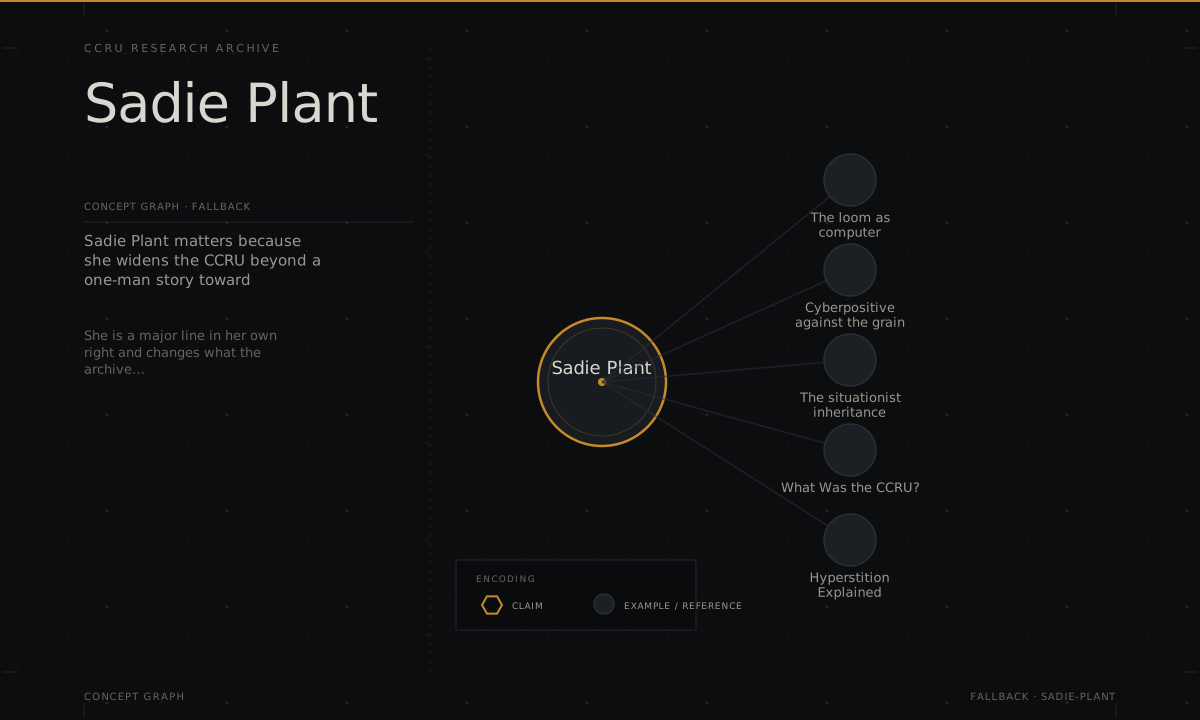
Sadie Plant matters because she widens the CCRU beyond a one-man story toward cybernetics, media theory, technical subjectivity, and cyberfeminist thinking.
Core argument
Plant is historically central, not a supporting correction. Without her, the archive looks narrower and more doctrinal than it was.
Her presence changes the archive's center of gravity. Media theory, cyberfeminism, and technical culture come into view much more clearly.
Worked examples
These named texts, talks, sites, and records show where the argument becomes concrete.
ccru.net Home Record
"ccru.net Home" is a good checkpoint because it keeps Sadie Plant inside scene evidence rather than later reputation.
Cybergothic Record
"Cybergothic" is a good checkpoint because it keeps Sadie Plant inside scene evidence rather than later reputation.
What Was The CCRU Guide
"What Was The CCRU" widens Sadie Plant back into the larger CCRU field instead of treating the figure as self-explanatory.
Hyperstition Concept
"Hyperstition" names one recurring pressure that helps Sadie Plant make sense beyond biography alone.
Common misreadings
These are the recurring simplifications, exaggerations, and misreadings that make the subject look flatter than it is.
- Plant is mainly useful as a balance to Land.
She is a major line in her own right and changes what the archive can be seen to include.
Significance
Plant remains essential because she breaks the one-name mythology and reconnects the archive to media theory, cybernetics, and collective intellectual practice.
Stakes of this figure
Writer and theorist whose work on cybernetics, media, and culture helps widen the archive beyond a single-author story.
Periodisation
- 1990s cybernetics
- 1990s media theory
Key works for entering the figure
- Plant - The Future Looms (_Clicking In_ 1996).pdf
- Plant - Babes in the Net (New Statesman 1995).pdf
References
Records cited
These linked sources are the quickest way to test the argument against named materials rather than second-hand summary.
ccru.net Home Record
"ccru.net Home" ties Sadie Plant to a document, lecture, or interview you can actually test.
Cybergothic Record
"Cybergothic" ties Sadie Plant to a document, lecture, or interview you can actually test.
What Was The CCRU Guide
"What Was The CCRU" shows what changes once Sadie Plant is read comparatively rather than mythically.