Plant's wager: the loom was already a computer
This is why Plant's strand is constitutive for the archive rather than adjacent to it. Strip it out and what remains is a single-author Land-centric project with a much narrower account of where abstraction comes from. With Plant in place, the archive has two origin stories for its machines — military-industrial runaway and textile-matrilineal continuity — and the tension between them is productive rather than resolved. Readers who treat cyberfeminism as a detour from the 'real' work have simply misread which tracks the archive actually runs on.
Xenofeminism as afterlife, not sequel
Laboria Cuboniks' *Xenofeminism: A Politics for Alienation* (manifesto, 2015) and Helen Hester's *Xenofeminism* (Polity, 2018) are the cluster's second centre of gravity. They inherit Plant's technophilic orientation but break with her on a key point: where Plant tends to read the technical as already carrying an emancipatory current one can ride, xenofeminism — in the manifesto's own framing — treats alienation, abstraction, and construction as tools that have to be taken up deliberately. The manifesto's slogan 'If nature is unjust, change nature' (Laboria Cuboniks 2015) is, read in context, a constructivist commitment, not a continuist one.
The disagreement inside the cluster sits here. Is the technical subject something one joins (Plant), or something one has to build against the grain of given embodiment (Cuboniks, Hester)? The archive holds both. Hester's *Xenofeminism* (Polity, 2018) is the most patient version of the second position — it takes the 2015 manifesto's compressed claims and works through, at book length, what a reproductive politics oriented by xenofeminist commitments would actually demand. Reading the manifesto without Hester leaves the reader with slogans; reading Hester without Plant leaves the reader without the lineage the slogans are reworking. (All three characterisations here should be checked against the primary texts: the specifics are attributable to Cuboniks 2015 and Hester 2018, not to retrieval evidence internal to this archive.)
The technical subject as an open problem
What the cluster shares, across its disagreements, is a refusal to treat the subject of technical practice as given. The question is not 'how do women use technology' but 'what kind of subject does a given technical arrangement produce, and can it be otherwise.' This is why Luciana Parisi's work on biotech sits legibly next to Plant's on weaving: Parisi argues that 'bacterial sex marks continual variation in evolution, where contagious matter is the mode of transmission of aimless life' (Parisi, 'Biotech: Life by Contagion'), treating the cell itself as a technical site where inheritance is being rewritten through endosymbiosis and transgenesis rather than through pre-ordained design.
Read in this neighbourhood, xenofeminism's interest in hormones, pharmacology, and reproductive infrastructure is not a topical add-on. It is the same problem Plant poses about looms and Parisi poses about cells: where does the line of the technical subject get drawn, and who gets to draw it? The cluster's coherence lives at this level of abstraction — not in a shared politics, but in a shared refusal to take the subject as a natural kind.
The common trap: reading this cluster as a detour
The trap readers fall into is treating cyberfeminism and xenofeminism as a side-branch — a 'feminist response to' a main line that runs through Land, Fisher, and hyperstition. This mistake flattens the archive. Without Plant, there is no account of why the archive is interested in textiles, switchboards, and distributed pattern-recognition at all; those motifs do not originate with Land. Without xenofeminism, the archive's afterlife loses one of its most developed constructive programmes and becomes almost entirely diagnostic.
The signal that a reader has fallen into the trap: they can name five hyperstition texts but cannot say what Plant's argument about Jacquard actually is. The corrective is to read *Zeros and Ones* as primary archive material, not as context.
How this cluster touches adjacent ones
The cluster connects outward in at least three directions. First, to Parisi and the biotech/complexity material, where the technical subject becomes explicitly biological and the question of construction moves to the cellular scale. Second, to the accelerationist strand, where xenofeminism is in open negotiation — sometimes alliance, sometimes argument — with left-accelerationist proposals about infrastructure and automation. Third, to the numogrammatic and occult material, where Plant's interest in weaving, pattern, and non-linear time finds a stranger kin.
Readers should not expect these connections to be frictionless. Xenofeminism's Promethean commitments sit uneasily next to the archive's more pessimist registers, and Plant's continuism sits uneasily next to Land's rupture-talk. The cluster earns its place by holding these frictions open rather than resolving them.
Where to go next
If you read one document to orient yourself across this cluster, read Zeros and Ones (Plant, Doubleday, 1997). It is the load-bearing text: it sets up the lineage the xenofeminists inherit and revise, it demonstrates the archive's technical-subject problem at full length, and it contains more of the cluster's characteristic moves per page than any other single work. Pair it afterwards with Hester's *Xenofeminism* (Polity, 2018) to see where the argument goes once alienation rather than continuity becomes the organising commitment.
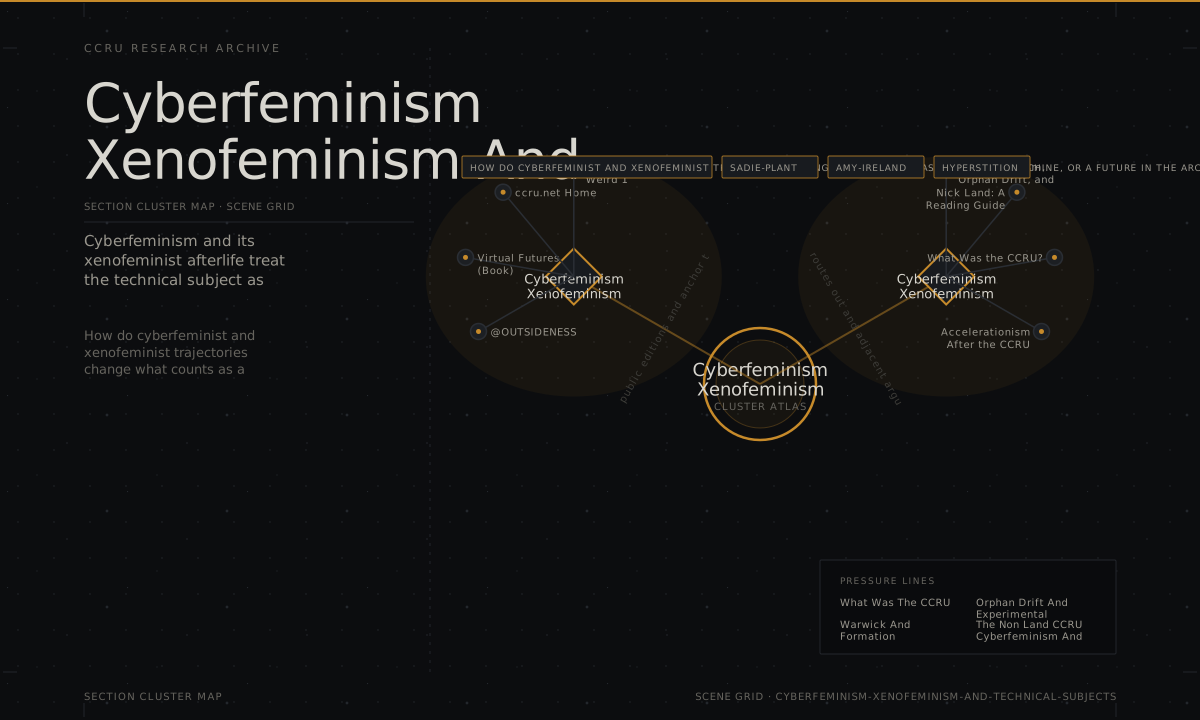
Cyberfeminism and its xenofeminist afterlife treat the technical subject as something the archive helps construct, not something it merely describes — gender and machine are read together.
Core argument
Cyberfeminist material is central to the archive's real shape. It widens the archive beyond one-man accounts and toward media, gender, and technical life.
Technical subjectivity is one of the archive's key recurring problems. The section helps connect older materials to later feminist and systems-oriented afterlives.
Worked examples
These named texts, talks, sites, and records show where the argument becomes concrete.
What Was The CCRU Guide
Start with "What Was The CCRU" if you want the wider frame before dropping into Cyberfeminism Xenofeminism And Technical Subjects.
Sadie Plant Person
"Sadie Plant" is one of the clearest figures for the pressures gathered inside Cyberfeminism Xenofeminism And Technical Subjects.
Hyperstition Concept
"Hyperstition" names one recurring problem inside Cyberfeminism Xenofeminism And Technical Subjects.
ccru.net Home Record
"ccru.net Home" is a checkpoint where Cyberfeminism Xenofeminism And Technical Subjects stops sounding abstract.
Hyperstition New Weird 1 Record
"Hyperstition New Weird 1" is a checkpoint where Cyberfeminism Xenofeminism And Technical Subjects stops sounding abstract.
Common misreadings
These are the recurring simplifications, exaggerations, and misreadings that make the subject look flatter than it is.
- This cluster is a side route away from the real archive.
It is one of the main ways the archive regains historical and conceptual breadth.
Significance
This section matters because it reconnects the archive to media theory, feminism, and technical culture rather than only to the later Land-centered afterlife.
Themes
- cyberfeminism
- xenofeminism
- technical subjects
- sadie plant
- amy ireland
Where this section sits in the archive
Sadie Plant's *Zeros and Ones: Digital Women and the New Technoculture* (Doubleday, 1997) is the anchor of this cluster, and the wager it makes — as the book's subtitle and structure announce — is specific: Ada Lovelace's engine, the Jacquard loom, the telephone switchboard, and the punch card belong, on Plant's reading, to a single continuous technical lineage that computing inherits, rather than to a metaphorics of women-and-technology grafted on after the fact. Plant reads cybernetics backwards through weaving. The machine is not, on this account, masculine-and-then-feminised by late arrivals — it was textile, distributed, and woven from the start. (These characterisations are drawn from *Zeros and Ones* directly; readers should take them up at the source rather than on this essay's authority.)
Sources by cluster
These mini-clusters widen the section through named works and support traces rather than through adjacent keywords alone.
Section source cluster
Cyberfeminism Xenofeminism And Technical Subjects: public editions and anchor texts
Anchor editions: cybergothic.pdf; ccru.net Home; Hyperstition New Weird 1.
Work
abstracted from the banks of every computer in the human system. Unthinkable complexity. Lines of light ranged in the nonspace of the mind, clusters and constellations of data' (Gibson). - Even primitive VR corrodes b...
Work
Work
Work
Work
Work
Section source cluster
Cyberfeminism Xenofeminism And Technical Subjects: routes out and adjacent arguments
Adjacent routes: What Was The CCRU; What Is Hyperstition; Sadie Plant.
Guide
"What Was The CCRU" gives the wider argumentative frame around this section.
Guide
"What Is Hyperstition" gives the wider argumentative frame around this section.
Person
"Sadie Plant" is one of the figures most closely bound up with this section's local problem.
Person
"Amy Ireland" is one of the figures most closely bound up with this section's local problem.
Concept
"Hyperstition" names one of the recurring conceptual pressures inside this section.
Section
"Warwick And Formation" is the neighboring cluster to open once this section's local pattern is visible.
Texts in this section
68 classified works grouped into 3 editorial subclusters. Reviewed: 48; needs review: 20.
Cyberfeminist interventions 55 works
- Ada
- Black Circuit Code for the Numbers to Co
- Plant - Babes in the Net (New Statesman 1995)
- Plant - Baudrillard s Women (Forget Baudrillard 1993)
- Plant - Beyond the Screens Film Cyberpunk Cyberfeminism (Variant 1993)
- Plant - Cultural Studies and Philosophy Questionnare (Parallax 1995)
- Plant - Escape Attempts (Review) (Canadian Journal of Sociology 1995)
- Plant - Feminisations (1996)
- Plant - Ghosts in the Machine (Review) (New Statesman 1995)
- Plant - Information War in The Age of Dangerous Substances (Lecture 1998)
- Plant - Interview with Fringecore
- Plant - Interview with RosieX (Nutek Women)
- Plant - Interviewed by Jenna Glatzer
- Plant - IT Girl for the 21st Century (Interview with Ann Treneman 1997)
- Plant - Net Gains (New Statesman 1995)
- Plant - On the Matrix Cyberfeminist Simulations (1996)
- Plant - Return to the Soft Machine (Review) (New Scientist 1996)
- Plant - September 11th 2001 (9.11 911 Oil) (Mute 2001)
- Plant - The Future Looms (Clicking In 1996)
- Plant - The Future Looms (Geekgirl)
- Plant - The Situationist International A Case of Spectacular Neglect (Radical Philosophy 1990)
- Plant - The Virtual Complexity of Culture (Future Natural 1996)
- Plant - XTRA Interview w (2002)
- Plant, Miller Ullman - Sexing the Machine (Salon)
- Plant- Technically Speaking (Interview with Zoey Kroll 1999)
- Pre Face or How to Begin at the End
- Sadie Plant - On the Matrix; Cyberfeminist Simulations
- Sadie Plant - The Future Looms; Weaving Women and Cybernetics
- Scrap Metal and Fabric
- Shuttle Systems
- SPIKE-70-Amy-Ireland-Is-Crypto-Patriarchys-Newest-Tech
- stewart-home-sadie-plant-james-mannox-the-art-strike-papers-the-years-without-art-1990-1993
- Transarchitectures Visions of Digital Communities Sadie Plant
- Zer(0) Knowledge under the Dark Side of The Cycle w Rachel-Rose O'Leary - Diffractions Collective
- Zeros and Ones
- An archigenesis of experienceNeeds editorial review
- CCRU- Intelligence Is No Longer On The Side Of PowerNeeds editorial review
- Information is Alive Part1Needs editorial review
- Let's Make It Worse Quicker - A Box Of ChocolatesNeeds editorial review
- Plant - A World of Difference (New Statesman 2003)Needs editorial review
- Plant - Art and Writing (Foreword) (2012)Needs editorial review
- Plant - Bright Young Things (Review) (New Scientist 1996)Needs editorial review
- Plant - Critique and Recuperation in Twentieth Century Philosophical Discourse (Dissertation 1989)Needs editorial review
- Plant - Field Experiments (Nettime 1996)Needs editorial review
- Plant - Information Sage (Village Voice 1998)Needs editorial review
- Plant - Intelligence Is No Longer On The Side Of Power (Interview with Matt Fuller Datacide 1995)Needs editorial review
- Plant - Nomads and Revolutionaries (Journal of the British Society for Phenomenology 1993)Needs editorial review
- Plant - On the Mobile (2001)Needs editorial review
- Plant - Reviews in Radical Philosophy 54 (1989)Needs editorial review
- Plant - Self Congratulation and Piety in Glasgow (Here and Now 10 1990)Needs editorial review
- Plant - The Future Looms (Broadsheet 1993)Needs editorial review
- Plant - The Great Toyshop of Europe (New Statesman 2003)Needs editorial review
- Plant - When Blowing the Strike is Striking the Blow (Here and Now 10 Art Supplement 1990)Needs editorial review
- stewart-home-what-is-situationism-a-readerNeeds editorial review
- The Good, the Bad, and the ProductiveNeeds editorial review
Technical matter and recursive bodies 8 works
- A Requiem to Sexual Difference; A Response to Luciana Parisi's ‘Event and Evolution.'
- Matthew Fuller - Luciana Parisi Interview (2004)
- Parisi - Abstract Sex (Continuum) (2004)
- Parisi - Event and Evolution
- Plant - Becoming Positive
- Plant - Becoming Positive (German)
- Plant - Bio Becoming Positive (Excerpt) (Ars Electronica 1997)
- Plant - Coming Across the Future (1998)
Xenofeminism and its critics 5 works
References
Records cited
These linked sources are the quickest way to test the argument against named materials rather than second-hand summary.
ccru.net Home Record
"ccru.net Home" is the first record to test the framing around Cyberfeminism Xenofeminism And Technical Subjects.
Hyperstition New Weird 1 Record
"Hyperstition New Weird 1" is the first record to test the framing around Cyberfeminism Xenofeminism And Technical Subjects.
What Was The CCRU Guide
"What Was The CCRU" gives the larger argument around Cyberfeminism Xenofeminism And Technical Subjects before you widen sideways.
External references
Inherited outward references from the guides, exhibits, people, and concept pages that anchor this section cluster.