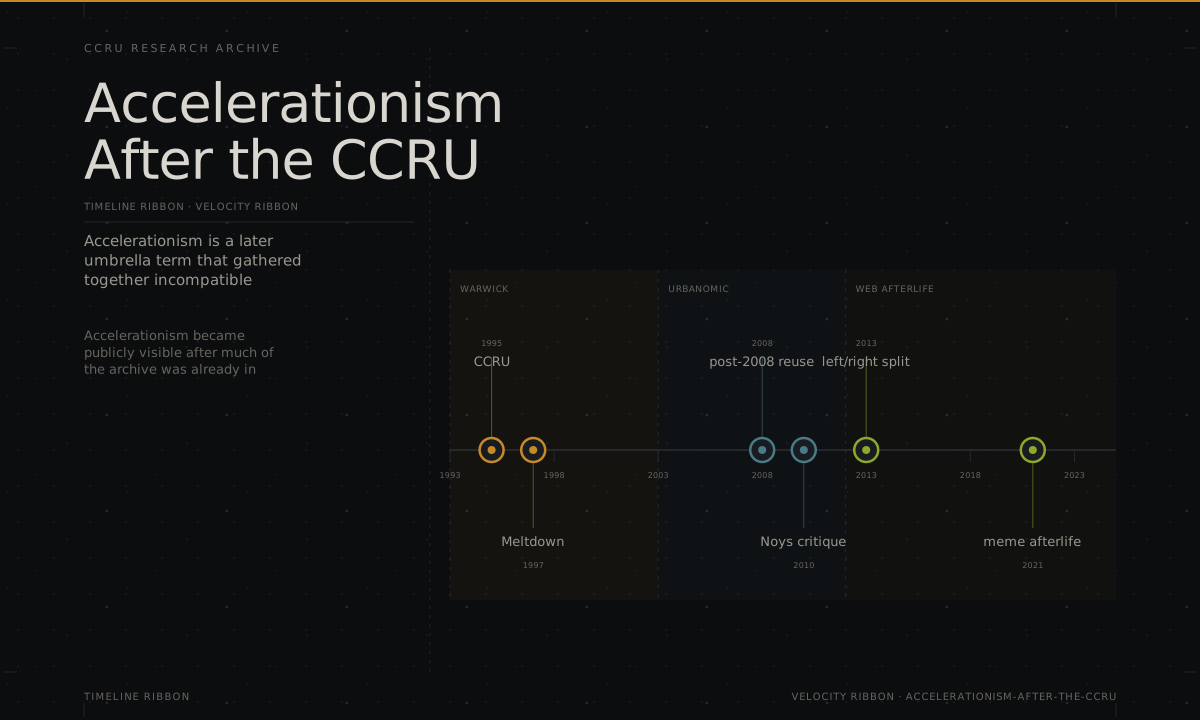
Accelerationism is a later umbrella term that gathered together incompatible arguments about capital, abstraction, technology, planning, and political strategy. It touches the CCRU strongly, especially through Nick Land and later editorial framing, but it should be treated as one afterlife among several rather than as the secret essence of the whole archive.
Key points
- Accelerationism is a reception problem before it is a stable doctrine.
- The term bundles together Landian intensification, left or Promethean projects, and later reactionary or sensationalized afterlives that should not be collapsed into one line.
- The CCRU matters here, but reading the archive backwards through accelerationism usually produces bad history.
Core argument
Accelerationism became publicly visible after much of the archive was already in motion. This stops readers from projecting a later keyword backward onto every earlier source. Example: #Accelerate: The Accelerationist Reader (Robin Mackay-#Accelerate_ The Accelerationist Reader)
The term covers several branches that share vocabulary more than a doctrine. Without that distinction, public argument turns genealogy into caricature. Example: A History of Accelerationism (Endgamers_ A History of Accelerationism - by Jacob Siegel)
The most useful way to read accelerationism is as a field of disputes. That preserves disagreements over planning, abstraction, politics, and reaction instead of turning them into a single slogan. Example: A Quick and Dirty Introduction to Accelerationism (Nick Land - A Quick and Dirty Introduction to Accelerationism)
Accelerationism became publicly visible after much of the archive was already in motion. This stops readers from projecting a later keyword backward onto every earlier source.
Compare and contrast
CCRU vs later accelerationism
CCRU
A looser scene of cybernetics, theory-fiction, media writing, occult numeracy, and institutional drift.
Later accelerationism
A later public label that reorganized parts of that scene into a more portable and more contentious political keyword.
How the label arrived
Benjamin Noys coined "accelerationism" in his 2014 book Malign Velocities as a warning to fellow leftists, intending the word to taint the position by association with Italian Futurism. The label stuck, then escaped. Within a decade the word was being used by a New Jersey homeland security bulletin, a House committee hearing, and an MSNBC host calling Donald Trump "the ultimate accelerationist". Somewhere in the middle of that drift sits the CCRU, treated alternately as origin point, secret essence, or embarrassing ancestor.
The argument of this guide is simple. Accelerationism is one afterlife of the CCRU among several, not its hidden core. Reading the Warwick archive backwards through the 2013 Srnicek-Williams manifesto, or through Land's Dark Enlightenment turn, or through the imageboard violence of the late 2010s, will produce a CCRU that never existed. The work of the guide is to keep those layers separate so the earlier writing can be read on its own terms.
The keyword arrived after much of the archive
Much of the material now gathered under accelerationism predates the term's most visible public life. The label spread through editorials, primers, anthologies, blog debates, and journalism that condensed a more scattered set of problems into one recognizable banner. That does not make the term useless. It makes it historical.[1]
Reading the archive through this history changes the question. Instead of asking whether the CCRU already was accelerationism, you start asking how later readers stitched together Land, editorial framing, political argument, and public controversy into a new keyword.
Start with what was actually there in the 1990s. The Urbanomic anthology #Accelerate tracks the impulse through Nick Land, Sadie Plant, Iain Grant and CCRU, but situates them inside a longer arc running from post-68 theory through rave, acid house and SF cinema. Robin Mackay, who edited that volume, has stressed that the constellation only became legible as "accelerationism" retroactively, after positions in political philosophy, art and design began converging around the term in the late 2000s (CCCB interview). The 1990s texts, Plant and Land's "Cyberpositive", Land's "Circuitries", "Machinic Desire", "Meltdown", "Cybergothic", do not call themselves accelerationist. They are cyberpositive, machinic, cybergothic. The relabelling happens elsewhere, later.
One label, several branches
The term is easiest to misuse when treated as a doctrine. At minimum, readers need to separate Landian intensification, left or Promethean arguments about scale and planning, and later reactionary or sensationalized afterlives that dominate public controversy. These strands overlap, borrow, and fight, but they do not settle into one stable program.[2]
That distinction is what keeps the history honest. It also keeps the present debates readable. Without it, every mention of automation, modernity, or abstraction starts collapsing into the same ideological shorthand.
It also changes how the archive itself looks. Once the branches are separated, the CCRU stops appearing as a single accelerative machine and starts looking like one important source-world among several later receptions, anthologies, and arguments.
The first hard fork came over the destination. Mark Fisher's 2010 Goldsmiths symposium framed the 1990s Warwick moment as a return to a repudiated 1970s impulse, and drew on Braudel and DeLanda to separate markets, as bottom-up self-organising networks, from capital, as an oligarchic predatory system. That distinction is what made a left accelerationism conceivable at all. Srnicek and Williams then argued explicitly for reclaiming modernity, abstraction, scale and technical capacity for emancipatory politics. The Promethean branch is a different project from a cult of collapse or speed, and treating it as a cover for Landian inhumanism collapses something the participants kept apart.
Land's own trajectory is the second fork, and the loudest. By the early 2010s he was writing The Dark Enlightenment as a commentary on Curtis Yarvin, declaring "Neoreaction is Accelerationism with a flat tire" and recasting the political left as a "perfectly weighted decelerator" draining techno-economic momentum. By 2017 he could write that "there is no distinction to be made between the destruction of capitalism and its intensification". Whether this is continuous with the 1990s work or a break from it is one of the live disagreements inside the archive. Edmund Berger's micro-history treats Land and CCRU as the conduit through which hyperstition entered the lineage, but distinguishes the neo-accelerationism of Srnicek and Williams as a separate operation that pulled Land back into visibility against his earlier disappearance.
The third fork is the one the press grabbed. Jacob Siegel notes the proliferation of self-labelled tendencies, left, right, unconditional, blaccelerationist, eco, white-nationalist, transgender, each "mixed and matched" because the term operates as a memetic ideology. The 2016 Trump-Pepe runaway-train meme worked precisely because it was legible to two audiences at once, mainline supporters reading it as anti-technocratic revolt and online accelerationists reading the conductor-less final panel as machine takeover. After Christchurch the word migrated again, this time inside the counter-extremist apparatus, where the Foreign Policy Research Institute could call it "the most inherently violent and dangerous ideology circulating in the global white supremacist extremist movement". Land has consistently disavowed racialist violence as another humanist delusion, and even Noys felt obliged to defend him on that narrow point, with qualifications.
This is where the disagreement inside the archive sharpens. Matt Colquhoun, writing from a left-accelerationist position and working on Mark Fisher, conceded after Christchurch that Land's call to "exacerbate schism" did track with the imageboard reading even as the imageboard reading was a bastardisation. The Promethean left wants to keep the 1990s machinery, the Braudelian markets-against-capital distinction, the Plant-Land cyberpositive feedback loops, while severing them from what Land became. The Landian right takes the severance as evidence of squeamishness. Neither side is reading the same CCRU.
The CCRU was not primarily about acceleration
There is a fourth position worth naming, which is that the CCRU was never primarily about acceleration at all. The Urbanomic edition of CCRU Writings 1997-2003 is dominated by the Architectonic Order of the Eschaton, the Numogram, hyperstition, Lemurian time-war fictions, none of which need the accelerationist frame to function. "Swarmachines" speaks of "decolonized ants, swarms without strategies" and "imperceptible mutations, waiting in the wings", an idiom closer to insectoid politics than to capital-as-AI. Reading the collection accelerationism-first is reading it through a keyword that became dominant fifteen years after the texts were written.
What changes if you accept this. You stop expecting the 1997-2003 writings to settle the Land-versus-Srnicek argument, because they predate it. You read "Meltdown" and "Cybergothic" as cybernetic-occult experiments rather than as policy positions. You treat the Dark Enlightenment essays as a later turn that needs its own account, not as the secret meaning of the earlier work. You notice that the Promethean left and the Landian right share a vocabulary but not a project, and that the imageboard usage shares neither vocabulary nor project, only the brand. The CCRU becomes legible again once accelerationism is demoted from essence to afterlife.
Why the editorial afterlife matters
Accelerationism is also a story about packaging. Anthologies, primers, interviews, and histories turned a field of disagreements into something portable enough to circulate widely. Robin Mackay's editorial role matters here because it shows that afterlife is not just passive survival. It is active framing.[3]
That is one reason the term became so public. It could be taught, attacked, defended, and oversimplified because editorial labor helped stabilize it just enough to travel.
Why media stories keep flattening it
The label is compact, dramatic, and almost designed for overstatement. Journalism and backlash pieces often compress several lineages into one story because that makes the subject easier to narrate. The result is a familiar flattening: speed becomes the whole issue, politics becomes caricature, and the differences between branches disappear.[4]
A useful guide should resist that flattening without pretending the term needs to be rescued from criticism. The point is not to protect accelerationism. The point is to show what readers lose when every disagreement is swallowed by one headline-friendly word.
The most important thing readers lose is relation. Capital, technology, planning, reaction, and editorial framing all start getting bundled together too quickly. A better guide keeps those threads distinguishable long enough for the archive to remain historically legible.
That distinction is also what makes the keyword genuinely useful for research rather than just for discourse tracking. Once the branches are separated, readers can ask better questions about which texts, editors, and later scenes actually changed the term, and which merely repeated it as shorthand.
The cybernetic underframe
For accelerationism the crucial lesson was this: A negative feedback circuit - such as a steam-engine 'governor' or a thermostat - functions to keep some state of a system in the same place.
How to read the disputes well
Start with a history or editorial frame. Then compare that frame with later Land material, critical responses, and a few CCRU-adjacent sources. Read the term as a contested reception field, not as a single doctrine. When you do that, accelerationism stops being a piece of lore and becomes a way of tracking how later readers reorganized parts of the archive into a public argument.
Worked examples
These named texts, talks, sites, and records show where the argument becomes concrete.
#Accelerate: The Accelerationist Reader Record
A key editorial package in the public consolidation of the term.
A History of Accelerationism Record
Useful because it shows how the term was narrated outward to later readers.
A Quick and Dirty Introduction to Accelerationism Record
A later Land text that matters precisely because it belongs to the afterlife, not because it settles the whole history.
Accelerationism Branches and Debates Section
The section hub that distributes the term across texts and disputes.
Tensions and limits
The term is useful for public discovery and terrible as a universal decoder ring.
Promethean and Landian branches share enough vocabulary to confuse readers even when their political stakes diverge sharply.
Because accelerationism is headline-friendly, journalism often flattens the disagreements that make it worth studying.
Common misreadings
These are the recurring simplifications, exaggerations, and misreadings that make the subject look flatter than it is.
- Accelerationism is the same thing as the CCRU.
The CCRU is one major source-world for later debates, not the whole meaning of the term.
- All accelerationisms share one politics.
Landian, Promethean, reactionary, and journalistic versions share a label more than a unified program.
Significance
Accelerationism matters now because it is still one of the main ways the CCRU enters public conversation, often through distortion. If those distortions are left unscrutinized, readers arrive with a flattened map before they encounter the archive itself.
It also matters because questions about automation, infrastructure, planning, climate, reaction, and platform power keep reopening arguments about modernity and abstraction that were bundled into the term.
References
Records cited
Linked archive records for this guide. Numbers correspond to the footnote markers in the body above.
Nick Land - A Quick and Dirty Introduction to Accelerationism Record
A later Land intervention that should be located in phase, not mistaken for origin.
Endgamers_ A History of Accelerationism - by Jacob Siegel Record
A useful public history of how the label spread and mutated.
Robin Mackay-#Accelerate_ The Accelerationist Reader Record
A key editorial node in the public packaging of accelerationism.
2026-03-13-accelerationism-scoring.md Record
Shows how contemporary editorial work sorts and stabilizes the term inside the corpus.
Reader questions
Did accelerationism start with the CCRU?
The CCRU is one of the key source scenes, especially through texts like “Meltdown,” but the later public label bundled together different political and philosophical projects that no longer matched the original setting cleanly.
Why do people argue about accelerationism origins?
Because later left and right accelerationist uses retroactively rewrote the archive, turning a messy scene of theory-fiction, cybernetics, media writing, and para-academic circulation into a cleaner political keyword than it ever was at the time.
Reading routes through this guide
Featured exhibit
A curated exhibit on how Mark Fisher and adjacent materials helped translate the archive into public theory culture.
Featured reading path
A staged reading route that keeps early Land, collected writings, and later afterlives distinct.