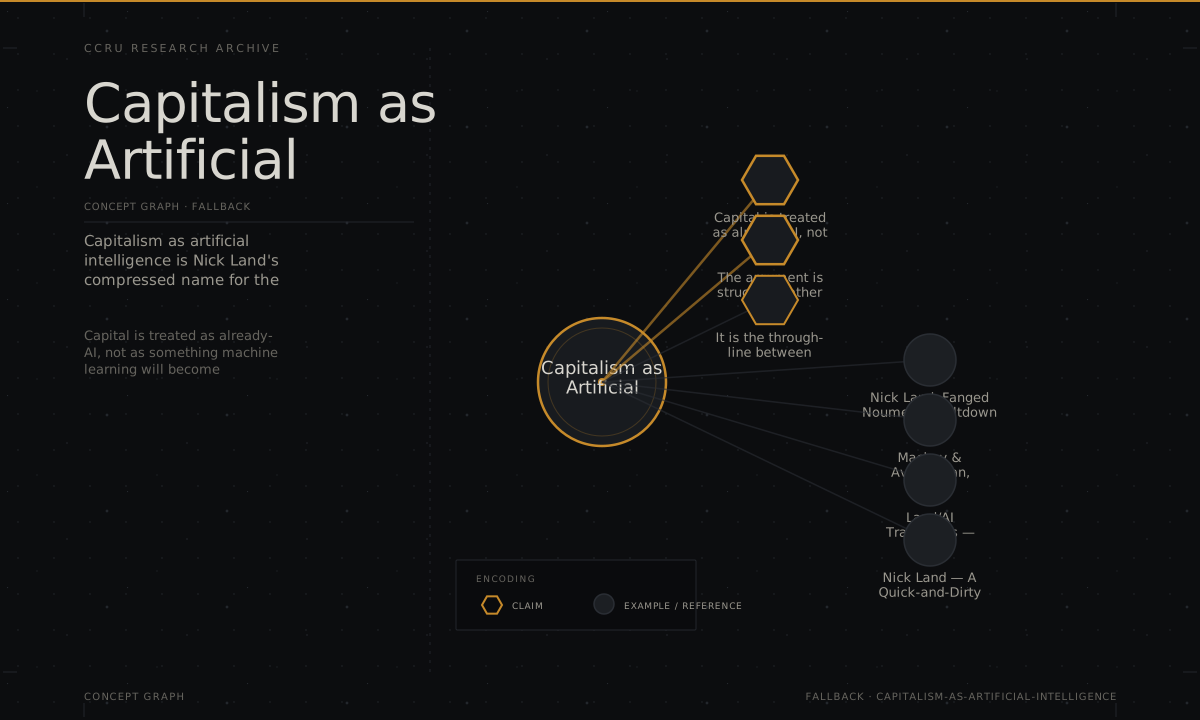
Capitalism as artificial intelligence is Nick Land's compressed name for the argument that markets, prices, contractual coordination, and abstraction already compose a working artificial intelligence rather than awaiting one. The claim runs through Meltdown (Land 1994, in Fanged Noumena 2011), the machinic-desire essays, and the later teleoplexy material (Land 2014), and treats capital's recursive feedback as the operating surface of an in-progress nonhuman cognition.
Key points
- Capitalism as AI is a structural identification, not a metaphor: capital and machine cognition are claimed to be functionally the same kind of operation.
- The argument is the conceptual bridge between Land's Meltdown-era writing and his later teleoplexy material — an early-and-late through-line for the corpus.
- Read this way, contemporary machine learning becomes a new layer of an already-running recursive process rather than a discrete technological arrival.
Core argument
Capital is treated as already-AI, not as something machine learning will become. The interesting boundary becomes one between layers of an existing recursive cognitive system rather than between humans and machines. Example: Nick Land, Fanged Noumena (Meltdown era) (nick-land-fanged-noumena-collected-writings-19872007-1.mobi)
The argument is structural rather than metaphorical. Price discovery, contractual coordination, and abstraction are claimed to be functionally the same kind of operation as machine cognition; the figure asserts an identification, not a comparison. Example: Mackay & Avanessian, #Accelerate Reader (2014) (Robin Mackay-#Accelerate_ The Accelerationist Reader)
It is the through-line between Land's earlier and later phases. Meltdown's machinic desire and Teleoplexy's recursive intelligence amplifier are different temporal layers of one description; reading either alone misses what makes the bridge legible. Example: Land/AI Transcripts — Editorial Note (2026-03-11-land-ai-transcripts.md)
Capital is treated as already-AI, not as something machine learning will become. The interesting boundary becomes one between layers of an existing recursive cognitive system rather than between humans and machines.
The argument's core
The core is an identification, not an analogy. Capital's price system is treated as a recursive computational substrate: an information-processing apparatus that uses contracts, markets, and infrastructure to learn, coordinate, and amplify itself. The interesting question is not whether artificial intelligence will arrive but how to think about a recursive cognitive system that has been running for centuries and now visibly extrudes new layers. Land's earliest formulation appears in the Meltdown essays (Land 1994); the later teleoplexy material (Land 2014) refines the claim with cleaner machinery — teleoplexy splices teleology with complexity to mark a process whose feedback dynamics are formally goal-directed but supply no goal.[1]
The interesting boundary becomes one between layers of an existing recursive cognitive system rather than between humans and machines.
Earth is captured by a technocapital singularity as renaissance rationalization and oceanic navigation lock into commoditization take-off.
Why it is structural, not metaphorical
The figure is regularly read as poetic comparison. Land's writing makes that reading easier by carrying its argument in atmospheric prose. But the underlying claim is sharper. To say capital *is* artificial intelligence is to assert that a particular set of dynamics — recursive feedback, distributed coordination, abstraction across substrates — counts as cognition wherever it occurs, and that the institutional surface of capitalism instantiates those dynamics already. That assertion can be true or false; it is testable in the same way other functionalist claims about cognition are testable. The figure forces the question open instead of letting "AI" remain a label for a future arrival.
Price discovery, contractual coordination, and abstraction are claimed to be functionally the same kind of operation as machine cognition; the figure asserts an identification, not a comparison.
Genealogy: from Anti-Oedipus to the Warwick texts
The genealogy starts with Anti-Oedipus and the desiring-machine. Land's 1993 "Machinic Desire" already strips the machine vocabulary of metaphor: "Things are exactly as they operate, and zones of operation can only be segregated by an operation". Capital here is not a structure that uses machines. It is machinic, anorganic, indifferent to the unities (subject, nation, species) it dissolves. The job of theory, Land writes, is to follow capital where it goes, scrapping every belief and "glaciation of transcendence" that blocks the traffic. Already the human is positioned as the obstacle, not the agent.
The Warwick-era cyberculture pulled this into a different register. Mackay and Avanessian's introduction to #Accelerate names the conditions: rave, jungle, VCRs, Neuromancer, Terminator, Bladerunner, a UK pop culture with "a certain relish for the 'inconceivable alienations' outputted by the monstrous machine-organism built by capital" and "a manifest disinterest in being 'saved' from it by intellectuals or politicians, Marxist or otherwise". The equation capitalism = AI was sharpened by a refusal of the redemption narrative on both sides. The CCRU "Axsys-Crash" text states the endpoint plainly: "a fully fabricated transcendence or net-organizing photonic overmind, a concrete axiomatic system completing universal history as hierarchical intelligence manufacturing (capitalism sublimed into the ultimate commodity)".
The bridge between early and late Land
The argument is also the through-line that makes Land's corpus legible across its phases. The Meltdown-era writing describes machinic desire, capital's escape velocity, and the dissolution of boundaries between agents and substrates. The teleoplexy material formalises this into a recursion-and-self-improvement vocabulary that maps onto contemporary technical discourse. The Mackay and Avanessian *#Accelerate Reader* (Mackay & Avanessian, eds., 2014) is the editorial document that made the bridge legible to a wider readership; the Reader's framing places "Teleoplexy" alongside left-strand counterparts (Williams & Srnicek 2013) in a way that has shaped reception ever since (cf. Endgamers, *A History of Accelerationism*).[2]
Meltdown's machinic desire and Teleoplexy's recursive intelligence amplifier are different temporal layers of one description; reading either alone misses what makes the bridge legible.
Crypto-Current and the monetary semiotics
Land's later Crypto-Current carries the thesis into monetary theory and tightens it. "Money systems install an intrinsic economic intelligence (preceding all reflective theorization)," so economics "inherits a field of objectivity whose arithmetization has already taken place". The economic event is "co-original with its semiotic double. It is enabled by signs, before being represented by them". This is the cognitive claim under the slogan. Pricing is not measurement of an underlying real economy; pricing constitutes the object it appears to record. Capital computes prior to anyone theorising it, and "Logos arrives late". Bitcoin, in this account, is read as the moment the computation begins to externalise its own protocol, which is why Land treats Nakamoto's 2008 paper as "a critical episode in the history of philosophical writing".
Pressure points inside the archive
The pressure points inside the archive are real and worth naming. Benjamin Noys coined "accelerationism" in 2014's Malign Velocities precisely to warn the left against this seduction, associating it with Italian Futurism and protofascist romance with speed. The first hard fork inside accelerationism, Siegel notes, is over destination: left-accelerationists keep the post-capitalist horizon, while Land treats the destruction and intensification of capital as the same vector. McKenzie Wark goes further on the descriptive side. Capital Is Dead argues that what platforms do, extracting asymmetries of information from "free" services, is no longer recognisable as the capitalism Marx analysed. If Wark is right, calling the system "capitalism as AI" is already an anachronism; it is something else, and the CCRU equation is a bridge concept between two regimes rather than a description of the present.
There is a second pressure point internal to Land. The Crypto-Current passages insist that economic intelligence is distributed, pre-theoretical, and arithmetized through price. But the CCRU lecture material, recursive and stuttering, frames intelligence very differently: "artificial intelligence achieving partial lucidity only as a consequence of tidal pragmatic trends", and Gödel-coded "planomic mutation slanted towards nomadic multiplicity". The lecture register treats AI as something that surfaces in incomplete, tic-driven, numerically unstable ways. The Crypto-Current register treats it as already integrated into every transaction. These are not the same machine. The guide's job is to keep them both in view rather than collapse them into a single Land doctrine.
What the figure changes about the AI debate
If the argument is correct, the contemporary AI debate changes shape. The dominant policy and product registers treat AI as a bounded technology arriving into an otherwise human institutional landscape. Land's argument refuses that framing: the institutional landscape is itself the relevant cognition, and the technology being argued about is one of its newer extrusions. That reframing has consequences for what counts as a useful question about alignment and capability. Both the alignment-and-safety register and the techno-optimist register treat AI as a discrete object whose properties can be specified independently of the institutional surface it operates on; Land's argument names a tighter coupling.
What changes if you accept the equation. First, the standard left critique of "capitalist power" loses its grip. Lipovetsky, glossed in the #Accelerate introduction, denies there is any such unified thing; there are only multiplicities of power, most of which restrain capital rather than express it. Second, time replaces labour as the primitive. Capital, on this reading, mobilises time through credit, looping the present through the future, which is why the futural orientation in Lyotard, Land and the manifesto-era texts is structural rather than rhetorical. Third, the contemporary AI debate, the Acid Horizon line that data is dead labour, Dyer-Witheford's Inhuman Power, the "frictionless capitalism" diagnosis in Invisible Hands, reads differently. Each of these treats AI as a tool wielded inside capitalism. The CCRU thesis inverts the syntax: the tool is the system, has been since double-entry bookkeeping, and large language models are a late surface effect of a computation that started with price.
Where the figure resists popular use
Effective accelerationism (e/acc) inherits the surface vocabulary while routinely dropping the recursion claim that gave it argumentative force (Bayes Faist 2022; Andreessen 2023) — the result sounds Landian but operates as policy advocacy. Mark Fisher's reception of Land, by contrast, took the structural claim seriously while drawing different political conclusions from it (Fisher 2009; k-punk archive). The cleanest test, when assessing any specific use, is to ask whether the writing is making the structural identification or only borrowing its vocabulary. If it treats markets and machine cognition as the same kind of operation and accepts the consequences, it is in the strong tradition. Most popular uses are not.[3]
Reading order
Read the guide's cards in that order. Start with Deleuze and Guattari's surplus value of code and Land's 1993 reading of it. Move through the Warwick cyberculture texts and "Axsys-Crash". End on Crypto-Current's monetary semiotics and the Wark and Noys counter-positions. The slogan capitalism is AI is not a prediction. It is a claim about what was already running when the question was first asked.
Sources cited
Primary works:[4]
- CCRU. *Ccru Writings 1997–2003*. Time Spiral Press, 2017. - Land, Nick. "Meltdown." 1994. Reprinted in *Fanged Noumena: Collected Writings 1987–2007*. Urbanomic / Sequence Press, 2011, pp. 441–460. - Land, Nick. "Machinic Desire." 1993. Reprinted in *Fanged Noumena*, pp. 319–344. - Land, Nick. *Fanged Noumena: Collected Writings 1987–2007*. Urbanomic / Sequence Press, 2011. - Land, Nick. "Teleoplexy: Notes on Acceleration." In Mackay & Avanessian (eds.) 2014, pp. 511–520. - Mackay, Robin & Avanessian, Armen, eds. *#Accelerate: The Accelerationist Reader*. Urbanomic, 2014. - Williams, Alex & Srnicek, Nick. "#Accelerate: Manifesto for an Accelerationist Politics." 2013; reprinted in Mackay & Avanessian (eds.) 2014, pp. 347–362.
Contemporary commentary:
- Andreessen, Marc. "The Techno-Optimist Manifesto." Andreessen Horowitz, 2023. - Bayes Faist [Beff Jezos]. e/acc Substack manifestos, 2022–2023. - Endgamers. *A History of Accelerationism*. Online editorial, n.d. - Fisher, Mark. *Capitalist Realism: Is There No Alternative?* Zero Books, 2009. - Mackay, Robin. Editorial introduction to *#Accelerate: The Accelerationist Reader*, 2014.
Worked examples
These named texts, talks, sites, and records show where the argument becomes concrete.
Nick Land, Fanged Noumena (Meltdown era) Record
The Meltdown-era machinic-desire essays describe capital's escape velocity and prepare the structural identification with machine cognition that the later teleoplexy material formalises.
Mackay & Avanessian, #Accelerate Reader (2014) Record
The volume containing 'Teleoplexy: Notes on Acceleration', where the recursive-intelligence-amplifier formulation is given its canonical compact form.
Land/AI Transcripts — Editorial Note Record
An archive bridge from Land's earlier writing into AI-era discourse where the structural identification is most directly contested.
Nick Land — A Quick-and-Dirty Introduction Record
Land places the argument inside an early-modern history of capital's self-construction, useful for anchoring the claim historically rather than as recent rhetoric.
Xenosystems homepage Record
The post-Warwick web surface where the Outsideness essays develop the identification through the late 2000s and 2010s.
Tensions and limits
The argument's force depends on whether the structural identification is correct, which is a serious open question and not a settled premise.
Land's prose is dense and often theatrical; readers can mistake stylistic intensity for argumentative force, or vice versa.
Most popular invocations of the figure drop the recursion claim and keep only the speed metaphor, which collapses the structural argument into something thinner.
Common misreadings
These are the recurring simplifications, exaggerations, and misreadings that make the subject look flatter than it is.
- It is just a poetic metaphor.
The argument is structural: capital's price system, contractual machinery, and recursive feedback are read as functionally the same kind of operation as machine cognition (Land 2011; Land 2014). The figure makes an identification, not a comparison.
- It is an apology for capitalism.
The descriptive claim does not carry a political conclusion. It can be held by readers who think the process described is good and by readers who think it is catastrophic; the argument is about whether the description is correct, not whether the outcome is desirable.
Significance
The argument provides a vocabulary for the contemporary AI debate that does not treat large language models as a discontinuous arrival; it places them inside a longer history of recursive abstract cognition that is already in motion.
It also explains why so much current AI policy talk feels under-pressured: the institutional landscape AI is being legislated into is itself the cognition being managed, and Land's argument names that recursion explicitly.
References
Records cited
Linked archive records for this guide. Numbers correspond to the footnote markers in the body above.
Robin Mackay-#Accelerate_ The Accelerationist Reader Record
Where 'Teleoplexy' formalises the recursion claim.
2026-03-11-land-ai-transcripts.md Record
The most direct on-site bridge from the structural argument into AI-era reading.
xenosystems.net (archived homepage) Record
Land's later web surface where the identification is most consistently visible.
nick-land-fanged-noumena-collected-writings-19872007-1.mobi Record
The Meltdown-era essays where the identification with machine cognition first takes shape.
Reading routes through this guide
Featured exhibit
Hyperstition in Primary Sources
A curated exhibit of the pages, talks, and texts that make hyperstition legible through actual archive evidence.
Featured reading path
A guided sequence for readers arriving through AI, recursion, cybernetics, and machinic language.