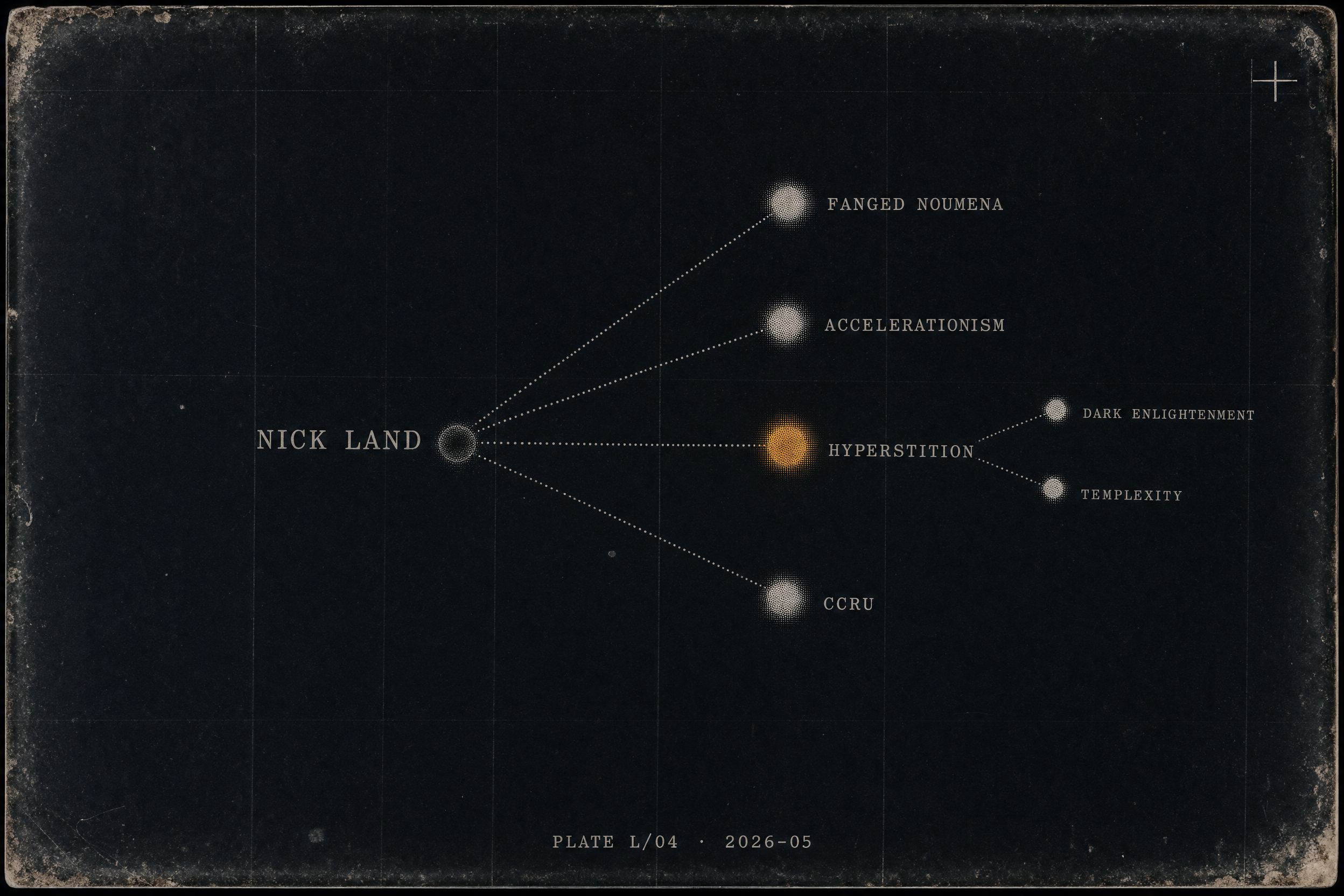
Prose as method
This is why *Fanged Noumena: Collected Writings 1987–2007* (Urbanomic / Sequence, 2011) works as a single artifact despite gathering twenty years of heterogeneous material. The continuity is not thematic but rhythmic. The essays share a compositional logic in which argument is indistinguishable from velocity. When readers call early Land 'difficult,' they usually mean the prose refuses to settle into the expository register that would let them extract a thesis. That refusal is the thesis — capital, for Land, 'is nothing beside the abstract accelerative social factor,' and the prose tries to be that factor rather than describe it.
The political as derivative, then the political as operative
The internal tension that organizes the whole body of work is a shift in proportionality. In the Warwick-era writing, the political is derivative — a surface effect of more fundamental machinic, capital, and libidinal processes. Capital is not a policy question because capital is not inside the human register to begin with; it is an impersonal process that humans are occasions of, not agents within. The accelerationist passages collected in *Fanged Noumena* and restated in the *Reader*'s 'Quick-and-Dirty Introduction to Accelerationism' insist that every political determination gets 'shucked off as an accident, at some stage of its intensification process.'
In the late blog-era writing, the proportionality flips. 'The Dark Enlightenment' essays and the Xenosystems pieces gathered in *A Nick Land Reader* operate inside an explicitly political register: Moldbug-exegesis, regime taxonomies (Communist Tyranny, Authoritarian Capitalism, and so on), quarrels with Anissimov over whether Neoreaction is fundamentally capitalist or monarchist in 'Monkey Business' (Xenosystems, 2013). These are not machinic abstractions with political examples attached; they are political arguments structured as such. Same author, same recursive prose-instinct, but the variable the prose is solving for has changed. Most readings flatten this. Partisans of the late work project its political register backward and misread *Fanged Noumena* as proto-neoreaction. Critics of the late work treat it as betrayal and refuse the continuity of method. Both errors depend on collapsing the two phases into one mythology rather than tracking where the proportionality inverts.
Style meeting a register it cannot modulate
The late period is best read as Land's prose-method hitting a political register it can no longer modulate. The recursive style that worked at the level of Kant-commentary or capital-theory — where the referents were abstract enough to absorb acceleration — meets object-language about populations, regimes, and policy. The 'Dark Enlightenment' passages on race as 'everything and nothing,' or the regime-growth tables that read like Moldbug reformatted, show the style accelerating across material that is no longer the kind of thing acceleration clarifies. What had been a method for dissolving humanist framings becomes a method for producing taxonomies, and taxonomies are exactly what the early method was built to corrode.
This is not a moral claim about the late work; it is a structural one about what the style can and cannot carry. *Templexity: Disordered Loops Through Shanghai Time* (Urbanomic, 2014) is the interesting border case — a text from the same years as the Xenosystems material that is still working in the early compositional mode rather than the political-taxonomic one. Holding *Templexity* next to 'Monkey Business' suggests the phase split is less a clean chronological break than a register split: by the mid-2010s Land is writing in two partly incompatible modes, and collapsing them into a single 'late Land' figure loses the texture of what is actually on the page.
Why he has to be read inside a field
Land alone is also a misleading object. The Warwick work was produced inside the CCRU, and the *Fanged Noumena* material is continuous with collectively authored texts — the numogram, the Shao Yong/Yi Jing experiments, the Lemurian occult-fictional apparatus of *Occultures* — where it is often unclear where Land's voice ends and the collective's begins. Reading him as a solo thinker produces the figure the mythology wants — the charismatic outlier — and obscures the fact that the prose-method was developed inside a research apparatus. The late work's isolation is not just biographical; it is a formal condition. The recursive style loses some of its friction when there is no longer a collective to push against.
This is why periodization has to come before judgment. The question 'what do you think of Land?' is malformed because it assumes a stable object. The useful questions are narrower: what does the prose-method do in 1992, what does it do in 2001, what does it do in 2013, and where does the proportionality between machinic abstraction and political register sit in each case? The mythology wants a single figure. The work rewards being kept in pieces.
Deepest single document
For a reader wanting to see the prose-method at full operating temperature, before the register shift, the anchor is Fanged Noumena: Collected Writings 1987–2007. Read non-sequentially, treating the volume as a tonal archive rather than an argument, and the distinctive contribution — prose as the site where capital, libido, and abstraction become indistinguishable — becomes legible in a way no secondary account reproduces.
Nick Land is central to the CCRU, but he is easiest to understand when his Warwick-era work, collected writings, and later blog-era afterlives are kept distinct rather than merged into one mythology.
Core argument
Land needs periodization before he needs judgment. Readers otherwise project later notoriety backward onto very different earlier materials.
Land is strongest when read inside a field rather than alone. That restores the wider scene and makes the archive historically accurate.
Worked examples
These named texts, talks, sites, and records show where the argument becomes concrete.
A Quick and Dirty Introduction to Accelerationism Record
A late self-framing text that belongs to the afterlife, not the origin.
Fanged Noumena Record
A collected package that changes sequence, emphasis, and later legibility.
CCRU Lecture 1 Record
A scene-facing checkpoint that keeps Land inside a collective moment.
Common misreadings
These are the recurring simplifications, exaggerations, and misreadings that make the subject look flatter than it is.
- All Land material belongs to one stable project.
The archive changes over time, and Land's public role changes with it.
Significance
Land still dominates public discovery of the CCRU, which is why clear staging matters. He is the main gravitational figure, but not the whole archive.
Stakes of this figure
Philosopher and writer whose work is central to the archive and to many later debates about accelerationism, technology, and reaction.
Periodisation
- 1990s CCRU
- 2000s afterlife
- 2010s blog-era influence
Key works for entering the figure
- Nick Land - A Quick and Dirty Introduction to Accelerationism
- nick-land-fanged-noumena-collected-writings-19872007-1.mobi
- CCRU - Lecture 1
References
Records cited
These linked sources are the quickest way to test the argument against named materials rather than second-hand summary.
Nick Land - A Quick and Dirty Introduction to Accelerationism Record
Shows later self-framing in Land's own voice.
nick-land-fanged-noumena-collected-writings-19872007-1.mobi Record
Shows how editorial packaging reshapes the reading order.
CCRU - Lecture 1 Record
Keeps the scene audible rather than purely retrospective.
External references
Stable outward routes for this figure: original sites, archived copies, and public relay surfaces worth keeping in view.