The body of work, dated
The dates matter because the cluster is phased. Thirst is 1992 and reads like a monograph. The mid-'90s essays read like someone leaving the monograph behind at speed. By 1997–98 the voice has broken up into CCRU plural-authorship. Fanged Noumena preserves all of this as sequence — which is why it functions as the anthology everyone cites, but also why it flattens: read cover-to-cover it looks like a single trajectory rather than three distinct registers.
Why this is a philosophical project, not a political one
The common trap is reading early Land through late-Land notoriety — assuming The Dark Enlightenment with its Moldbug gov-corp and neocameralism was always latent in the 1992 prose, and that Thirst is just Dark Enlightenment in disguise. The Dark Enlightenment essay is recognisably a political document: it formalises the state as 'gov-corp', replaces voice with exit, and treats Singapore and Dubai as reference cases. Thirst is not that kind of book. On the standard reading, it is a philosophical monograph on Bataille, expenditure, and death, whose polemical target is Kant and the security procedures of academic thought, not democracy.
The pre-break work is doing continental philosophy — Kant, Schopenhauer, Nietzsche, Bataille, Deleuze-Guattari — at full technical load. Capital appears in it as a libidinal-metaphysical category, not a policy position. 'Cyberpositive', on the reading the atlas adopts, treats runaway positive feedback as a cosmological tendency rather than as a policy of deregulation; it is a metaphysics of the loop before it is anything else. The later work simplifies this philosophical project into a political one. Readers who come in through the politics miss that the early argument is against the very form of thought that produces political positions.
Capital, libido, abstraction — already one thing
The signature move of pre-break Land is the refusal to separate three vocabularies that philosophy and social theory keep apart: the economic (capital, markets, accumulation), the libidinal (Freud's primary process, Thanatos, desiring-production), and the abstract (Kant's transcendental, number, machine). These are read as one runaway rather than three adjacent topics.
The Black Ice passage archived in the corpus shows the register: 'datapulsional syntheses impact isotropically on the analytical engines forming the concentric ruins of biodromic defense lines', 'Eros' ascent … Thanatos' — Freudian metapsychology, cybernetic feedback, and a war on identitarian thought compressed into a single sentence. This is not metaphor-stacking for effect. It is the working claim that Freudian metapsychology, capital, and cybernetic feedback describe the same process at different scales. Whether that claim is defensible is a live question downstream; Parisi's biotech-contagion work and Fisher's Post-Capitalist Desire lectures both inherit the knot and handle it differently, but the atlas does not claim to settle who accepts or rejects which component.
Where the 'break' sits — a reader's taxonomy
There is no single agreed account of when Land 'breaks', and the atlas does not pretend otherwise. What follows is the atlas's own taxonomy of the three reading-strategies currently in circulation, offered as orientation rather than as a survey of positions held by named critics.
One strategy places the break late — around 2012, with The Dark Enlightenment and its gov-corp machinery — and treats everything in Fanged Noumena as continuous pre-break material. A second places it mid-'90s, inside CCRU itself, and treats the numogram and hyperstition work as already post-philosophical, already something other than the Thirst project. A third treats the break as a slow drift of which the explicit politics is only the last symptom. The disagreement is not pedantic: it determines what you read Land for. If the break is late, 'Cyberpositive' and 'Meat' belong with Thirst. If the break is mid-'90s, 'Cyberpositive' belongs with the CCRU artefacts — with Digital Hyperstition and the lemurian material — and Thirst stands alone as a different book by a different writer.
Method, not just content
Pre-break Land is methodological as well as substantive. The prose does something specific: it refuses the essay's standard contract of exposition-argument-conclusion and runs instead as a single overheated surface where citation, neologism, and polemic arrive simultaneously. This is not stylistic decoration. The [Black Ice] passage names what it is doing — 'Thought without identity is no thought at all' — and positions the writing as a break with 'analytical engines' and 'biodromic defense lines'. The form is part of the argument.
The atlas's own reading is that CCRU's later work inherits this method before it inherits any of Land's specific claims. The numogram lectures in the archive, with their looping repetitions and their refusal of expository order, read as extensions of this written register into spoken form. That is a synthesis the atlas is offering, not a claim supported by a specific documented inheritance. But it is why the section matters for readers who don't care about Land personally: the method is load-bearing for everything downstream.
What to read for, entering cold
Read Thirst for the Bataille apparatus and the theory of the zero — this is the philosophical ground the later work never quite replaces. Read the Fanged Noumena essays in clusters rather than cover-to-cover, grouping the Kant-capital-libido essays together, the cybernetic-turn essays together, and the numogram pieces last and separately (these belong with CCRU, not with the earlier philosophy).
Read 'Cyberpositive' specifically for the co-signature with Plant — this is where the single-author voice begins to run against the collective one, and the shift is visible on the page. Watch for what is already gone by 1995 that was present in 1992: the sustained engagement with a single thinker, the monograph's patience, the willingness to cite secondary literature. What replaces it is faster, flatter, more polemic, more plural.
The deepest single document for orientation is the Urbanomic collection itself: Fanged Noumena. It preserves the sequence and lets you see the phase-changes rather than having them narrated to you. For the argument that this pre-break body is continuous with CCRU's method rather than simply prior to it, see the companion guide Nick Land's Pre-Break Philosophical Project.
Pre-break Land is the philosophical body of work that makes the CCRU possible: dense, polemic, pre-political prose where capital, libido, and abstraction are already running together.
Core argument
Early Land needs to be read in phase. The earlier work belongs to a different scene and public function than the later afterlife.
Reading Land inside the section restores relation. It places the figure back among adjacent concepts, people, and archive conditions.
Worked examples
These named texts, talks, sites, and records show where the argument becomes concrete.
Nick Land Reading Guide Guide
Start with "Nick Land Reading Guide" if you want the wider frame before dropping into Nick Land Before The Break.
Nick Land Person
"Nick Land" is one of the clearest figures for the pressures gathered inside Nick Land Before The Break.
Numogram Concept
"Numogram" names one recurring problem inside Nick Land Before The Break.
Unknown Lands Lecture 1 Record
"Unknown Lands Lecture 1" is a checkpoint where Nick Land Before The Break stops sounding abstract.
Nick Land Fanged Noumena Record
"Nick Land Fanged Noumena" is a checkpoint where Nick Land Before The Break stops sounding abstract.
Common misreadings
These are the recurring simplifications, exaggerations, and misreadings that make the subject look flatter than it is.
- Later notoriety explains the early work completely.
It explains one afterlife, not the whole earlier scene or the original archive context.
Significance
This section matters because it separates the Land most readers search for from the Land that actually structured a major line inside the CCRU.
Themes
- nick land
- warwick
- kant capital
- fanged noumena
- early land
Where this section sits in the archive
Two books and a scatter of essays anchor the cluster. The Thirst for Annihilation is the Bataille book — a philosophical monograph working on base materialism, expenditure, and the zero. Fanged Noumena: Collected Writings 1987–2007 is the retrospective Urbanomic edition that gathers the essays of the late '80s through the CCRU-era numogram pieces into a single sequence. Between them sits Cyberpositive, co-signed — a short piece in the Abstract Culture orbit where the academic single-author voice begins to run alongside the collective one.
Sources by cluster
These mini-clusters widen the section through named works and support traces rather than through adjacent keywords alone.
Section source cluster
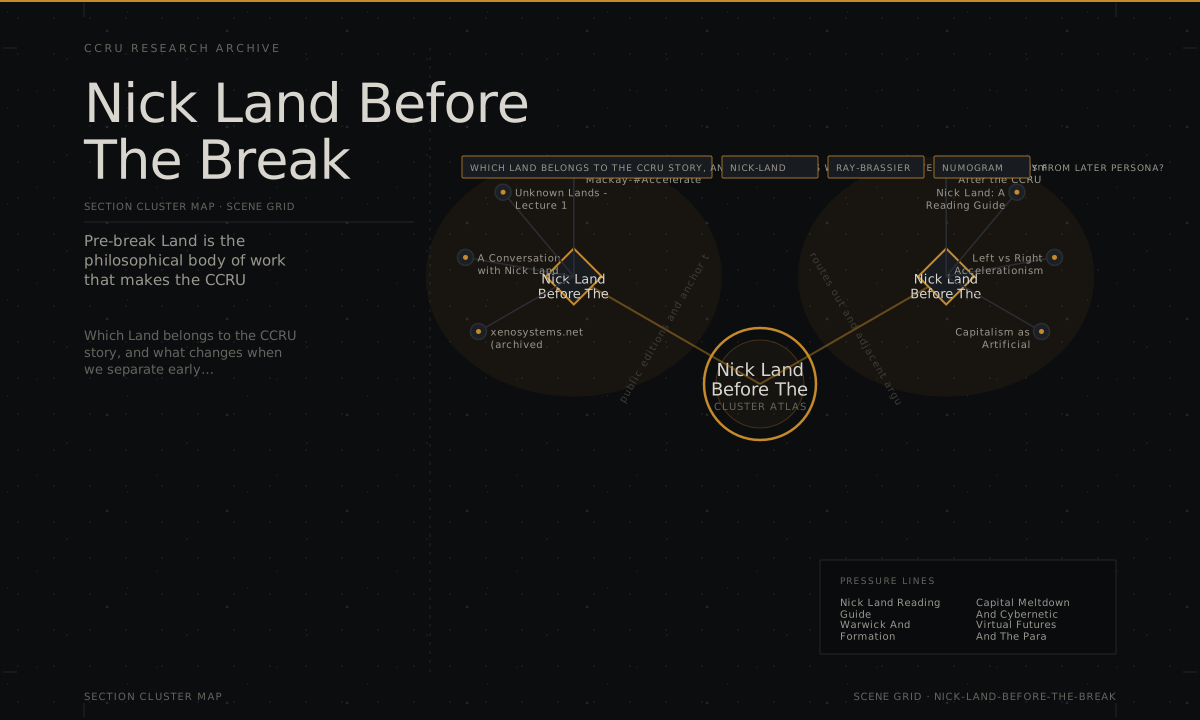
Nick Land Before The Break: public editions and anchor texts
Anchor editions: Ray Brassier - Mad Black Deleuzianism; On Nick Land; A Conversation with Nick Land (Part 2) - by Vincent Lê; Fanged Noumena - Nick Land.
Work
Ray Brassier - Mad Black Deleuzianism; On Nick Land
Brassier's talk re-reads Land through conceptual critique, arguing that the politics of accelerationism cannot be grasped without confronting its philosophical commitments. Ray Brassier's Mad Black Deleuzianism re-rea...
Work
A Conversation with Nick Land (Part 2) - by Vincent Lê
A conversation that makes later Land's political and teleoplexic vocabulary unusually explicit without dissolving its hostility or abstraction. A conversation that makes later Land's political and teleoplexic vocabula...
Work
A major collection page that gathers early and middle Land into the editorial form most responsible for his later circulation. Fanged Noumena gathers early and middle Nick Land into the editorial format most responsib...
Work
A lecture introduction that explains why Land is still studied, distinguishing early philosophical promise from later controversy and myth. A lecture introduction that explains why Land is still studied, distinguishin...
Work
Robin Mackay-#Accelerate The Accelerationist Reader
The main reader-introduction page for accelerationism, packaging the field as a set of competing lineages rather than a single slogan. "Accelerationism is a political heresy": the opening sentence of Mackay and Avanes...
Work
Section source cluster
Nick Land Before The Break: routes out and adjacent arguments
Adjacent routes: Accelerationism After the CCRU; Capitalism as Artificial Intelligence; AI Accelerationism Explained.
Guide
Accelerationism After the CCRU
Accelerationism is one of the most public labels attached to the CCRU, but it is not the archive's secret essence. The more accurate starting point is that accelerationism is a later umbrella term that gathered togeth...
Guide
Capitalism as Artificial Intelligence
Capitalism as artificial intelligence is the compressed name for one of Nick Land's most consequential arguments: that markets, prices, contractual coordination, and abstraction already compose a working artificial in...
Guide
AI accelerationism is the label that has attached itself, between 2022 and 2025, to a cluster of arguments connecting contemporary artificial intelligence with the older accelerationist tradition. The label covers gen...
Guide
The best way to start Nick Land is to separate phases before you make judgments. Read the Warwick and CCRU-era work as one phase, the editorial and spoken entry points as another practical route into it, and the later...
Guide
Left accelerationism and right accelerationism share a vocabulary, an editorial moment, and a name. They do not share a position. The left strand treats capital's technical machinery as a contestable resource politics...
Guide
The fastest way to make the CCRU less mystical is to put it back into time. Most readers do not meet the Cybernetic Culture Research Unit at Warwick in the mid-1990s. They meet it through Mark Fisher, k-punk, Nick Lan...
Texts in this section
46 classified works grouped into 3 editorial subclusters. Reviewed: 34; needs review: 12.
Collected readers and early receptions 13 works
- A Nick Land Reader; Selected Writings2 source files
- Critchley-Frieze-NL
- Fanged Noumena - Nick Land3 source files
- Fanged Noumena - Wikipedia
- Fanged-Noumena-Introduction
- LAND, N - Fanged Noumena Collected Writings 1987-2007
- Nick Land - Fanged Noumena Collected Writings
- Nick Land - Fanged Noumena; Collected Writings 1987-2007
- nick-land-fanged-noumena-collected-writings-19872007
- nick-land-fanged-noumena-collected-writings-19872007-12 source files
- week 2
- BUKET Nevidna PoezijaNeeds editorial review
- The Aesthetics of Transcendental MateriaNeeds editorial review
CCRU-era Land texts 32 works
- A Conversation with Nick Land (Part 1) - by Vincent Lê
- Autistic Mercury - Dark Star; A Review of Nick Land's 'The Thirst for Annihilation'
- Being Sufficiently Thirst for Annihilation
- Chasm - Nick Land3 source files
- Future takes care of itself. Acceleration is not human (f. Nick Land) Deterritorial Investigations
- Introduction to the Afterlife - Nick Land 1
- Mackay - Nick Land, An Experiment in Inhumanism (Divus) (2012)
- McKenzie Wark - The Thirst for Annihilation; Georges Bataille and Virtulent Nihilism
- Nick Land - The Thirst for Annihilation; George Bataille and Virulent Nihilism (Complete)2 source files
- Nick Land An Experiment in Inhumanism - Robin Mackay
- Nick Land Philo-Fiction, Chasm, and the Abstract Manifesto The Dark Fantastic Literature, Philosophy, and Digital Arts
- nick-land-chasm
- nick-land-cryptocurrent-an-introduction-to-bitcoin-and-philosophy
- nick-land-meat-or-how-to-kill-oedipus-in-cyberspace
- nick-land-phylundu-abstract-horror-exterminator
- Phyl-Undhu Abstract Horror, Ex - Nick Land3 source files
- prospectmagazine.co.uk-Nick Land the Alt-writer-fpscreenshot
- Somebody Wants to Take Down Nick Land - Jacobite
- THE HANDSOME EXCURSIONS DREAM Nick Land Oversees 'Exit' Camp Community. Someone's Phone Is Dead
- The Thirst for Annihilation - Nick Land2 source files
- The Thirst for Annihilation Ge
- week 3
- Flint Land - Organisation is Suppression (Interview) (Wired) (1997)Needs editorial review
- james-ellis-a-methodology-of-possession-on-the-philosophy-of-nick-land-1Needs editorial review2 source files
- Land - Machine and Technocultual Complexity, The Challenge of the Deleuze-Guattari Conjunction (Reviews) (Theory, Culture and Society) (1995)Needs editorial review
- Land - Meat or How to Kill Oedipus in Cyberspace (Cyberspace Cyberbodies Cyberpunk) (1995)Needs editorial review
- Land - Narcissism and Dispersion (Philosophers Poets) (1990)Needs editorial review
- Land, Nick - This is Not a DrillNeeds editorial review
- Nick Land - Reignition; Nick Land's Writings 4Needs editorial review
- Nick Land and Alexander Dugin on Liberalism, Empire, and the EschatonNeeds editorial review
- Surging Into the Inhuman - KtismaticsNeeds editorial review
- Who Is Nick Land - Tablet MagazineNeeds editorial review
Interpretations and interviews 1 works
References
Records cited
These linked sources are the quickest way to test the argument against named materials rather than second-hand summary.
Unknown Lands Lecture 1 Record
"Unknown Lands Lecture 1" is the first record to test the framing around Nick Land Before The Break.
Nick Land Fanged Noumena Record
"Nick Land Fanged Noumena" is the first record to test the framing around Nick Land Before The Break.
CCRU Lecture 1 Record
"CCRU Lecture 1" is the first record to test the framing around Nick Land Before The Break.
Nick Land Reading Guide Guide
"Nick Land Reading Guide" gives the larger argument around Nick Land Before The Break before you widen sideways.
External references
Inherited outward references from the guides, exhibits, people, and concept pages that anchor this section cluster.