What the term names
Distinguish it from techno-optimism. Techno-optimism is a disposition: technology, on net, makes things better, so build more of it. Accelerationism is a thesis about tendencies and limits: whatever is already happening under capital and computation has an internal vector, and the strategic question is whether to brake, redirect, or ride it. A techno-optimist can be a reformist; an accelerationist, by definition, cannot. Equally, distinguish it from futurism (an aesthetic of the new) and from mere 'speed' (a tempo). The smallest unit of work the term does in the archive is to mark a text's stance on the limit: does it treat capital's dynamic as something to be contained, or as something whose containment is itself the problem?
Because the branches are incompatible, the term is most useful in the plural and most misleading in the singular. Its operational value is diagnostic — it tells you which question a writer is answering — not doctrinal.
Where it became load-bearing
The conventional lineage runs back to Marx's 'Fragment on Machines' in the Grundrisse (1857–58), where fixed capital and the general intellect are already figured as a process overrunning the social form that hosts it — the passage every later branch reaches back to, whether to radicalize or to rebuke. The present retrieval does not include that text directly; readers should treat the genealogical claim as a standard framing to be checked against the primary source rather than as something evidenced here.
Inside the CCRU orbit, the concept does real work before it has the name. Nick Land's 1990s writings — later collected in Fanged Noumena: Collected Writings 1987–2007 (Urbanomic / Sequence, 2011) — treat capital as an intelligence-producing runaway, and the later term retroactively organizes that body of work. The term 'accelerationism' itself only becomes load-bearing as a keyword with its circulation in the late 2000s (the polemical use is commonly attributed to Benjamin Noys) and, most visibly, with the consolidation performed by #Accelerate: The Accelerationist Reader (ed. Robin Mackay & Armen Avanessian, Urbanomic, 2014), which gathers Marx, Land, the Williams & Srnicek 'Manifesto for an Accelerationist Politics,' and adjacent materials into a single canon. Both attributions — Noys's coinage, the Reader's consolidating role — are widely repeated in secondary literature; this page reports them as such rather than as first-hand archival findings.
Post-2014 the term fragments rapidly: left-accelerationism (Srnicek/Williams), right- and 'unconditional' branches around Land, and the later web-native 'e/acc' variant. Each branch cites overlapping anchor texts and means something different by them.
What's frequently misread
The dominant circulating misreading — the one the page has to defuse — is that accelerationism is a single political position meaning 'speed everything up so it collapses faster.' This reading collapses four distinctions at once: between intensification and tempo, between collapse-strategy and redirection-strategy, between Land's anti-humanist thesis about capital-as-agent and the left branch's thesis about repurposing capitalist infrastructures for post-capitalist ends, and between any of these and the venture-capital mood-board version ('e/acc') that arrived a decade later. A reader who treats the term as one doctrine will find every primary text either confirming or contradicting their summary depending on which paragraph they open.
A secondary misreading treats accelerationism as the CCRU's native and preferred self-description. It is not. The CCRU's own working vocabulary, as the available lecture and numogram materials make plain, was hyperstition, cyberpositive, numogram, syzygy, K-space — 'accelerationism' is largely a reception-side term applied to the 1990s material after the fact. Treat the word, in the archive, as a label affixed from outside and later: useful for locating debates, misleading as a banner.
The practical rule: when you encounter 'accelerationism' in a source, ask which branch, which anchor text, and which limit is in play before inferring any commitment. For orientation across the branches and their quarrels, the deepest single document is Accelerationism: Branches and Debates.
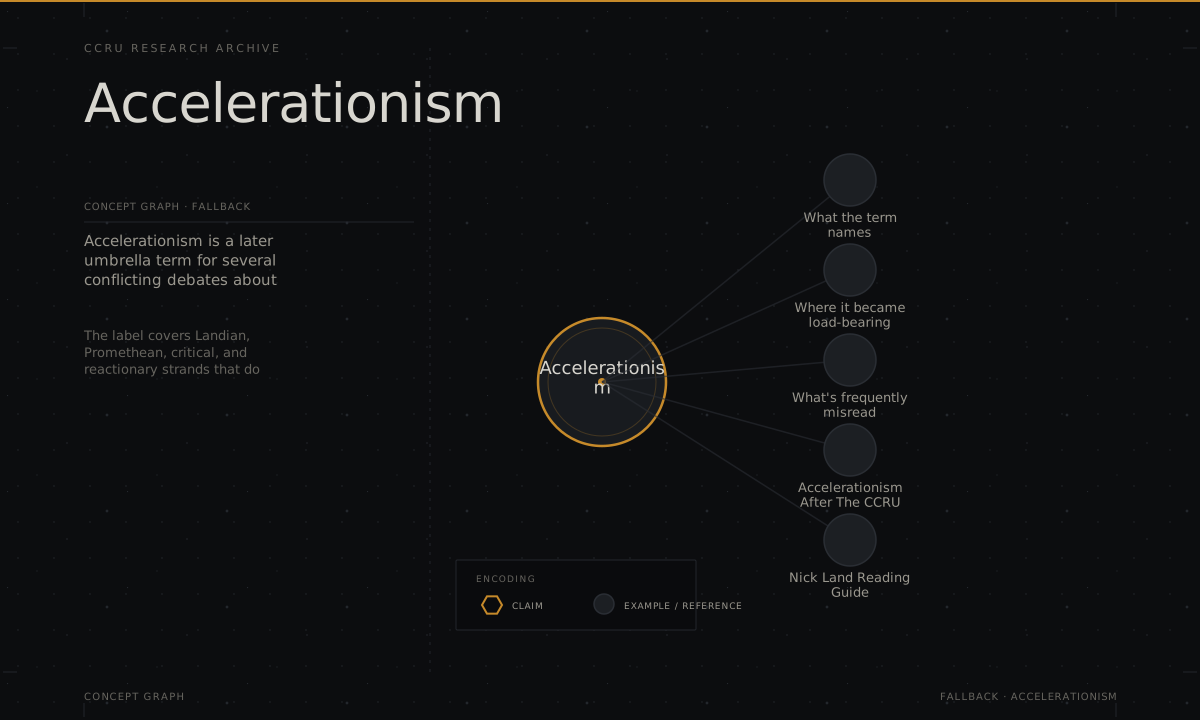
Accelerationism is a later umbrella term for several conflicting debates about capital, abstraction, technology, and strategy. It is tied to the CCRU, but it should be treated as a reception problem rather than as the archive's one true doctrine.
Core argument
Accelerationism is historically composite. The term gathers several incompatible branches under one public label.
The term is most useful when read genealogically. That keeps its editorial, political, and journalistic mutations visible.
Worked examples
These named texts, talks, sites, and records show where the argument becomes concrete.
Robin Mackay Accelerate Reader Record
The Accelerate reader frames accelerationism through selection, sequence, and editorial recovery. It makes Accelerationism checkable against a concrete archive object.
Endgamers History Of Accelerationism Record
A later reception history exposes how accelerationism becomes a public controversy. It makes Accelerationism checkable against a concrete archive object.
Nick Land Person
"Nick Land" shows who carries, translates, or contests Accelerationism in practice.
Accelerationism After The CCRU Guide
"Accelerationism After The CCRU" keeps Accelerationism attached to a guide-length argument and route map.
Common misreadings
These are the recurring simplifications, exaggerations, and misreadings that make the subject look flatter than it is.
- Accelerationism has one stable political meaning.
The label covers Landian, Promethean, critical, and reactionary strands that do not collapse neatly together.
Significance
Accelerationism matters because it remains one of the main public keywords through which readers encounter the archive, often in distorted form.
Working definition
A later umbrella term that gathers together incompatible arguments about capitalism, technological change, abstraction, and political strategy.
Representative extracts
Definition · Robin Mackay-#Accelerate_ The Accelerationist Reader · extracted text
Accelerationism is a political heresy: the insistence that the only radical political response to capitalism is not to protest, disrupt, or critique, nor to await its demise at the hands of its own contradictions, but to accelerate its uprooting, alienating, decoding, abstractive tendencies.
Why this matters: Mackay's definition frames the term by what it refuses — protest, critique, and waiting — establishing the shared point of departure from which the record's incompatible variants diverge.
Mechanism · Nick Land - A Quick and Dirty Introduction to Accelerationism · extracted text
For accelerationism the crucial lesson was this: A negative feedback circuit - such as a steam-engine 'governor' or a thermostat - functions to keep some state of a system in the same place.
Why this matters: Land grounds the concept in cybernetics rather than political theory; defining negative feedback is scaffolding for its opposite, the runaway positive loop that accelerationism actually names.
Stakes · Endgamers_ A History of Accelerationism - by Jacob Siegel · extracted text
Accelerationism is an attempt to answer the question of why the project of modernity has stalled in the post-industrial societies where capitalism and liberal democracy are most advanced.
Why this matters: Here accelerationism is recast as a diagnosis of stagnation, which explains how mutually hostile camps can share one label: they agree on the problem, not the remedy.
History · Endgamers_ A History of Accelerationism - by Jacob Siegel · extracted text
After Warwick fizzled out and Land disappeared for a while in the early 2000's accelerationism seemed to cool off. Then in 2013, the publication of #Accelerate: Manifesto for an Accelerationist Politics jump-started the new crop of left-wing accelerationists.
Why this matters: The passage supplies the record's periodization: a dormant decade separates the Warwick milieu from the 2013 manifesto, and the term's left/right split dates from that revival.
Afterlife · Robin Mackay-#Accelerate_ The Accelerationist Reader · extracted text
today's accelerationisms can be seen as a refinement and rethinking of them through the prism of the decades that spanned the end of the twentieth century and the birth of the twenty-first.
Why this matters: Mackay's plural 'accelerationisms' concedes the term has fractured while insisting the fragments remain answerable to the earlier material this archive collects.
References
Records cited
These linked sources are the quickest way to test the argument against named materials rather than second-hand summary.
Nick Land Quick And Dirty Introduction Record
Land's late accelerationist shorthand turns the concept toward manifestos and blog-era compression. Use it to test Accelerationism against source material rather than summary.
Robin Mackay Accelerate Reader Record
The Accelerate reader frames accelerationism through selection, sequence, and editorial recovery. Use it to test Accelerationism against source material rather than summary.
Endgamers History Of Accelerationism Record
A later reception history exposes how accelerationism becomes a public controversy. Use it to test Accelerationism against source material rather than summary.
Accelerationism After The CCRU Guide
"Accelerationism After The CCRU" widens Accelerationism through linked sources, people, and sections.