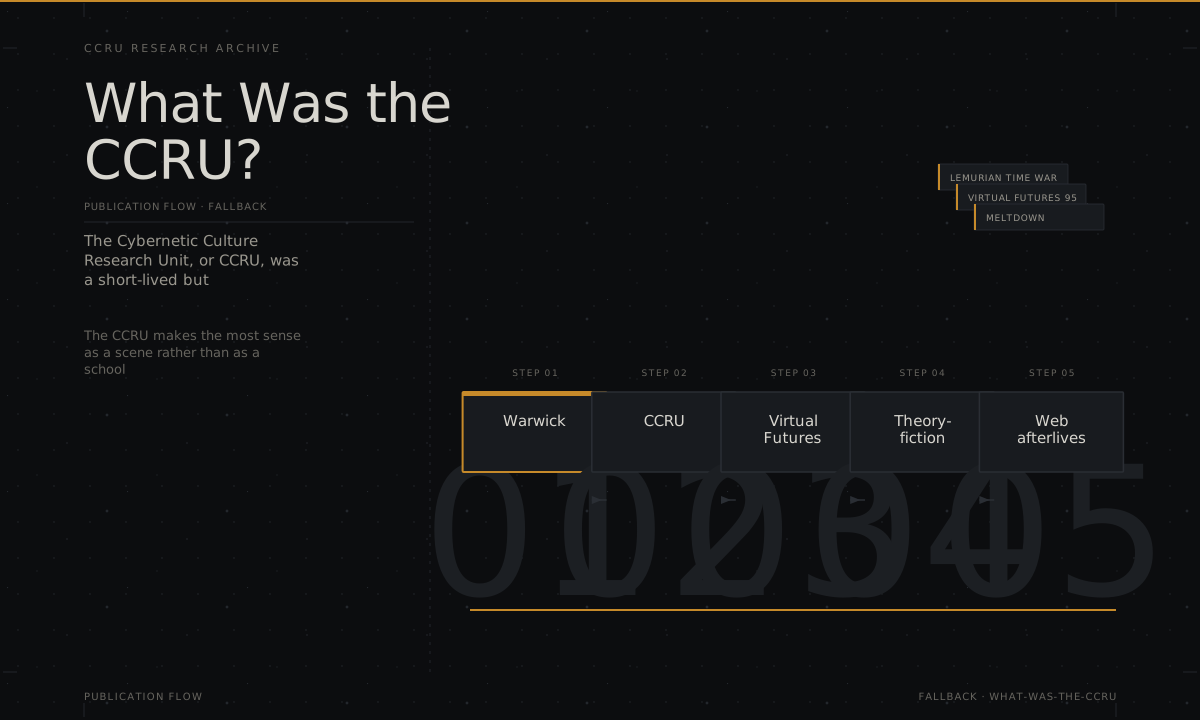
The Cybernetic Culture Research Unit, or CCRU, was a short-lived but influential research formation that emerged around Warwick in the 1990s. It fused cybernetics, media theory, philosophy, theory-fiction, music writing, and experimental publication into a scene that later survived through web traces, recordings, essays, and arguments about its afterlife.
Key points
- The CCRU was a collaborative scene more than a fixed doctrine.
- Nick Land mattered, but Sadie Plant, Luciana Parisi, Orphan Drift, Mark Fisher, and adjacent figures are essential to understanding it.
- Its afterlife matters because later internet theory culture and accelerationism debates remade how the CCRU was remembered.
Core argument
The CCRU makes the most sense as a scene rather than as a school. That distinction prevents the archive from collapsing into a single doctrine or personality cult. Example: CCRU Lecture 1 (CCRU - Lecture 1)
Its distinctiveness lay in the fusion of styles and media, not in one reusable thesis. It explains why web surfaces, lectures, pamphlets, and design matter as much as canonical essays. Example: ccru.net homepage (ccru.net (archived homepage))
The afterlife is part of the subject, not just an epilogue. Readers usually arrive through Fisher, Land, accelerationism, or AI-adjacent discourse rather than through Warwick in the 1990s. Example: Virtual Futures (Book) (Virtual Futures (Book))
The CCRU makes the most sense as a scene rather than as a school. That distinction prevents the archive from collapsing into a single doctrine or personality cult.
It was a scene before it was a canon
The most useful starting point is to think of the CCRU as a collaborative scene rather than as a shelf of approved doctrines. The surviving material comes in lectures, flyers, pamphlet-like texts, archived websites, interviews, design-heavy surfaces, and later editorial reconstructions. That mix matters. It tells you that the CCRU was never simply a body of propositions waiting to be extracted from a few canonical essays. It was also a mode of circulation.[1]
Warwick matters because it provided the institutional setting and some of the earliest infrastructure. But the CCRU's real shape only appears when you place the university beside Virtual Futures events, ccru.net, later web captures, and the para-academic culture that let ideas travel without staying obedient to ordinary disciplinary boundaries. The result is less like a school than like a relay system: concepts, styles, and names moving across overlapping media.
The Cybernetic Culture Research Unit was initially set up by Warwick University in the UK to support the philosopher, cyberfeminist, and cultural theorist Sadie Plant.
What held it together was a working method rather than a thesis. Output came from what the group called a swarm assemblage, produced through sleepless collective writing sessions where authorship dissolved on purpose. The Urbanomic editors describe Ccru as "an ongoing experiment in collectivity, collective production, anonymity, and masks" (archive.org PDF of Writings 1997-2003.pdf)). That is why so much of the primary material is signed by fictional personae, attributed to the Architectonic Order of the Eschaton, or routed through the Lemurian time-sorcery mythos that the second edition of the Writings catalogues (Urbanomic, second edition). The masks did real work. They were how the group refused the academic individuation that Warwick's philosophy department eventually used to terminate the unit (k-punk archive).
Archive instrumentMap the CCRU scene in the constellationThe introductory guide should enter through the attested ccru.net node that opens the reviewed What Was the CCRU route, not through the instrument root.
What made it feel new
The CCRU still feels unusual because it fused forms that academic writing usually keeps apart. Cybernetics, fiction, occult residue, music journalism, continental philosophy, media theory, and graphic or web design are not side interests here. They are part of the method. A text like "Cyberpositive" matters partly because of what it argues, but also because of how it stages system, contagion, and speed at the level of style.
That is also why newcomers often bounce off the writing. The prose is compressed, allusive, and sometimes aggressively theatrical. But the strangeness is not mere decoration. It comes from an attempt to make concepts operate like machines, narratives, or transmission systems rather than like stable textbook definitions. Once you see that, the difficulty starts to look methodological rather than ornamental.
Hyperstition as the central conceptual export
The central conceptual export is hyperstition. The shorthand is that fictions make themselves real, but the more precise version is the one Maggie Roberts gives: hyperstitions name both the effects and the mechanisms by which a category of ideas operate as carriers of apocalyptic phase-out culture (merliquify). The CCRU position holds that there is always a distinction between what is presently imaginary and what is real, while insisting the imaginary can become the real. Hyperstition is the operational form of that crossing. The numogram, the Lemurian mythos, the Architectonic Order, even the dating conventions of the texts, all function as carriers rather than ornaments. Urbanomic's ongoing numogrammatics workshops treat this material as a live formal object, not a closed period piece (Urbanomic event).
It was never just Nick Land
Nick Land is central to the CCRU and any honest introduction has to say so quickly. His writing, persona, and later notoriety shaped how the group has been remembered. But a Land-only story falsifies the archive almost immediately. Sadie Plant matters because she widens the frame toward media theory, cyberfeminist questions, and technical subjectivity. Luciana Parisi matters because she gives the scene one of its sharpest routes into distributed life, contagion, and machinic systems. Orphan Drift matters because it keeps collective experiment, interface culture, and art practice in view rather than letting the whole formation collapse into solitary systems prose.
Mark Fisher matters differently. He is one of the CCRU's decisive mediators rather than its origin. Through k-punk and later public criticism, Fisher helped translate parts of the scene into a wider vocabulary of music writing, cultural criticism, and internet-era theory. Once those figures enter the picture, the CCRU starts to look less like a single thinker's fever dream and more like a dense, unstable field of overlapping practices.
Land is the gravitational mass and pretending otherwise falsifies the record. Ian Hamilton Grant's accounts of entering Land's office during the late period, and the surrounding stories of erratic behaviour, belong to the history. So does the fact that Land served as the group's principal intellectual driver, the figure whose later trajectory feeds directly into speculative realism, accelerationism, and a wider anti-humanist aesthetic. The mistake is treating gravitational mass as identity. Plant's cyberfeminism, Parisi's work on abstract sex and computation, Fisher's writing on the eerie and on capitalist realism, and the music-press lineage that runs through Reynolds and Eshun, all developed in and against the same room. Strip them out and what remains is a caricature that flatters either Land's later admirers or his loudest critics, depending on which side picks up the cartoon.
Why it spread beyond Warwick
The CCRU survived because it produced portable concepts and portable styles. Hyperstition is the clearest example: a term that could detach from its first context and travel through blogs, essays, forums, and later cultural theory. But the same is true of its broader habits of thought. Recursion, feedback, runaway systems, machinic desire, nonlinear time, and narrative causality all moved well because they gave later readers ways to name processes that ordinary political or cultural commentary often treated too flatly.
This portability is one reason the CCRU belongs to internet-native theory culture as much as to 1990s Warwick. Readers today usually meet the material through later circuits: Fisher, accelerationism discourse, Land's blog-era afterlife, Amy Ireland, Robin Mackay, or more recent attempts to connect the scene to AI and recursive culture. The afterlife is therefore part of the object, and one of the main ways the real story became visible.
What the CCRU was not
It was not a clean doctrine, and it was not a prophecy machine. The scene contained tensions that later retellings often smooth out. Some readers want a unified philosophy; others want a villain origin story for later reactionary politics; others want a set of eerie predictions about markets, machines, and culture. None of those frames is completely baseless, but each becomes misleading when treated as the whole truth.[2]
It was also not simply a costume of occult references wrapped around standard theory. The strange motifs matter because they changed how the work moved, how it was remembered, and how readers learned to approach it. But that same mythic tone also encouraged distortion. The CCRU often intensified its own legend, and later readers were not wrong to notice that. The task is to read the myth-making as part of the object rather than either dismissing it or surrendering to it.
The archive is also internally divided, and the guide should not pretend otherwise. Edmund Berger's Underground Streams maps the split between the original CCRU-Land accelerationism and the later left accelerationism of Srnicek and Williams, treating them as distinct formations rather than versions of one position (Monoskop PDF). Inside the original scene, the cybergothic, occult, numogrammatic strand sits awkwardly with the more sober media-theoretical work, and Fisher's later writing visibly pulls away from the libidinal-apocalyptic register even as it keeps the hyperstitional method. There is no single CCRU line on capital, on the human, or on what counts as theory. The Writings 1997-2003 reads as an anthology of mutually pressuring positions held together by shared technique (Urbanomic).
Entry points into the primary material
The difficulty of the primary material is real and is also frequently overstated as mystique. The strongest entry points explain the concepts in plain language first, then move back into the denser primary sources. Monoskop's bibliographic page is the cleanest external map, listing the journals Collapse and Abstract Culture alongside the conference outputs (Monoskop). Urbanomic's two editions of the collected Writings are the canonical print object (first edition, second edition). Abstract Culture: Digital Hyperstition (1999) is freely readable and the best place to see the method working at length (Monoskop PDF).
Why people still keep rediscovering it
The CCRU keeps resurfacing because it sits at an unusual crossroads. It speaks to readers interested in cybernetics, digital culture, media systems, speculative philosophy, music writing, internet-native theory scenes, and the public afterlife of accelerationism. It also attracts readers who sense that culture is no longer something humans simply observe from the outside, but something that loops back through networks, prices, symbols, and machines.
That does not mean the CCRU solved these problems. Often it dramatized them better than it explained them. But that is part of its endurance. It made certain pressures vivid before they became ordinary. Even now, the archive remains one of the clearest places to watch theory, style, and circulation begin to merge under digital conditions.
Readers keep returning to this material because later internet theory culture, accelerationism debates, and parts of AI discourse keep circling problems the CCRU made unusually vivid, even when the archive remains messy and uneven. After this guide, read the Writings as a polyphonic document with named contributors and named disagreements, treat hyperstition as an operational category rather than a slogan about self-fulfilling prophecy, and let the Lemurian apparatus stand as a working notation rather than a costume. The Land question matters but it is the second question, not the first. The first question is what the room was doing.
Keywords
Ccru, cybernetic culture research unit, abstract culture, sadie plant, nick land, y2k, millenium bug, kode9, katasonix, kodwo eshun, simon reynolds
Ccru, cybernetic culture research unit, abstract culture, sadie plant, nick land, y2k, millenium bug, kode9, katasonix, kodwo eshun, simon reynolds
Worked examples
These named texts, talks, sites, and records show where the argument becomes concrete.
CCRU Lecture 1 Record
A useful spoken entry point because the scene becomes audible as lecture, recap, and atmosphere rather than just as printed density.
ccru.net homepage Record
Shows how the group presented itself publicly through design, navigation, and self-mythologizing web architecture.
Keeps the CCRU tied to para-academic events, public interfaces, and a wider scene rather than only to later mythology.
Ritual / 0rphan Drift Archive Work
A reminder that the CCRU orbit includes collective experiment, media ecology, and art practice rather than philosophy alone.
Tensions and limits
Nick Land remains the strongest gravitational center in the archive, even when that emphasis distorts the group picture.
The CCRU's writing style can be methodologically revealing and still create unnecessary opacity for newcomers.
Later rediscovery kept the material alive, but it also encouraged cherry-picking and retrospective myth-making.
Common misreadings
These are the recurring simplifications, exaggerations, and misreadings that make the subject look flatter than it is.
- The CCRU was a doctrine.
It had recurring motifs and obsessions, but the surviving material looks more like a relay system than a settled school.
- The CCRU was only Nick Land.
Land is central, but the historical picture breaks down quickly if Plant, Parisi, Orphan Drift, and later mediators vanish.
Significance
Readers keep returning to the CCRU because it staged problems that still feel current: recursive media, abstraction, machinic culture, online theory scenes, and the way narratives start acting like operators rather than commentary.
It matters now because it lets you watch theory, style, networks, and myth begin to merge under digital conditions, long before those pressures became ordinary online experience.
References
Records cited
Linked archive records for this guide. Numbers correspond to the footnote markers in the body above.
CCRU - Lecture 1 Record
A spoken overview that helps the early scene feel historically real rather than legendary.
ccru.net (archived homepage) Record
A public-facing surface that makes the CCRU's self-presentation legible in its own idiom.
External references
Selected outward references: source sites, archived copies, and durable relay surfaces that widen this guide beyond the internal archive layer.
Reader questions
What was the CCRU?
The CCRU was a loose research scene that formed around Warwick in the 1990s, then lived on through theory-fiction, Virtual Futures, web circulation, and later mythologies around figures like Nick Land and Mark Fisher.
Why does the CCRU keep getting rediscovered?
Because it sits at the crossing point of several still-live interests: internet-native theory culture, accelerationism, hyperstition, para-academic circulation, and contemporary attempts to think AI, finance, media, and recursion together.
Reading routes through this guide
Featured exhibit
Virtual Futures and the Para-Academic Scene
A curated exhibit on the events, interfaces, and public surfaces that helped the CCRU circulate beyond one department or one medium.
Featured reading path
A short guided sequence for readers who want the clearest first path through the CCRU site.