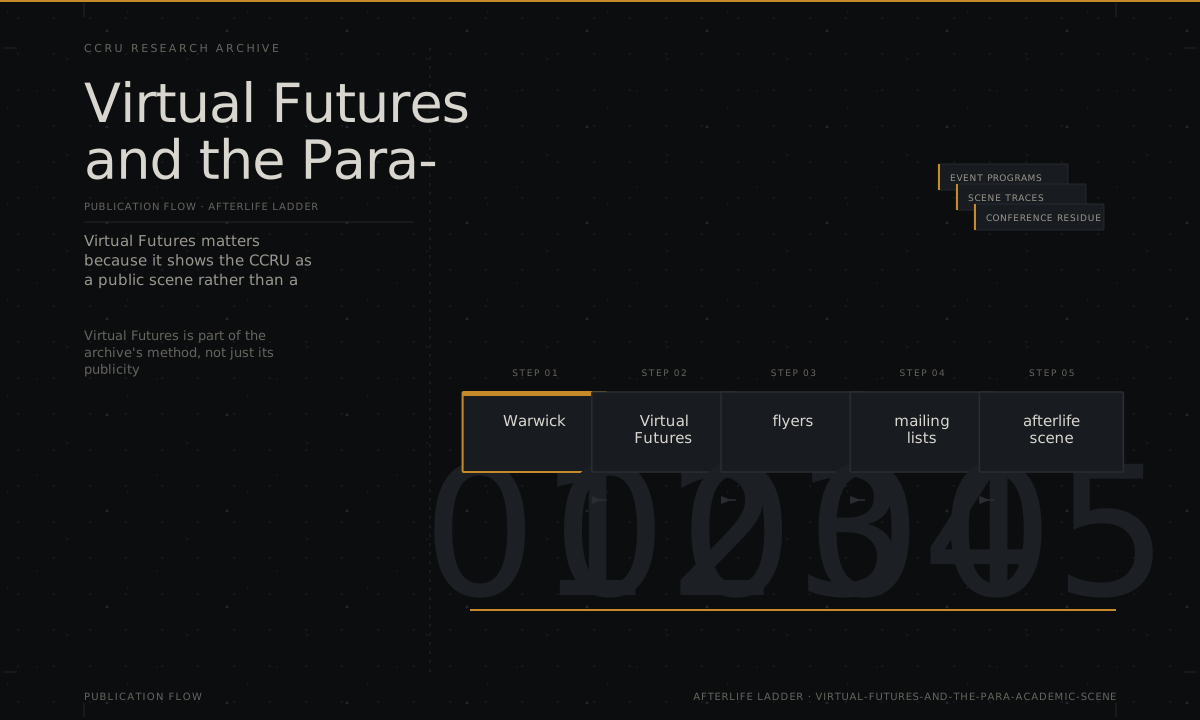
Virtual Futures matters because it shows the CCRU as a public scene rather than a retrospective shelf of difficult texts. Programs, lectures, archived interfaces, and para-academic circulation reveal how ideas moved through rooms, recordings, invitations, and mixed audiences.
Core argument
Virtual Futures is part of the archive's method, not just its publicity. Event culture changed how the material was staged, heard, and later remembered.
Para-academic infrastructure explains why the archive travelled beyond one department. Without workshops, programs, recordings, and web surfaces, much of the CCRU would remain locally sealed.
Interface and presentation belong to the intellectual history here. The archive's public surfaces are not decorative wrappers around the 'real' work; they are part of how the work became legible and transmissible.
An exhibit on Virtual Futures, CCRU event culture, and the para-academic infrastructures that made the archive public, social, and portable.
The scene was public before it became historical
One of the most misleading habits around the CCRU is to imagine it as a hidden core later excavated by internet readers. The event layer complicates that picture. Virtual Futures and related para-academic forms already made the material public, but they made it public in a way that does not fit standard institutional categories. This was neither a conventional department seminar culture nor a purely underground scene. It was a hybrid formation: semi-academic, experimental, performative, and unusually open to crossover between philosophy, media, design, fiction, and cultural theory.
That hybrid character explains why the archive still feels so contemporary. Much of intellectual life now moves through mixed channels: talks, clips, websites, distributed files, podcasts, editorial packages, and scenes that are partly institutional and partly not. Virtual Futures makes clear that this mixed circulation was not an afterthought. It was already part of the archive's ecology.
The key point is that publicness here is infrastructural, not merely promotional. Event schedules, recordings, and interfaces gave the material routes of travel. They also shaped how later readers could reconstruct the scene once the original moment had passed.
Programs, interfaces, and books are not just packaging
The temptation is to treat event programs or archived websites as secondary material surrounding the real texts. But in this case the interfaces and packages are part of the intellectual evidence. They show what the archive thought counted as a public surface, how it framed itself, and what sort of audience it imagined. The CCRU web traces matter for the same reason lecture recordings matter: they preserve mode, presentation, and invitation as well as propositional content.
That is also why the Virtual Futures book belongs here. It does not merely summarize an event. It helps convert a scene into something portable, teachable, and revisitable. A book, like a website, can freeze and stabilize what was once ambient. But stabilization is not neutral. It changes proportion. It can clarify a scene while also beginning the process of canon formation.
Once those packages exist, memory starts to organize itself around what was easiest to preserve. That is one reason this exhibit keeps books, web traces, and lecture surfaces together rather than separating them into primary and secondary evidence. Each one changes how the scene survives.
Para-academia changed how the archive moved
The phrase para-academic can sound vague until it is tied to materials. Here it means something specific: circulation that depends on proximity to academic life without staying bounded by its normal containers. The archive moves through workshops, lecture programs, hybrid publications, collective experiments, design practices, and later recordings. That movement explains both its persistence and its unevenness. Some lines survive richly because they were packaged or replayed; others survive only in fragments because their primary life was social, spatial, or event-based.
This is one reason Orphan Drift belongs in the same exhibit as Virtual Futures. Once collective art and design practice are put beside lectures and books, the archive stops looking like a philosophy story with a little aesthetic residue around the edges. It starts looking like a distributed media culture. That is historically more faithful and intellectually more interesting.
It opens the route outward into experimental practice, where scene formation exceeds conferences and books and moves through alternative publics.
How the route is built
The route opens with the Virtual Futures book because it gives the exhibit a portable frame for event culture. ccru.net then supplies a public web surface: a way the formation presented itself beyond a department. Lecture 1 moves the exhibit into speech, where scene-framing becomes audible rather than merely bibliographic. Unknown Lands adds later spoken contextualization, useful for seeing how the archive was retrospectively situated without collapsing it into nostalgia.
Ritual closes the route by showing that para-academic circulation also ran through collective artistic practice. The point is not that all these objects are the same kind of source. The point is the opposite: the scene depended on different formats working together. Read as a sequence, the exhibit shows a formation whose public life was assembled through events, sites, talks, books, and experimental collectives.
Notes on the items in the route
Why here: The book opens the exhibit because it gives event culture a durable editorial form. It is a portable trace of a scene that otherwise risks becoming anecdote.
Notice: The important feature is packaging: conferences, contributors, topics, and public theory are gathered into a form that can circulate. Scene energy becomes durable when it is edited into an object.
Why here: ccru.net supplies the web-facing side of the formation. It shows that para-academic circulation was also an interface problem, not only an event history.
Notice: The surface makes the archive public while preserving opacity, density, and strangeness. It is an interface that invites entry while refusing to become a clean brochure.
Why here: Lecture 1 brings voice and scene-framing into the exhibit. It is useful because spoken form reveals how concepts were introduced, repeated, and staged for listeners.
Notice: The looseness matters. A lecture can carry formation energy that a polished essay hides, including hesitations, pivots, and the feel of concepts being staged aloud.
Why here: Unknown Lands adds a later spoken context. It helps show how the archive was explained and repositioned after its original para-academic moment.
Notice: The value is not only content but retrospection: how the scene is made intelligible afterward. Later explanation becomes part of the archive's afterlife.
Why here: Ritual closes the exhibit by reminding the reader that para-academic circulation also ran through collective art practice and media experiment.
Notice: The object resists a narrow conference-history reading. Scene formation includes images, rituals, collectives, and alternative publics, not only named events and programs.
Sequence: It opens the route outward into experimental practice, where scene formation exceeds conferences and books and moves through alternative publics.
What readers usually miss
Readers often miss that the event layer is not only background context. It helps explain the archive's tone, portability, and afterlife. A lecture can make a dense line more legible than a printed fragment. A website can preserve a mode of public presentation that disappears when the text is copied out of context. A book package can canonize one slice of a scene and quietly demote another. All of these are interpretive facts, not only archival curiosities.
They also miss the tension inside public circulation itself. Making the archive portable is good because it keeps the material alive. It is also risky because portability can over-stabilize what was once more plural, more atmospheric, or more scene-dependent. Virtual Futures is valuable not because it solves that tension, but because it makes it visible.
What the sequence shows
The sequence proves that the CCRU's public formation cannot be reconstructed from canonical essays alone. It needs event culture, web interfaces, spoken framing, later contextualization, and collective practice. Those formats are not secondary packaging around the real archive. They are part of how the archive became available, confusing, transmissible, and durable.
Curated items
Text page
The Virtual Futures volume matters because it turns programs, speakers, and scene memory into a portable object without pretending the room itself can be recovered intact.
Record
ccru.net belongs here as a designed public surface: it shows how the formation presented itself, not just which titles it happened to contain.
Record
CCRU Lecture 1 lets the formation arrive as cadence and performance, making clear that public staging was part of the method rather than secondary decoration.
Record
Unknown Lands Lecture 1 keeps the scene alive for later readers while also revealing how retrospective framing quietly edits proportion and emphasis.
Text page
Ritual 0rphan Drift Archive widens para-academic culture beyond the lecture hall into collective art, design, and media ecology.