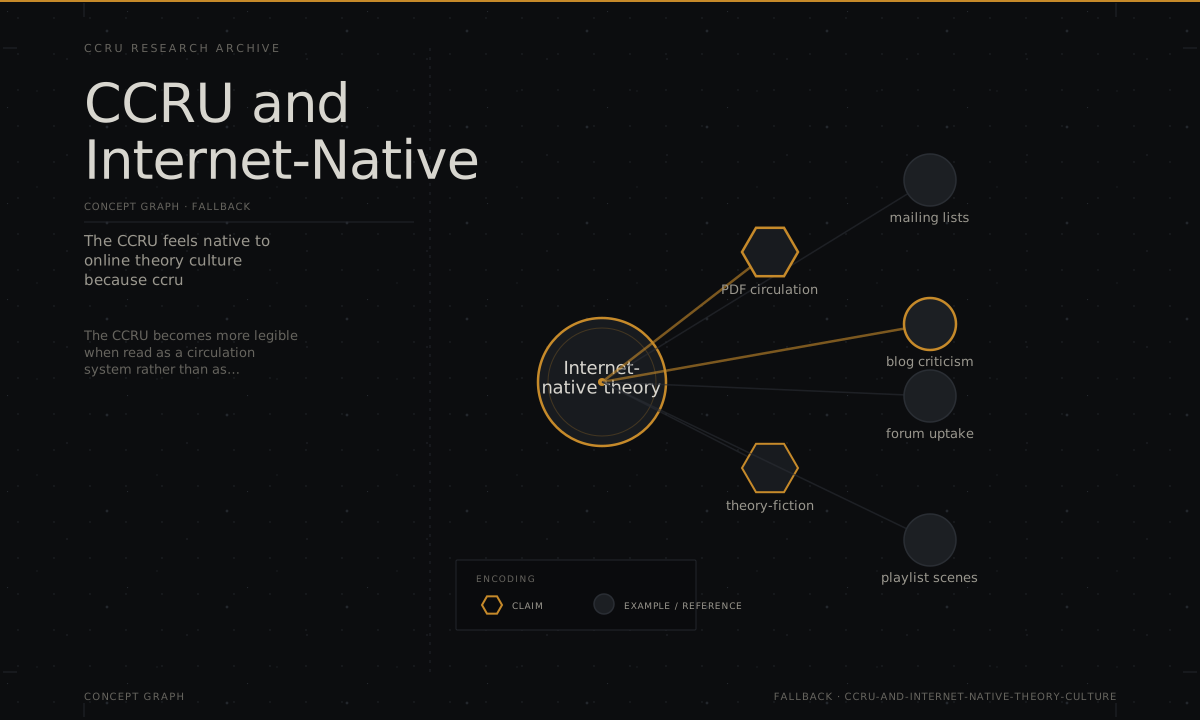
The CCRU feels native to online theory culture because ccru.net, Virtual Futures, k-punk, and later xenosystems show ideas moving through interfaces, events, blogs, PDFs, and relay figures rather than through one stable book culture.
Key points
- The CCRU was never only a shelf of difficult texts; it was a distributed scene with a strong web and para-academic life.
- Blogs and archived sites did not merely preserve the material; they changed how later readers understood it.
- The online afterlife is part of the subject because most contemporary readers arrive through Fisher, Land, k-punk, xenosystems, screenshots, and secondary discourse rather than through Warwick alone.
Core argument
The CCRU becomes more legible when read as a circulation system rather than as a sealed canon. That shift explains why web captures, lectures, event traces, and editorial repackaging matter alongside denser primary texts. Example: ccru.net homepage (ccru.net (archived homepage))
Internet-native theory culture did not begin with today's platforms. The CCRU's afterlife shows an earlier ecology of blogs, archived interfaces, distributed files, and para-academic scenes. Example: k-punk homepage (k-punk.abstractdynamics.org (archived homepage))
The online afterlife did real intellectual work, not just publicity work. Figures like Mark Fisher and Robin Mackay translated, contested, and redistributed the materials in ways that changed what later readers could see. Example: xenosystems.net (xenosystems.net (archived homepage))
The CCRU becomes more legible when read as a circulation system rather than as a sealed canon. That shift explains why web captures, lectures, event traces, and editorial repackaging matter alongside denser primary texts.
The CCRU was distributed before it was rediscovered
It is easy to tell the story as if the archive began as a closed academic scene and only later escaped online. That misses what made it distinct. Even while Warwick mattered as an institutional setting, the CCRU was already moving through events, para-academic experimentation, pamphlet-like writing, web surfaces, and design-heavy public interfaces. The material did not behave like a stable canon waiting to be shelved. It behaved like a relay system.
The thesis: the CCRU was already structured like an internet-native theory operation before the contemporary internet existed to receive it, which is why its distortions in circulation feel less like damage and more like continuation. The group's preferred forms, distributed PDFs, pseudonymous co-authorship, memetic phrases, event programs, music-press crossovers, mapped onto blog culture, screenshot culture, and platform theory scenes with almost no friction. Reception did not betray the work. Reception extended a method the work had already chosen.
This matters because later readers often approach the materials through circulation first and doctrine second. They notice the names, interfaces, rumors, blog trails, and recurring keywords before they feel able to parse the most compressed texts. That path is not a distraction from the formation. It is one of its real historical forms.
Authorship protocols and production conditions
Look at how the material was produced. Urbanomic's contributor page describes "a name on a door in the philosophy department of Warwick University" that blurred "traditional scholarship, cyberpunk sci-fi and music journalism" (Urbanomic). The lecture transcript in the archive notes that collaboration was "so total that they were never able to really identify who wrote what part of what piece or who came up with what idea first". That is not a sentimental claim about collective spirit. It is a description of an authorship protocol incompatible with the standard academic citation economy and perfectly compatible with handle-based forum culture, anonymous imageboard theory, and the later pseudonym ecologies of accelerationist Twitter and Substack.
Look at the formats. Abstract Culture ran as numbered Swarm pamphlets, with Digital Hyperstition (1999) being the one most often encountered today as a scanned PDF on Internet Archive (archive.org) and Monoskop (monoskop.org). The Urbanomic compilation Ccru: Writings 1997–2003 only consolidated this material into book form long after the fact (Urbanomic). For roughly a decade the canonical access point to most of the corpus was a website and its mirrors. The Wayback capture of ccru.net/syzygy.htm (web.archive.org) is, for many readers, the primary text. Print followed web, not the other way around.
Look at the self-description. The Writings answer the question of method directly: "Ccru feeds its own researches back into its own microcultural production. Its basic tool in this respect is 'pulp-theory/fiction hybridity' or Hyperstition" (archive.org mirror _hocr.html)). Hyperstition treats fiction as an operational vector, a unit that produces the conditions of its own truth by being circulated. A theory of circulation built into the theory itself does not have a clean outside from which a reader could observe "the work" undisturbed by its uptake. Slogans like "cyberpunk tortures fiction in intensity" were designed to detach and travel. They did.
Archived sites are part of the evidence, not just wrappers
The ccru.net homepage matters because it preserves more than information. It preserves tone, arrangement, naming, and interface style. The site makes the scene feel less like a neutral bibliography and more like a self-conscious machine for staging ideas. That public face is intellectually relevant. It tells you how the material wanted to appear, how it wanted to connect, and how it expected a reader to navigate.[1]
The same is true of later web surfaces. k-punk is not important only because it mentions the CCRU. It matters because Fisher uses blogging to translate and restage parts of the formation inside a different public ecology. xenosystems is equally important for a different reason: it shows how one later Land line migrates into a harder, narrower, and more overtly contemporary online frame. These sites are evidence of transformation, not just storage.
This is the internet-native texture the guide is trying to preserve: collective, interface-like, and hard to flatten into doctrine.
Blogs and editorial relays changed the archive's meaning
The internet did not merely rescue the CCRU from obscurity. It selected, amplified, and rearranged it. Fisher's blog writing helped link the materials to music, cultural criticism, mood, labor, and public feeling. Editorial labor by figures like Robin Mackay helped detach difficult work from one institutional moment and present it to later readers in a more portable form. In both cases, redistribution was also reinterpretation.[2]
The common bad reading treats the CCRU as a buried Warwick episode that the internet later rediscovered and partially garbled. Under that reading, the job of an archive is restoration, returning slogans to context, attributing pseudonyms, fixing the record. The better reading is that the garbling was anticipated by the production conditions. Once the material entered "blogs, screenshots, extract culture, forums, and later public theory scenes, it gets reorganized. Some parts become more legible, some become slogans, and some become detached from their original scene conditions". Reorganization is not noise around the signal. It is one of the ways the signal propagates. The Lemurian apparatus, the Numogram, the Barker geotrauma material that Urbanomic's catalogue copy lists (Urbanomic), all of it was built to be excerpted, redrawn, re-attributed, and re-fictioned by later hands.
That is why a serious history of the CCRU has to track more than origin points. It also has to track the mechanisms of afterlife. Which concepts travelled? Which figures became gateways? Which surfaces shaped memory? Why did some motifs become slogans while others disappeared? The answers live in interfaces and relays as much as in canonical essays.
Para-academic scenes matter as much as platform scenes
If the online story becomes too abstract, Virtual Futures helps pull it back to earth. Events, workshops, and para-academic gatherings show the archive moving through live public contexts rather than floating as disembodied theory. That matters because it keeps the CCRU tied to infrastructure: rooms, programs, collaborations, recordings, organizers, and temporary institutions.
Internet-native theory culture is therefore not just a story about websites. It is also a story about how off-campus circulation, events, blogs, archived pages, and editorial packages interact. The CCRU belongs here because it lived through those combinations unusually early and unusually intensely.
Competing editorial lines inside the field
This is where the archive has to take a position, and the positions inside the field genuinely disagree. The Urbanomic editorial line, visible across the Writings and the later CCRU Recursed (Urbanomic), tends toward consolidation: assemble the dispersed material, give it covers, give it ISBNs, stabilize the corpus for future scholarship. The Monoskop and Internet Archive lines tend toward open circulation of the original artefacts, scans of Swarm 4, the 1999 hyperstition pamphlet, the loose PDFs (Monoskop). The blog inheritance, k-punk, Hyperstition, xenosystems and their successors, tends toward continued production in the same mode, treating CCRU concepts as live operators rather than historical objects. None of these is wrong. They pull the archive in incompatible directions. A reader who only ever uses Urbanomic will miss the web texture. A reader who only ever uses web captures will miss the editorial reconstruction work. A reader who only reads downstream blogs will mistake later applications for source claims.
How to read the online afterlife without flattening it
The danger of the online frame is not that it is false. The danger is that it becomes too smooth. Screenshots, blog references, and recurring names can make the material feel easier than it is. They can also make it feel narrower than it was, especially when later Land discourse or accelerationism headlines start to stand in for everything.[3]
The best way to avoid that flattening is to move back and forth. Use web captures to see public surfaces. Use guide pages and bridge figures to gain orientation. Then return to records, talks, and texts to test the framing against ccru.net, Virtual Futures, k-punk, and the other named materials that actually carried the scene. The goal is not to purify the CCRU of its online afterlife. The goal is to understand how that afterlife became part of its public meaning.
The practical instruction the archive front-loads in: "use web captures, bridge figures, and editorial pages to understand circulation, but keep checking back against records and texts. The question is not whether the internet distorted the archive; it is how the distortion also became part of its public meaning." That is the orientation a reader should leave this guide with. Track which version of a text you have, scanned 1999 pamphlet, 2015 Time Spiral reprint, 2024 Monoskop omnibus PDF (Monoskop), Wayback capture of ccru.net. Track which hands re-circulated which fragment. When a phrase like "Lemurian time-sorcery" arrives detached from a source, treat the detachment itself as data about how the apparatus works.
Read differently after this guide in two ways. First, stop looking for a definitive CCRU text and start mapping a CCRU distribution: the same idea will appear in a lecture transcript, a Swarm pamphlet, a ccru.net page, an Urbanomic anthology, and a 2007 blog post, and the differences between those instances are part of the meaning. Second, stop treating internet-native theory culture as the CCRU's afterlife. It is the medium the CCRU was already writing for, ten years before it fully arrived.
Keywords and circulating fragments
Ccru, cybernetic culture research unit, abstract culture, sadie plant, nick land, y2k, millenium bug, kode9, katasonix, kodwo eshun, simon reynolds
erotic, magnetic, currency waves, cellullar radiating. amplified sensory perception, physical telepathy, touch, infinite response, it finds you, trickster, tease, danger
Worked examples
These named texts, talks, sites, and records show where the argument becomes concrete.
ccru.net homepage Record
The CCRU's own public surface: part interface, part manifesto, part self-mythologizing relay point.
k-punk homepage Record
Shows how blog culture translated CCRU-adjacent problems into public criticism, music writing, and searchable afterlife.
xenosystems.net Record
A later web surface where one Land line hardens into a different, highly online form of public theory.
Virtual Futures Text page
Keeps the story tied to events, para-academic circulation, and a wider scene rather than to isolated web lore.
Tensions and limits
The web afterlife made the material more portable, but it also encouraged sloganization and personality cult retellings.
Blog-era Land and Fisher are crucial entry points, yet they can easily dominate the scene and make earlier collectivities harder to see.
Calling the CCRU 'internet-native' is useful only if it names a circulation style and media ecology, not a vague claim that it predicted online life.
Common misreadings
These are the recurring simplifications, exaggerations, and misreadings that make the subject look flatter than it is.
- The online afterlife is only degradation.
It distorts the scene, but it also preserves interfaces, seriality, argument, and public uptake that would otherwise disappear.
- Only printed texts count as serious evidence.
For the CCRU, websites, talks, event programs, and blog-era writing are part of how the archive actually lived.
Significance
The CCRU matters here because contemporary readers usually do not encounter it through a library catalogue. They encounter it through screenshots, blog references, clips, archived HTML, recommendations, and overlapping discourse about AI, accelerationism, and theory online.
It also matters because these materials are a sharp case study in how style, medium, and circulation shape thought. The web did not simply carry the CCRU outward. It changed which parts became legible, which parts became infamous, and which parts were forgotten.
References
Records cited
Linked archive records for this guide. Numbers correspond to the footnote markers in the body above.
ccru.net (archived homepage) Record
A public-facing web surface that shows the CCRU presenting itself in its own idiom.
xenosystems.net (archived homepage) Record
Useful for seeing how one strand of the scene changed online rather than merely surviving there.
k-punk.abstractdynamics.org (archived homepage) Record
A bridge surface where public criticism, blog culture, and the CCRU afterlife meet.
Reading routes through this guide
Featured exhibit
Virtual Futures and the Para-Academic Scene
A curated exhibit on the events, interfaces, and public surfaces that helped the CCRU circulate beyond one department or one medium.
Featured reading path
A short guided sequence for readers who want the clearest first path through the CCRU site.