K-punk as method, not medium
This strand of the archive — public-facing, responsive, serialized — is what k-punk names. It includes Fisher but also the broader early-2000s theory-blog ecology he was embedded in and partially curated through his linking habits. Reading *K-Punk* as a collected-essays volume loses the networked form. The disagreement inside the archive: some readers treat the blog posts as drafts toward the books, others treat the books as crystallizations that lost something the posts had. Both camps agree the medium matters; they disagree which artifact is load-bearing.
Capitalist Realism as the translation test case
*Capitalist Realism: Is There No Alternative?* (Zer0, 2009) is a short book — under a hundred pages — that reached readers CCRU-era texts rarely did, and it did so without dropping the conceptual infrastructure: the phrase 'business ontology,' the reading of depression as a political artifact, the use of Jameson and Žižek alongside *Children of Men* and call-center labor. The book is the test of whether CCRU-descended theory can survive being legible.
The common trap: treating *Capitalist Realism*'s clarity as proof that the harder archive material was unnecessary obscurity all along, and that Fisher retroactively cleaned up what CCRU muddied. This misreads what the book does. It compresses. Compression is a different operation from clarification, and it throws off different heat. The para-academic infrastructure that made the book possible — the Zer0 Books imprint, and later Repeater, which Fisher helped build as an editor rather than only as an author — is itself part of what the book transmits. The argument-form is inseparable from the publishing form.
Hauntology and the lost futures strand
*Ghosts of My Life* (Zer0, 2014) collects Fisher's hauntology writing — the Burial essays, the Joy Division pieces, the long engagement with the sonic textures of the 1970s British public sphere. This is where Fisher parts most visibly from the Land-inflected CCRU. Where accelerationist CCRU material pressed forward — 'whether we look back into the deep past or forward into the not-too-distant future, the ground upon which we stand appears as but a brief terrestrial pocket' — Fisher turned to what the future felt like when it stopped arriving.
Read *Ghosts of My Life* for the method, not only the mood. Fisher uses popular music the way the CCRU used fiction — as a diagnostic surface, not as illustration of a thesis formed elsewhere. The disagreement here is sharp: some readers treat hauntology as Fisher's retreat from CCRU's forward-pressure into nostalgia; others treat it as the necessary correction, the recognition that the cybernetic-futurist register had become another capitalist realism. The archive holds both readings without resolving them.
What Fisher did not carry across
Fisher translated a great deal. He did not translate everything, and the gaps are load-bearing. The Lemurian materials — the numogram, the qabbalistic arithmetic of Land's 'Qabbala 101' (*Collapse*, 2007), where 'numbers do not require — and will never find — any kind of logical redemption' and are treated as 'an eternal hypercosmic delight' — barely appear in Fisher's public work. Neither does the harder late-1990s Land, the texts collected in *Fanged Noumena* (Urbanomic/Sequence, 2011) where the philosophical register gives way to cosmogonic horror.
This is not oversight. Fisher made choices. The public-theory register he built could carry capitalist realism, hauntology, mental-health politics, and a usable version of desire and cybernetics. It could not carry — or he judged it should not try to carry — the occult-numerical apparatus or the accelerationist horror-theology. Readers who enter through Fisher and assume they now have CCRU are missing roughly half the archive. Readers who enter through Land and dismiss Fisher as the soft version are missing the other half.
The para-academic infrastructure
Public theory in this cluster is not only a writing style. It is a set of presses, venues, and labor arrangements. Zer0 Books and, after an editorial split, Repeater Books are the institutional form Fisher's practice took. (Both imprints' histories are documented on their own mastheads and in interviews given by Fisher and Tariq Goddard around Repeater's founding; readers should treat these as background facts rather than archival discoveries.) The catalogs extended the k-punk sensibility into adjacent projects by writers working in comparable registers.
The cluster also includes Fisher's teaching at Goldsmiths, the Warwick-to-London migration of CCRU-adjacent thinkers, and the blog-ring that preceded all of it. A section-page reader should understand that 'Mark Fisher' names a node in a distribution network, not a solo author. The internal disagreement: whether the Zer0/Repeater catalog represents a coherent theoretical program or a house style that sometimes substituted for one.
Reading order and the exit into the guide
The Capitalist Realism guide is one exit from this cluster — it walks the 2009 book's argument directly. This section covers the terrain that guide assumes: the other Fisher, the publishing infrastructure, the hauntology strand, the things Fisher did not carry across from the CCRU source material.
For readers new to the cluster: start with *Capitalist Realism* for the compressed version, then *Ghosts of My Life* for the method working on different material, then sample *K-Punk* by decade rather than reading it linearly — the 2005 posts and the 2015 posts are doing different things and the collected volume's chronological sweep can flatten this. The deepest single document for understanding Fisher-as-translator rather than Fisher-as-author is K-Punk: The Collected and Unpublished Writings, precisely because its unevenness shows the translation happening in real time rather than after the fact.
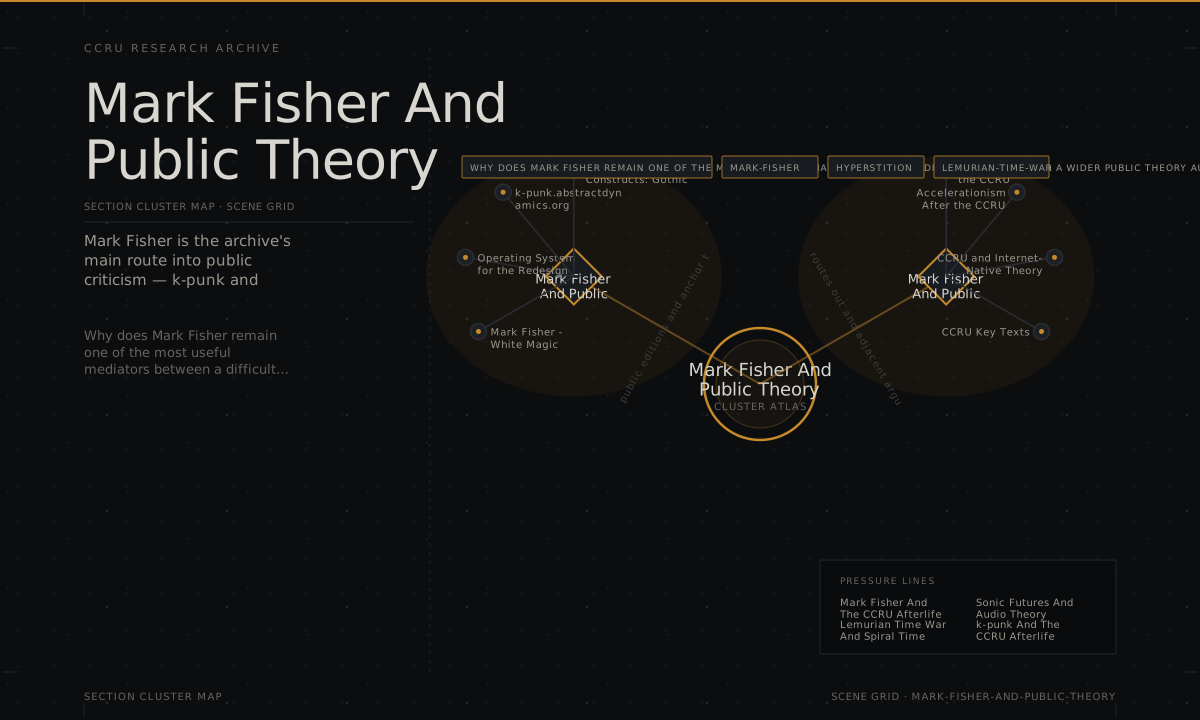
Mark Fisher is the archive's main route into public criticism — k-punk and Capitalist Realism translated CCRU vocabulary into blogs, music writing, and political theory without thinning it.
Core argument
Public theory is one of the archive's main afterlife mechanisms. It shows how difficult material remained active without staying confined to specialist circles.
Fisher's role is translational rather than merely biographical. He helps clarify what changed when archive motifs entered blog culture and cultural criticism.
Worked examples
These named texts, talks, sites, and records show where the argument becomes concrete.
Mark Fisher And The CCRU Afterlife Guide
Start with "Mark Fisher And The CCRU Afterlife" if you want the wider frame before dropping into Mark Fisher And Public Theory.
Mark Fisher Person
"Mark Fisher" is one of the clearest figures for the pressures gathered inside Mark Fisher And Public Theory.
Hyperstition Concept
"Hyperstition" names one recurring problem inside Mark Fisher And Public Theory.
k-punk Home Record
"k-punk Home" is a checkpoint where Mark Fisher And Public Theory stops sounding abstract.
Ghost Lemurs Of Madagascar Record
"Ghost Lemurs Of Madagascar" is a checkpoint where Mark Fisher And Public Theory stops sounding abstract.
Common misreadings
These are the recurring simplifications, exaggerations, and misreadings that make the subject look flatter than it is.
- Fisher's public clarity replaces the archive.
It translates parts of the archive into a new register, but it does not exhaust the original scene.
Significance
This section matters because many readers encounter the CCRU through Fisher first. Public theory is therefore one of the archive's major entry infrastructures.
Themes
- mark fisher
- public theory
- k-punk
- eerie
- afterlife
Where this section sits in the archive
The blog k-punk ran from 2003 until Fisher's death in 2017, and *K-Punk: The Collected and Unpublished Writings* (Repeater, 2018) compiles roughly a thousand pages of what that daily practice produced. The temptation is to treat the blog as a delivery vehicle — CCRU ideas repackaged for a wider readership. That gets the direction of causation wrong. The blog form, with its speed, its capacity to metabolize a Burial track or a Big Brother episode in the same register as Spinoza, is itself the theoretical work. Fisher did not have a theory he then blogged. He had a blog, and the theory happened there.
Sources by cluster
These mini-clusters widen the section through named works and support traces rather than through adjacent keywords alone.
Section source cluster
Mark Fisher And Public Theory: public editions and anchor texts
Anchor editions: Ccru - Occultures (Divus) (2012); Mark Fisher - White Magic; k-punk.abstractdynamics.org (archived homepage).
Work
Ccru - Occultures (Divus) (2012)
A later republication of the occultures line that shows how lemurian motifs persisted into the archive's afterlife without losing their recursive charge. A later republication of the occultures line that shows how lem...
Work
A key Fisher page on confinement, flight, and propagation, showing how occult vocabulary becomes a public theory of communication and escape. A prisoner writes letters. A pirate station broadcasts from a trawler outsi...
Work
k-punk.abstractdynamics.org (archived homepage)
The archived k-punk homepage shows how Fisher translated CCRU-adjacent motifs into a public critical culture organized around politics, pedagogy, and serial blogging. The domain itself carries the argument: k-punk.abs...
Work
Operating System for the Redesign of Sonic Reality
A landmark Kodwo Eshun chapter that insists sound must be treated as conceptual machinery rather than as a mute supplement to criticism. A landmark Kodwo Eshun chapter that insists sound must be treated as conceptual...
Work
Negarestani - Labor of the Inhuman Part 2
The continuation of Labor of the Inhuman, extending Negarestani's constructive account of revision, normativity, and the remaking of the human. The continuation of Labor of the Inhuman, extending Negarestani's constru...
Work
Section source cluster
Mark Fisher And Public Theory: routes out and adjacent arguments
Adjacent routes: Mark Fisher and the CCRU; What Was the CCRU?; CCRU Timeline.
Guide
Mark Fisher is one of the best ways into the CCRU because he translated difficult archive motifs into public criticism about culture, mood, work, music, media, and political feeling. He does not stand at the archive's...
Guide
The Cybernetic Culture Research Unit, or CCRU, was a loose research formation that emerged around Warwick in the 1990s and then persisted through texts, events, recordings, websites, and arguments long after its origi...
Guide
The fastest way to make the CCRU less mystical is to put it back into time. Most readers do not meet the Cybernetic Culture Research Unit at Warwick in the mid-1990s. They meet it through Mark Fisher, k-punk, Nick Lan...
Guide
Accelerationism After the CCRU
Accelerationism is one of the most public labels attached to the CCRU, but it is not the archive's secret essence. The more accurate starting point is that accelerationism is a later umbrella term that gathered togeth...
Guide
If you want to start the CCRU well, begin with one clear scene map, then take one bridge route, then move into a small number of named sources with that context in place. A good first session might mean What Was the C...
Guide
The reason people search for a “CCRU glossary” is obvious once you spend time with the material itself. Its vocabulary is part of the attraction and part of the barrier. Hyperstition, numogram, accelerationism, geotra...
Texts in this section
30 classified works grouped into 3 editorial subclusters. Reviewed: 21; needs review: 9.
k-punk and public criticism 25 works
- 170414 The Fisher-Function.indd
- Alien Rhythms
- Ccru - Syzygy Conversation between Mark Fisher & Steve Goodman 24 11 98 Sonicwarfare
- Mark Fisher - Capitalist Realism and Neoliberal Hegemony; A Dialogue
- Mark Fisher - White Magic
- Mark Fisher Memorial
- Mark Fisher; Capitalist Realism Is There No Alternative - BLACKOUT ((poetry & politics))
- mark-fisher-a-critique-of-practical-nihilism-agency-in-scott-bakkers-neuropath
- mark-fisher-baroque-sunbursts
- mark-fisher-exiting-the-vampire-castle-1
- mark-fisher-hommeostasis
- mark-fisher-what-is-hauntology-3
- nyx-a-noctournal-nyx-a-noctournal-issue-6-monsters
- Post-Capitalist Desire
- ReynoldsRetro D-Generation - or, the dawn of K-Punk
- suzzane livingston dazed fisher co
- The Fisher-Function - Robin Mackay
- To Wish Impossible Things; On Mark Fisher's Ab-joy (After All)
- Annihilism abstractNeeds editorial review
- Fisher - Mindgames (Dazed and Confused 2011)Needs editorial review
- Fisher - Terminator vs AvatarNeeds editorial review
- Fisher- At Home with TechNeeds editorial review
- For Your UnpleasureNeeds editorial review
- The Apocalyptic, Ancient and Modern - JacobiteNeeds editorial review
- The Genealogy of PoliticsNeeds editorial review
Hauntology, the eerie, and culture 3 works
- Fisher - Deja Vudu
- Fisher - White Magic (1998)
- matt-colquhoun-acid-communismNeeds editorial review
Fisher on CCRU, music, and politics 2 works
References
Records cited
These linked sources are the quickest way to test the argument against named materials rather than second-hand summary.
k-punk Home Record
"k-punk Home" is the first record to test the framing around Mark Fisher And Public Theory.
Ghost Lemurs Of Madagascar Record
"Ghost Lemurs Of Madagascar" is the first record to test the framing around Mark Fisher And Public Theory.
Ray Brassier Mad Black Deleuzianism Record
"Ray Brassier Mad Black Deleuzianism" is the first record to test the framing around Mark Fisher And Public Theory.
Mark Fisher And The CCRU Afterlife Guide
"Mark Fisher And The CCRU Afterlife" gives the larger argument around Mark Fisher And Public Theory before you widen sideways.
External references
Inherited outward references from the guides, exhibits, people, and concept pages that anchor this section cluster.