Translation as theoretical method
Capitalist Realism: Is There No Alternative? (Zer0 Books, 2009) is the cleanest demonstration. Jameson's thesis about the unimaginability of capitalism's end gets compressed into a tractable public-theory object that runs on concrete examples — call-centre labour, mental health as privatised pathology, children's films — rather than on citation density. The book is short because the argument had already been metabolised through years of blog writing; what looks like brevity is actually compression of a much larger digestive process. This is what the CCRU as a theoretical apparatus looks like when it's made to address a reader outside the scene.
Hauntology against nostalgia
Ghosts of My Life: Writings on Depression, Hauntology and Lost Futures (Zer0 Books, 2014) performs the same translation on a harder target. Derridean hauntology had existed as a specialist term; Fisher repurposed it to name a specific cultural condition — the slow cancellation of the future — and then tied that condition to concrete sonic and visual materials. The move worth naming: hauntology in Fisher is not about the past returning but about the felt absence of futures that were promised and withheld. That reframing makes the concept do diagnostic work. Burial, Ghost Box, the 70s public-information film: these are not nostalgia objects but evidence of a cultural time that has stopped producing new time.
The internal tension sits here, and it is best named as a disagreement Fisher has with himself. Simon Reynolds, Fisher's closest interlocutor on this terrain, reads the same material through retromania as a productive, if compromised, cultural recycling. Fisher's hauntology is less forgiving: it reads retromania as symptom, not practice. But the late acid-communism fragment reverses the pressure from the other side, treating hauntology itself as a trap Fisher needed to escape — a criticism that circles lost futures without generating new ones. That project did not survive into finished form, and the portrait has to hold this: Ghosts diagnoses brilliantly and also models the condition it diagnoses, which is why the late Fisher was trying to write his way out of his own earlier book.
What the translation cost
The standard misreading treats Fisher as the CCRU in clearer form — as if he had extracted the sober theoretical content and left the occult-numerical apparatus behind as embarrassing juvenilia. This gets the relation exactly wrong. The Lemurian materials, the numogram, the hyperstitional fictions, the para-academic infrastructures that produced Abstract Culture and the late-90s pamphlets — these are not ornament around a core of real theory. They are the production conditions of the vocabulary Fisher later translated. Capital as inhuman system, culture as libidinal circuitry, time as non-linear — these concepts were forged in the scene Fisher's books do not, and cannot, reproduce in miniature.
So the translation has a cost, and the portrait has to name it. Fisher's public-facing work gained readers at the price of the archive's harder textures. The numerical experiments, the collaborative fiction, the refusal of authorial signature — none of these survive into the books in any literal form. They persist only as the pressure that gives the books their specific gravity. This is why Fisher is best understood as a bridge figure: he carries something across, and what he carries is not identical to what was on the other side. Readers who come to the CCRU through Fisher and expect to find Fisher writ occult are consistently disoriented by what they actually find.
The blog as collective organ
K-Punk: The Collected and Unpublished Writings (ed. Darren Ambrose, Repeater, 2018) is the document where the method is most visible because it is least edited into book-shape. The blog form, for Fisher, was not a lesser venue than the book; it was the native medium of a criticism that needed to respond in near-real-time to cultural events while also sustaining long-arc conceptual work. The specific intellectual move: treating the comment thread, the cross-blog argument, and the tag-based archive as a collective organ of theory-production. This inherits directly from CCRU's refusal of the single-author monograph as the proper unit of thought, but rebuilds it for a different infrastructure.
What this means for reception: Fisher is often read as a solo critic with exceptional reach, but the k-punk project only works because it was networked. Fisher's name sits alongside Simon Reynolds and Kodwo Eshun in the CCRU's own archived self-listing, and those adjacencies were not retrospective — they were the reading and writing ecology the blog ran inside. The collected volume makes this visible by virtue of its scale; no single post carries the argument, but the accumulation does. This is the shape CCRU's collective-authorship commitment takes when translated into public criticism: not anonymous group-signature, but a visible individual voice supported by an ecology that the books cannot fully represent.
The work as contribution
Fisher matters to the cluster because he proved that the CCRU's diagnostic vocabulary could operate outside the scene that produced it without being thinned into slogan. Capitalist realism, lost futures, the slow cancellation — these phrases now circulate in contexts that have no relation to the 1990s Warwick milieu, and they still carry analytic weight. That portability is the contribution. It is also the limit: portable concepts travel by shedding context, and the context they shed is precisely what the archive preserves. The portrait must hold both — the gain and the loss, the bridge and what the bridge cannot carry — rather than collapsing Fisher into either pure continuity with the CCRU or pure departure from it.
Deepest single document: Capitalist Realism: Is There No Alternative?.
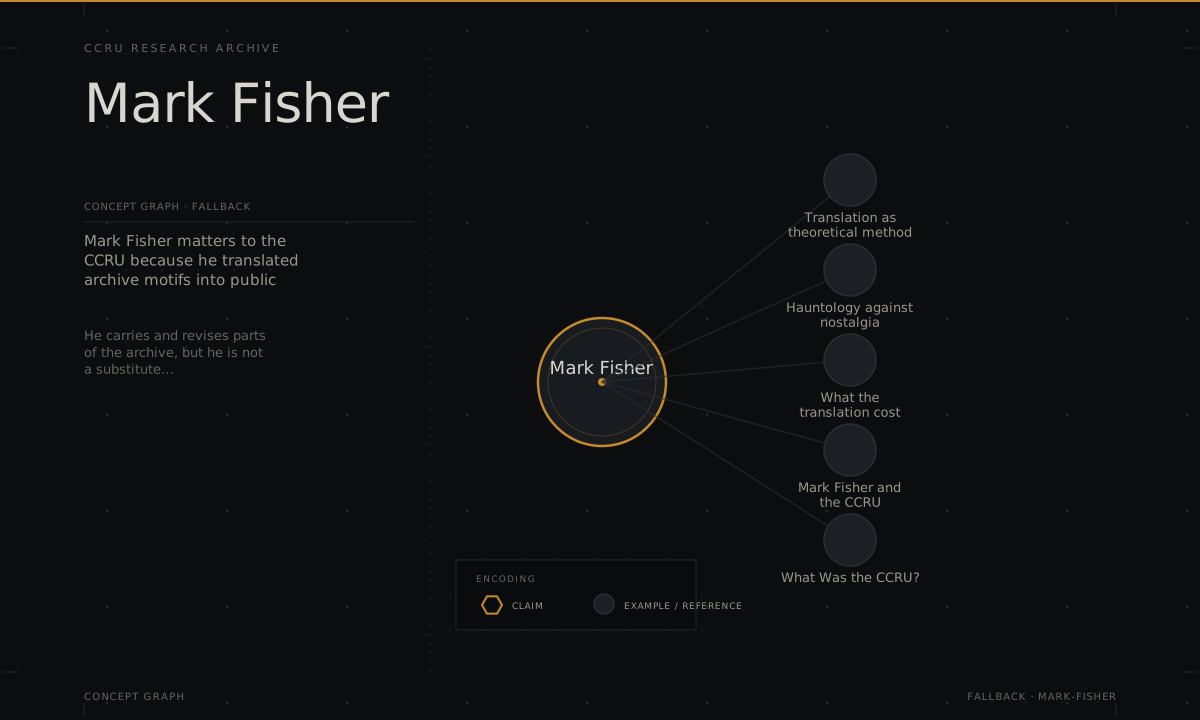
Mark Fisher matters to the CCRU because he translated archive motifs into public criticism about culture, media, labor, and collective feeling without simply repeating the original scene in miniature.
Core argument
Fisher is best understood as a bridge figure rather than as a replacement for the archive. That distinction keeps his clarity from swallowing the archive's wider plurality.
k-punk is part of the CCRU's public history. It shows how blog culture and criticism kept the archive moving and searchable.
Worked examples
These named texts, talks, sites, and records show where the argument becomes concrete.
k-punk Home Record
"k-punk Home" is a good checkpoint because it keeps Mark Fisher inside scene evidence rather than later reputation.
Ghost Lemurs Of Madagascar Record
"Ghost Lemurs Of Madagascar" is a good checkpoint because it keeps Mark Fisher inside scene evidence rather than later reputation.
Mark Fisher And The CCRU Afterlife Guide
"Mark Fisher And The CCRU Afterlife" widens Mark Fisher back into the larger CCRU field instead of treating the figure as self-explanatory.
Hyperstition Concept
"Hyperstition" names one recurring pressure that helps Mark Fisher make sense beyond biography alone.
Common misreadings
These are the recurring simplifications, exaggerations, and misreadings that make the subject look flatter than it is.
- Fisher is the CCRU in a clearer form.
He carries and revises parts of the archive, but he is not a substitute for the whole field.
Significance
Fisher remains one of the easiest and most compelling routes through which new readers rediscover the CCRU. He keeps the archive tied to ordinary cultural objects and public feeling instead of letting it harden into lore.
Stakes of this figure
Critic and theorist whose later writing helps contextualize the archive's cultural afterlife and translates difficult motifs into clearer public arguments.
Periodisation
- 1990s adjacency
- 2000s k-punk
- 2010s postcapitalist debates
Key works for entering the figure
- k-punk.abstractdynamics.org
- Mark Fisher vs. Nick Land featuring Nicholas Blincoe
- Ghost Lemurs of Madagascar
References
Records cited
These linked sources are the quickest way to test the argument against named materials rather than second-hand summary.
k-punk Home Record
"k-punk Home" ties Mark Fisher to a document, lecture, or interview you can actually test.
Ghost Lemurs Of Madagascar Record
"Ghost Lemurs Of Madagascar" ties Mark Fisher to a document, lecture, or interview you can actually test.
Ray Brassier Mad Black Deleuzianism Record
"Ray Brassier Mad Black Deleuzianism" ties Mark Fisher to a document, lecture, or interview you can actually test.
Mark Fisher And The CCRU Afterlife Guide
"Mark Fisher And The CCRU Afterlife" shows what changes once Mark Fisher is read comparatively rather than mythically.
External references
Stable outward routes for this figure: original sites, archived copies, and public relay surfaces worth keeping in view.