Start with the bass bin, not the footnote
The entry mistake, which this section is built to disarm, is to treat the music as decorative texture around real thinking. Read the other way, certain arguments about time, fear, and collective body become most legible through the audio; the prose pointing at them reads as secondary documentation. The strongest attested version of this claim is Goodman's own — that frequencies, vibrations, and rhythms are already doing conceptual work before any theorist glosses them. The weaker versions in this essay are mine.
Hyperdub as catalogue
Hyperdub functions in this cluster the way a small press functions elsewhere: a catalogue with an editorial line. Reading Kode9's label by catalogue number, by year, by which records cluster — Burial's 2006 and 2007 records, the early dubstep 12-inches around them, the later drift through footwork after the Chicago connection — is the move this section asks for. I am not producing a discography here; the load-bearing claim is only that the catalogue is worth reading as argument, and the reader who wants to test that can queue it up.
Whether Hyperdub and Sonic Warfare are tightly coupled — book glossing catalogue, catalogue instantiating book — or whether the records overflow the theoretical frame is a live question this essay does not resolve. What it insists on is the refusal to demote the audio to example.
Jungle, time, control
Jungle is the cluster's sharpest case of a sonic argument not fully available in prose. The breakbeat chopped, time-stretched, and re-pitched across mid-90s jungle is a live operation on tempo — a refusal to let rhythm settle into the regular grid that drum-machine pop and disciplinary timekeeping share. The CCRU's wider chronopolitics has a documentary instance in the datastream fragments where [Hyper-C treats conventional chronology as 'fake time'](raw::ccru-datastreams::68), engineering an 'anti-Gregorian Y2K positive occupation' and a 'counter-chronic program' against sequential causality. Read alongside the records, that counter-chronic program stops being only a manifesto and starts being describable as something a DJ cutting between two plates at 170 BPM is already doing.
This is where the common trap bites hardest. If you read the CCRU's writing on time without ever having heard the records it was written alongside, you get the diagram without the torque. The rhythm is doing work the prose cannot do alone: it is demonstrating, in the body of the listener, what it means for a tempo to refuse capture. Read this strand backwards — records first, then prose — and the theoretical texts stop sounding like science fiction and start sounding like liner notes.
Hauntology, audibly
Mark Fisher's Ghosts of My Life anchors the second axis of the cluster. The hauntology guide elsewhere in this archive handles Fisher's cultural diagnosis at length; this section's narrower job is the sonic one. The claim worth isolating here — and it is a claim worth testing against Fisher's pages rather than taking on my authority — is that hauntology is first a claim about specific production techniques. Sampled vinyl crackle, tape saturation, the audibly degraded loop, the echo that arrives before its source is resolved: these are the technical means by which a recording can be heard to contain its own absence. That is narrower than the cultural argument and is what this section adds to the hauntology guide rather than recapitulating it.
Where Goodman pushes toward affect, fear, and the weaponization of frequency, Fisher pulls toward loss, cancellation, and the recorded surface as séance. I will not claim the two resolve into a single position. A reader trying to force them into one will flatten what the section is actually mapping.
Soundsystem and collective body
Running under both Goodman and Fisher is the question of whose body sound organizes. Goodman's own lineage runs through Kodwo Eshun's Afrofuturist writing on sonic fiction and through Jamaican soundsystem practice; this is attested in Sonic Warfare's own references rather than in the retrieval set in front of me, and the reader should treat the claim accordingly. The concrete anchors are nameable: dub soundsystem culture in the Jamaican and London lineages, jungle's pirate-radio rave infrastructure in mid-90s London, and on Hyperdub itself the diasporic reach of artists like Burial, Cooly G, and Ikonika.
The claim the section asks you to hold is narrower than a politics: a soundsystem at volume assembles a collective body through frequency and duration rather than through argument, and the relevant archive for this is partly unwritten — pirate schedules, residencies, compilations. That is a limit of the bibliography, not a license for vagueness. The theoretical work is incomplete without the listening.
Afterlife and the wider drift
The cluster is also the main channel through which the archive has leaked into wider culture. More readers arrive at the CCRU through Burial, Hyperdub, or Fisher's blog than through any academic route. That demographic fact changes how the section should be used: it is often not an introduction but a reorientation for readers who already know the audio and are working backwards to the theoretical scaffolding.
If you have read the hauntology guide, treat it as an exit point and do not recapitulate it here; the other exits from this cluster — sonic warfare, rhythm as chronopolitics, soundsystem as collective body — remain open and under-mapped.
Where to go deepest
For a single document that holds the cluster's central wager — that sound is a theoretical operator, not an illustration — go to Sonic Warfare. Read it with the Hyperdub catalogue queued up. The book is designed to be read that way; reading it without the records is reading half the argument.
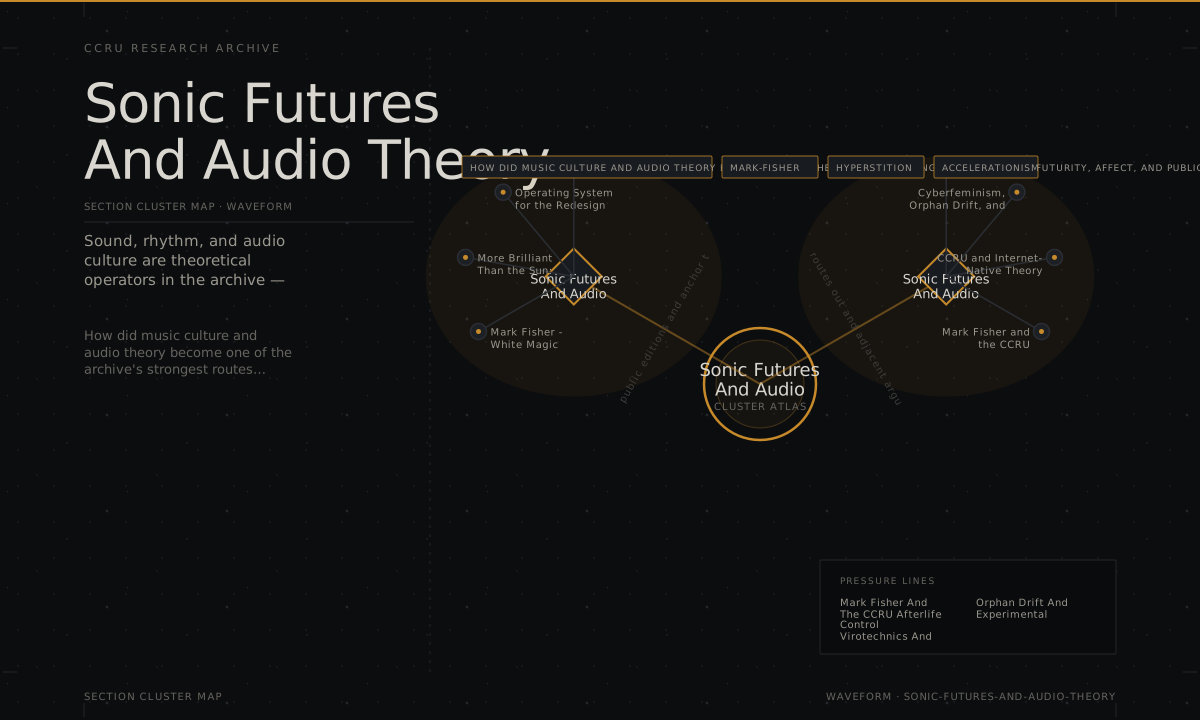
Sound, rhythm, and audio culture are theoretical operators in the archive — Hyperdub, jungle, and dubstep are read as arguments about time, control, and collective body.
Core argument
Sound is one of the archive's major thinking media. Music and rhythm often carry theory into public culture more effectively than abstract prose alone.
Audio culture helps explain the archive's wider afterlife. It connects the CCRU to scenes of listening, mood, and cultural criticism.
Worked examples
These named texts, talks, sites, and records show where the argument becomes concrete.
Mark Fisher And The CCRU Afterlife Guide
Start with "Mark Fisher And The CCRU Afterlife" if you want the wider frame before dropping into Sonic Futures And Audio Theory.
Mark Fisher Person
"Mark Fisher" is one of the clearest figures for the pressures gathered inside Sonic Futures And Audio Theory.
Hyperstition Concept
"Hyperstition" names one recurring problem inside Sonic Futures And Audio Theory.
k-punk Home Record
"k-punk Home" is a checkpoint where Sonic Futures And Audio Theory stops sounding abstract.
ccru.net Home Record
"ccru.net Home" is a checkpoint where Sonic Futures And Audio Theory stops sounding abstract.
Common misreadings
These are the recurring simplifications, exaggerations, and misreadings that make the subject look flatter than it is.
- Music references are decorative texture.
The section shows that sonic culture is part of the archive's method and circulation history.
Significance
This section matters because sound and mood are among the archive's strongest bridges into public theory and cultural experience.
Themes
- jungle
- hyperdub
- kodwo eshun
- kode9
- audio theory
Where this section sits in the archive
A dubplate at 140 BPM with the sub dropped an octave is not, in the reading this section proposes, an illustration of a theory the archive has worked out elsewhere in prose. It is the argument. When Steve Goodman writes Sonic Warfare: Sound under his Kode9 name while running his Hyperdub label catalogue (2004–) across the same decade, the two can be read as one operation — a proposition distributed across a book and a run of 12-inches. That is this essayist's framing, not a settled consensus. The cluster gathered under this section refuses the division between theoretical work and audio work.
Sources by cluster
These mini-clusters widen the section through named works and support traces rather than through adjacent keywords alone.
Section source cluster
Sonic Futures And Audio Theory: public editions and anchor texts
Anchor editions: k-punk Home; ccru.net Home; Negarestani Labor Of The Inhuman Part 1.
Section source cluster
Sonic Futures And Audio Theory: talks, captures, and support traces
Source traces: Atomization and Liberation; Plant - Coming Across the Future (1998); mark-fisher-what-is-hauntology-3.
Text page
Atomization and Liberation Vast Abrupt | 7 activity, the logical symmetry between fundamentally opposite conclusions regarding the good/bad, up/down, left/right movements of the world. Left-modernist metaphorics of ag...
Text page
Plant - Coming Across the Future (1998)
464 SADIE PLANT perspecti\re which cannot accept anv other relation (or, rather, can accePt nothing but relations). Masochism exceeds such relations with thc master; indeed it goes beyond ali relations, no mattcr hou....
Text page
mark-fisher-what-is-hauntology-3
the consumer present, together with a conspicuous use of digitally enabled technologies such as CGI. Yet this anx- ious insistence on the paraphernalia of the contemporary obfuscates the fact that the formal features...
Text page
reza-negarestani-nature-its-man-and-his-goat-enigmata-of-natural-and-cultural-chimeras
295 ChimerizationS HINGE Reza Negarestani Nature, its man and his goat (Enigmata of natural and cultural chimeras) juxtaposition but a configuration that gradationally unravels degrees of the horizon and alludes to ne...
Text page
Dancecult 7(2) 90 “call-and-response” of the black Atlantic (1993)—that communicative imaginary in which transactions take place across time and space through recordings and performances that activate collective enunc...
Text page
ABSTRACT This thesis uses Deleuzian cybernetics to advance upon post-modern accounts of the contemporary image economy. It begins with the hypothesis that the schizophrenic behaviours of late capitalism have induced a...
Section source cluster
Sonic Futures And Audio Theory: routes out and adjacent arguments
Adjacent routes: Mark Fisher And The CCRU Afterlife; What Was The CCRU; Mark Fisher.
Guide
Mark Fisher And The CCRU Afterlife
"Mark Fisher And The CCRU Afterlife" gives the wider argumentative frame around this section.
Guide
"What Was The CCRU" gives the wider argumentative frame around this section.
Person
"Mark Fisher" is one of the figures most closely bound up with this section's local problem.
Concept
"Hyperstition" names one of the recurring conceptual pressures inside this section.
Concept
"Accelerationism" names one of the recurring conceptual pressures inside this section.
Section
Control Virotechnics And Swarm Systems
"Control Virotechnics And Swarm Systems" is the neighboring cluster to open once this section's local pattern is visible.
Texts in this section
54 classified works grouped into 3 editorial subclusters. Reviewed: 27; needs review: 27.
Rave, jungle, and dance cultures 15 works
- 93-97 Rewind - Robin Mackay
- Back to the Future Technopolitics and the legacy of the CCRU
- Edmund Berger - Acceleration Now (or how we can stop fearing and learn to love chaos) Deterritorial Investigations
- factmag.com-Infinity is Now in defence of the hardcore continuum
- Music is the Message Jeff Mills Interviewed by Hari Kunzru
- Rebranding Garage The Dreem Teem (2001) - Riddim.ca
- The Philosophy of Jungle and New Breakcore Music From Rufige Kru to Machine Girl Blue Labyrinths
- Towards a Transcendental Deduction of Jungle (Interview) (Part 1) - Robin Macka
- Vague Post-Punk Memories
- Ccru Datastream 6 - Making a Killing on the NetNeeds editorial review
- LAND -- Origins of the Cthulhu ClubNeeds editorial review
- Philosophers' lslandsNeeds editorial review
- ReynoldsRetro You Remind Me of Gold Mark Fisher and Simon Reynolds dialogue about the state of dance music and the state of the future (2010)Needs editorial review
- tickdeliriumNeeds editorial review
- WRAP THESIS Goodman 1999Needs editorial review
Sonic warfare and affect 36 works
- A Question They Never Stop Asking
- Ccru Datastream 4 - A Scratch on the Vinyl of History
- extended JLS context
- On Vanishing Land
- Operating System for the Redesign of Sonic Reality
- Plant - Upward Mobility (Review) (Sight and Sound 1996)
- Rumours of War
- Screaming
- Some Excursions into Sonic Fiction - Mediamatic
- Sonic Warfare Review
- Sound and Concept
- The Militant Image; A Cine-Geography
- The Ontology of Vibrational Force
- Unsafe
- What the Dog brought in - by Zero Philosophy
- A Thousand RepsNeeds editorial review
- An Interview with Patricia CowingsNeeds editorial review
- Annihilism now!Needs editorial review
- Apocalypse - Been in Effect -Needs editorial review
- Code and Materiality Bouequet I MallarmeNeeds editorial review
- d377ff8bd7bbd68f99527807256c3d13Needs editorial review
- foxxNeeds editorial review
- Machine Sirens and Vocal IntelligenceNeeds editorial review
- Module 03 Lava RitesNeeds editorial review
- SISU Manifesto + User GuideNeeds editorial review
- Technoecologies of SensationNeeds editorial review
- The Algorithmic Poetics of @GlissantBotNeeds editorial review
- The Puzzle House (scraps) Dump 2 - by Zero PhilosophyNeeds editorial review
- The ThingNeeds editorial review
- Towards an Inhuman Critique of RepresentNeeds editorial review
- Twilight City; Outline for an archaeopsychic geography of New LondonNeeds editorial review
- Victims Themselves of a Close Encounter; On the Sensory Language and Bass Fiction of Space Ape (In Memoriam)Needs editorial review
- weblobdeathcult - newjoy - jacobreberNeeds editorial review
- weblobsterdeathcult - openingsequence - jacobreberNeeds editorial review
- wk1 theory-fictions and occult practicesNeeds editorial review
- Y7 Revisions of Heaven & Hell - Do Not ResearchNeeds editorial review
Audio technology and cultural form 3 works
References
Records cited
These linked sources are the quickest way to test the argument against named materials rather than second-hand summary.
k-punk Home Record
"k-punk Home" is the first record to test the framing around Sonic Futures And Audio Theory.
ccru.net Home Record
"ccru.net Home" is the first record to test the framing around Sonic Futures And Audio Theory.
Mark Fisher And The CCRU Afterlife Guide
"Mark Fisher And The CCRU Afterlife" gives the larger argument around Sonic Futures And Audio Theory before you widen sideways.
External references
Inherited outward references from the guides, exhibits, people, and concept pages that anchor this section cluster.