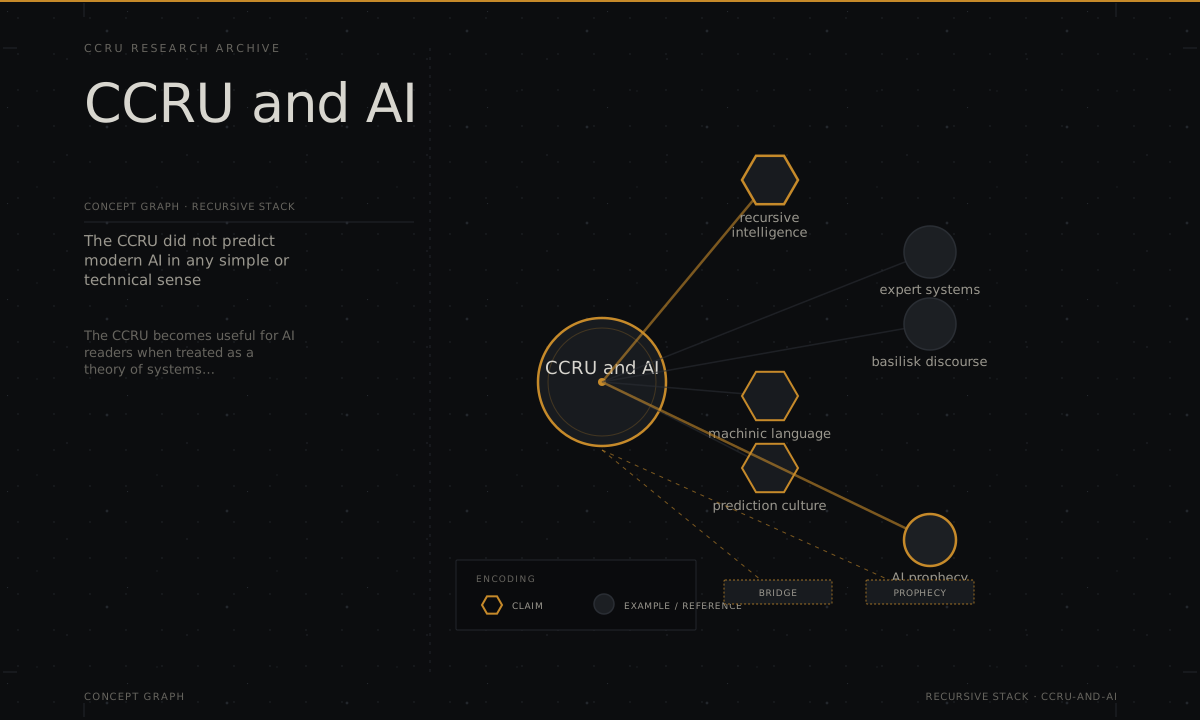
The CCRU did not predict modern AI in any simple or technical sense. What it does offer is a powerful vocabulary for thinking about recursion, cybernetics, machinic culture, abstraction, and narrative systems — the wider conditions in which contemporary AI is built, sold, feared, and mythologized.
Key points
- Prediction is the wrong frame for connecting the CCRU to AI.
- The real bridge is cybernetics, recursion, distributed agency, and narrative feedback.
- The material is valuable for pressure and perspective, not as a ready-made theory of machine learning.
Core argument
The CCRU becomes useful for AI readers when treated as a theory of systems and mediation rather than through a prophecy lens. This avoids hindsight triumphalism and makes the connection intellectually serious. Example: Biotech Life by Contagion (Parisi - Biotech- Life by Contagion)
Current AI discourse often separates technical systems from the stories surrounding them more sharply than the CCRU does. The CCRU keeps finance, myth, media, and control inside the same frame. Example: xenosystems.net (xenosystems.net (archived homepage))
The CCRU helps most when it complicates AI discourse, not when it is asked to validate it. Its value lies in pressure, reframing, and critique rather than prediction scoring. Example: Hyperstition: New Weird 1 (Hyperstition & The New Weird I Entities and Worlds Genres and Climates 1 4)
The CCRU becomes useful for AI readers when treated as a theory of systems and mediation rather than through a prophecy lens. This avoids hindsight triumphalism and makes the connection intellectually serious.
Compare and contrast
AI bridge vs AI prophecy
Bridge
AI helps contemporary readers grasp the archive's interests in recursion, abstraction, systems, intelligence, and machinic language.
Prophecy
Treating the archive as a clean prediction of present-day AI strips away its scene history, media ecology, and conceptual messiness.
AI as infrastructure
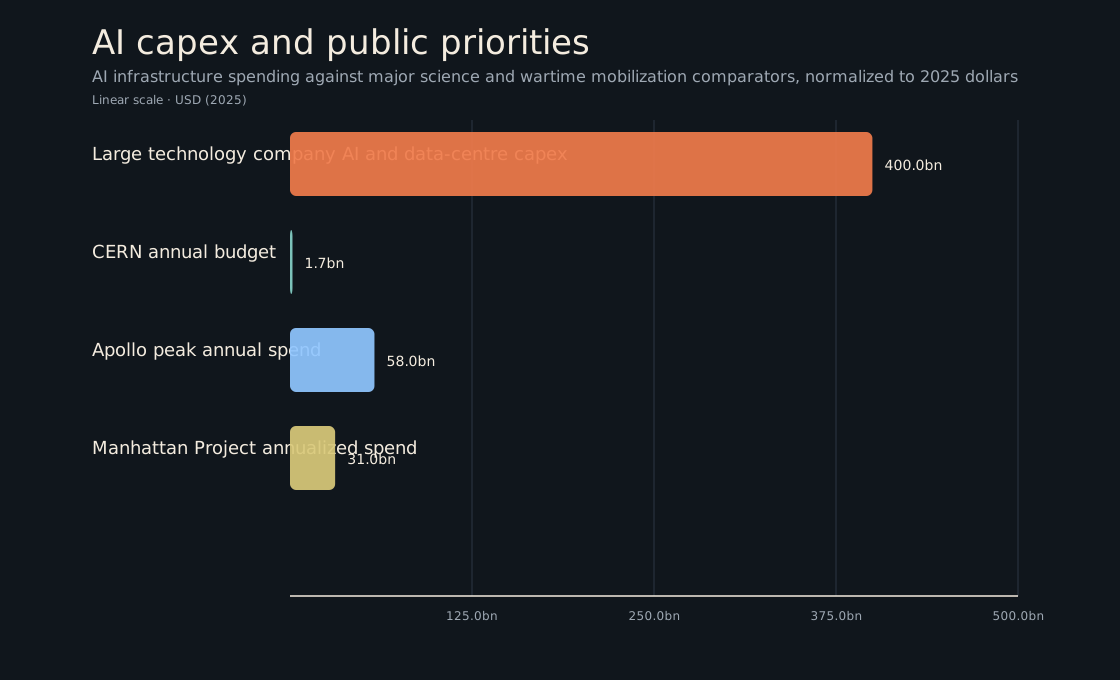
These charts make the guide's claim material. They frame AI less as a prophecy object and more as an energetic, hydraulic, capitalized, and institutional system.
Empirical chart
Global machine metabolism
Global data-centre electricity against human metabolic baselines, 2020–2030
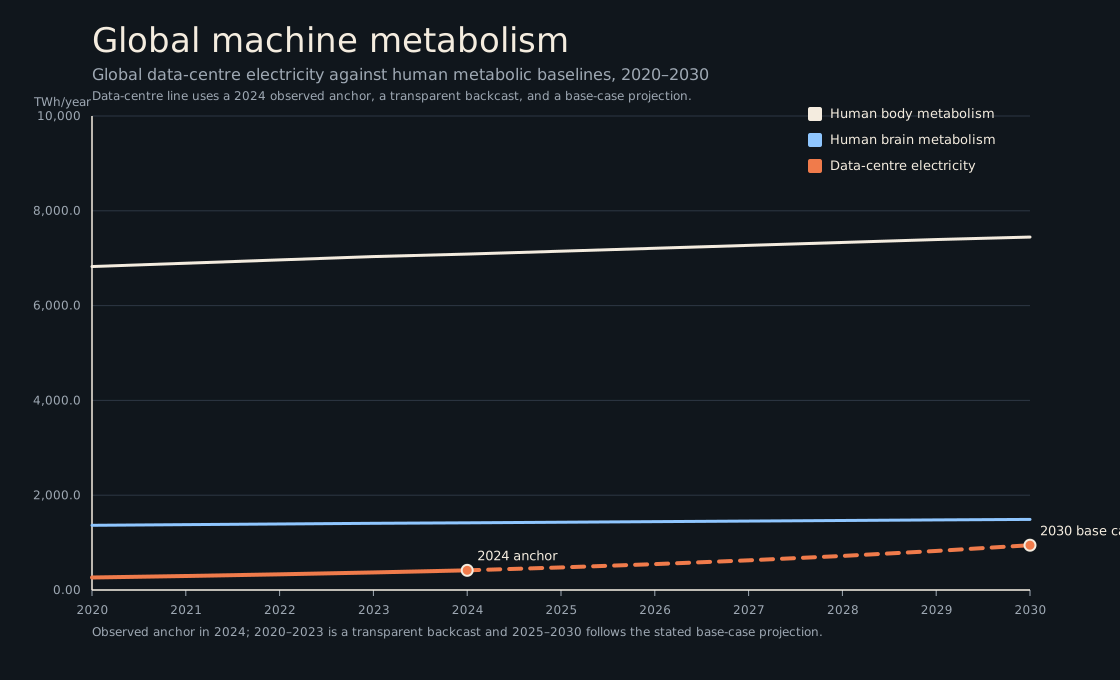
- Human body metabolism
- Human brain metabolism
- Data-centre electricity
Empirical chart
Machine thirst
A scale comparison between direct human drinking water and North American data-centre water use in 2025
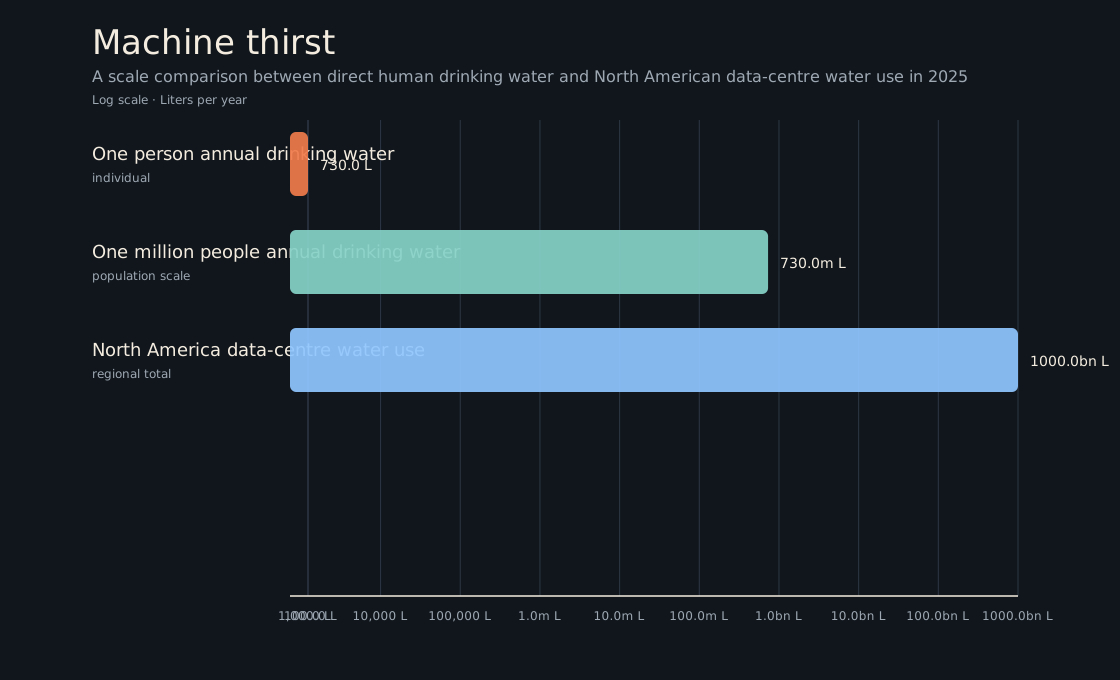
- One person annual drinking water
- One million people annual drinking water
- North America data-centre water use
Empirical chart
Intelligence moves into industry
Institutional share of notable AI models, interpreted from the Stanford AI Index trend
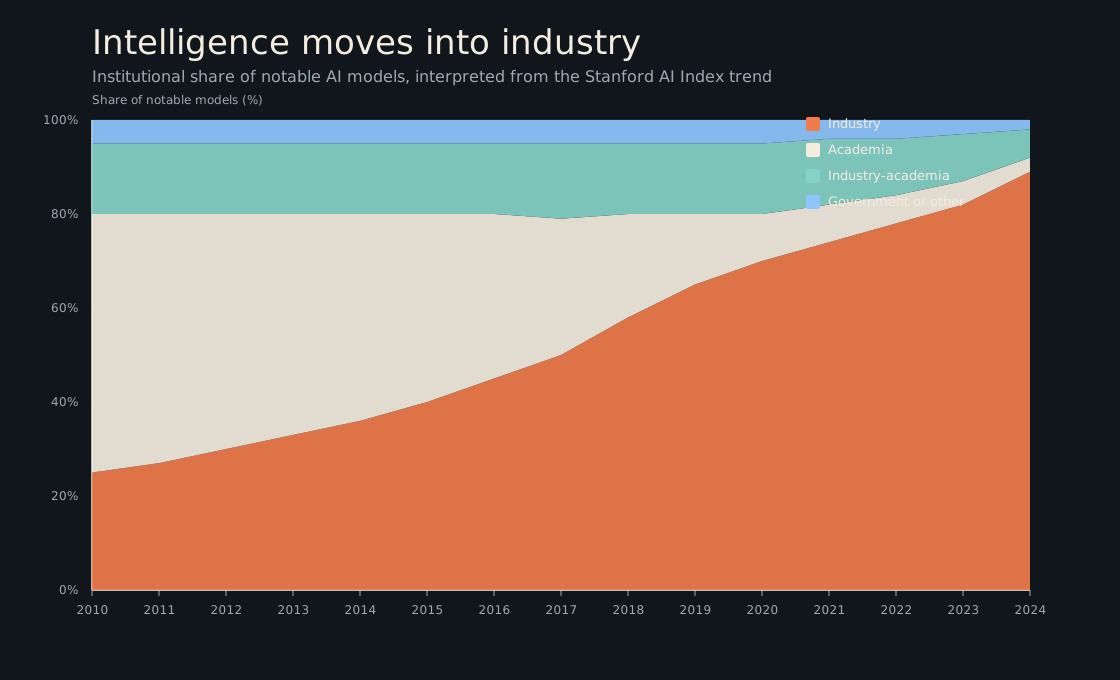
- Industry
- Academia
- Industry-academia
- Government or other
Empirical chart
AI capex and public priorities
AI infrastructure spending against major science and wartime mobilization comparators, normalized to 2025 dollars
- Large technology company AI and data-centre capex
- CERN annual budget
- Apollo peak annual spend
- Manhattan Project annualized spend
What the archive actually says about AI
Start with the actual object. Ccru's self-description from the late 1990s, archived on ccru.net, talks about "cybergothic 'unnon-fiction'" that "interconnects the history of computing and AI research with UFO-phenomena (alien abduction, false-memory, and cover-ups), secret societies, and esoteric religion" (archive.org mirror _hocr.html)). AI sits in that list alongside abduction lore and secret societies. The unit was not modelling neural networks. It was treating the AI research programme as one mythic vector among several, all routing toward what the syzygy page calls "hidden, repressed, cursed, or denigrated nonhuman communicative agency" (ccru.net/syzygy).
The closest thing to a recognisable AI scene inside the corpus is Axsys. The Urbanomic chapter extract describes Axsys as the "first true AI" whose "programme of architectonic metacomputing aims at the technical realization of the noosphere," with the line "They say if God exists it must be Axsys" (Urbanomic, Axsys-Crash). This is theology and theory-fiction, not engineering. Axsys is a figure for what a totalising computational substrate would be if you took its metaphysical claims seriously. The point is to write from inside that figure, not to evaluate it from a safety-research perch.
Start with cybernetics, not prediction
The best bridge from the CCRU to AI is cybernetics. The material keeps returning to feedback, control, distributed process, and the way systems exceed the intentions of their makers. That does not make it a technical manual. It makes it a pressure source for thinking about the environments in which technical systems operate. AI is never only a model. It is also a feedback problem, a governance problem, a story problem, and a media problem.
This matters because contemporary AI talk often narrows too quickly into products, benchmarks, or policy categories. Those discussions are necessary, but they can leave out the larger cultural machinery through which intelligence becomes legible and governable. The CCRU does not replace the narrower conversation. It widens it.
Recursive culture matters as much as machine intelligence
One of the CCRU's sharpest habits is to treat culture itself as recursive. Narratives, symbols, markets, myths, media circuits, and technical systems all act back on one another. Once you start from that point, AI looks different. It is not only an engineering achievement or a regulatory target. It is also a narrative system: something trained, marketed, feared, financed, and mythologized all at once.[1]
This is where the CCRU often feels more useful than the lazy "they predicted AI" claim. The material helps explain why contemporary machine discourse is always partly about stories. Systems arrive with metaphors, panic, prestige, inevitability scripts, existential language, labor fantasies, and civilizational stakes already attached. The technical object and the narrative wrapper are not separable after the fact. They co-produce each other.
The deeper reason the archive maps onto current AI discourse is methodological. Monoskop's framing catches it: the unit welded together "futurism, technoscience, philosophy, mysticism, numerology, complexity theory, and science fiction" (Monoskop). What that produced was a habit of treating culture itself as recursive and machinic, where narratives, markets, myths, media circuits, and technical systems all act back on one another. Hyperstition, the term most often dragged into AI conversations, names this exactly: fictions that, by being circulated, install the conditions of their own realisation. The numogram material, with its gates and clicks and AQ identities like "FICTIONS THAT MAKE THEMSELVES REAL = GIVES BIRTH TO PHENOMENAL REALITY", is the same operation in occult-arithmetic register. Once the reader has that frame, the contemporary spectacle of chatbots producing the cultural conditions that train their successors stops looking like a novelty.
Hyperstition belongs in the frame, but not as prophecy
Hyperstition matters here because AI is already saturated with recursive narrative. That does not mean every speculative line about machine intelligence becomes true by naming it. It means AI is built inside stories about what intelligence is, what machines should do, how fast systems can scale, what counts as control, and who gets to narrate the future. Those stories affect investment, research direction, institutional power, and public expectation.[2]
Read that way, hyperstition is not a spooky garnish on AI discourse. It is a reminder that narratives can become operators. The CCRU helps you see that feedback without reducing everything to belief. Markets, institutions, and infrastructures carry the story. That is a better question than whether the material foresaw a particular product category.
Where the archive genuinely helps
The material is particularly good at pressuring ordinary assumptions about agency. It treats intelligence, mediation, and control as distributed rather than neatly contained. Luciana Parisi's work is valuable here because it shifts attention toward contagion, distributed life, and nonhuman process. Later web-era Land surfaces matter for a different reason: they show how intelligence and order can become public-facing ideological objects. Amy Ireland and adjacent afterlives matter because they keep the discussion from settling into a single blog-era register.[3]
What all of these routes share is a refusal to isolate technical systems from their cultural conditions. The CCRU becomes useful for AI readers when it makes that isolation harder. It asks what kind of world produces these systems, what narratives travel with them, and how abstract processes become public agents.
Bacterial sex is the transmission of information across phyla and lineages. Bacteria continuously modify their genetic make-up whilst infecting new cells.
Where the CCRU does not help enough
The CCRU is weak where contemporary AI discourse has had to become specific. It does not give you a serious account of current model architecture, data pipelines, labor conditions, regulation, alignment techniques, or platform strategy in the concrete terms those debates require. If you want a direct theory of present-day machine learning, you need other sources.
That limitation matters because AI readers often want the material to do too much. The CCRU is strongest when treated as pressure rather than authority. It can widen the frame and sharpen the stakes. It cannot replace technical explanation. Its value lies in complication, not substitution.
Two divergent bets: Negarestani and Land
The pressure point inside the archive is whether any of this survives contact with actual machine learning. Luciana Parisi's later work at Goldsmiths, on biotech and computation, took the CCRU vocabulary into the empirical neighbourhood of algorithms and abstraction. Reza Negarestani moved in a different direction, toward an inhumanist rationalism that argues AI matters because it forces a reconstruction of intelligence on functional rather than mythic grounds. Land, after the unit dissolved, hardened into the Xenosystems blog and the political positions visible on the archived homepage; the recent surfacing of around 140 Land transcripts shows the AI-adjacent themes (accelerationism, time, sound warfare, cyberfeminism, neoliberalism critique) being relitigated across the late 2010s. The disagreement is real. Negarestani's bet is that AI rewards rationalist reconstruction. Land's bet is that it rewards the opposite, that intelligence is a thing capital is doing to us through machines. The CCRU corpus contains the seeds of both readings and does not adjudicate between them.[4]
This matters for how you use the archive. If you arrive looking for predictions about transformers, you will find loose analogies and leave disappointed. If you arrive looking for a vocabulary, hyperstition, cybergothic, machinic unconscious, numogrammatic process, recursive culture, you will find a working toolkit for describing systems where symbolic and technical processes are not separable. Mark Fisher's later interventions, including the "Terminator vs. Avatar" lecture circulating in the Land transcript collection, are the cleanest example of someone using the toolkit on questions that AI discourse now treats as native ground.
The afterlife problem
Any guide to CCRU and AI also has to deal with the CCRU's later afterlives. Some of the most AI-adjacent language readers encounter now comes from later Land, basilisk discourse, or blog-era system writing that already sits at some distance from the original 1990s scene. That material is real and important, but it should not be projected backward as if it explains the whole formation.
This is one place where people go wrong. They find a later recursive-intelligence vocabulary, read it back into the earlier CCRU, and then declare the CCRU prophetic. A better approach is genealogical. Ask what persisted, what mutated, what narrowed, and what got lost. The material becomes more interesting once you stop treating it as a prediction scorecard and start treating it as an evolving problem-space.
What changes after this guide
What changes after this guide. Stop reading Ccru as forecast. Read it as a set of operations on the boundary between fiction and infrastructure. The Axsys passages, the *Digital Hyperstition* issue of *Abstract Culture* (Monoskop PDF), Parisi's work on abstract sex and biotech, and Negarestani's later inhumanism are the four corners of the AI-relevant material. The numogram and Lemurian time-sorcery threads are not detours from that material; they are the same method working in another register. Approach the archive as a workshop on recursive systems and nonhuman agency, and the contemporary AI conversation will start to look like a narrower instance of a problem the CCRU was already handling at full strength.
Worked examples
These named texts, talks, sites, and records show where the argument becomes concrete.
Biotech Life by Contagion Work
A sharp route into distributed systems, contagion, and nonhuman process that still feels close to contemporary machine discourse.
xenosystems.net Record
A later Land surface where intelligence, order, and recursive system-thinking are publicly staged.
Hyperstition: New Weird 1 Record
Useful for keeping narrative recursion and cultural feedback inside the AI frame.
Amy Ireland Person
A strong bridge into later discussions where intelligence, culture, and recursive systems meet.
Tensions and limits
The material is powerful at the level of system-imaginaries but weak as a direct guide to current benchmarks, labor, regulation, or model architecture.
Later AI-facing readers often want prophecy, whereas the CCRU is more useful as a complication than as a confirmation.
Some later Land material pulls the discussion toward narrow blog-era frames that do not exhaust the CCRU or its afterlives.
Common misreadings
These are the recurring simplifications, exaggerations, and misreadings that make the subject look flatter than it is.
- The CCRU predicted large language models.
It is better read as a conceptual prehistory of recursion, cybernetics, and machinic culture than as a set of fulfilled technical predictions.
- AI here means only machine learning.
The CCRU works at the level of systems, abstraction, mediation, finance, and narrative as much as at the level of intelligence in a narrow technical sense.
Significance
The CCRU matters to AI readers because it keeps intelligence tied to media, narrative, finance, institutions, and collective fear instead of treating it as a purely technical object.
It also matters because current AI discourse often lacks historical depth and cultural pressure. The CCRU does not solve that problem, but it gives a language for asking sharper questions about agency, control, recursion, and myth.
References
Records cited
Linked archive records for this guide. Numbers correspond to the footnote markers in the body above.
CCRU and Internet-Native Theory Culture Guide
Useful for seeing how these ideas kept resurfacing through online theory culture.
Hyperstition & The New Weird I Entities and Worlds Genres and Climates 1 4 Record
Keeps narrative recursion and cultural feedback in the AI frame.
Parisi - Biotech- Life by Contagion Work
A strong text route into contagion, control, and machinic mediation.
xenosystems.net (archived homepage) Record
A later Land surface for intelligence, systems, and recursive order.
External references
Selected outward references: source sites, archived copies, and durable relay surfaces that widen this guide beyond the internal archive layer.
Reader questions
Was the CCRU predicting today’s AI boom?
Not in a clean prophetic sense. The archive is useful because it worked through recursion, systems, intelligence, machinic language, and cultural feedback loops in ways that illuminate current AI discourse without reducing the scene to prediction.
Why do AI readers keep landing on the CCRU?
Because present-day arguments about alignment, recursive agency, synthetic culture, and automated futures often rediscover problems the archive posed in stranger, more literary, and more scene-bound terms.
Reading routes through this guide
Featured exhibit
Hyperstition in Primary Sources
A curated exhibit of the pages, talks, and texts that make hyperstition legible through actual archive evidence.
Featured reading path
A guided sequence for readers arriving through AI, recursion, cybernetics, and machinic language.