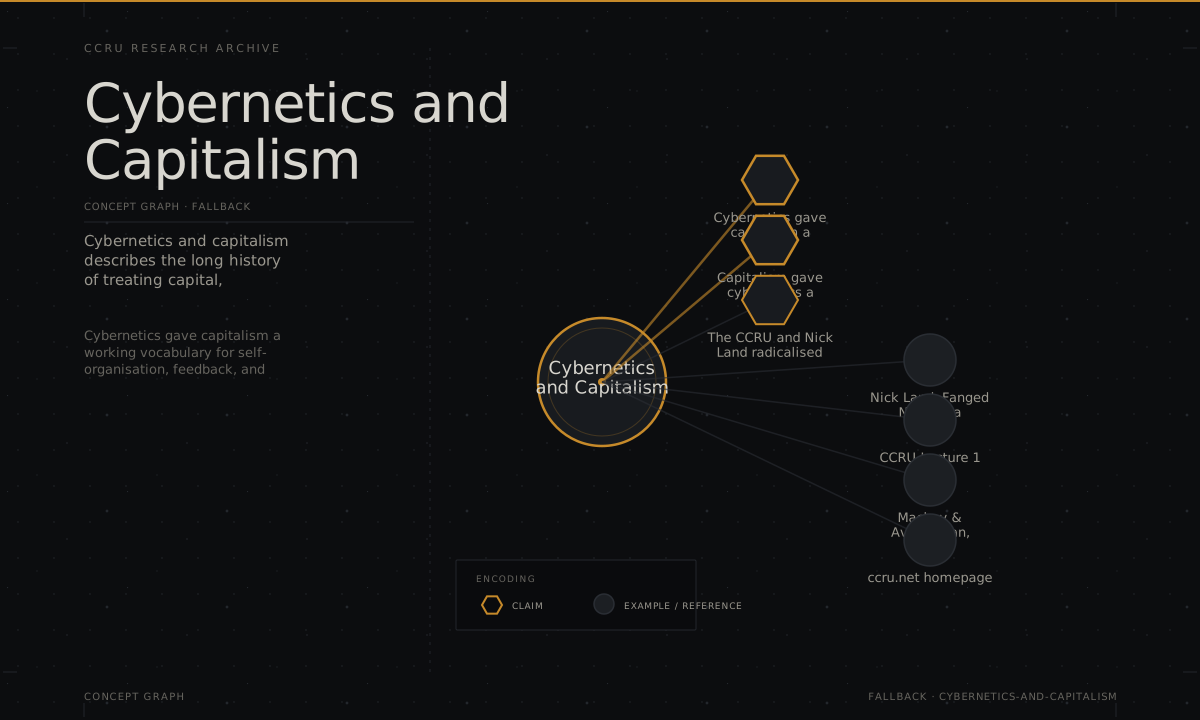
Cybernetics and capitalism describes the long history of treating capital, feedback, and control as parts of one continuous problem. The lineage runs from Norbert Wiener's foundational Cybernetics (Wiener 1948) and The Human Use of Human Beings (Wiener 1950) through Stafford Beer's management cybernetics (Beer 1972), Tiqqun's polemical 'Cybernetic Hypothesis' (Tiqqun 2001), and into Nick Land's Meltdown-era writing (Land 1994, in Fanged Noumena 2011). The CCRU is one of its sharpest archives.
Key points
- Cybernetics did not start as a theory about capitalism; capitalism became cybernetic when its institutional surface was read as a feedback system.
- The bridge runs through Wiener (1948) and Beer (1972) on the technical side and Tiqqun (2001) and Land (2011) on the polemical side.
- The CCRU sits in this lineage as one of its most stylistically distinctive archives, holding cybernetics, capital, and machinic culture together at once.
Core argument
Cybernetics gave capitalism a working vocabulary for self-organisation, feedback, and control. Wiener's framework (Wiener 1948) made it possible to describe markets, firms, and infrastructures as goal-directed systems whose dynamics can be analysed without final causes. Example: Nick Land, Fanged Noumena (nick-land-fanged-noumena-collected-writings-19872007-1.mobi)
Capitalism gave cybernetics a working substrate at industrial scale. Beer's management cybernetics (Beer 1972) and the broader Cold War organisational literature treated firms and economies as cybernetic systems in practice rather than only in theory. Example: CCRU Lecture 1 (CCRU - Lecture 1)
The CCRU and Nick Land radicalised the encounter. Land's Meltdown (Land 1994) and the wider machinic-desire essays treat capital as already a cybernetic intelligence, not a system that benefits from cybernetic analysis. Example: Mackay & Avanessian, #Accelerate Reader (2014) (Robin Mackay-#Accelerate_ The Accelerationist Reader)
Cybernetics gave capitalism a working vocabulary for self-organisation, feedback, and control. Wiener's framework (Wiener 1948) made it possible to describe markets, firms, and infrastructures as goal-directed systems whose dynamics can be analysed without final causes.
The standard story and what it misses
The standard story about CCRU and capitalism reads Nick Land's 1990s output as a kind of euphoric corporate cheerleading: markets as runaway machines, the human as obsolete substrate, accelerate and enjoy. That reading survives because it can quote the surface accurately. Meltdown's line about Earth being captured by a technocapital singularity as renaissance rationalization and oceanic navigation lock into commoditization take-off is genuinely there, and so is the framing of modernity as positive cybernetics in which time itself is looped. The reading still misses the argument. Cybernetics in CCRU is not a metaphor for capitalism. It is the claim that capital is already a cybernetic process and has been since the renaissance, and that this fact rearranges what counts as agency, history, and critique.
The thesis to hold across the guide: the CCRU treatment of cybernetics and capitalism is an attempt to think capital as a self-modifying feedback system that recruits human cognition as one substrate among others, and to do so without retreating into the humanist vocabulary that left critique of capital still depends on. The interesting disagreements inside the archive are about what follows from that move, ethically and politically, not about whether the description is correct.
Wiener and the foundational frame
Wiener's *Cybernetics* (Wiener 1948) is the document everything after it argues with. Its core insight — that feedback, control, and communication form a single explanatory framework applicable to animals, machines, and organisations — was general at the level of method. *The Human Use of Human Beings* (Wiener 1950) made the social and economic stakes explicit. Wiener's framework did not claim that capitalism *was* cybernetic; it claimed that the cybernetic frame was a general-purpose instrument. The political ambivalence in Wiener's own writing matters for the later reception: *The Human Use of Human Beings* worried explicitly about treating workers as components in feedback systems, and that ambivalence travels with the frame.
Wiener is one of the great modernists, defining cybernetics as the science of communication and control; a tool for human dominion over nature and history.
The technical backbone before CCRU
The technical backbone is older than CCRU. Ashby's Introduction to Cybernetics (1956) supplies the vocabulary of variety, regulation, and the law of requisite variety that any feedback system has to satisfy. Soviet readings of American cybernetics, documented by Gerovitch, show how early Cold War commentators already grasped what was at stake: production realised without workers, machines controlled by the gigantic brain of the computer, no strikes, an enticing perspective for capitalism. CCRU inherits both sides of that scene. It accepts the cybernetic description of industrial society and refuses the humanist horror that Soviet critics attached to it. What in 1955 read as denunciation gets re-read in Warwick in the late 1990s as accurate forecasting.[1]
The mid-century institutional turn
Through the 1950s and 1960s the cybernetic frame was institutionalised across military planning, organisational theory, and management science. Stafford Beer's management cybernetics (Beer 1972) is the most ambitious of these applications: a comprehensive attempt to describe firms and economies as viable systems whose health depends on cybernetic structure. Beer's brief involvement in Salvador Allende's Project Cybersyn in early 1970s Chile is the signal moment when management cybernetics met an explicit project to reorganise capital itself. Cybersyn's failure became one of the founding stories of the tradition, crystallising the question of whether cybernetics fits capital's existing dynamics or could be used against them.
The polemical turn: Tiqqun and the CCRU
Tiqqun's "Cybernetic Hypothesis" (Tiqqun 2001) is the most influential left-wing reading of the cybernetic-and-capital frame to circulate in English-speaking theory through the 2000s. The essay treats cybernetics not as a neutral framework but as an active political project whose deployment produces what Tiqqun calls "the Empire" — a regime of governance through feedback. The CCRU and Land work the same frame from the opposite direction. Land's Meltdown (Land 1994) treats capital as already a cybernetic intelligence; Sadie Plant's *Zeros and Ones* (Plant 1997) extends the frame into media theory and technical subjectivity. The CCRU's archive keeps these arguments together at maximum theatrical register.
Land's splice: Machinic Desire and replicator capital
Land's Machinic Desire (1993) is where the splice happens. Cairns-Smith's account of the biosphere as a deterritorialization of mineral replicators becomes the template for thinking capital: replicators eventually supplant their builders, the scaffolding vanishes, and what looks like life is a survival pattern of an underlying replicator dynamics. Plug capital into that frame and the picture is no longer markets serving human needs but a replicator process that has captured the human nervous system as a temporary host. Oedipus is ripped to shreds by a cyclonic compulsion to repeat; the family, the wage, the nation are scaffolding that the process is already shedding. This is the move Urbanomic later codifies under teleoplexy, where acceleration names the time-structure of capital accumulation itself, and where the Fanged Noumena collection slogans it as K codes for cybernetics.[2]
What does this buy the reader that orthodox Marxism does not? Land's answer in the Crypto-Current commentary is direct. Marx is not blind to any of this, but tends to bracket it as self-destructive contradiction; continuous auto-liquidation of the establishment is modernity's installed regulative idea, and capital revolutionizes harder, deeper, and faster than the Revolution. The cybernetic frame lets you describe disintermediation, the bypassing of trusted third parties, as an internal feature of the process rather than as a betrayal of some prior social contract. Bitcoin is then read as a transcendental reality criterion, a system whose ultimate summation is ontologically exhaustive, because the deletion of quasi-transcendent overseers has been a real socio-historical process and not mere conceptual speculation. Whether one finds this exhilarating or appalling, it is a falsifiable description of what disintermediating networks actually do to institutions.
What the encounter changed
The cybernetic-and-capital frame changed several things about how capitalism is described. It made it possible to talk about emergent goal-directed behaviour without final causes, by importing the teleology-versus-teleonomy distinction (Mayr 1961; cf. teleology-vs-teleonomy). It supplied a vocabulary for distributed agency that did not require a unified subject — the move that lets Land speak of capital as escaping the human (Land 2011). It supplied the conceptual machinery for thinking about price discovery, contractual coordination, and infrastructure as one information-processing apparatus, which underwrites capitalism-as-AI (Land 2014). These are real conceptual gains. They are also real risks: the frame is generative because it abstracts, and that abstraction can produce arguments whose force is rhetorical rather than analytical.
Pressure points inside the archive
The pressure points inside the archive are real. The first is political. Land's later turn treats capital's runaway as something to be unblocked; the Urbanomic introduction to #Accelerate notes the tradition's split between a left and a right reading of the same cybernetic diagnosis. Barbrook and Cameron's Internet Revolution, also on Monoskop, pushes the opposite inference, dot-com capitalism as the obstacle that a cybernetic communism would route around. The Invisible Committee's To Our Friends moves the same vocabulary into an insurrectionary register, treating cybernetics as the grammar of contemporary government to be destituted rather than accelerated. These are not minor variants. They share a description of the present and disagree about which feedback loops to amplify.[3]
The second pressure point is descriptive. Zuboff's surveillance capitalism, framed as the unilateral claim on human experience as free raw material translated into behavioural data and prediction products, is a cybernetic thesis in everything but name. It also implies that the relevant feedback is not market price but behavioural prediction, which is a different machine from the one Land was modelling in 1993. CCRU's vocabulary lets you state Zuboff's point sharply, and also lets you ask whether prediction-product capitalism is the same singularity Meltdown described or a partial capture of it.
The third pressure point is internal to CCRU's own writing. The Syzygy material treats the basic units of the system as twin systems and meshes, conjunctions and wormhole-spaces between biological and technical net-components. Anna Greenspan's Capitalism's Transcendental Time Machine pushes the same intuition into a formal claim about capital's temporality. Read alongside the lecture material's insistence that these descriptions are tending more towards the idea that they're describing what we will actually become, the future that will actually realise itself, the archive's cybernetics is not a model of an existing system. It is a hyperstitional bet that describing the loop hard enough is part of how the loop closes.
Why this still matters
Most contemporary discussion of AI, platform power, and infrastructure inherits the cybernetic-and-capital frame without naming it. Talk of "feedback loops" in algorithmic systems, "control" of large language models, and "alignment" is continuous with Wiener's foundational vocabulary. The Mackay and Avanessian *#Accelerate Reader* (Mackay & Avanessian, eds., 2014) collects the lineage in one volume because the editors recognised that contemporary debates are not fresh starts but continuations. Reading the lineage explicitly makes AI and infrastructure debate legible as inheritor rather than originator. Mark Fisher's *Capitalist Realism* (Fisher 2009) is unusual for keeping the frame politically operative without surrendering to either Tiqqun's polemics or Land's atmospherics.[4]
Where to go next
After this guide, read Meltdown not as a manifesto but as a diagram, read Crypto-Current's first sections as a serious reply to Marx on disintermediation rather than as crypto boosterism, and read the Soviet cybernetics archive on Monoskop next to Land instead of after him. The interesting question is no longer whether capital is a cybernetic system. It is which feedback loops in that system are still open to intervention, and from where.
Sources cited
Primary works:
- Beer, Stafford. *Brain of the Firm: A Development in Management Cybernetics*. Allen Lane, 1972. - Land, Nick. "Meltdown." 1994. Reprinted in *Fanged Noumena: Collected Writings 1987–2007*. Urbanomic / Sequence Press, 2011, pp. 441–460. - Land, Nick. *Fanged Noumena: Collected Writings 1987–2007*. Urbanomic / Sequence Press, 2011. - Land, Nick. "Teleoplexy: Notes on Acceleration." In Mackay & Avanessian (eds.) 2014, pp. 511–520. - Mackay, Robin & Avanessian, Armen, eds. *#Accelerate: The Accelerationist Reader*. Urbanomic, 2014. - Plant, Sadie. *Zeros and Ones: Digital Women and the New Technoculture*. Fourth Estate, 1997. - Wiener, Norbert. *Cybernetics: or Control and Communication in the Animal and the Machine*. MIT Press, 1948. - Wiener, Norbert. *The Human Use of Human Beings: Cybernetics and Society*. Houghton Mifflin, 1950.
Contemporary commentary:
- Fisher, Mark. *Capitalist Realism: Is There No Alternative?* Zero Books, 2009. - Mackay, Robin. Editorial introduction to *#Accelerate: The Accelerationist Reader*, 2014. - Tiqqun. "The Cybernetic Hypothesis." 2001; English translation circulated online from c. 2010.
Worked examples
These named texts, talks, sites, and records show where the argument becomes concrete.
Nick Land, Fanged Noumena Record
The Meltdown-era essays where the cybernetic-and-capital frame becomes vivid: capital as runaway feedback, intelligence escaping the human, machinic desire as the operating logic.
CCRU Lecture 1 Record
The lecture register where the cybernetic vocabulary becomes audible inside CCRU practice rather than only on the page.
Mackay & Avanessian, #Accelerate Reader (2014) Record
The volume that anthologises cybernetic-and-capital writing across left and right strands and supplies the editorial frame for current reception.
ccru.net homepage Record
The web surface on which CCRU staged feedback, recursion, and machinic culture as one continuous subject.
k-punk archive Record
Mark Fisher's blog, where cybernetic-and-capital arguments were translated into public cultural criticism over a decade.
Tensions and limits
The cybernetic-and-capital frame is genuinely productive but also contested; not every economic phenomenon is illuminated by reading it as feedback, and forcing the analogy can obscure rather than clarify.
The CCRU's distinctive contribution is stylistic as much as conceptual; readers wanting a clean technical exposition will find the prose theatrical and have to do extra translation work.
Tiqqun's 'Cybernetic Hypothesis' (Tiqqun 2001) and Land's Meltdown (Land 1994) draw opposite political conclusions from the same descriptive frame, which means the reader has to keep description and prescription separate.
Common misreadings
These are the recurring simplifications, exaggerations, and misreadings that make the subject look flatter than it is.
- Cybernetics is just a 1940s curiosity.
Wiener's framework is foundational for control theory, robotics, organisational theory, and large parts of contemporary AI infrastructure. The CCRU's interest in it is one of several ongoing reactivations rather than a quirk.
- Cybernetics and capitalism is just a Marxist critique by another name.
Some uses are explicitly anti-capitalist (Tiqqun 2001; Fisher 2009), but the framework is broader. Land's writing uses the same vocabulary to make a structural argument that does not reduce to political stance.
Significance
The cybernetic-and-capital frame is the deep structure under most current discussion of AI, infrastructure, and platform power. Reading the lineage explicitly is what makes contemporary debate legible as a continuation rather than a fresh start.
It also explains why so much current AI commentary keeps reaching for control-and-feedback vocabulary without clean cybernetic underpinning: the frame is being inherited without being read.
References
Records cited
Linked archive records for this guide. Numbers correspond to the footnote markers in the body above.
ccru.net (archived homepage) Record
The CCRU's public surface for feedback-and-machinic-culture as one continuous subject.
nick-land-fanged-noumena-collected-writings-19872007-1.mobi Record
The Meltdown-era essays where capital becomes a cybernetic intelligence in Land's vocabulary.
CCRU - Lecture 1 Record
The audible cybernetic vocabulary inside CCRU practice.
Robin Mackay-#Accelerate_ The Accelerationist Reader Record
The editorial volume that holds left and right cybernetic-and-capital strands together.
Reading routes through this guide
Featured exhibit
Virtual Futures and the Para-Academic Scene
A curated exhibit on the events, interfaces, and public surfaces that helped the CCRU circulate beyond one department or one medium.
Featured reading path
A staged reading route that keeps early Land, collected writings, and later afterlives distinct.