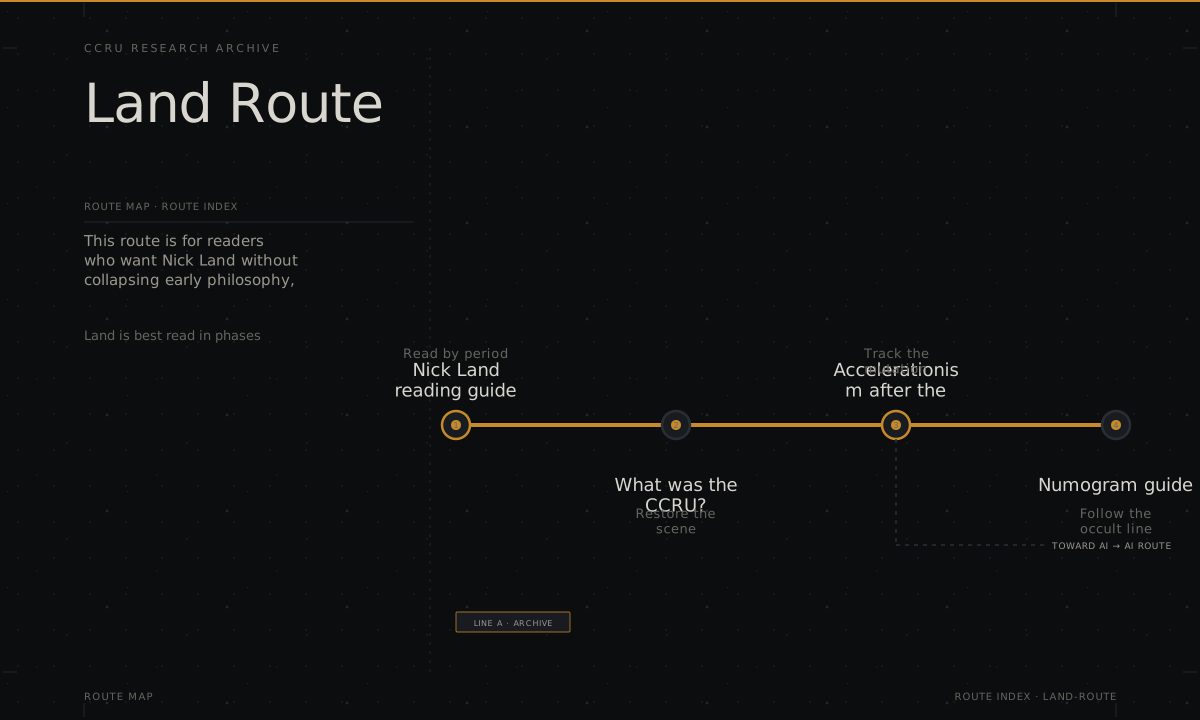
This route is for readers who want Nick Land without collapsing early philosophy, CCRU-era writing, collected material, and later notoriety into one image.
Route thesis
Land is best read in phases. This route works only if each phase stays historically visible and later notoriety is treated as one afterlife rather than the archive's secret essence.
How readers usually arrive
Most readers arrive at Land through the wrong door. They read a tweet, a 2010s blog post, or an accelerationist primer, and then open Fanged Noumena expecting argument. What they get instead is a cut-up soundtrack of Bladerunner, Terminator and Apocalypse Now wired into Trakl and Cioran (Urbanomic). The route below assumes the reader wants to follow Land's own trajectory rather than its reception.
The thesis: Land's writing only becomes legible when read as a sequence of escape attempts from continental philosophy, each one burning the previous vehicle. Read chronologically, the prose gets faster, more numerical, more depersonalised, until the author signature dissolves into CCRU collective output. Read out of order, it looks like style. Read in order, it looks like a method consuming its operator.
Why phase separation matters
The guide and person page come first because they prevent false continuity. Together they establish that Land's scene role, collected-text afterlife, and later public image do not belong to one seamless story. The spoken step matters for the same reason: it makes periodization audible.
Stage one: the Kant essays
Start with the early-1990s Kant and Heidegger material in Fanged Noumena. This is the stage most accelerationist readers skip, and skipping it is the standard misreading. Without the Kant essays the later cybergothic vocabulary reads as posturing; with them it reads as the residue of a serious quarrel with transcendental philosophy. Urbanomic's framing of the volume as a "rigorously schizophrenic escape route out of academic philosophy" is accurate to the sequence, not just the destination (Urbanomic). The reader should finish this stage able to say what Land thought Kant had locked shut.
Stage two: the Deleuze-and-Guattari hinge
The middle stage is the Deleuze-and-Guattari-saturated material around Thirst for Annihilation and the early Ccru-adjacent essays. Here the prose stops arguing and starts routing intensities. Pair this with Brassier's reading in Alien Theory, which treats the Land of this period as still inside a recognisable post-Heideggerian problem space even as the surface goes feral. The reader who only knows late Land mistakes this stage for juvenilia. It is the hinge. Without it the jump to numogram work looks arbitrary.
Stage three: the Ccru phase
Then the Ccru phase. This is where the Land Route forks from a Land-as-author route. The Lecture 1 transcript describes Ccru members going on to "pioneer popular trends in the art world, philosophical movements like speculative realism, and political theories like accelerationism and xenofeminism", which is the standard genealogical claim, but the route should resist it. Reading the numerical and qabbalistic material as proto-accelerationism flattens it. The lecture is explicit that for Ccru, esoteric codes function as "ever more intensive deterritorializations" of logical reference, ad infinitum, and that numerology is treated as "just as valid as mathematical set theory, despite its occult veneer". The point of the numogram is closer to conjuring a golem with prosthetic knowledge than to forecasting capital. A reader who skips the Cantor and Crowley material in Lecture 1 will not understand why the late work looks the way it does.
The Cyclonopedia trap
The trap on this route is Cyclonopedia. Negarestani's book is often slotted in as Land's natural sequel because of the geotraumatic vocabulary, and the Leper Creativity symposium does extend Barker's spinal catastrophism into a model for "geotraumatic diagnostic procedure". But Cyclonopedia is a different machine. Reading it as Land-plus-oil collapses Negarestani's narratological move, where each particle of dust is "a crystallized data-base or a plot ready to combine and react", into a thematic gloss. Place Cyclonopedia adjacent to the Land Route, not inside it. The route notes flag this explicitly so the reader does not mistake influence for continuation.
Late-stage Land as optional coda
Late-stage Land, the post-Shanghai blog material and Xenosystems, sits at the end of the route as an optional coda. The reading-path's position is that this material is downstream of the Ccru phase and cannot be understood without it, but that the inverse is not true. A reader who has worked through the Kant essays, the D&G-period writing, and the Ccru numerical work can read the later political output as one possible exit from the system. A reader who starts there reads the earlier work backwards through it and sees only prefiguration.
What the middle of the route teaches
The middle of the route is about editorial packaging. Fanged Noumena and A Nick Land Reader show how difficult work gets stabilized for later readers, and Outsideness makes the later branch visible as mutation rather than climax.
The payoff
The payoff: after this route the rest of the archive opens. The Virtual Futures material stops looking like 1990s cyber-hype and starts looking like the institutional setting where this writing got tested in front of an audience. The Lecture 1 transcript stops being a curiosity and starts being a reading guide, particularly its insistence that for Ccru numerology operates as "the very essence of humanity's vanity project of preserving itself by finding its own values hidden everywhere". The Cyclonopedia symposium becomes legible as a parallel project rather than a sequel. And the standard reception narrative, the one that runs Land straight into accelerationism and stops, becomes visible as one path among several the work actually licenses.
When to fork
Two forks matter most. One returns early Land to scene history, which prevents solitary-genius mythology. The other follows later Land into public notoriety and adjacent debates, which prevents later visibility from silently becoming the archive's final form.
If you only read three things
-
Nick Land: A Reading Guide
Why this stop matters: Start with the guide that separates phases and warns against the usual shortcuts before later notoriety starts doing the organizing for you.
-
Unknown Lands - Lecture 1
Why this stop matters: A lecture helps because it frames the material historically rather than only reputationally, which is crucial for readers who arrived through later controversy.
-
A Nick Land Reader; Selected Writings
Why this stop matters: A curated text-page route is more useful than treating density itself as a test of seriousness because it gives the material sequence, contrast, and room to be compared.
Full route
-
Why this item is here: Begin with the flagship guide so the route stays periodized from the first move rather than letting later notoriety silently dictate the reading order.
-
Nick Land
Why this item is here: The person page makes biographical and publication phases legible and keeps the route from becoming a simple notoriety timeline.
-
Why this item is here: Spoken framing helps new readers hear periodization rather than only intensity, which is exactly what Land routes usually fail to do.
-
nick-land-fanged-noumena-collected-writings-19872007-1.mobi
Why this item is here: The collected-writings layer matters because it stabilizes a reading route while also reshaping the archive line into a portable object for later readers.
-
A Nick Land Reader; Selected Writings
Why this item is here: A staged text route makes the material more teachable without pretending it is easy, which is why it belongs after the package rather than before it.
-
@OUTSIDENESS
Why this item is here: Ending on a later branch keeps mutation visible and stops the route from implying one seamless continuity between scene writing and later public ideology.
Where the route forks
If you want earlier Land embedded in scene history rather than treated as solitary genius
That section keeps early work tied to formation context, adjacent figures, and neighboring concepts.
Fork to: Nick Land Before the Break
If you want the later public afterlife rather than the archive phase
This is the safest place to size later notoriety without mistaking it for the archive's complete meaning.
Fork to: Nick Land After Warwick
If you want to compare later Land with broader public debate
From here you can fork into later Land, accelerationism, or back outward into the wider scene depending on which break now looks most important.
Fork to: Accelerationism After the CCRU
Read next
Section
Use this if you want early Land put back inside the wider CCRU scene, with neighboring figures and concepts kept in view.
Section
Use this if later public visibility, platform mutation, and post-Warwick repackaging are the real question.
Guide
Accelerationism After the CCRU
The best next move once Land starts pulling you toward later public keyword battles and the accelerationism label begins to dominate the field.
Flagship guides
Sections
References
External references
Inherited outward references from the guides, works, and adjacent pages this route relies on.