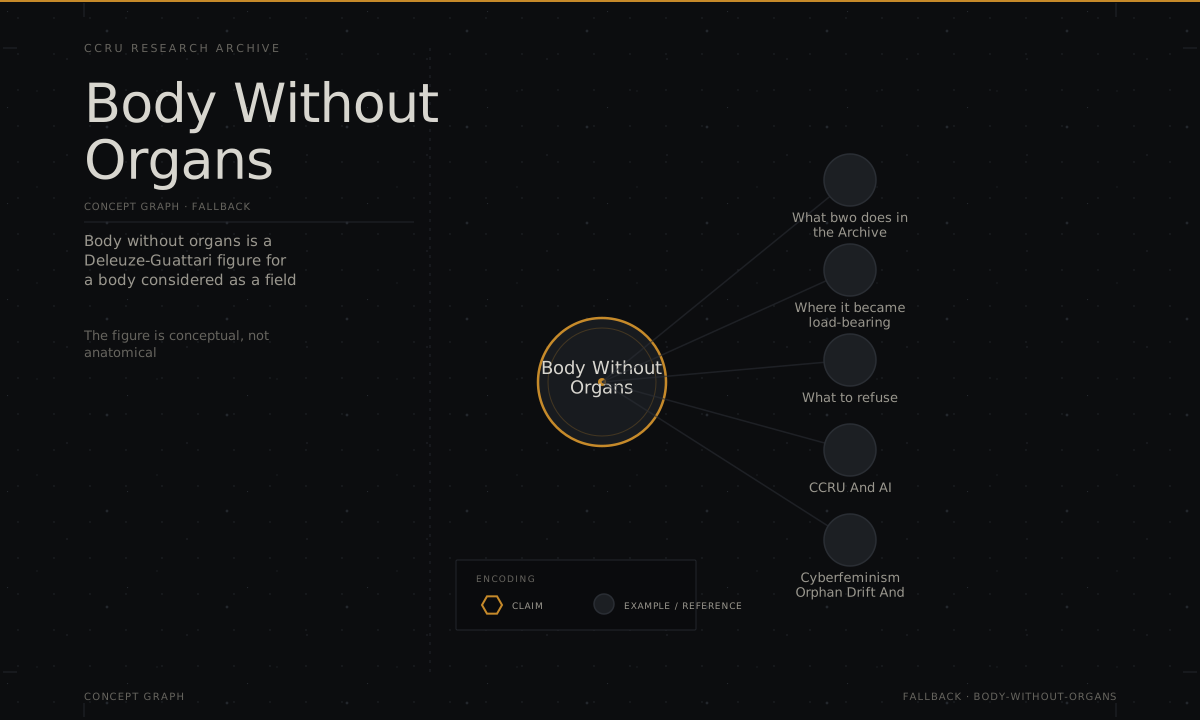
What bwo does in the Archive
Distinguish BwO from rhizome. Rhizome names a connective topology — n-dimensional branching, any point linkable to any other. BwO names the surface on which such connections register as intensities. Rhizome is about how things link; BwO is about the smooth/striated field those linkages modify. Conflating them flattens the operational difference: you can map rhizomatic connections without doing any work on the BwO, and you can work a BwO (intensify it, puncture it, stratify it) without drawing a rhizome. When CCRU texts stage machinic desire, rhizome describes the routing; BwO describes the substrate being charged.
Where it became load-bearing
The concept is imported from Gilles Deleuze and Félix Guattari, Anti-Oedipus (Editions de Minuit, 1972; Penguin trans. 1977) and elaborated in A Thousand Plateaus (Editions de Minuit, 1980; Athlone trans. 1987), where the 'How Do You Make Yourself a Body Without Organs?' plateau is the passage most often invoked when the concept is put to operational use. The CCRU inheritance is real but is a working appropriation, not a commentary: the body in question is no longer organic at all — capital, cyberspace, or a sonic terrain is treated as the intensity-surface.
The clearest textual instance in the archive is the Occultures fragment (Ccru: Writings 1997–2003; reprinted Divus, 2012), where Catajungle is described as 'a terrain, a sub-cartesian region of intensive diagonals cutting through nongeometric space.' That formulation — a non-organic region defined by the intensities propagating across it — is BwO-work in all but name. The surrounding figures in the same passage (the Datacombs as 'ghost-stacks of sedimented virtuality,' the Crypt as a contagious 'splitting') are not explicitly named as BwOs in the text, but they are staged on the same operational plane: regions, not bodies, characterized by what flows and what sediments.
The point at which BwO becomes load-bearing, rather than decorative, is the point at which CCRU stops using it to describe subjects and starts using it to describe infrastructures: sonic territories, virtual sedimentations, occult diagrams. At that moment it is no longer a Deleuze-Guattari citation being deployed. It is a working surface.
What to refuse
The dominant misreading is literalist-somatic: that BwO names a body whose organs have been removed, or a transgressive body (mutilated, ecstatic, drugged) as an aesthetic program. This reading survives because the phrase sounds like body-horror and because some secondary literature treats the 'How Do You Make Yourself a BwO' plateau as a manual for extreme states. The CCRU's operational use refuses this. The BwO is not a mutilated organism and not a metaphor for one. It is a topological surface defined by what flows across it and what gets stratified. The Catajungle passage suggests the type of extension the CCRU licenses — a sonic-spatial terrain handled as an intensity-field — and by that logic markets, networks, or numogram zones could be treated similarly, though the archive's explicit textual warrant for such extensions is narrower than the ambition of the concept.
A secondary misreading treats BwO as synonymous with deterritorialization or with the rhizome itself. Keep them separate: deterritorialization is a movement, rhizome is a connectivity pattern, BwO is the charged surface those operations act on. When a CCRU text stages machinic desire, the three terms are doing three different jobs; collapsing them removes the analysis.
For the deepest single-document treatment of how CCRU puts this surface to work on non-organic substrates, see Ccru: Writings 1997–2003.
Source quotations and adjacent argument
These passages keep the BwO tied to Deleuze-Guattari, machinic desire, and techno-capitalist surfaces rather than to body-horror literalism.
Even the appearance of transcendence is immanently produced: ‘in reality the unconscious belongs to the realm of physics; the body without organs and its intensities are not metaphors, but matter itself’.3 Where Kant’s transcendental subject gives the law to itself in its autonomy, Deleuze-Guattari’s machinic unconscious diffuses all law into automatism.
No revolution without insurrectionary desire, no effective route for insurrectionary desire without integral anti-fascism. Wilhelm Reich, Georges Bataille, Gilles Deleuze, and Félix Guattari are perhaps the most important theoretical loci in this development.
is precisely one in which techno-capitalism has come of its own by radically subsuming human culture, political economy and science into what Deleuze and Guattari would call its frenzied body without organs.
This could be seen as a relapse back into the juridical-dialectical domain of law-and-transgression associated with Bataille, which appears strictly incompatible with Deleuze-Guattari’s coolly functionalist diagrammatics of desire, and whose mechanisms Land dismantled early on.
Body without organs is a Deleuze-Guattari figure for a body considered as a field of intensities rather than as a hierarchy of organs. The CCRU recruits it for arguments about machinic desire and distributed agency.
Core argument
Body without organs is a figure for intensity, not for absence. Treating it as 'a body that has lost its organs' inverts the point. The figure is positive: a surface organised by intensity rather than by functional partition.
The CCRU uses it as a vehicle for machinic-desire arguments. It is the figure that lets the archive write about distributed agency without falling back on either subject-centred or systems-theoretical vocabulary.
Worked examples
These named texts, talks, sites, and records show where the argument becomes concrete.
Nick Land Fanged Noumena Record
Fanged Noumena gives the Land corpus its retrospective editorial architecture. It makes Body Without Organs checkable against a concrete archive object.
ccru.net Home Record
The old web interface shows how zones, links, and presentation became part of the argument. It makes Body Without Organs checkable against a concrete archive object.
Nick Land Person
"Nick Land" shows who carries, translates, or contests Body Without Organs in practice.
CCRU And AI Guide
"CCRU And AI" keeps Body Without Organs attached to a guide-length argument and route map.
Common misreadings
These are the recurring simplifications, exaggerations, and misreadings that make the subject look flatter than it is.
- Body without organs means a body whose organs have been removed.
The figure is conceptual, not anatomical. It names a body considered as a field of intensities and flows rather than as a hierarchy of partitioned functions; the negation is structural, not surgical.
Significance
The figure remains useful for contemporary writing about distributed cognition, machinic agency, and the limits of subject-centred description — domains where ordinary vocabulary keeps reinstating the bounded individual the figure is designed to displace.
Working definition
A figure Deleuze and Guattari developed across Anti-Oedipus and A Thousand Plateaus that the CCRU recruited for arguments about machinic desire and distributed agency.
Representative extracts
Definition · Gilles Deleuze & Félix Guattari — A Thousand Plateaus · A Thousand Plateaus
The body without organs is opposed not to the organs but to that organisation of the organs called the organism.
Why this matters: The structural definition. The negation is targeted at organisation rather than at the organs themselves — the distinction the CCRU's recruitment of the figure most consistently relies on.
Stakes · Nick Land — Fanged Noumena · collected writings
Desire is a flow that has no subject; it is machinic, contagious, and circulates between bodies before it arrives at any of them.
Why this matters: The CCRU's working use of the figure: agency and desire are distributed across substrates rather than localised in subjects.
History · nick-land-fanged-noumena-collected-writings-19872007-1.mobi · extracted passage
The apprehension of death as time-in-itself = intensive continuum degree-0 is shared by Spinoza, Kant, Freud, Deleuze and Guattari, and Gibson (amongst others). It is nominated variously: substance, pure apperception, death-drive, body without organs, cyberspace matrix.
Why this matters: Land files the figure in a lineage running from Spinoza to Gibson, so it reads as one alias for the intensive continuum rather than an isolated Deleuzian coinage.
Afterlife · CCRU - Lecture 1 · 00:32:15
So yeah, where Deleuze and Guattari wanted to liberate human creativity and autonomy, the nihilists who have appropriated their work seek to dissolve society altogether into the machinic unconscious.
Why this matters: The lecture registers the concept's contested inheritance in a single contrast, useful for tracking how far the CCRU's dissolution-minded use departs from Deleuze and Guattari's own aims.
References
Records cited
These linked sources are the quickest way to test the argument against named materials rather than second-hand summary.
Nick Land Fanged Noumena Record
Fanged Noumena gives the Land corpus its retrospective editorial architecture. Use it to test Body Without Organs against source material rather than summary.
ccru.net Home Record
The old web interface shows how zones, links, and presentation became part of the argument. Use it to test Body Without Organs against source material rather than summary.
CCRU Lecture 1 Record
The lecture format preserves cadence, definition, and Warwick-era scene explanation. Use it to test Body Without Organs against source material rather than summary.
CCRU And AI Guide
"CCRU And AI" widens Body Without Organs through linked sources, people, and sections.