The Lemurian fragment as evidence
This is the cluster's first piece of evidence that style is load-bearing. A reader can paraphrase a Heidegger paragraph and retain most of the thought. Try that with the syzygy arithmetic — 'Murrumur + Katak 45 + 18 = 63 Ciphers Djynxx / 45 + 81 = 126 Paraciphers Murrumur' — and you keep nothing. The pacing of list, gate, cipher, sub-list is the argument that number is demonic rather than arithmetic.
The Numogram writings as method, not ornament
The extended Numogram materials — the base-variant numograms, the syzygy arithmetic, the tic-counting discussions — perform a claim that discursive prose cannot make: that numerical operation and narrative generation are the same activity. When a document lists 'Gt-36: 666 Woah, here we go' mid-sequence, the voice-breaking into and out of technical register is not a lapse of tone. It is the method showing itself. The same document pivots from a sober discussion of how qabalistic tic-counts might 'code meaning' in the brain into an extended table of alternate-base numograms ('Base 0: Void … Base 3: Difference Engine — Dialectical Synthesis'). No academic paraphrase preserves that pivot, because the pivot is the argument.
Inside the cluster there is real disagreement about how seriously to take this. One camp (closer to the occult-practice reading) holds that the Numogram texts are executable — that a reader who performs the tic-counts generates the effects they describe. Another camp reads them as constraint-based fictional systems in the Oulipo tradition, effective as literature precisely because they are not believed. The archive does not resolve this. It was probably designed not to.
Cyberstyle as inherited density
The 'cyber' in cyberstyle is load-bearing. It names a specific mid-1990s compression: Gibson's sentence rhythms, rave flyer typography, Usenet brevity, hypertext link-density, sampler culture's willingness to quote without attribution. The Ccru homepage tag-list is itself a cyberstyle artifact — a flat index where 'sadie plant, nick land, y2k, millenium bug, kode9, katasonix, kodwo eshun, simon reynolds … deleuze, guattari, virilio, baudrillard, irigaray, I ching, mathematics, occult, numerology … jungle, rhythm, drum'n'bass, breakbeat culture … lovecraft, crowley, hyper-C, professor barker, miskatonic university' all sit at the same level.
Read that list as a sentence. It tells you that the archive does not hierarchize its sources — and the refusal to hierarchize is itself a claim about how concepts travel. Real theorists, fictional institutions (Miskatonic University), invented colleagues (Professor Barker), music producers, and genres get indexed identically. Translate that into an academic 'this project draws on continental philosophy, cybernetics, and Afrofuturism' and you destroy the specific point the flat list is making.
Fisher and the question of clarity
Mark Fisher is named on that same Ccru tag-list, and *K-Punk: The Collected and Unpublished Writings* (Repeater, 2018) is often cited as the cluster's accessible edge: a writer who moved between blog post, review, and theoretical essay without the argument fracturing. The disagreement this provokes is genuine. Some readers treat Fisher's accessibility as evidence that theory-fiction does not require the density of Land or Negarestani — that cyberstyle can be clear. Others argue Fisher's apparent clarity is itself a stylistic performance, no less crafted than Ccru's coded fragments, and read *Capitalist Realism* as a text whose flat affect is part of its diagnosis.
The cluster does not adjudicate. It flags Fisher as the cluster's internal test case: if the style-as-method thesis holds, it must hold for the readable writer as much as for the cryptic one. The K-Punk guide is where that argument gets tested in detail.
Cyclonopaedia as the outer edge
*Cyclonopaedia: Complicity with Anonymous Materials* (Reza Negarestani, re.press, 2008) is the cluster's outer edge and the text against which the others calibrate. It is standardly described as a framed narrative — a found manuscript attributed to a missing Iranian scholar, footnoted with real geology and invented demonology, wrapped in a fiction whose characters read one another's marginalia. Readers who ask 'but what is Negarestani really claiming?' have already lost the thread. Whatever theses the book advances about petroleum, solar economy, and geo-theology are inseparable from the frame that presents them as the paranoid reconstruction of a possibly non-existent scholar.
The common trap enters here. A reader treats the narrative apparatus as decoration around 'the real theory,' extracts a summary, and believes they now possess the book's argument. They do not. The argument is that certain claims can only be made by a text that compromises its own authority — and no paraphrase preserves that self-compromise. This is also why it belongs in the same cluster as the Ccru fragments: one text hides inside a fictional scholar, the other hides inside a fictional research unit, and the family resemblance is the move.
Where the Guide takes over
The Theory-Fiction As Method guide argues the specific thesis that in this archive style performs the argument rather than packaging it. That argument belongs to the guide. This section's job is to show you the cluster the guide is one reading of — so you can see what else falls inside it.
What falls inside: Ccru's collective-pseudonym texts, Fisher's genre-mobility, Negarestani's frame-fictions, the Numogram's notational metaphysics, the cyberstyle inheritance from Gibson and rave print culture. What falls just outside: purely expository secondary literature about these works (useful, but not itself theory-fiction), and purely literary fiction that references the ideas without enacting their method. The boundary is not sharp. The archive contains its own border disputes — and the Ccru homepage tag-list, with its refusal to separate Lovecraft from Deleuze from drum'n'bass, is itself one of them.
Where to Start if you only read one thing
For the single deepest document in the cluster — the one that forces the style-as-method question without letting the reader settle it — go to Cyclonopaedia. Fisher is more readable, the Ccru fragments are stranger, but *Cyclonopaedia* is the text that cannot be summarized without being falsified, which is the cluster's central claim made maximally unavoidable.
Read it with a second book open — the Ccru collected writings — and watch how the two texts use incompatible versions of the same move. The comparison is where the cluster becomes legible.
Theory-fiction is method, not garnish — the archive's prose performs its argument through pacing, register, and narrative, so style and content are not separable.
Core argument
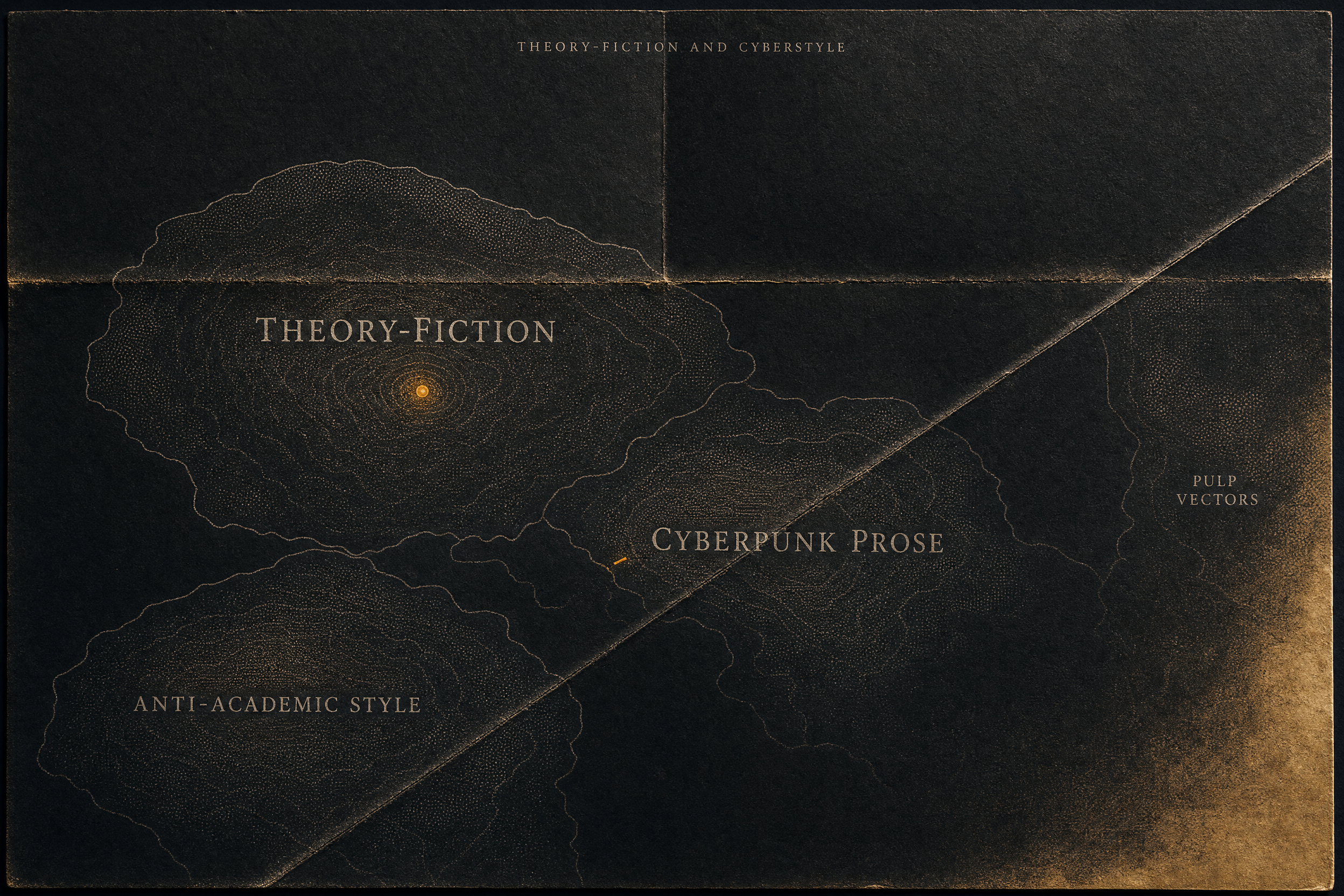
The archive does not separate style from thought in the usual academic way. Theory-fiction and cyberstyle are part of how concepts are made to move.
Difficulty here is often methodological rather than merely ornamental. Readers need to see what the style is trying to do before deciding whether it works.
Worked examples
These named texts, talks, sites, and records show where the argument becomes concrete.
What Was The CCRU Guide
Start with "What Was The CCRU" if you want the wider frame before dropping into Theory-Fiction and Cyberstyle.
Nick Land Person
"Nick Land" is one of the clearest figures for the pressures gathered inside Theory-Fiction and Cyberstyle.
Hyperstition Concept
"Hyperstition" names one recurring problem inside Theory-Fiction and Cyberstyle.
CCRU Lecture 1 Record
"CCRU Lecture 1" is a checkpoint where Theory-Fiction and Cyberstyle stops sounding abstract.
Cybergothic Record
"Cybergothic" is a checkpoint where Theory-Fiction and Cyberstyle stops sounding abstract.
Common misreadings
These are the recurring simplifications, exaggerations, and misreadings that make the subject look flatter than it is.
- The strange style is just edgy packaging.
The style is one of the archive's methods for handling recursion, contamination, system, and atmosphere.
Significance
This section matters because it helps readers stop mistaking hybrid style for empty mystique. It gives the archive's most intimidating prose a method-level explanation.
Themes
- theory-fiction
- cyberstyle
- writing method
- anti-academic prose
- cybergothic
Where this section sits in the archive
Open *Ccru: Writings 1997–2003* (Time Spiral Press / Urbanomic, 2015) at any of the Lemurian or Cthulhu Club fragments and the question of genre collapses. The texts are simultaneously dated correspondence, invented mythography, numerical puzzle, and argument about time. The Numogram documents — with their tic-counts, Gt-gate sequences, and Zone glyphs — are not illustrations of a philosophy of number; they are the philosophy, executed as ritual notation. Strip the notation and the claim evaporates.
Sources by cluster
These mini-clusters widen the section through named works and support traces rather than through adjacent keywords alone.
Section source cluster
Theory-Fiction and Cyberstyle: public editions and anchor texts
Anchor editions: CCRU Lecture 1; Cybergothic; Invaders From The Future.
Section source cluster
Theory-Fiction and Cyberstyle: routes out and adjacent arguments
Adjacent routes: What Was The CCRU; What Is Hyperstition; Nick Land.
Guide
"What Was The CCRU" gives the wider argumentative frame around this section.
Guide
"What Is Hyperstition" gives the wider argumentative frame around this section.
Person
"Nick Land" is one of the figures most closely bound up with this section's local problem.
Person
"Mark Fisher" is one of the figures most closely bound up with this section's local problem.
Concept
"Hyperstition" names one of the recurring conceptual pressures inside this section.
Concept
"Numogram" names one of the recurring conceptual pressures inside this section.
Texts in this section
181 classified works grouped into 3 editorial subclusters. Reviewed: 39; needs review: 142.
Theory-fiction manifestos 137 works
- [Nettime-bold] Ccru Datastream 00
- Ccru - Cyberhype 1 Do You Believe in the New Economy (Mute 17)
- Ccru - Cyberhype 3 Economics does the Shrink Act On Irrational Exuberance (Mute 19)
- Ccru - Cyberhype 5 Age of Assymetry (Mute 21)
- Ccru - Cyberhype 6 Darkside of the Wave (Mute 22)
- Ccru - Cyberhype 7 Nanotech Nightmares (Mute 23)
- Ccru - Cyberhype 8 Commodities Leap the Species Barrier (Mute 24)
- CCRU- CYBERHYPE II - BRAIN PLAGUES
- CCRU- Cyberhype-4 Chinese Whisper Markets
- CCRU- Cyberhype-5 The Age of Asymmetry
- CCRU- Cyberhype-6 Darkside of the Wave
- CCRU- Cyberhype-7 Nanotech Nightmares
- CCRU- Cyberhype-8 Commodities Leap The Species Barrier
- CCRU- cyberpositive
- Dan O'Hara on Ballard, Cyberpositive, and the skeuomorph - Imperica - arts, technology, and media magazine
- Fisher - Y2K-Positive (Mute) (1999)
- k-punk Simon's interview with CCRU (1998)
- Kodwo Eshun - 0D Cyberpositive (Review) (1995)
- outthere
- Plant Land - Cyberpositive
- Plant Land - Cyberpositive (Unnatural) (1994)
- Requiem for Detective Fiction
- Speculative Aesthetics - Discussion 1
- Speculative Aesthetics - Discussion 3
- week 5
- When Matter Thinks
- 2 Miller041023Needs editorial review
- 3 Miller051023Needs editorial review
- 4 Miller061023Needs editorial review
- 5 Miller091023Needs editorial review
- 6 Miller111023Needs editorial review
- [DNA Zygotic]Needs editorial review
- [Fuck Face]Needs editorial review
- [Tragic Anatomies]Needs editorial review
- [Zygotic Acceleration, Biogenetic De-sublimated Libidinal Model (enlarged x1000)]Needs editorial review
- A Reduction Short of the TruthNeeds editorial review
- Abstract urbanismNeeds editorial review
- African Influences in CyberneticsNeeds editorial review
- AI Insepction II Beside A Cold StatueNeeds editorial review
- Always One Bit More, Computing and the Experience of AmbiguityNeeds editorial review
- Amortal KombatNeeds editorial review
- An account of some experimental derive iNeeds editorial review
- ArabesqueNeeds editorial review
- Art censorshipNeeds editorial review
- Big Diff, Granularity, Incoherence, and Production in the Github Software RepositoryNeeds editorial review
- Bouequet Stealth Poetry Module 02Needs editorial review
- CCRU- Fei Ch-ien Rinse Out sino-futurist under-currencyNeeds editorial review
- Ch1Needs editorial review
- Collapse; Philosophical Research and Development Issue #1; Numerical Materialism - Editorial IntroductionNeeds editorial review
- Coming into contact Sadie PlanNeeds editorial review
- Construction Site for Possible Worlds - IntroductionNeeds editorial review
- cryptolithNeeds editorial review
- currentaffairs.org-The Strange and Terrifying Ideas of Neoreactionaries-fpscreenshotNeeds editorial review
- cyberhypeNeeds editorial review
- Cyberphilosophy - Outsiders of Body and ThoughtNeeds editorial review
- Darton Pontefract and BeyondNeeds editorial review
- DETH SPRITZNeeds editorial review
- Disintegration - JacobiteNeeds editorial review
- e-m-cioran-bezna-5Needs editorial review2 source files
- eastersermonNeeds editorial review
- Energy TimeNeeds editorial review
- Fate Will and the Sea Sovereign CreativiNeeds editorial review
- Feminism between Fish and Future AI A GeNeeds editorial review
- From 953 AD to 1 Gigayear; Cheikh Anta Diop's Future Vector of EnergyNeeds editorial review
- Gateway to the WestNeeds editorial review
- Generative ClassificationsNeeds editorial review
- Glasgow 1997 South Africa 1900Needs editorial review
- Healing TimeNeeds editorial review
- Here and Now 16-17 (Cyberdrivel). pdfNeeds editorial review
- HouseNeeds editorial review
- I Can SeeNeeds editorial review
- Indie ReactionariesNeeds editorial review
- InsideAOENeeds editorial review
- jake-chapman-bedtime-tales-for-sleepless-nightsNeeds editorial review
- jake-chapman-my-giant-colouring-book-1Needs editorial review
- jon-k-shaw-fiction-as-method-1Needs editorial review
- Killing TimeNeeds editorial review
- Leviathan RotsNeeds editorial review
- Mackay - Retro Retard (Inventory) (1996)Needs editorial review
- Media Ontology and Transcendental InstrumentalityNeeds editorial review
- Mondo Mitomane and Traffic DeriveNeeds editorial review
- Moving Mountains Shamanic Rock art and tNeeds editorial review
- Navigating pan-Africanisms; On the Chimurenga LibraryNeeds editorial review
- neroeditions.com-Communication Guerrillas NERO Editions-fpscreenshotNeeds editorial review
- neroeditions.com-Engineering the World Crafting the Mind NERO Editions-fpscreenshotNeeds editorial review
- Neskoncni Prodajni Oddelek VesoljaNeeds editorial review
- Neurosys; On the Fictional Psychopathology of Abstract HorrorNeeds editorial review
- Note on Diagonal Method - by Zero PhilosophyNeeds editorial review
- NurluNeeds editorial review
- occtempNeeds editorial review
- Omnicide - Foreword In Praise of Abnormal PersistenceNeeds editorial review
- Ontology for Ontologys Sake Object OrienNeeds editorial review
- Origin Unknown Interview TracksNeeds editorial review
- part 3 – cosmic dys𝔭𝔢𝔭𝔰𝔦a & divine excrement or, an essay unveiling the teleoplexic identity of miltonic chaos, capitalist nigredo and alchemical pepsi cola™Needs editorial review
- part 4 - cosmic dys𝔭𝔢𝔭𝔰𝔦a & divine excrement or, an essay unveiling the teleoplexic identity of miltonic chaos, capitalist nigredo and alchemical pepsi cola™Needs editorial review
- Peters - Cyberdrivel (Here and Now 16-17 1995-1996)Needs editorial review
- PhixNeeds editorial review
- Pli-3-Kant-Trials-of-JudgementNeeds editorial review
- Pli-4-Deleuze-and-the-Transcendental-UnconsciousNeeds editorial review
- Primal GravyNeeds editorial review
- Process Hacks and Possible Worlds (Interview)Needs editorial review
- Psycho Politics - JacobiteNeeds editorial review
- Psychogeographical book and film reviewsNeeds editorial review
- Qabbalistic Oddments 01 - by Zero PhilosophyNeeds editorial review
- Qabbalistic Oddments 02 - by Zero PhilosophyNeeds editorial review
- Ralp Rumneys Revenge and Other Scams PsyNeeds editorial review
- Renegade Academia; The Cybernetic Culture Research UnitNeeds editorial review
- Reviews from Transgressions 5Needs editorial review
- ShorelinesNeeds editorial review
- Situationist poise space and architecturNeeds editorial review
- Speak to MeNeeds editorial review
- steve-goodman-speed-tribes-netwar-affective-hacking-and-the-audiosocial-1Needs editorial review
- SUM-10-2 web singleNeeds editorial review
- ŠUM#17 - Meta-Stability and the Diagonal MethodNeeds editorial review
- The Alien InsideNeeds editorial review
- The Asymmetry of LoveNeeds editorial review
- The Cartoonist - by Zero PhilosophyNeeds editorial review
- The Creativity ConundrumNeeds editorial review
- The Enigma VariationsNeeds editorial review
- The GASTRULATION of GEIST or, an Extended Meditation upon the World-Historical Connection Between Digestion and SimulationNeeds editorial review
- The Gates of Sleep - by Zero PhilosophyNeeds editorial review
- The Great Wall of EducationNeeds editorial review
- The Infinite Sales Bay of the Universe synthetic zerØNeeds editorial review
- The Puzzle House (scraps) Dump 1 - by Zero PhilosophyNeeds editorial review
- The Revolving Door and the Straight Labyrinth An Initiation in Occult Time (Part 1)Needs editorial review
- The switchNeeds editorial review
- The transgressive geographies of everydaNeeds editorial review
- The Transmaniacs Italian psychogeographyNeeds editorial review
- The Utter Limits Labyrinths of Xenop h oNeeds editorial review
- TheBoar VirtualFutures1995Needs editorial review
- Transgressions-1-1995-excerptsNeeds editorial review
- Transgressions-4-excerptsNeeds editorial review
- Transgressions-5-2001-exceprtsNeeds editorial review
- VF Internet&CommsNeeds editorial review
- VF1995 JANewsNeeds editorial review
- Why We Need the Canon Wars Compact MagNeeds editorial review
- WRAP Theses Fisher 1999Needs editorial review
Cyberpunk and gothic prose 12 works
- Amerikan gothic
- Autogeddon
- Black [Bedlam]
- CCRU- amerikkkan gothik
- cybergothic
- Cybergothic Hyperstition [Fast-Forward to the Old Ones]
- Cybergothic vs. Steampunk
- Fisher - Gothic Materialism (Pli 2001)
- Land - Cybergothic (Virtual Futures Cyberotics Technology Posthuman Pragmatism) (1998)
- zoran rosko vacuum player Nick Land - Hallucinatory but razor strict accelerationist and inhumanly progressive thoughts rabid nihilism, mad black deleuzianism, cybergothic
- easter 1998Needs editorial review
- The Worm Bins - by Zero PhilosophyNeeds editorial review
Style, design, and anti-academic aesthetics 32 works
- Fisher - Writing Machines (1998-99)
- Land - Art as Insurrection, The Question of Aesthetics in Kant, Schopenhauer and Nietzsche (Nietzsche and Modern German Thought) (1991)
- Website Style Lookbook v2
- [[Fanged Poetics]] Preliminary Notes on a Dark ConceptualismNeeds editorial review
- Aborting the Human RaceNeeds editorial review
- Acts of Letting and of CreationNeeds editorial review
- An Obituary for the LiberalNeeds editorial review
- AOEhierarchyNeeds editorial review
- Computational logic and ecological rationalityNeeds editorial review
- Cutting Away from Smooth SpaceNeeds editorial review
- Disturbing Suburbia Rediscovering the SuNeeds editorial review
- Fractals, Complexity, and Connectivity in AfricaNeeds editorial review
- Hard to Be a God - Strugatsky, Arkady; Strugatsky,Needs editorial review2 source files
- I See the Sea On Paul NobleNeeds editorial review
- Know Your SortsNeeds editorial review
- matthew-fuller-elegance-from-software-studies-a-lexicon-1Needs editorial review
- matthew-fuller-interview-with-a-photocopierNeeds editorial review
- michel-houellebecq-hp-lovecraft-against-the-world-against-lifeNeeds editorial review
- Misosophy The Shadows of the TranscendentalNeeds editorial review
- Nobody Knows What A Book Is AnymoreNeeds editorial review
- Pure Happiness The Project Against ItselNeeds editorial review
- Rethinking Symmetry in EthnomathematicsNeeds editorial review
- ron-eglash-african-fractalsNeeds editorial review
- ron-eglash-fractals-complexity-and-connectivity-in-africaNeeds editorial review
- Shadows of CopernicanismNeeds editorial review
- Shake This LandNeeds editorial review
- The Adventures of a SexNeeds editorial review
- The two-fold thought of Deleuze and Guattari intersections -- Charles J StivaleNeeds editorial review
- Transgressions-2-3Needs editorial review
- wendigosNeeds editorial review
- Worse LuckNeeds editorial review
- Xenopoetics; Time, Matter, Transmission (PhD Thesis 2019)Needs editorial review
References
Records cited
These linked sources are the quickest way to test the argument against named materials rather than second-hand summary.
CCRU Lecture 1 Record
"CCRU Lecture 1" is the first record to test the framing around Theory-Fiction and Cyberstyle.
Cybergothic Record
"Cybergothic" is the first record to test the framing around Theory-Fiction and Cyberstyle.
Invaders From The Future Record
"Invaders From The Future" is the first record to test the framing around Theory-Fiction and Cyberstyle.
What Was The CCRU Guide
"What Was The CCRU" gives the larger argument around Theory-Fiction and Cyberstyle before you widen sideways.
External references
Inherited outward references from the guides, exhibits, people, and concept pages that anchor this section cluster.