Warwick, 1994–1996: the conference as reactor
Read the conferences not as venues where finished research was reported but as the form the research took. My interpretive claim — one I cannot fully document from the primary retrieval block — is that the CCRU's numogrammatic and cybernetic material was drafted into conference proceedings, performance scripts, and edited volumes before it resembled monographs. The sequencing matters: a reader looking for the 'real' texts that the events supposedly popularised finds the order reversed. The events generated the texts.
Mute and the magazine circuit
Mute magazine, founded in the mid-1990s around Pauline van Mourik Broekman and Simon Worthington, is the other load-bearing surface. It circulated cybernetic-culture writing in a register neither journalistic nor strictly academic, and over the following decade absorbed writers adjacent to the CCRU — Matthew Fuller, later Mark Fisher. (Founding particulars here are drawn from Mute's own publication record rather than from the retrieval set.)
The magazine circuit matters because it establishes a baseline: para-academic work lived in print-runs of a few thousand, in listings, in reviews-of-reviews. Alongside Mute sit the CCRU's own Abstract Culture pamphlet series and the web-zines — the Hyperstition blog and its satellites — that followed. My reading, offered as synthesis rather than documented fact, is that the editorial stance diverges: Mute's left-communist and feminist contributors often treated emerging Landian accelerationism as a symptom requiring diagnosis, while Abstract Culture treated the same material as operational. Both were para-academic; they were not the same project. Readers should test this framing against specific Mute issues rather than accept it as settled.
The afterlife: urbanomic and the small-press turn
Robin Mackay's Urbanomic, founded in 2006, is the archive's second life. Collapse journal and the Urbanomic book list recovered, edited, and recontextualised CCRU-adjacent material that the universities had let drop. Mackay's own A Brief History of Geotrauma is exemplary of the mode: a long essay delivered through a small press with academic apparatus but no institutional gatekeeping, pursuing what Mackay calls egress 'into dreams where the lagoon of personal memory drains into a sea of cosmic trauma.'
Urbanomic is not Virtual Futures redux. The events are smaller and more curated, and the editorial apparatus (copy-editing, citation, pagination) is closer to conventional publishing than anything Abstract Culture attempted. Whether this counts as stabilisation or as domestication is genuinely contested — it is the question that divides the cluster's later readers, and the section does not adjudicate it.
Why the form is the method
The standard move is to treat events, pamphlets, and small journals as the publicity arm of a textual project. That inverts the situation. The CCRU's concepts — hyperstition, the numogram, the calendric counter-chronologies of Hyper-C — were designed to work through distribution. Hyper-C, as the CCRU framed it, treats conventional chronology as 'fake time' and pursues 'an anti-Gregorian Y2K positive occupation of the so-called computer calendar': an operation that requires users, not readers. A hyperstition requires circulation to complete itself; a numogram requires a community of users to become more than a diagram. Publishing these objects through conventional monograph routes would have neutralised them.
This is the point new readers most reliably miss. Para-academic form is not a workaround for institutional exclusion (though it is sometimes that too). It is continuous with a theory of how ideas become real. The CCRU Writings 1997–2003 volume is legible only once you accept that its contents were staged, performed, and serialised before they were collected.
The trap: treating events as background
The common trap is simple. A reader enters through Fanged Noumena or the Urbanomic reissues, encounters references to Virtual Futures, Warwick seminars, and Mute issues, and files all of it under 'context.' The texts feel like the archive; the events feel like the story of the archive.
Reverse the priority. The conferences were where arguments were tested against audiences that included musicians, programmers, and artists, not only philosophers. The workshops were where the numogram was used, not just described — and the CCRU Lectures insist on treating it, in their own phrase, 'as just as valid as mathematical set theory, despite its occult veneer.' The Abstract Culture pamphlets were printed in runs small enough that readership and authorship overlapped. If you read only the collected texts, you are reading transcripts of a practice whose live form you have declined to reconstruct.
Internal disagreements worth tracking
Inside this cluster there are at least three live disagreements, which I flag as the drafter's synthesis rather than documented positions — readers should locate the primary texts themselves. First: whether para-academic circulation is a principled alternative to the university or a provisional exile from it. Fisher's k-punk posts and his later 'Exiting the Vampire Castle' suggest the former; Land's departure from Warwick for Shanghai and for the blog-form (later collected in A Nick Land Reader) suggests the latter is closer to what happened in practice. Second: whether the 1990s conference-and-pamphlet mode can be reproduced, or whether it was specific to a pre-platform media ecology that no longer exists. Third: whether the Urbanomic afterlife has preserved the method or domesticated it — a charge made periodically by readers who came up through Abstract Culture and the Hyperstition blog, and rejected by readers who credit Mackay with making the 1990s material readable at all.
None of these disagreements resolve. They are useful as navigational aids. A reader who notices which disagreement a given text is taking a position inside will orient faster than one who treats the cluster as unified.
Where to go next
If you read one document to understand how the para-academic surface actually worked, read Mackay's editorial introduction to CCRU Writings 1997–2003 — it reconstructs the publication ecology (Abstract Culture, conference proceedings, websites, zines) from which the collected texts emerged, and is candid about what the collection cannot preserve.
Start there: CCRU Writings 1997–2003. Then work outward to the Virtual Futures anthologies and to early Mute issues, in that order.
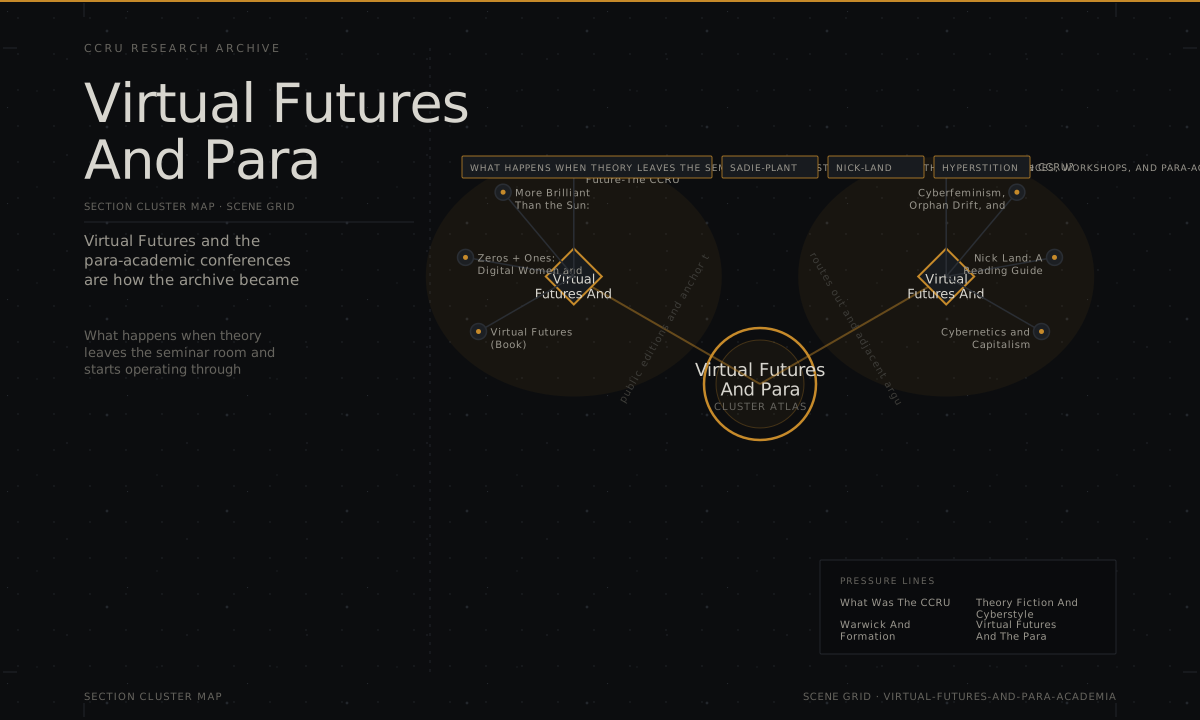
Virtual Futures and the para-academic conferences are how the archive became public — events, performances, and workshops circulate the work in registers a journal cannot.
Core argument
Virtual Futures is part of the archive's method, not just its publicity. It shows theory leaving the seminar room and becoming performative, social, and media-facing.
Para-academic circulation is one of the archive's core infrastructures. Without it, the CCRU looks too sealed inside Warwick and too detached from later public circulation.
Worked examples
These named texts, talks, sites, and records show where the argument becomes concrete.
What Was The CCRU Guide
Start with "What Was The CCRU" if you want the wider frame before dropping into Virtual Futures And Para Academia.
Sadie Plant Person
"Sadie Plant" is one of the clearest figures for the pressures gathered inside Virtual Futures And Para Academia.
Hyperstition Concept
"Hyperstition" names one recurring problem inside Virtual Futures And Para Academia.
CCRU Lecture 1 Record
"CCRU Lecture 1" is a checkpoint where Virtual Futures And Para Academia stops sounding abstract.
ccru.net Home Record
"ccru.net Home" is a checkpoint where Virtual Futures And Para Academia stops sounding abstract.
Common misreadings
These are the recurring simplifications, exaggerations, and misreadings that make the subject look flatter than it is.
- Events are only background to the real texts.
The events and public interfaces are part of how the archive actually lived and spread.
Significance
This section matters because it keeps the archive tied to infrastructures of circulation: rooms, programs, recordings, and off-campus scenes rather than abstract lore alone.
Themes
- virtual futures
- para-academia
- events
- workshops
- off campus
Where this section sits in the archive
The Virtual Futures conference series ran at Warwick across the mid-1990s, and it is where the CCRU's working style first became legible to outsiders. By widely-attested historiography — the account reconstructed in Robin Mackay's editorial apparatus to CCRU Writings 1997–2003 and in the Routledge Virtual Futures anthologies themselves — the events mixed academic papers with DJ sets, performance, film, and unannounced interventions. Sadie Plant and Nick Land were central; younger participants who would form the CCRU's inner ring arrived and left as collaborators. (These participant lists and dates are drawn from standard secondary accounts rather than from primary retrieval; readers should treat them as received historiography.)
Sources by cluster
These mini-clusters widen the section through named works and support traces rather than through adjacent keywords alone.
Section source cluster
Virtual Futures And Para Academia: talks, captures, and support traces
Source traces: Syzygy; Gordon Matta-Clark; ‘Somewhere Outside the Law'; Dan O'Hara on Ballard, Cyberpositive, and the skeuomorph - Imperica - arts, technology, and media magazine.
Text page
soothsaying of the Maya and the Ancient Egyptians. Just as the Mayan city of Chichén Itzá was abandoned in the 9th century when the calendar drawn up by the priests came to an end, the inhabitants suddenly finding the...
Text page
Gordon Matta-Clark; ‘Somewhere Outside the Law'
321 enunciation which he induces and deduces from it – indefinitely: ‘Keeping it an ongoing open process. Not finishing/just keeping going and starting over & over.’)14 Splitting (1974) consisted not only of cutting t...
Text page
That was also a period where the words "Virtual" and "Cyber" were used extensively, both in theory and practice. Are these words still relevant and how has their meaning changed? 'Virtual' is still used, and useful, e...
Text page
Plant - The Virtual Complexity of Culture (Future Natural 1996)
Chapter 13 The virtual complexity of culture Sadie Plant What alchemical transformation occurs when you connect everything to everything?1 As theories of chaos and complexity leak out from the sciences, an emergent co...
Text page
Disturbing Suburbia Rediscovering the Su
David’s symbolic purchase of a sugar-gum for his garden reveals the extent to which notions of propriety and the cultivation of nature are codified within the representational identity of the suburb. Whereas a ‘camell...
Text page
manifestation of the prominence of ‘hydraulic capitalism’ in industrial Cornwall: the waters of the river were routed and rerouted to be used many times by the multiple waterwheels. This use of gravity as natural capi...
Section source cluster
Virtual Futures And Para Academia: routes out and adjacent arguments
Adjacent routes: What Was The CCRU; How To Use This Archive; Sadie Plant.
Guide
"What Was The CCRU" gives the wider argumentative frame around this section.
Guide
"How To Use This Archive" gives the wider argumentative frame around this section.
Person
"Sadie Plant" is one of the figures most closely bound up with this section's local problem.
Person
"Nick Land" is one of the figures most closely bound up with this section's local problem.
Concept
"Hyperstition" names one of the recurring conceptual pressures inside this section.
Section
"Warwick And Formation" is the neighboring cluster to open once this section's local pattern is visible.
Reader questions
What was Virtual Futures in relation to the CCRU?
Virtual Futures was one of the main relay surfaces through which the scene became visible outside its immediate setting, connecting event culture, para-academic circulation, theory performance, and later mythologizing.
Why does para-academia matter here?
Because the CCRU archive did not circulate only through formal publication. Conferences, flyers, recordings, PDFs, mailing lists, and later web traces were part of how its ideas moved and mutated.
Texts in this section
8 classified works grouped into 2 editorial subclusters. Reviewed: 8; needs review: 0.
Virtual Futures events 6 works
Para-academic method and pedagogy 2 works
References
Records cited
These linked sources are the quickest way to test the argument against named materials rather than second-hand summary.
CCRU Lecture 1 Record
"CCRU Lecture 1" is the first record to test the framing around Virtual Futures And Para Academia.
ccru.net Home Record
"ccru.net Home" is the first record to test the framing around Virtual Futures And Para Academia.
What Was The CCRU Guide
"What Was The CCRU" gives the larger argument around Virtual Futures And Para Academia before you widen sideways.
External references
Inherited outward references from the guides, exhibits, people, and concept pages that anchor this section cluster.