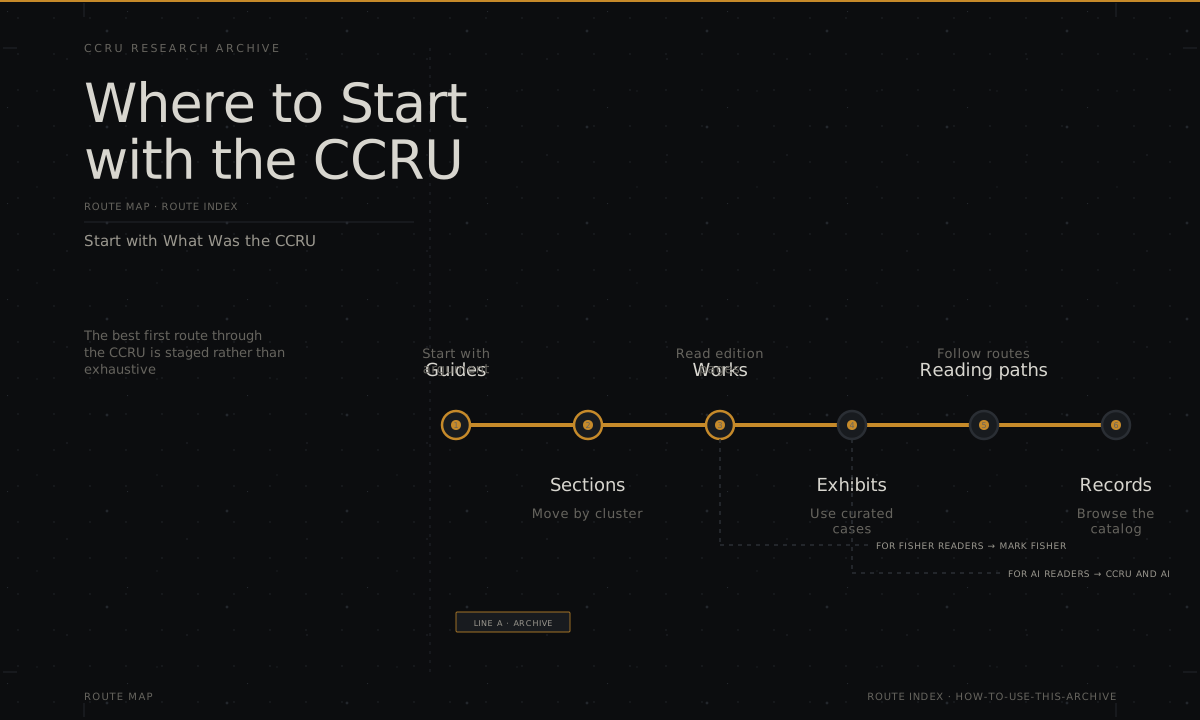
Start with What Was the CCRU?, then choose one bridge such as hyperstition or Mark Fisher, then land on CCRU Lecture 1 or Ghost Lemurs of Madagascar. The useful sequence is orientation, bridge, evidence, then depth.
Key points
- Most readers need a scene map before they need a dense primary text.
- Bridge figures and bridge concepts are useful because the CCRU has multiple centers.
- The right goal for a first session is not mastery; it is a small number of memorable distinctions and one or two sources worth returning to.
Core argument
The best first route through the CCRU is staged rather than exhaustive. A newcomer who tries to read the whole corpus at once usually gets atmosphere without understanding. Example: What Was the CCRU? (CCRU - Lecture 1)
Different interests need different bridges. A reader coming through Fisher, Land, AI, or hyperstition should not be forced into one identical path. Example: What Is Hyperstition? (Ghost Lemurs of Madagascar)
Editorial orientation is useful only if it drives you back toward evidence. The point is to reach records, talks, and texts with better questions, not to stay indefinitely inside explanation. Example: Mark Fisher and the CCRU (Virtual Futures (Book))
The best first route through the CCRU is staged rather than exhaustive. A newcomer who tries to read the whole corpus at once usually gets atmosphere without understanding.
How readers usually arrive, and why it usually fails
Most readers arrive at the CCRU through one of four doors: a Mark Fisher footnote, a Nick Land citation, an AI-discourse meme about hyperstition, or a screenshot of the numogram on a timeline. They then download the largest PDF they can find, usually the Urbanomic Writings 1997–2003 or the Time Spiral Press scan on Internet Archive, open it at random, and try to absorb the atmosphere. This almost never works. The archive does not reward that approach, and this guide exists because the failure pattern is consistent enough to plan around.
The argument of this page is simple. The CCRU corpus is legible only when you arrive with a scene map, a single bridge concept, and the knowledge that some texts are evidence and some are provisional editorial framing. Without that orientation, the writing reads as undifferentiated intensity: Lemurian time-wars, numogram zones, voodoo, cybernetics, geotrauma, Barker's spinal catastrophism, all flattened into one tone. With it, the same pages start to separate into distinct registers that argue with each other.
Start with the scene before the slogans
The first question to settle is simple: what was the CCRU? Until that is clear, later concepts and personalities arrive detached from the scene that made them meaningful. Readers who skip this step often end up with a handful of keywords, an exaggerated sense of Nick Land's singularity, and no feel for the collective, para-academic, or media-theoretical dimensions of the archive.
That is why a scene map belongs at the start. It gives you the basic distinctions: formation rather than doctrine, multiple contributors rather than one-mastermind myth, circulation through mixed media rather than through a tidy canon alone. Once that frame is in place, later pages stop feeling like disconnected curiosities.
Start with what the CCRU was as an institutional fact. A research unit attached to Warwick's Philosophy Department in the late 1990s, running the Virtual Futures and Virotechnology conferences and the journal Abstract Culture, eventually shut down after friction with the department. That history matters because it tells you the writings were produced inside a working group, not by a single author, and that the group was already collapsing the line between conference paper, fiction, and ritual document by the time the canonical pieces were written. Urbanomic's blurb for the Writings names the mix directly: "fiction, number theory, voodoo, philosophy, anthropology, palate tectonics, information science, semiotics, geotraumatics, occultism". That list is the actual generic spread you will hit on page one.
who or what is the cybernetic culture research unit or what i'll be referring to by shorthand as the CCRU of course well okay the story goes like this
Choose one bridge, not the whole formation at once
After the scene map, the material becomes easier if you choose one bridge. Fisher is the bridge if you come through music, public criticism, and blog culture. Hyperstition is the bridge if you want one portable concept that explains why narrative, fiction, and circulation matter so much here. Land is the bridge if you want the formation's most gravitational figure, but he works best when phased and contextualized. The AI route is useful if your interest comes through recursion, cybernetics, and machinic culture.[1]
The point is not that every reader needs the same ladder. The point is that most readers need a ladder. A bridge narrows the problem enough that real sources become usable instead of merely atmospheric.
The second move is to pick one bridge concept and stay with it for a while. Hyperstition is the obvious choice because it is the concept that has travelled furthest outside the archive and the one most often misread once it gets there. The popular gloss treats it as "fictions that become real," which is close enough to be dangerous. The CCRU's own usage is narrower. Hyperstition names a specific operation in which a fiction routes belief, attention, and capital through itself until the fictional element becomes a working component of the system that hosts it. The 1999 piece "Barker Speaks" is the test case. The CCRU present what reads as a real interview with a Professor D. C. Barker, complete with an invented publications list at the end. Barker does not exist. The interview format is the hyperstitional vector. Read it as a hoax and you have missed the point; read it as straight doctrine and you have also missed the point. The form is the argument.
From hyperstition the rest of the apparatus opens up in a controlled way. The numogram and the Lemurian time-war material look like occult decoration until you notice that the CCRU treats numerology as "the very essence of humanity's vanity project of preserving itself by finding its own values hidden everywhere", which is a critique of numerology performed through numerology. The geotraumatic material, the proto-human ape "dragged through its body to expire upon its tongue", is doing the same trick with evolutionary biology and Freud. In each case a discredited or marginal discourse is being run as live infrastructure to think with, not endorsed and not satirised. This is the tonal register that breaks new readers. The archive does not signal which level it is operating on, because the refusal to signal is part of the method.
Move into sources sooner than you think
Good orientation should shorten the distance to evidence. Once you have one overview and one bridge, go to a small number of named sources. CCRU Lecture 1 gives you pacing and scene-setting. Ghost Lemurs of Madagascar gives you something recognizably central, strange, and still readable. Virtual Futures keeps the story tied to events and public infrastructure. k-punk shows one important afterlife, and ccru.net shows that interface and presentation were part of the scene rather than wrappers around it.[2]
What matters is not quantity. It is sequence. One or two well-chosen sources will teach you more than ten random files opened without context.
Once hyperstition is in place as a bridge, move to a small number of source pages with that orientation already loaded. The Abstract Culture swarms, scanned at Monoskop, are the right next stop because they show the CCRU at journal-issue scale rather than as isolated fragments. After that, the Writings 1997–2003 in either the Time Spiral scan or the Urbanomic editions becomes navigable, because you can now tell a Barker piece from a Pandemonium catalogue entry from a straight theoretical essay. The Spanish Escritos edition preserves the same internal architecture, which is useful confirmation that the table of contents is doing real work and not just gesturing.
Archive instrumentOpen a guided corpus mapThe archive-orientation guide can demonstrate object-level navigation by opening on an attested archival surface instead of a blank root view.
Learn the materials' asymmetries
Some materials are dense because the thinking is genuinely compressed. Others are difficult because the source is fragmentary, stylized, badly preserved, or written in a deliberately charged idiom. Those are not the same kind of difficulty. One of the main uses of a staged guide is to help you tell the difference.
The CCRU also has multiple centers. It contains philosophical writing, cyberfeminist media theory, collective experimental practice, para-academic event culture, blog-era afterlives, and later public disputes about accelerationism or AI. A useful first route should make that plurality feel manageable without pretending it disappears.
There is a live disagreement inside the archive about how to handle this material, and the guide should name it. One reading, closer to the Urbanomic editorial line, treats the CCRU writings as a finished body of work to be canonised and footnoted. Another, closer to the texts' own self-description, treats the brand itself as demonic and meaningless, "tuning into Cyber-hype dynamics, numerizing culture, and innovating methods of propagation", which makes any canonisation a category error. The site does not resolve this. It keeps provisional text pages provisional and treats records as evidence rather than as universal landing pages, because the second reading has to be left structurally available even when the first is more useful for new arrivals.
What changes if you take this route
What changes if you accept this route. You stop reading the CCRU as an aesthetic and start reading it as a working group with techniques. "Barker Speaks" stops being weird worldbuilding and becomes a demonstration of how to build a citation that recruits its own evidence. The numogram stops being mystical furniture and becomes a notation system whose claims about number can be checked against the group's own line on numerology. The Lemurian material stops being lore and becomes a stress test for the idea that the present emerges cleanly out of the past and the future cleanly out of the present, which is the linear-time assumption the whole archive is trying to break.
Practically: read this page, then read one short orientation on hyperstition, then open one Abstract Culture swarm at Monoskop and one Barker-adjacent piece in the Writings. That is the staged route. Skip the staging and the archive will keep reading as atmosphere, which is the one thing it is not.
What not to do on your first pass
Do not try to solve the whole formation immediately. Do not assume the densest file is the deepest file. Do not mistake later notoriety for original centrality. Do not let one personality or one keyword stand in for the whole formation. And do not stay forever inside orientation guides once they have done their job.[3]
The right early outcome is smaller and more useful: you should know roughly what the CCRU was, why people keep returning to it, which entry route fits your interest, and which source or two are worth reading next. Once you have that, the material becomes much less noisy and much more teachable.
Worked examples
These named texts, talks, sites, and records show where the argument becomes concrete.
What Was the CCRU? Guide
The scene map. Read this first if you need the broad answer before anything else.
What Is Hyperstition? Guide
A strong bridge if you want one portable concept before the materials widen.
Mark Fisher and the CCRU Guide
The best bridge for readers entering through public criticism, music, or cultural theory.
Ghost Lemurs of Madagascar Record
A vivid first source: strange, central, and readable enough to reward early contact.
Tensions and limits
Any staged guide risks becoming overprotective if it keeps readers away from primary sources for too long.
The CCRU has multiple entry points, so every staged sequence is a wager rather than a universal law.
Some sources remain fragmentary or difficult even with context; the goal is better difficulty, not the abolition of difficulty.
Common misreadings
These are the recurring simplifications, exaggerations, and misreadings that make the subject look flatter than it is.
- The right start is the hardest text in the folder.
For almost everyone, a guide plus one or two carefully chosen sources produces a far better first understanding.
- You need to read the archive chronologically from the beginning.
A question-led path works better because the surviving materials are too mixed in form, tone, and preservation state to reward a simple crawl.
Significance
Readers now tend to discover the CCRU through scattered references, screenshots, personalities, or keyword clouds. A practical starting route matters because otherwise the material is easy to mistake for either pure lore or pure opacity.
A good starting sequence also improves every later move. Once a reader knows the formation story, one bridge concept, and one or two source surfaces, the rest of the material opens much faster.
References
Records cited
Linked archive records for this guide. Numbers correspond to the footnote markers in the body above.
k-punk.abstractdynamics.org (archived homepage) Record
A bridge surface for readers entering through Fisher or public theory.
CCRU - Lecture 1 Record
A spoken overview that lets the formation arrive in sequence rather than in fragments.
Ghost Lemurs of Madagascar Record
A first source that shows the CCRU can be weird and still concretely readable.
Reading routes through this guide
Featured exhibit
Virtual Futures and the Para-Academic Scene
A curated exhibit on the events, interfaces, and public surfaces that helped the CCRU circulate beyond one department or one medium.
Featured reading path
A short guided sequence for readers who want the clearest first path through the CCRU site.