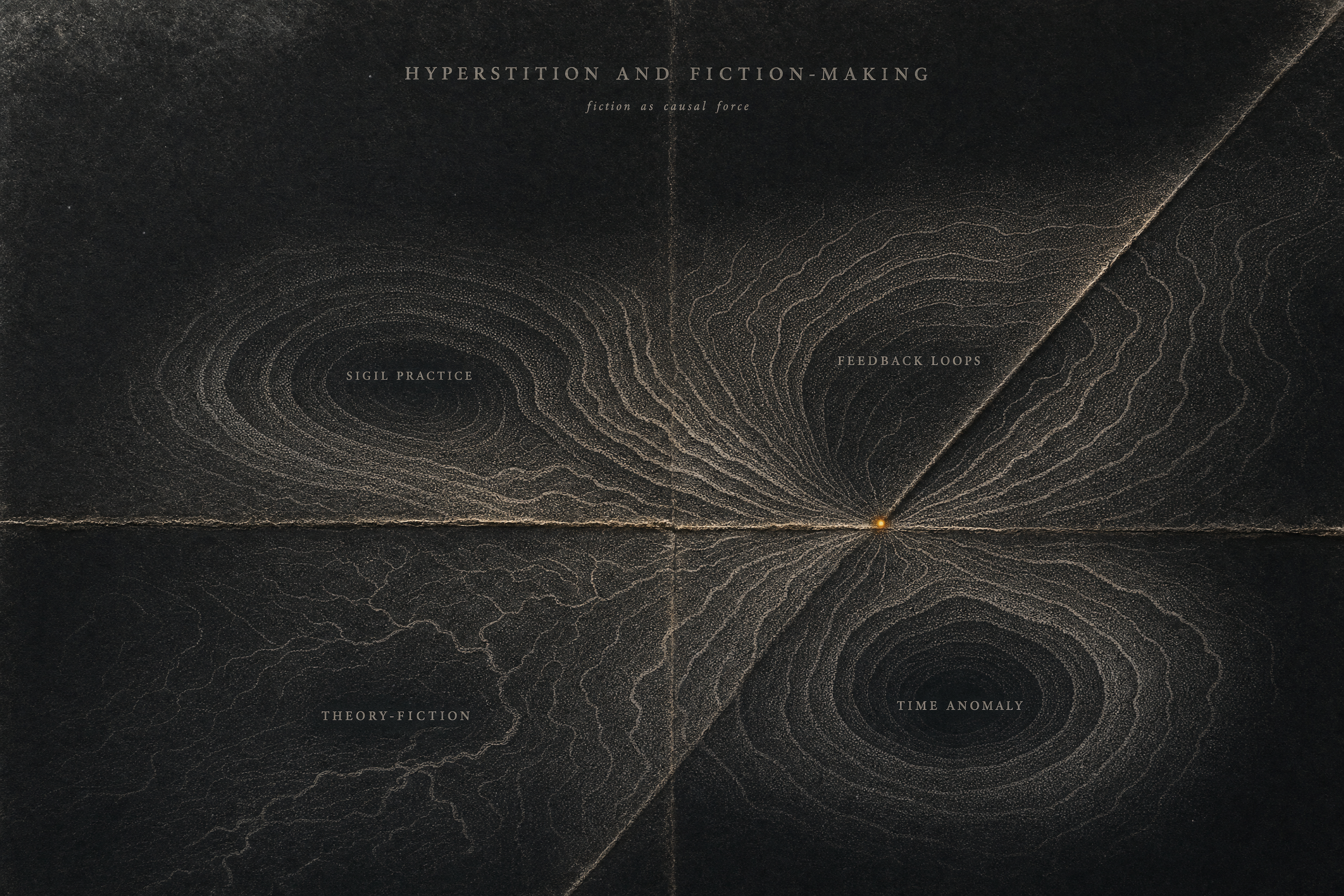
Start with the circulation, not the sigil
Read across the cluster and you see the pattern: the numogram diagrams, the Cthulhu Club fragments, the Barker interviews, the Orphan Drift image-texts. Each piece is weak on its own. The mechanism is the crossing — one fragment cites another fragment that cites a third that cites the first. The question this section exists to pose: what counts as an instance of that mechanism, and what is merely occult-flavoured writing?
The load-bearing cases
Three anchors carry the cluster. Ccru: Writings 1997–2003 is the primary corpus: the Lemurian time-war, Barker's numogram, the Cthulhu Club, the Mu materials. Cyclonopaedia: Complicity with Anonymous Materials is the long-form theory-fiction that demonstrates the method outside CCRU — petroleum as narrative agent, the Middle East as a text being written by oil. Amy Ireland's essays for Urbanomic extend the practice into horror and time; readers wanting an entry point can start with her essay on Sadie Plant and the black circuit, or her work on gender and hyperstitional time, though a fuller citation of the Ireland corpus would strengthen this section and is acknowledged as a gap in the current evidence base.
A fourth name belongs here as friction: Sadie Plant, whose departure from CCRU and whose [Zeros + Ones (Fourth Estate, 1997)] shares the circulation-as-cause intuition but routes it through feminist media history rather than sorcery. Readers who start with Plant and readers who start with Barker end up disagreeing about what hyperstition is even for.
Why media form is part of the mechanism
The archive's worked cases are not novels. They are zines (Abstract Culture), broken websites, transcribed lectures, footnoted encyclopaedia entries that cite invented sources, image-tracks. The form matters because the form is doing the propagation. A Lemurian fragment published as a peer-reviewed paper would fail; published as an anonymous ccru.net sub-page with a broken link to "Professor Barker," it works.
This is where the common trap sits. A reader arriving from elsewhere will translate hyperstition as "self-fulfilling prophecy" — a psychological category about belief causing outcome. The CCRU usage is infrastructural. The carrier (the forum post, the rumour chain, the sigil tattooed and photographed and reposted) is not the vehicle of the idea; it is the idea's body. Strip the carrier and there is no hyperstition left to analyse. The /guides/what-is-hyperstition guide argues this thesis directly; this section's job is to show you the cases it generalises from.
Cyclonopaedia as the clearest demonstration
If you want to watch the mechanism at full length, Cyclonopaedia is the single worked text. It presents itself as a manuscript found by a fictional academic, annotates itself, contradicts itself, cites real and invented sources interchangeably, and treats petroleum as an agent with narrative intentions. Some readers have subsequently extended its premises — writing about oil as tellurian agent in registers Negarestani did not occupy — though cataloguing that reception rigorously would require evidence this section does not currently have in hand.
One can read Cyclonopaedia two ways: as a hyperstition (the book enacts what it describes, and its uptake proves it), or as a novel about hyperstition (the performative apparatus is sophisticated theory-fiction packaging around an argument that could, in principle, be paraphrased). The two readings generate different research programmes and the disagreement is worth sitting with rather than resolving.
The Lemurian mythos and the numogram
The CCRU's own flagship case is harder to summarise because it was never meant to be summarised. The Lemurian time-war, the decimal labyrinth, the Mu materials, and the numogram diagrams (see Unleashing the Numogram and the Barker lectures) together form a mythos distributed across dozens of fragments, many contradictory, several falsely attributed. Readers are supposed to get lost inside it. Getting lost is the induction.
What to read for: the numbering system. The numogram is not decorative. It is a sorting grid — tic-counts, gates, paradecimal extensions into higher bases — that lets any new fragment (a date, a name, a word) be slotted in and made to resonate with the rest. This is the technical core of why the fiction can keep growing. New users add new entries; the grid absorbs them. Qabbalistic counting procedures do the same structural work that hashtags and memes do in later networks.
The e/acc question and the thinning problem
A useful diagnostic for post-2020 internet usage — hyperstition as e/acc slogan, as Twitter-occulture, as "meme magic" discourse — is to ask whether the concept survives the transposition. One way to read it: what the chan-boards and acceleration-posters are doing is recognisably the mechanism, just on faster infrastructure, and the concept is robust. Another way: circulation without the numogram-style technical apparatus produces only self-fulfilling prophecy with better branding — the very trap this section is here to defuse.
I present these as a diagnostic schema rather than an observed archival dispute between named camps; adjudicating it would require retrieving specific Ireland essays defending the continuity, and specific critics arguing for the thinning, which this section does not do. What the schema is good for: a reader cannot adjudicate from slogans. You have to go to a worked case and see whether the fiction is doing infrastructural work or just decorating an argument.
Where to go next
If you read one document from this cluster, read Cyclonopaedia. It is long, it is difficult, and it is the only book-length object in the cluster that exhibits the full mechanism — citation apparatus, unreliable frame, real-world uptake — rather than describing it. The CCRU fragments are indispensable but they reward readers who already know what they are looking at. Negarestani shows you what you are looking at by making you do it.
Hyperstition is fiction that becomes operative through circulation: the archive treats narrative, sigil, and rumour as causes rather than illustrations of culture.
Core argument
Hyperstition is easier to understand as a practice of fiction-making than as a slogan. The section shows how stories become active through circulation and uptake.
Media form is part of the mechanism. Talks, essays, blogs, and weird fiction all help make the concept legible.
Worked examples
These named texts, talks, sites, and records show where the argument becomes concrete.
What Is Hyperstition Guide
Start with "What Is Hyperstition" if you want the wider frame before dropping into Hyperstition And Fiction Making.
Amy Ireland Person
"Amy Ireland" is one of the clearest figures for the pressures gathered inside Hyperstition And Fiction Making.
Hyperstition Concept
"Hyperstition" names one recurring problem inside Hyperstition And Fiction Making.
Hyperstition New Weird 1 Record
"Hyperstition New Weird 1" is a checkpoint where Hyperstition And Fiction Making stops sounding abstract.
Ghost Lemurs Of Madagascar Record
"Ghost Lemurs Of Madagascar" is a checkpoint where Hyperstition And Fiction Making stops sounding abstract.
Common misreadings
These are the recurring simplifications, exaggerations, and misreadings that make the subject look flatter than it is.
- Hyperstition is only an abstract theory term.
The section makes clear that the concept lives through examples, genres, and repeated narrative procedures.
Significance
This section matters because it keeps one of the archive's most portable concepts tied to actual source materials and narrative operations.
Themes
- hyperstition
- fiction-making
- world-building
- feedback
- narrative causation
Where this section sits in the archive
A hyperstition is not a single text. It is what happens when a text, sigil, or rumour is picked up, repeated, mutated, and embedded in infrastructure until the fiction is doing causal work. The CCRU materials make this legible because they were built for it: the Lemurian mythos in Ccru: Writings 1997–2003 arrived already distributed across aliases, false attributions, and pseudo-academic apparatus — a cloud of names (Sadie Plant, Nick Land, Kode9, Professor Barker, Miskatonic University, Lovecraft, Crowley) that deliberately refuses to resolve into an author.
Sources by cluster
These mini-clusters widen the section through named works and support traces rather than through adjacent keywords alone.
Section source cluster
Hyperstition And Fiction Making: public editions and anchor texts
Anchor editions: Negarestani - Labor of the Inhuman Part 1; Hyperstition New Weird 1; Ghost Lemurs Of Madagascar.
Work
Negarestani - Labor of the Inhuman Part 1
Jordan Belson, Samadhi, 1967. Film still. norms rather than natural laws (ought instead of is), the concept of entailment for humanity-as-a- commitment is non-monotonic. That is to say, entailment no longer expresses...
Work
Work
Work
Work
Section source cluster
Hyperstition And Fiction Making: talks, captures, and support traces
Source traces: Rational Inhumanism Vs Landian Anti-Philosophy - TripleAmpersand Journal (&&&)TripleAmpersand Journal (&&&); Cyberpositive Relaunch - 0rphan Drift Archive; Edmund Berger - Underground Streams; A Micro-History of Hyperstition and Esoteric Resistance.
Text page
depth, cruelty as candor, disdain for reasons as unmasking. The result is not radicalism but transgression-theatre, where negation is enjoyed as politics and the collapse of norms is taken for emancipation. At the sam...
Text page
Cyberpositive Relaunch - 0rphan Drift Archive
advances your alienation from your own semantic security as you reproduce and disguise its syntactic irruption with the fantasy of your own intimacy. Suhail Malik ‘It is happening again…It is happening again…It is hap...
Text page
Edmund Berger - Underground Streams; A Micro-History of Hyperstition and Esoteric Resistance
act as anti-markets. As Marx noted, capital constrained the application of technological innovation; synthesizing with Braudel, Land's position is that the acceleration of market circulation would then, presumably, un...
Text page
Poetry is Cosmic War Interview
(Laboria writes of 'the right to speak as no one in particular' h Xenofeminism: A Politics for Alienation and uses this as a basis from which to advocate for gender fluidity and reject biological determinism); both em...
Text page
52 R a d i c a l P h i l o s o p h y 1 4 4 (J u l y / A u g u s t 2 0 0 7) which depicts the nature-philosophy as no more than an ephemeral episode (roughly 1797–1800) in Schellingʼs fifty-year career. Instead, he ar...
Section source cluster
Hyperstition And Fiction Making: routes out and adjacent arguments
Adjacent routes: What Is Hyperstition; What Was The CCRU; Amy Ireland.
Guide
"What Is Hyperstition" gives the wider argumentative frame around this section.
Guide
"What Was The CCRU" gives the wider argumentative frame around this section.
Person
"Amy Ireland" is one of the figures most closely bound up with this section's local problem.
Person
"Mark Fisher" is one of the figures most closely bound up with this section's local problem.
Concept
"Hyperstition" names one of the recurring conceptual pressures inside this section.
Concept
"Lemurian Time War" names one of the recurring conceptual pressures inside this section.
Texts in this section
20 classified works grouped into 4 editorial subclusters. Reviewed: 10; needs review: 10.
Definitions and histories 11 works
- carstens hyperstition
- Delphi Carstens - Hyperstition
- Edmund Berger - Underground Streams; A Micro-History of Hyperstition and Esoteric Resistance
- hyperstition.abstractdynamics.org
- The Emergence of Hyperstition
- Underground Streams; A Micro-History of Hyperstition and Esoteric Resistance
- wk2 hyperstition and the urban sublime
- reallastparasol21decNeeds editorial review
- SCENE REPORT SAN FRANCISCO - by rina nicolae - incognitaNeeds editorial review
- UNCOVERING THE APOCALYPSE Narratives ofNeeds editorial review
- Zerok Un HolesNeeds editorial review
Myth-science and narrative causation 4 works
World-building and entities 4 works
- carverNeeds editorial review
- Coincidence Engineering A review of CCRU Writings 1997-2003 - TripleAmpersand Journal (&&&)TripleAmpersand Journal (&&&)Needs editorial review
- cthulhuclubNeeds editorial review
- Mandatory Damp Squib Post Vauung's LairNeeds editorial review
Critique and afterlives 1 works
References
Records cited
These linked sources are the quickest way to test the argument against named materials rather than second-hand summary.
Hyperstition New Weird 1 Record
"Hyperstition New Weird 1" is the first record to test the framing around Hyperstition And Fiction Making.
Ghost Lemurs Of Madagascar Record
"Ghost Lemurs Of Madagascar" is the first record to test the framing around Hyperstition And Fiction Making.
Cybergothic Record
"Cybergothic" is the first record to test the framing around Hyperstition And Fiction Making.
What Is Hyperstition Guide
"What Is Hyperstition" gives the larger argument around Hyperstition And Fiction Making before you widen sideways.
External references
Inherited outward references from the guides, exhibits, people, and concept pages that anchor this section cluster.