Continuation without translation
This is an editorial reading rather than a neutral summary, and it matters for the archive because it pushes against a common assumption about reception — that the CCRU's prose-method was a period style belonging to the late 1990s, to be historicized and then transcended. If Ireland's essay works as described, the method is portable: it can argue new claims without losing its recursive signature. The archive then looks less like a fossil bed than a working apparatus, and the existence of someone still operating the apparatus in current publication is what keeps that distinction alive.
Horror as epistemic operator
Ireland's writing on horror — including 'Noise: An Ontology of the Avant-Garde' and the Urbanomic essay 'Black Circuit: Code for the Numbers to Come' — treats horror not primarily as a genre to be analyzed but as an epistemic operator. The move is to resist the standard cultural-studies gesture whereby horror becomes a symptom of something else (late capitalism, gendered anxiety, technological dread). Horror is instead treated as a mode of access: the affective register in which claims about an indifferent or agent-hostile outside can be formulated without immediately being domesticated by the subject of the sentence.
This reads Lovecraftian and weird-fiction materials through the same lens the original CCRU turned on cybernetics and numerical occultism — as working diagrams rather than cultural artifacts. The consequence is a reading practice in which fiction and theory are not distinct registers awaiting mediation but already one register, with the seam between them functioning as a site of operation. This is the CCRU's founding methodological wager, and Ireland is among its most rigorous current practitioners.
Two registers, not one accessible and one hard
The Xenofeminism manifesto (Laboria Cuboniks, 2015), of which Ireland is a co-author, is the work most likely to be mistaken for the accessible version of her harder writing. The portrait resists this reading. The manifesto is programmatic, declarative, built for political coordination and circulation; it does the work a manifesto does, which is to produce alignment among readers who will not all share the same theoretical substrate. The Poememenon and the horror essays do something categorically different: they operate as form-as-method, where the reader's navigation of the sentence is part of what the argument claims about its object.
The tension is real and should not be smoothed. A manifesto that coordinates politically through simplification sits uneasily alongside essays that argue through density and recursion. But the tension is productive rather than contradictory if both are read as distinct operational modes within the same project — coordination on one axis, formal demonstration on the other — rather than as a hard core and its popularization. Readings that treat Xenofeminism as the user-friendly entry point to Ireland betray the harder work by implying it could have been said more simply. It couldn't; that is the whole claim.
The afterlife problem
Ireland's position in the dossier is that of a later relay rather than an origin figure, and this is what makes the contribution diagnostic. The question the CCRU archive poses to its own reception is whether the material survives only as historical document — collected, anthologized, footnoted — or whether its operations remain live. Ireland is a case that answers the question affirmatively: someone is still running the operations, producing new arguments in the same register about objects the original material only gestured toward.
The common confusion the portrait should dispel is that this constitutes preservation. It doesn't. Continuation alters what it continues. Ireland's work on form-as-occult-technology, on horror's epistemic function, and on xenofeminist political aesthetics retroactively reorganizes which elements of the CCRU corpus were load-bearing and which were period ornament. The archive looks different after Ireland than before — more focused on form, more committed to the claim that recursive prose is doing cognitive work the argument could not otherwise do. This is the afterlife operating as argument rather than as curation.
Deepest single document
Enter through the essay that most compactly demonstrates the method arguing itself: The Poememenon: Form as Occult Technology.
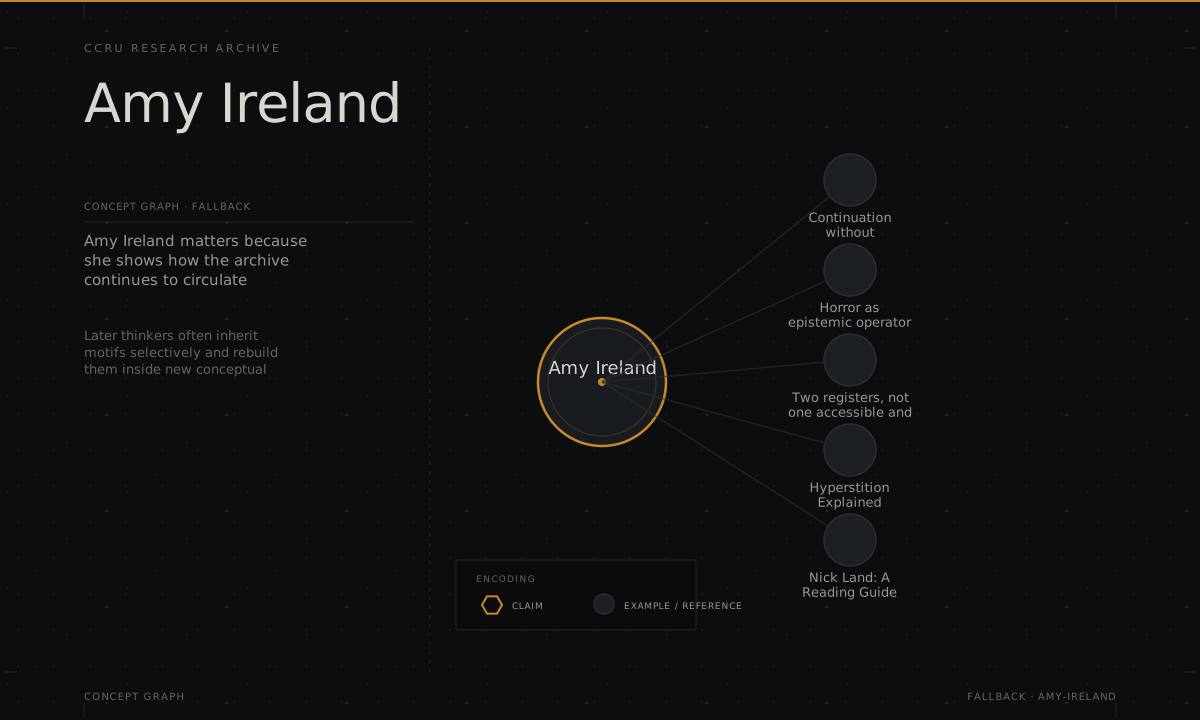
Amy Ireland matters because she shows how the archive continues to circulate through later debates about fiction, recursive culture, AI-adjacent thought, and aesthetic afterlives.
Core argument
Ireland is a later relay, not an origin figure. She helps readers see how archive motifs travel forward into new vocabularies.
Her importance lies in afterlife and recombination. She demonstrates how the archive survives through reinterpretation rather than simple preservation.
Worked examples
These named texts, talks, sites, and records show where the argument becomes concrete.
Hyperstition New Weird 1 Record
"Hyperstition New Weird 1" is a good checkpoint because it keeps Amy Ireland inside scene evidence rather than later reputation.
Xenosystems Home Record
"Xenosystems Home" is a good checkpoint because it keeps Amy Ireland inside scene evidence rather than later reputation.
What Is Hyperstition Guide
"What Is Hyperstition" widens Amy Ireland back into the larger CCRU field instead of treating the figure as self-explanatory.
Hyperstition Concept
"Hyperstition" names one recurring pressure that helps Amy Ireland make sense beyond biography alone.
Common misreadings
These are the recurring simplifications, exaggerations, and misreadings that make the subject look flatter than it is.
- Later uptake preserves the CCRU unchanged.
Later thinkers often inherit motifs selectively and rebuild them inside new conceptual scenes.
Significance
Ireland matters because she helps connect the archive to contemporary readers interested in recursion, fiction, intelligence, and later speculative culture.
Stakes of this figure
Writer and theorist whose work helps connect the archive to contemporary debates about fiction, AI, aesthetics, and the afterlives of theory.
Periodisation
- 2010s onward
Key works for entering the figure
- Amy Ireland Forever
- Amy Ireland—Noise An Ontology of the Avant-Garde
References
Records cited
These linked sources are the quickest way to test the argument against named materials rather than second-hand summary.
Hyperstition New Weird 1 Record
"Hyperstition New Weird 1" ties Amy Ireland to a document, lecture, or interview you can actually test.
Xenosystems Home Record
"Xenosystems Home" ties Amy Ireland to a document, lecture, or interview you can actually test.
What Is Hyperstition Guide
"What Is Hyperstition" shows what changes once Amy Ireland is read comparatively rather than mythically.