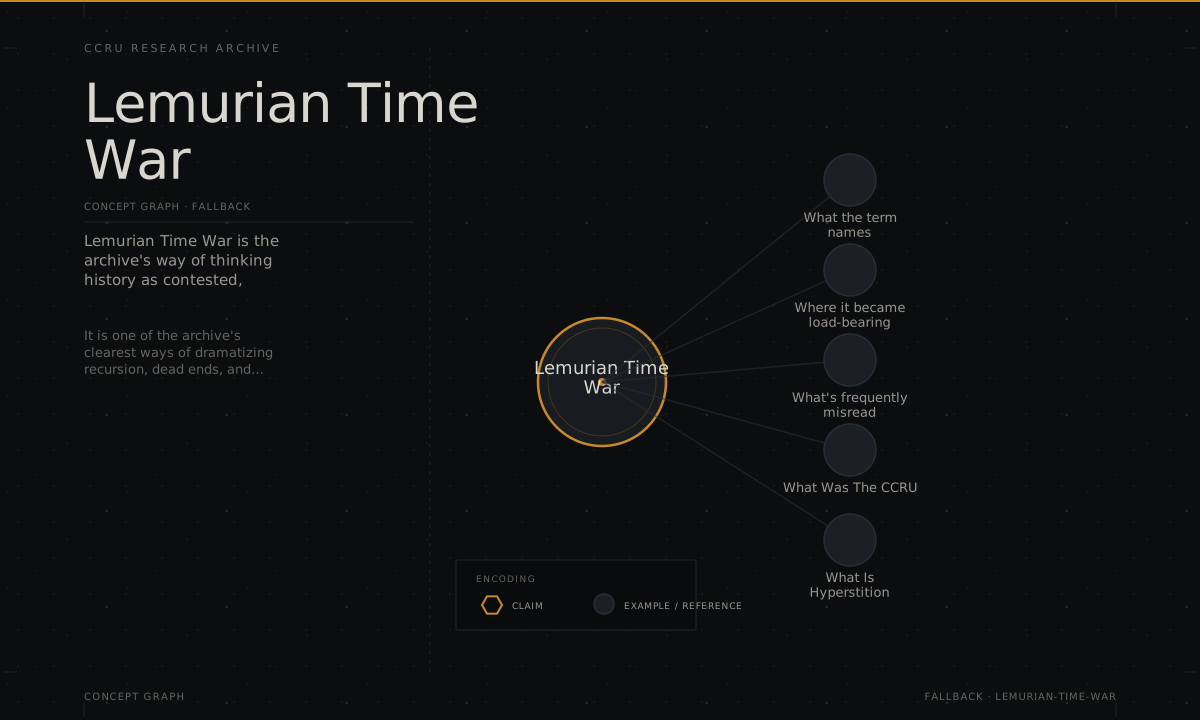
What the term names
The smallest unit of work the term does is this: it licenses reading a present phenomenon as the re-entry of a defeated branch rather than as survival, influence, or revival. A hyperstitional fiction in the late 1990s is, on this reading, not borrowing Lemurian imagery — it is a vehicle through which a Lemurian line routes itself forward. The Vauung's Lair discussions make the commitment casually explicit when they refer to 'ancient Chinese (late Lemurian) time sorcery': the Yijing is being read as a surviving artefact of a Lemurian temporal technology, not as its analogue. The 'late Lemurian' parenthetical is the model compressed into a phrase — present systems as residues of a defeated branch.
Distinguish sharply from alternate-history fiction. Alternate history posits a counterfactual branch and narrates it as sealed-off 'what if'. The Lemurian Time-War posits branches that are not sealed: the defeated timeline leaks, and the present is partly constituted by those leaks. Alternate history is comparative and hypothetical; the Time-War, as the term is used here, is operational and haunted. One produces parallel worlds as a reading exercise; the other proposes the current world as a contested outcome.
Where it became load-bearing
The cycle of texts collected in Ccru: Writings 1997–2003 (Time Spiral Press / Urbanomic, 2015/2017) is, by the volume's own organisation, where the concept stops being motif and becomes method — the Mu archive, the Architectonic Order of the Eschaton versus the Pandemonium/Lemurian insurgency, the dating of incursions. Mark Fisher's 'Lemurian Time-War' essay, collected in that volume, is standardly treated as the clearest operational statement of the apparatus as formal model rather than aesthetic.
The Numogram materials in evidence support the adjacent claim. At Vauung's Lair, the hexagram/zone mappings casually treat the Yijing as 'ancient Chinese (late Lemurian) time sorcery' — meaning the hexagram is read as a surviving Lemurian temporal technology, with the outer zones (0,3,6,9) excluded as 'hyper-temporal triadic Abomenon' lying outside linear time. That is the model doing live work: present numerical systems as residues, and time itself as layered rather than linear. Suzanne Treister's HEXEN 2.0 (Black Dog, 2012) is named in the brief as a later diagrammatic mapping of the cluster; its specific graphical commitments are not quoted from retrieval here.
What's frequently misread
The dominant, actually-circulating misreading: that the Lemurian material is occult dressing — Lovecraft homage with footnotes, theosophical kitsch repurposed for texture. On this reading the lemurs, the sunken continent, the Mu-dating and the pulp-horror register are decorative, and one can strip them off to find a 'real' argument underneath about capital, cybernetics, or time. The misreading is comfortable because it lets the reader keep a linear-historical frame while enjoying the imagery.
Refuse the strip-off move. The apparatus is the argument. The claim that time is a branching field with active residues cannot be stated neutrally and then illustrated, because the claim is that certain fictions are themselves the vehicles by which defeated branches act. Remove the Lemurian machinery and you do not recover a cleaner thesis — you recover linear time, which is what the cycle was built to contest. The pulp register is load-bearing: hyperstition requires carriers lurid enough to travel.
A secondary misreading worth flagging: treating 'Time-War' as metaphor for cultural struggle (modernity vs. tradition, etc.). Within the cycle it is not metaphor — the referent is branches, residues, and re-entries at the level of time itself; cultural conflict is a surface symptom.
Deepest single document: Ccru: Writings 1997–2003.
Lemurian Time War is the archive's way of thinking history as contested, recursive, and haunted by dead branches that do not stay gone. Time behaves less like a line than like a field of returns, residues, and out-of-sequence arrivals.
Core argument
The lemurian motif is a model of nonlinear temporality. It shows why ghosts, pirates, residues, and failed branches keep reappearing in the archive.
The concept makes history active rather than neutral. Time becomes a contested field rather than a passive container.
Worked examples
These named texts, talks, sites, and records show where the argument becomes concrete.
Ghost Lemurs Of Madagascar Record
Burroughs, lemurs, extinction, and retroactive capture make the mechanism visible. It makes Lemurian Time War checkable against a concrete archive object.
ccru.net Home Record
The old web interface shows how zones, links, and presentation became part of the argument. It makes Lemurian Time War checkable against a concrete archive object.
Nick Land Person
"Nick Land" shows who carries, translates, or contests Lemurian Time War in practice.
What Was The CCRU Guide
"What Was The CCRU" keeps Lemurian Time War attached to a guide-length argument and route map.
Archive instrumentOpen the Buried Dates circuitThe reviewed circuit is the strongest Time Engine route for Lemurian time-war because it separates the fiction's asserted dates from the real publications that carry them.
Common misreadings
These are the recurring simplifications, exaggerations, and misreadings that make the subject look flatter than it is.
- The lemur motif is just weird decoration.
It is one of the archive's clearest ways of dramatizing recursion, dead ends, and spiral time.
Significance
This concept matters because it gives newcomers a memorable route into the archive's nonlinear model of time without requiring immediate mastery of its strangest language.
Working definition
A CCRU phrase for temporal conflict in which extinct, spectral, or unrealized branches of history keep acting on the present.
Representative extracts
Mechanism · Ghost Lemurs of Madagascar · 00:11:03
in the tale Lemurian Time War, the writer, William Boros, is the main character. He operates in the past through another person, the Captain Mission, who lived many centuries earlier than Boros.
Why this matters: Here the mechanism gets its plainest statement: Burroughs acting on the eighteenth century through Captain Mission models the retroactive, cross-temporal agency the time war concept depends on.
Stakes · Ghost Lemurs of Madagascar · 00:24:59
the lemurs of madagascar that they mention, and all the time as a sort of gate or some sort of civilization key, that continues to come along even though they don't exist anymore.
Why this matters: This is the extinction argument in compressed form: a vanished lineage that still operates as a gate is precisely what the record means by dead branches acting on the present.
History · Ghost Lemurs of Madagascar · 00:38:22
This is what Helena Martins will talk about in the text: Performance in the Spiral Time, when she mentioned the ritualism of Congadas.
Why this matters: The reference to Martins and the Congadas documents the concept in reception, with spiral time tested against Afro-Brazilian ritual practice rather than confined to CCRU's own mythos.
Style · Ghost Lemurs of Madagascar · 00:11:03
this meeting of Boros and Captain Mission leads to another knowledge of time, Non chronological but spiral.
Why this matters: The spiral figure supplies the record's temporal geometry, replacing the single forward line with a shape in which separated moments can keep meeting and modifying each other.
References
Records cited
These linked sources are the quickest way to test the argument against named materials rather than second-hand summary.
Ghost Lemurs Of Madagascar Record
Burroughs, lemurs, extinction, and retroactive capture make the mechanism visible. Use it to test Lemurian Time War against source material rather than summary.
ccru.net Home Record
The old web interface shows how zones, links, and presentation became part of the argument. Use it to test Lemurian Time War against source material rather than summary.
What Was The CCRU Guide
"What Was The CCRU" widens Lemurian Time War through linked sources, people, and sections.