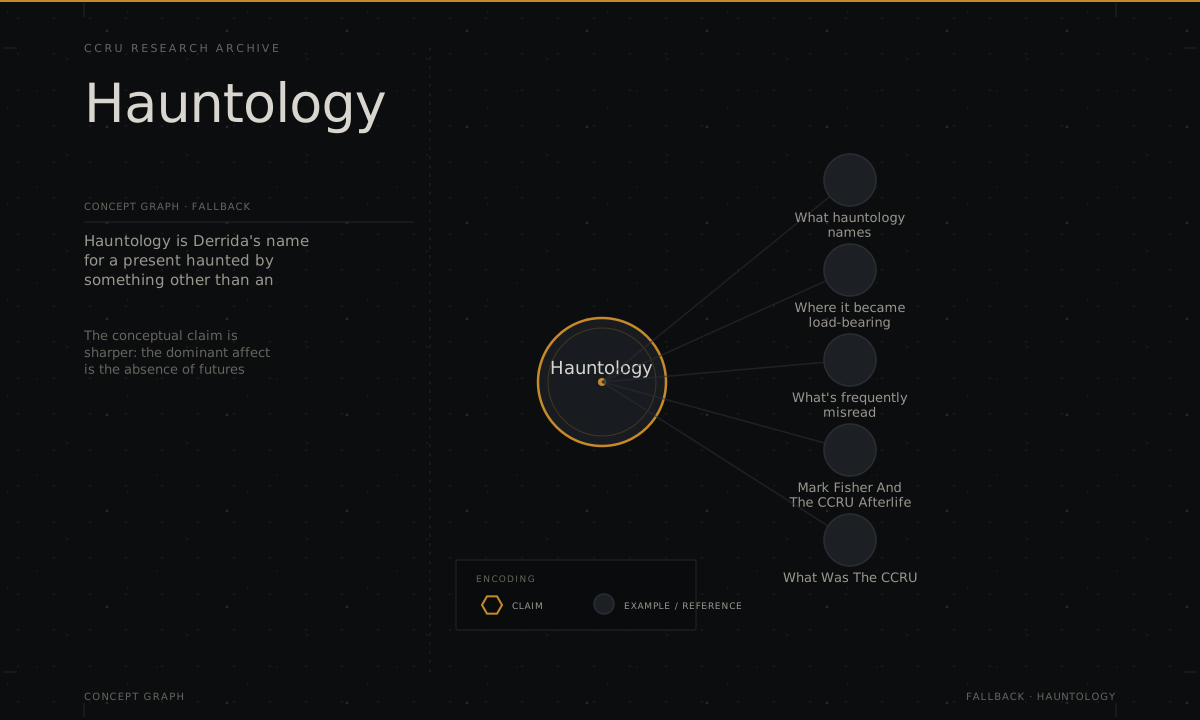
What hauntology names
The closest adjacent term, and the one readers constantly collapse it into, is nostalgia. Distinguish them operationally. Nostalgia points backward and wants the past back. Hauntology points at the present and asks why it cannot generate a future that feels like the future — why the twenty-first century aesthetically recycles the twentieth. Nostalgia is about longing; hauntology is about blockage. If your reading of an object ends with 'they miss the old days,' you have not performed the operation. If it ends with 'this object registers a future that was promised and then withdrawn,' you have.
The smallest unit of work the term does is this: take a cultural artefact, identify the specific lost future it mourns, name the mechanism (for Fisher, capitalist-realist foreclosure) that cancelled it. Without those three moves, the term is decorative.
Where it became load-bearing
Derrida coined the term in Specters of Marx (Routledge, 1994), where it names a present haunted by revolutionary futures that neither arrived nor died — ontology rewritten as hauntology, being rethought as being-haunted. In Derrida the concept is primarily an argument about time, presence, and the spectral debt the living owe to the not-yet and the no-longer. It is philosophically load-bearing but culturally diffuse.
The term becomes operational — capable of diagnostic work on specific objects — in Fisher's Ghosts of My Life: Writings on Depression, Hauntology and Lost Futures (Zer0 Books, 2014). Fisher's innovation is to periodise. He binds hauntology to a specific conjuncture: the neoliberal present in which cultural time stalls and the twentieth century's unrealised futures (social-democratic, psychedelic, modernist, rave) return as ghosts inside twenty-first-century production. The sonic register where this became most audible was the Hyperdub catalogue, which Fisher treated as the scene where the diagnosis could be heard rather than merely argued.
This is why the concept does different work in the two authors. Derrida's hauntology is an ontological claim about time and the spectral. Fisher's, without breaking with Derrida, is a periodising claim about a culture that has lost the capacity to produce the new. If you cite Derrida to license a reading of vinyl crackle, you are running Fisher's operation under Derrida's name.
What's frequently misread
The circulating misreading is that hauntology means 'aesthetics of the recent past' — a warm, analogue, slightly spooky retro sensibility. On that reading, anything with tape hiss, VHS tracking lines, or library-music samples qualifies. This flattens the concept into a mood board and strips out the thesis that carries its weight: the lost-future thesis. Without that thesis the term stops doing diagnostic work and becomes a genre label for a curated playlist.
The correction is not pedantic. In Ghosts of My Life, Fisher distinguishes hauntology from nostalgia precisely because it is a response to a blockage in cultural time — the condition of living inside a present that cannot imagine its own succession. Crackle, grain, and decay matter in hauntological work because they index the material failure of a promised future to arrive, not because old media sounds nice. Strip the politics and you are left with stylistics; at that point you are describing something real but you are not using Fisher's term. Use another one.
A secondary misreading treats Fisher and Derrida as interchangeable. They are not. Derrida's concept licenses Fisher's but does not do Fisher's periodising work. For orientation on why Fisher matters distinctively within the CCRU orbit, see Mark Fisher; for the primary document on the operation itself, read Ghosts of My Life.
Ghost Lemurs of Madagascar
My name is Eduardo and together with Erika I will be hosting the Ghost Lemurs of Madagascar podcast. This podcast will focus on collectives and groups that work with political action, with field reproduction and with artistic practice.
Hauntology is Derrida's name for a present haunted by something other than an ordinary past — by futures that did not arrive. Mark Fisher reworks the term into a periodising diagnosis of early twenty-first-century culture.
Core argument
Hauntology is about lost futures, not nostalgia. Treating it as a fancy word for missing the past collapses the concept's point: it names something pressing forward from a future that did not arrive.
Fisher's hauntology is substantively different from Derrida's. Derrida coined the term in a philosophical register; Fisher used it to make a periodising claim about the early twenty-first century. The two uses are connected but not interchangeable.
Worked examples
These named texts, talks, sites, and records show where the argument becomes concrete.
k-punk Home Record
k-punk Home preserves an interface and circulation surface, not just a detachable text. It makes Hauntology checkable against a concrete archive object.
Ghost Lemurs Of Madagascar Record
Burroughs, lemurs, extinction, and retroactive capture make the mechanism visible. It makes Hauntology checkable against a concrete archive object.
Mark Fisher Person
"Mark Fisher" shows who carries, translates, or contests Hauntology in practice.
Mark Fisher And The CCRU Afterlife Guide
"Mark Fisher And The CCRU Afterlife" keeps Hauntology attached to a guide-length argument and route map.
Common misreadings
These are the recurring simplifications, exaggerations, and misreadings that make the subject look flatter than it is.
- Hauntology is just nostalgia for old music.
The conceptual claim is sharper: the dominant affect is the absence of futures that should have arrived, not the presence of pasts being mourned.
Significance
Hauntology offers a precise diagnostic for periods in which the future feels formally cancelled — which makes it more, not less, useful as the AI-and-acceleration debate intensifies.
Working definition
Derrida's term for a present haunted by lost futures rather than ordinary pasts, reworked by Mark Fisher into a periodising diagnosis of early twenty-first-century culture.
Representative extracts
Definition · Mark Fisher — k-punk: hauntology and lost futures · essay
Hauntology, in the strict sense, is not nostalgia for the past but the felt pressure of futures that did not arrive.
Why this matters: The Fisher reworking of Derrida in compact form: the affective texture of absent arrivals, not remembered pasts.
Mechanism · k-punk (Mark Fisher's blog archive) · archived blog post
Yet spectres are unsettling because they are that which can not, by their very nature (or lack of nature), ever be fully seen; gaps in Being, they can only dwell at the periphery of the sensible, in glimmers, shimmers, suggestions.
Why this matters: Fisher moves the ghost from imagery to ontology: haunting names a structural non-presence, and the concept's characteristic aesthetics of indistinctness follow from that incapacity rather than decorate it.
Stakes · Ghost Lemurs of Madagascar · 00:24:59
the lemurs... gain this other sense of being ghostly creatures... that continues to come along even though they don't exist anymore.
Why this matters: Hauntology converges with the lemurian-time-war material at the figure of persistence-without-existence: extinct branches that continue to act on the present.
History · Mark Fisher — What Is Hauntology? · extracted passage
The concept of hauntology gained its second (un)life in the middle of the last decade. Critics were prompted to reach for the term again by a confluence of musical artists— Philip Jeck, Burial, the Ghost Box label, the Caretaker.
Why this matters: Anchors the concept's chronology: a named mid-2000s musical cohort converts Derrida's coinage into a periodising term, giving the revival a date and a canon rather than a mood.
References
Records cited
These linked sources are the quickest way to test the argument against named materials rather than second-hand summary.
k-punk Home Record
k-punk Home preserves an interface and circulation surface, not just a detachable text. Use it to test Hauntology against source material rather than summary.
Ghost Lemurs Of Madagascar Record
Burroughs, lemurs, extinction, and retroactive capture make the mechanism visible. Use it to test Hauntology against source material rather than summary.
ccru.net Home Record
The old web interface shows how zones, links, and presentation became part of the argument. Use it to test Hauntology against source material rather than summary.
Mark Fisher And The CCRU Afterlife Guide
"Mark Fisher And The CCRU Afterlife" widens Hauntology through linked sources, people, and sections.