Prose as argument
Distinguish sharply from speculative fiction and from literary theory. Speculative fiction invents worlds; literary theory analyses texts. Theory-fiction does neither. It argues — makes positive theoretical commitments about capital, time, intelligence, the Outside — but it argues through the operation of the writing rather than through propositional summary. A theory-fictional text cannot be fairly paraphrased; it can only be deployed. The CCRU's own preferred mode is narrative-citational because certain objects of thought — Barker's geotraumatics, the syzygetic couplings catalogued in the CCRU glossary Ccru: Writings 1997–2003 — refuse expository capture and become thinkable only through the apparatus that stages them.
becoming what they term, borrowing the phrase from Baudrillard, theory fictions, which means something like imaginary worlds that are not yet real but will become so in the future.
but will become so in the future. According to Baudrillard's account of theory fiction, whereas the utopian science fiction of the Renaissance described an ideal world
Where the method becomes load-bearing
The operation is already running across the late-1990s CCRU output. Consider the Barker-Hamilton geotraumatics material, in which every surface variation is read as marking 'a repression of some forgotten geotraumatic change that the variation helped stave off' Ccru: Writings 1997–2003 — a claim that depends entirely on the fictive Barker persona and his invented institutional setting to become operative. Consider the syzygy entries, where a single term is distributed across astronomical, anatomical, biological, mathematical, gnostic, cybergoth and 'Lemurian Time-Sorcery' registers in one glossary block Ccru: Writings 1997–2003: the argument about binary-synthesis-without-unification is performed by the register-shifting itself, not stated. Strip the apparatus and the theoretical content is not preserved but deleted.
The method becomes fully load-bearing outside CCRU proper in Cyclonopaedia: Complicity with Anonymous Materials (Reza Negarestani, re.press, 2008), whose argument about oil, Middle Eastern geopolitics and tellurian insurgency is staged through a recovered-manuscript frame and an unreliable author-function rather than stated in expository voice. Mark Fisher operates in a different register in K-Punk: The Collected and Unpublished Writings (Repeater, 2018), treating films, records and novels as theory-fictional documents to be diagnosed rather than interpreted — though Fisher's method is closer to theory-fictional reading than to theory-fictional writing, and this difference matters. For orientation across the broader cluster — cyberpunk prose, hyperstitional mechanics, numogrammatic fiction — see the section overview at /sections/theory-fiction-and-cyberstyle. This page handles the operational recognition problem.
The CCRU's early theory fictions
going to divide it into two parts. So first, the first part is going to focus on the CCRU's early theory fictions in which they time travel to a future where advanced biotechnology and AI are already a reality.
So first, the first part is going to focus on the CCRU's early theory fictions in which they time travel to a future where advanced biotechnology and AI are already a reality. And in particular, we're going to look at the work of the fictitious Professor D.C. Barker,
Refusing the 'stylish packaging' Reading
The dominant misreading treats theory-fiction as edgy stylistic packaging wrapped around real theoretical arguments that could be extracted and stated plainly. On this reading the fictions, pseudonyms and apocryphal citations are decorative — a goth literary finish over positions a patient commentator could restate in standard prose. Reject this. The CCRU position is the inverse: at least one strand of the argument is non-extractable. The invented-citation apparatus is not a dressed-up thesis; the apparatus is the thesis, because the claim is about what kinds of entities become operative when fictional citation structures are treated as real.
This is why theory-fiction is the prose surface of hyperstition rather than its promotional material. Hyperstition's core assertion — 'FICTIONS THAT MAKE THEMSELVES REAL = GIVES BIRTH TO PHENOMENAL REALITY' Numogramming the Yi Jing — is not a proposition that can be demonstrated from outside; it can only be executed in prose that acts as its own vector. A theory-fictional text that could be safely paraphrased would have already failed, because it would have conceded that the real argumentative work lives at the level of extractable proposition — exactly what the method denies.
Practical recognition test: if removing the narrative frame, the invented citations, or the register-shift leaves the argument intact, the text is speculative fiction with theoretical content, or theoretical writing with fictional examples. It is not theory-fiction. Theory-fiction is what breaks under that operation. For the deepest single-document encounter with the mode running at full intensity, read Cyclonopaedia.
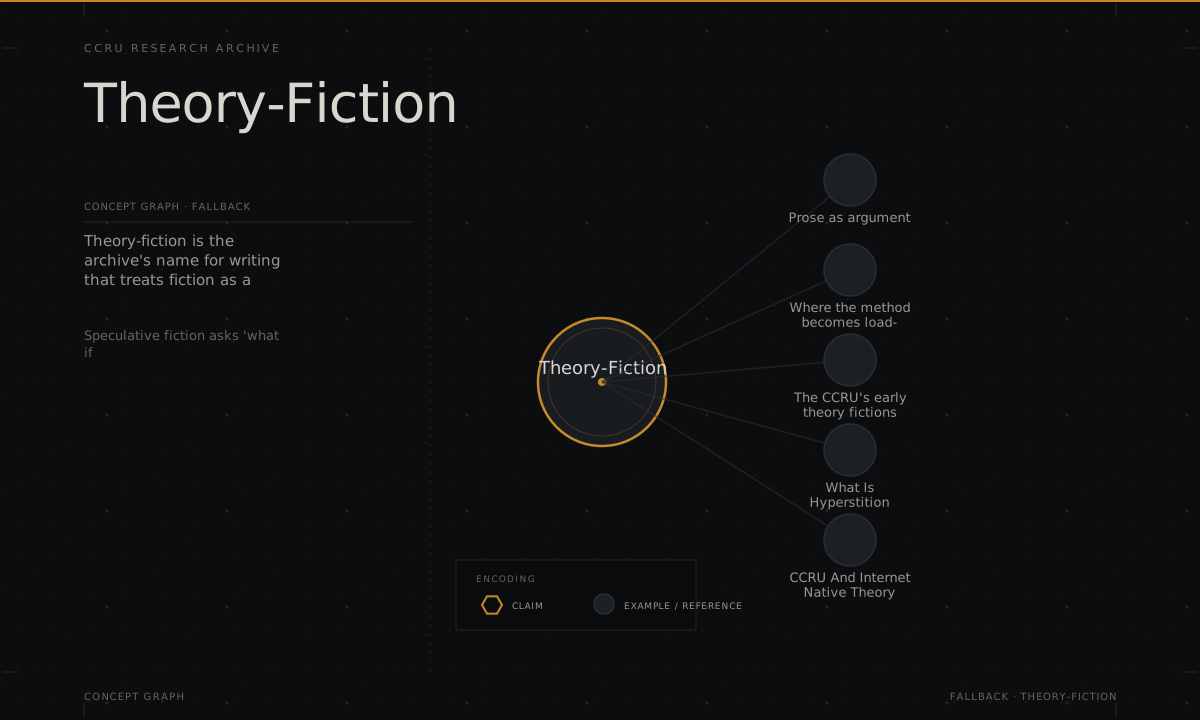
Theory-fiction is the archive's name for writing that treats fiction as a working theoretical operator rather than as a separate literary genre. Narrative and citation are recruited together because each does work the other cannot.
Core argument
Theory-fiction is a method, not a hybrid. Treating it as 'theory plus fiction' misses the point. The two registers are recruited together because each does work the other cannot.
Theory-fiction is the prose surface of hyperstition. Where hyperstition is the claim about how operative fictions work, theory-fiction is the writing technique that produces them in practice.
Worked examples
These named texts, talks, sites, and records show where the argument becomes concrete.
CCRU Lecture 1 Record
The lecture format preserves cadence, definition, and Warwick-era scene explanation. It makes Theory-Fiction checkable against a concrete archive object.
Hyperstition New Weird 1 Record
A spoken New Weird route keeps recursion, narrative machinery, and uptake in earshot. It makes Theory-Fiction checkable against a concrete archive object.
Nick Land Person
"Nick Land" shows who carries, translates, or contests Theory-Fiction in practice.
What Is Hyperstition Guide
"What Is Hyperstition" keeps Theory-Fiction attached to a guide-length argument and route map.
Common misreadings
These are the recurring simplifications, exaggerations, and misreadings that make the subject look flatter than it is.
- Theory-fiction is just speculative fiction with citations.
Speculative fiction asks 'what if?' and stays inside its frame. Theory-fiction recruits the frame itself as an argument and refuses to settle which register is doing the work at any given moment.
Significance
Theory-fiction is the archive's most portable inheritance for contemporary writing about AI, capital, and infrastructure: it offers a working method for serious arguments inside narrative and aesthetic registers.
Working definition
The archive's signature mode of writing in which narrative, persona, diagram, and citation are recruited together because each does conceptual work the others cannot.
Representative extracts
Definition · Hyperstition & The New Weird I — Entities and Worlds, Genres and Climates 1/4 · 00:00:49
what hyperstition does, and what it takes from the weird and the new weird, is that it turns the subject into a character.
Why this matters: Theory-fiction in compact form: the subject of an argument and the character of a fiction are no longer different positions to occupy.
Mechanism · Ghost Lemurs of Madagascar · 00:11:03
writing operates not as a passive representation but as an active agent of transformation... By writing a universe, the writer makes such a universe possible.
Why this matters: The active-agent claim is the operating premise of theory-fiction. Once writing is treated as world-making rather than reporting, the method follows.
Stakes · CCRU - Lecture 1 · 00:19:36
the CCRU see theory fiction as anticipating what is not yet real but will become so. Instead of renouncing reality altogether, as Baudrillard tends to do I think, the CCRU hold that there is always a distinction between what is presently imaginary and what is real
Why this matters: Marks the load-bearing divergence from Baudrillard: keeping the imaginary and the real distinct is what lets theory-fiction anticipate rather than dissolve into simulation.
Style · CCRU - Lecture 1 · 00:18:45
but also to theory as specific genres. For Baudrillard then, theory fiction named science fiction in the time of cybernetic capitals promised to realise all fictions and hence in some sense fictionalise all reality.
Why this matters: Supplies the Baudrillardian baseline the CCRU wrote against: a condition in which cybernetic capital realises fictions and fictionalises reality, so genre becomes a diagnosis rather than a shelf label.
References
Records cited
These linked sources are the quickest way to test the argument against named materials rather than second-hand summary.
CCRU Lecture 1 Record
The lecture format preserves cadence, definition, and Warwick-era scene explanation. Use it to test Theory-Fiction against source material rather than summary.
Hyperstition New Weird 1 Record
A spoken New Weird route keeps recursion, narrative machinery, and uptake in earshot. Use it to test Theory-Fiction against source material rather than summary.
Ghost Lemurs Of Madagascar Record
Burroughs, lemurs, extinction, and retroactive capture make the mechanism visible. Use it to test Theory-Fiction against source material rather than summary.
What Is Hyperstition Guide
"What Is Hyperstition" widens Theory-Fiction through linked sources, people, and sections.