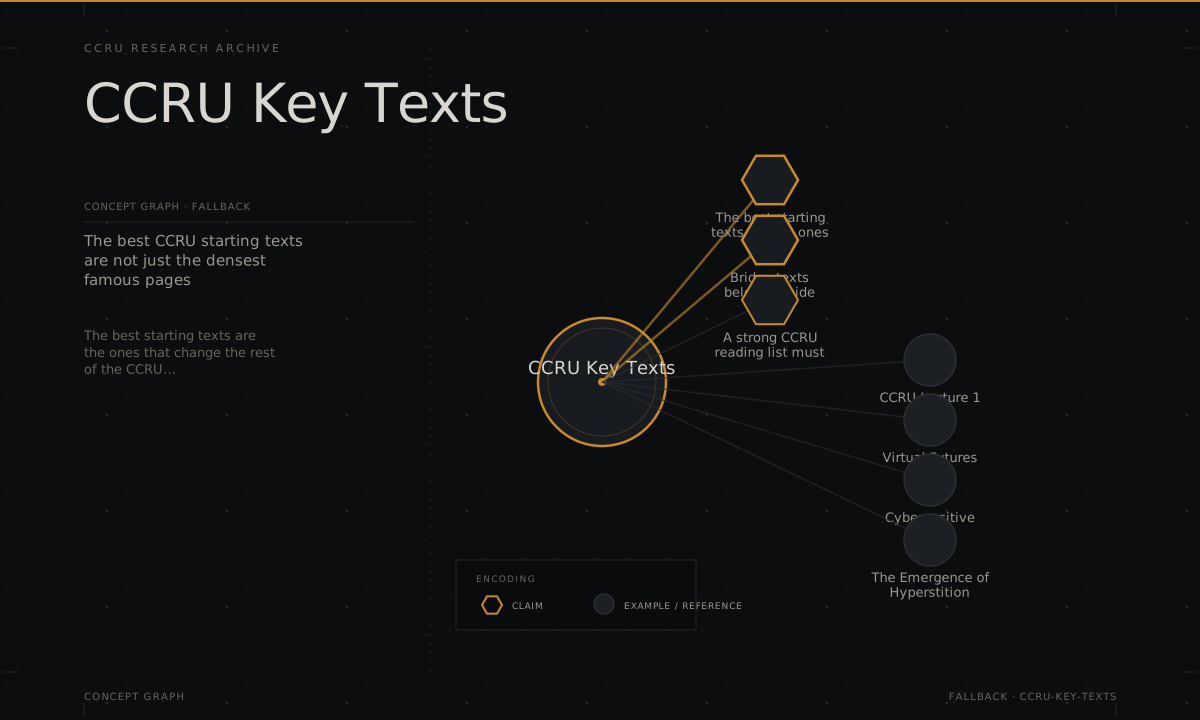
The best CCRU starting texts are not just the densest famous pages. They are the sources that give you scene orientation, one or two portable concepts, one bridge into public afterlives, and one or two primary texts that still retain the scene's pressure. A good first stack usually includes CCRU Lecture 1, Virtual Futures, Cyberpositive, The Emergence of Hyperstition, and one bridge source such as White Magic.
Key points
- A useful first stack mixes lectures, bridge texts, and primary works instead of starting from maximum density.
- The best key texts are chosen for explanatory leverage, not just canonical prestige.
- A starter stack should widen the CCRU field beyond one author while still keeping a few high-pressure sources in view.
Core argument
The best starting texts are the ones that change the rest of the CCRU field for you. A first stack should make later reading faster, not merely more intimidating. Example: CCRU Lecture 1 and Virtual Futures help later dense texts arrive with historical and tonal context.
Bridge texts belong beside primary texts. Without Fisher, introductory Land readers, or glossary-level explanations, the scene too easily collapses into atmosphere. Example: White Magic and A Nick Land Reader shorten the gap between explanation and primary material.
A strong CCRU reading list must widen beyond the familiar Land line. Otherwise the CCRU's cyberfeminist, para-academic, and collective strands remain invisible from the start. Example: Ritual / 0rphan Drift Archive and Luciana Parisi interviews change the proportions of the first stack immediately.
The best starting texts are the ones that change the rest of the CCRU field for you. A first stack should make later reading faster, not merely more intimidating.
The paratext problem
Anyone arriving at the CCRU through a search engine in 2024 hits a wall of paratext before hitting a text. Urbanomic markets *Ccru: Writings 1997–2003* with the line that the unit "does not, has not, and will never exist" (Urbanomic). Monoskop describes a group welding together "futurism, technoscience, philosophy, mysticism, numerology, complexity theory, and science fiction" (Monoskop). Neither sentence tells you what to read first. The reading order matters because the CCRU corpus is recursive: late texts presuppose the Numogram, the Numogram presupposes Lemurian time-sorcery, and Lemurian time-sorcery presupposes that fiction can operate on the real.
The thesis of this guide: there is no neutral entry point, and the common bad reading, treating CCRU output as either pure philosophy or pure fiction, breaks every text in the archive. Start instead with the texts where the operational claim is visible on the surface, then move outward to the mythos and inward to the number system.
Start with orientation, not maximum density
CCRU Lecture 1 is one of the best opening moves because it makes the early formation audible. It gives the reader something the denser pages often do not: pacing, sequence, and a sense that the archive was a scene before it was a canon. You hear movement between motifs rather than meeting them as a compressed wall. That matters because a strong first text should leave you with better questions, not just stronger intimidation.[1]
Virtual Futures (Book) belongs very early for a related reason. It places the CCRU inside a para-academic event culture and a wider scene of public interfaces. That changes how later texts land. Cyberpositive, for instance, reads differently once you understand that the CCRU was not only a shelf of essays but also a mode of staging, circulation, and scene-making. Orientation is not a soft option here. It is the thing that makes the harder pages more legible.
The single most useful first contact is Nick Land's "Meltdown" (1994), now bundled into the Urbanomic *Writings 1997–2003* collection (Urbanomic). Read it for the texture before the argument. The passage on "feral youth cultures" splicing "near rituals with innovated weapons, dangerous drugs and scavenged infotech" establishes the register the rest of the corpus will assume you accept. The same lecture series flags "Cyber Revolution" (1995) as Land's "most accomplished theory fiction" because *Meltdown* is "still more heavy on theory than fiction". That is a useful internal compass: the CCRU rates its own work by how far the fiction has displaced the theory.
Runaway capitalism has broken through all the social control mechanisms, accessing inconceivable alienations. Capital clones itself with increasing disregard for heredity, becoming abstract positive feedback, organizing itself.
This is the kind of sentence that justifies putting Cyberpositive in a first stack: it states the archive's velocity without commentary.
Archive instrumentMap the key textsThe key-text guide has a valid collected-writings node that gives readers a stable corpus-scale starting point.
Use one portable concept as a bridge
After the formation story, most readers need one concept that travels. The best candidate is usually hyperstition because it connects so much at once: fiction, feedback, media circulation, collective uptake, and the CCRU's weird relationship to narrative causality. The Emergence of Hyperstition works well here because it gives the term a source-level foothold. It lets the reader see why the concept became so portable without reducing it to vague internet folklore.
This is where the key-texts page should resist two temptations. One is to leap straight from a definition to grand theory. The other is to let the concept float free of named material. Hyperstition only becomes useful when it is tied to actual lectures, essays, and motifs. That is why pairing the text page with sources like Ghost Lemurs of Madagascar or the Hyperstition exhibit works so well: you watch a concept move through tone, voice, and form rather than only through summary.
What fiction is doing in these texts needs stating directly, because the search-engine summaries get it wrong. Theory-fiction in the CCRU sense anticipates "what is not yet real but will become so". There is still "a distinction between what is presently imaginary and what is real", but the imaginary is a staging ground for the real. This is the operational core of hyperstition, and it is why *Abstract Culture*, the zine series Ccru ran in the late nineties, matters as a second stop. Monoskop hosts the *Digital Hyperstition* issue (1999) as a PDF (Monoskop). Read it after *Meltdown* and the unit's house procedure, fiction as a vector that produces its referent, becomes legible.
Pandemonium and the Numogram
The third text is harder to recommend cleanly. *Pandemonium* and the Numogram material, collected in the Urbanomic volume and indexed in the Spanish translation's table of contents under "Mapeado temporal numogramático" and "La cabala al descubierto" (Internet Archive), is where most readers either commit or leave. The numerical apparatus carries the argument. The lecture material insists that "numeracy is ordinality" and that what matters is "the calcular indefiniteness of highly general numbers", a thinking "directly and effectively exterior" to the Platonism that "conflates thoughts, models of real phenomena, for things". The Numogram is a diagram for thinking outside representation. Reading it as occult cosplay misses the philosophical claim; reading it as pure philosophy misses that it was built to be used in fictions about Lemurian time-sorcery (Urbanomic).
Pandemonium is the complete system of Lemurian demonism and time sorcery. It consists of two principal components: Numogram and Matrix.
Keep one flagship primary text in the stack
A starter stack still needs at least one source that feels unmistakably like the CCRU at full pressure. Cyberpositive is one of the clearest options for that role. It keeps style, systems language, contagion, and theoretical compression in play without forcing the reader to start there cold. It is not easy, but it becomes much more usable once orientation and one concept are already in place.
Another strong route is A Nick Land Reader rather than a raw plunge into the entire Land corpus. The reader works because it curates pressure instead of assuming readers should assemble it themselves from scattered later reputations. This is one of the most important principles of a key-texts page: the best first versions of hard material are often editorially staged versions rather than maximal original density.
The cyberfeminist wiring
Fourth: the fiction proper. Sadie Plant's contribution to the Warwick *Virtual Futures* milieu, and the wider cyberfeminist register the unit absorbed, is best approached through the *Virtual Futures* anthology material, where passages like the Circuit Boy sequence, "Let me corrode your defenses... Let me buttfuck your irresistible chrome-plated ass", and the DNA sluts scanning the Contested Zone for Big Daddy Mainframe, establish that the CCRU's prose was always closer to VNS Matrix than to Cambridge analytic philosophy. New readers who arrive via Land's later political trajectory tend to be surprised by this. They should not be. Plant co-founded the unit, and the cyberfeminist wiring is load-bearing.
Add one bridge into the public afterlife
A serious CCRU reading list also needs one bridge text from the afterlife. Mark Fisher's White Magic works well because it translates CCRU motifs into a public critical idiom without dissolving them into cliché. It is especially useful for readers who arrived through culture writing, music, or public theory rather than through philosophy first. The point of including Fisher is not to replace the primary material. It is to make later circulation visible as part of the CCRU's living history.
If your route in is more explicitly political, Robin Mackay's #Accelerate reader becomes another useful bridge. If your route in is more online and systems-oriented, xenosystems and the internet-native guide become relevant. But some bridge belongs in the first stack because the public afterlife explains why the CCRU still generates searches in the first place. A list of “key texts” that ignores later relays misunderstands the object.
Widen the stack beyond the familiar Land line
One of the quickest ways to make a reading list worse is to let it become a single-author myth. That is why the stack should widen early. Ritual / 0rphan Drift Archive and the Luciana Parisi interview matter because they shift the CCRU's proportions. They force the reader to see collective practice, media ecology, cyberfeminist lines, and technical subjectivity rather than only a systems-philosophy lineage. The scene becomes historically truer the moment this widening happens.
This is not a matter of fairness alone. It is also a matter of understanding. Non-Land routes change what the CCRU's terms mean. Hyperstition, contagion, interface, recursion, and cyberculture do not look the same once Orphan Drift or Parisi enter the picture. The best key-texts guide therefore works like a pressure-balancing device: enough Land to register the scene's intensity, enough widening material to stop that intensity becoming the whole story.
There is a real disagreement inside the archive about which Land counts. The Urbanomic edition canonises the 1997–2003 stretch, the period of collective authorship, Lemurian mythos, and the Numogram (Urbanomic). The *Recursed 2005–1995* compilation extends the timeline backwards and forwards through *Abstract Culture* swarms and "inconclusive shards" (Urbanomic). Edmund Berger's *Underground Streams* traces hyperstition itself as a genealogy that exceeds Land (Monoskop). Different editors draw the unit's perimeter differently. A reader who only takes Land takes a fragment.
Cybergothic and the Barker scale
Fifth and last on the core list: the cybergothic material, including the "catastrophic transition to a post-Saurian megafauna regime" passage that frames Earth history as "neo-Hadean resurgence". This is where the CCRU stops resembling continental philosophy and starts resembling a William Gibson novel rewritten by a geologist. The Internet Archive hosts the full *Writings 1997–2003* PDF including the Barker scale of intensities running "between human agencies (below 1-Barker) and Unuttera... at 9-Barkers" (archive.org _hocr.html)). Read the Barker material after *Pandemonium* and the zone-tag apparatus that "affect zonings and de-zonings, inter-shufflings, groupings, insertions and extractions, operated according to concrete rules" resolves into a working system rather than ornamental jargon.
What makes a text a real entry point
A real CCRU entry-point text does four things. It clarifies context. It makes at least one portable concept legible. It exposes some of the CCRU's actual stylistic pressure. And it opens outward into a larger field of people, sections, and works. CCRU Lecture 1, Virtual Futures, Cyberpositive, The Emergence of Hyperstition, White Magic, and a widening non-Land route all satisfy those functions in different ways. That is why they belong near the top of the stack.
Searchers for “best starting texts” are usually asking for a sequence that preserves both readability and force. The published works layer is finally deep enough that this question matters. A key-texts guide is therefore not filler. It is part of the editorial search strategy and part of the publication's responsibility.
What changes after this guide
What changes after this guide. A reader who follows the order, *Meltdown*, *Abstract Culture: Digital Hyperstition*, *Pandemonium* and the Numogram, the cyberfeminist *Virtual Futures* material, then the cybergothic and Barker-scale texts, will stop asking whether the CCRU was serious. The question dissolves. The unit produced operational fictions whose seriousness is measured by what they cause downstream, not by whether their authors believed in Lemurians. Approach the corpus in publication-order or alphabetical-order and it reads as a hoax with footnotes. Approach it through the procedural claim that fiction is a route from the imaginary to the real, and the Numogram, the zone-tags, the feral youth, and Circuit Boy are all running the same protocol.
Worked examples
These named texts, talks, sites, and records show where the argument becomes concrete.
CCRU Lecture 1 Record
The best first source if you need the formation story and the scene's tonal register in one place.
Virtual Futures (Book) Text page
A public-facing frame that keeps the CCRU tied to event culture, para-academic circulation, and scene infrastructure.
Cyberpositive Text page
A flagship primary text once you have enough context to recognize style as method rather than noise.
The Emergence of Hyperstition Text page
A concept-defining text that gives one of the CCRU's most searched terms real source traction.
Tensions and limits
Any key-texts list is a wager: it favors explanatory leverage over total coverage.
A starter stack that is too bridge-heavy can make the material seem tidier than it is; a stack that is too primary-text-heavy can make it look unreadable.
The most famous texts are not always the best first ones, but avoiding them completely would hide what gives the CCRU its pressure.
Common misreadings
These are the recurring simplifications, exaggerations, and misreadings that make the subject look flatter than it is.
- A recurring distortion
The most common distortion is to treat the hardest and most notorious texts as the obvious beginning. That choice usually hands the scene over to atmosphere and later myth before the formation, concepts, and media ecology are in place.
- A recurring distortion
The second distortion is to let a reading list become a single-author canon. A serious starter stack has to hold together Land, Fisher, hyperstition material, Virtual Futures, and at least one widening route into the non-Land or cyberfeminist lines.
Significance
Searchers for 'CCRU key texts' or 'best starting texts' are usually asking for triage, not completeness. They want a stack that makes the scene usable fast.
This matters because the published works layer is now deep enough to overwhelm a newcomer. A key-texts guide turns that breadth into a practical reading instrument.
References
Records cited
Linked archive records for this guide. Numbers correspond to the footnote markers in the body above.
CCRU - Lecture 1 Record
A first-contact source because it places scene formation and tone in sequence.
Reader questions
What are the best starting texts for the CCRU?
The best starting texts are not just the loudest names. Strong entry points usually combine one scene-setting text, one concept-heavy piece like a hyperstition source, and one afterlife relay such as K-Punk or a later anthology framing.
Why not just read Nick Land first?
Because that route can flatten the archive too early. A better start shows how Land sits alongside other lines of work, including cyberfeminism, scene formation, para-academic events, and later public relays.
Reading routes through this guide
Featured exhibit
Hyperstition in Primary Sources
A curated exhibit of the pages, talks, and texts that make hyperstition legible through actual archive evidence.
Featured reading path
A short guided sequence for readers who want the clearest first path through the CCRU site.