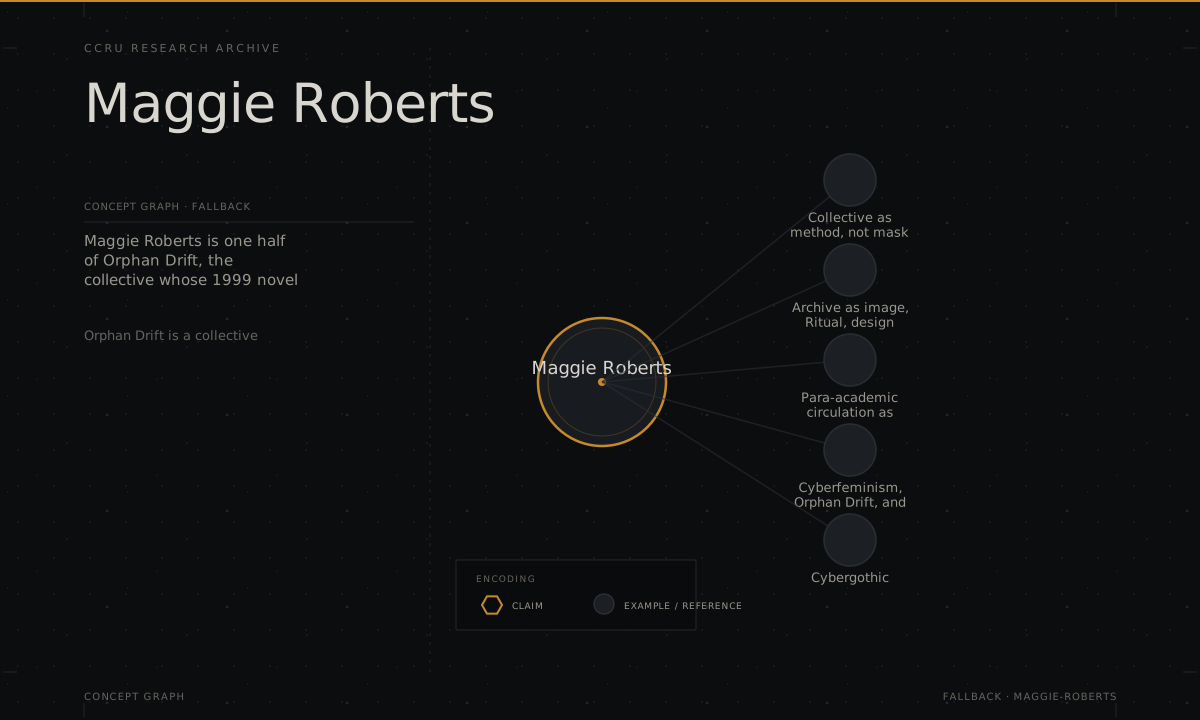
Collective as method, not mask
This is why reading Roberts 'out' of Orphan Drift misses the point twice. It re-individualizes what was deliberately pooled, and it treats the pooling as a stylistic choice rather than a theoretical commitment. The CCRU orbit contained other collective or pseudonymous signatures — Ccru itself, the Sightings texts attributed to Pseudanon — but Orphan Drift is the longest-running and most consistent working-out of the premise that an archive's mode of circulation is part of its content.
Archive as image, Ritual, design
The 1999 novel Orphan Drift (reissued by Urbanomic / The Vampire Salon, 2020) is the load-bearing document, and — on the evidence of the book itself and its reissue paratext — it is not a novel in any ordinary sense. It is a cut-up, image-saturated, ritually-structured block of prose that treats the page as a surface for visual and typographic decision rather than as a neutral carrier of text. This is Roberts's specific move, legible across the collective's practice from 1996 forward: the archive reproduces itself as image and ritual, not as text-only. Where the CCRU's text output leans on the essay and the numbered fragment, Orphan Drift routes the same theoretical commitments through image, video, installation, sound, and divinatory structure. (The fine-grained characterization here rests on the primary texts themselves rather than on retrievable secondary commentary; readers should treat it as a reading, not a citation.)
The intellectual claim embedded in this is load-bearing for the whole cluster. If hyperstition works — if fictions become real through the loops by which they are transmitted — then the medium of transmission cannot be bracketed as 'presentation.' A hyperstitional claim delivered in a peer-reviewed journal has already been falsified by its delivery system. Orphan Drift's ongoing practice (1996–) is the cluster's most sustained experiment in matching the carrier to the payload. Without it, CCRU collapses back into a literary-philosophical current with unusually lurid vocabulary.
Para-academic circulation as infrastructure
Roberts and Orphan Drift operated in proximity to a specific infrastructure — Mute magazine, Abstract Culture, the gallery and club circuits that overlapped Warwick's extramural activity — and that infrastructure is not incidental background. (The specific circulation claim here is drawn from the editorial framing of this portrait rather than from the retrieval base; the one retrieval chunk touching Roberts merely lists her among CCRU-adjacent names.) It is the condition under which the work could be what it is. University presses would have demanded individuation; art-world monographs would have demanded authorial narrative; trade publishing would have demanded the novel behave as a novel. The para-academic and art-para-academic zones allowed the collective signature and the cross-medium practice to survive without being translated back into legible product categories.
This is where Roberts's position inside the cluster is methodologically distinct from, say, Mark Fisher's or Kodwo Eshun's. Fisher found a voice that scaled into mass circulation; Eshun's work scaled into academic theory and curatorial practice. Roberts's Orphan Drift remains deliberately harder to extract from its original circulation context, and that non-extractability is the point. The work refuses to be ported into the formats that would reward it with individual recognition.
The reception tension the work produces
There is a genuine internal tension here, and it must be named rather than smoothed over. The collective signature produces a reception problem that the practice itself cannot solve: individual contribution is structurally illegible, but any attempt to make it legible re-installs the author-function the work was built to refuse. A portrait of Roberts faces this directly. One can mark her presence — her sustained role across the collective's long run, her visual and ritual vocabulary, her continuing work with Mukherjee as the spine of the project — without pretending to extract a separable 'Roberts oeuvre' from the pooled signature.
The common confusion — that Roberts is interchangeable with Orphan Drift the label — is wrong in one direction and right in another. Wrong, because Orphan Drift has had multiple members and Roberts is one specific practitioner inside it with her own working habits, exhibitions, and interventions. Right, because the work itself was built to make that kind of extraction feel slightly off, slightly like a category error. The honest portrait holds both at once: Roberts is distinct, and the distinctness cannot be made to behave like a single-author career without falsifying the premise.
Why the cluster cannot lose this
Strip Orphan Drift out of the CCRU archive and the cluster loses its only sustained demonstration that its claims about subjectivity, ritual, and hyperstition can be practiced rather than only argued. The rest of the corpus argues that fictions become real through their circulation; Orphan Drift runs the experiment. The rest argues that the individual author is a capitalist sorting effect; Orphan Drift refuses the signature. The rest argues that text is one transmission channel among many; Orphan Drift works across image, ritual, sound, and design as a matter of theoretical consistency, not aesthetic taste.
Roberts's specific weight inside this is the duration. A collective authorship project that survives one publication is a stunt; one that runs for decades, through reissues and new collaborations, is an institution — an institution built precisely to refuse what institutions usually do. That is the contribution the cluster cannot lose, and the deepest single entry point remains the text that first made the method visible: Orphan Drift.
Maggie Roberts is one half of Orphan Drift, the collective whose 1999 novel and ongoing practice keep the CCRU's interest in ritual, image, and collective experiment alive. Her position is distinct from Orphan Drift as a label and worth marking on its own terms.
Core argument
Roberts is a distinct curatorial-artistic voice inside Orphan Drift. Treating Orphan Drift as one anonymous label loses the specific work each collaborator brings to the project.
The Orphan Drift project is part of the CCRU's wider methodological argument. It demonstrates that the archive's conceptual commitments can be carried by collective artistic practice, not only by individual prose.
Worked examples
These named texts, talks, sites, and records show where the argument becomes concrete.
Cyberfeminism, Orphan Drift, and the Non-Land CCRU Guide
The guide page that places Roberts and Orphan Drift inside the wider non-Land map.
Cybergothic Concept
The register the Orphan Drift project most consistently operates inside.
Common misreadings
These are the recurring simplifications, exaggerations, and misreadings that make the subject look flatter than it is.
- Roberts is interchangeable with Orphan Drift the label.
Orphan Drift is a collective. Roberts has a specific curatorial and artistic position inside it that the label alone obscures.
Significance
Roberts and Orphan Drift demonstrate that the CCRU's methodological commitments can be carried by collective artistic and ritual practice. The 1999 novel and the continuing project remain one of the clearest non-textual contributions the archive holds.
Stakes of this figure
Curatorial-artistic voice inside Orphan Drift, the collective whose 1999 novel and continuing practice carry the CCRU's interest in ritual, image, and collective experiment.
Periodisation
- 1990s Warwick
- 2000s onward
Key works for entering the figure
- Orphan Drift — Orphan Drift (Cabinet 1999)
- Orphan Drift — exhibitions and curatorial projects, ongoing
References
Records cited
These linked sources are the quickest way to test the argument against named materials rather than second-hand summary.
Cyberfeminism, Orphan Drift, and the Non-Land CCRU Guide
The guide that situates her inside the wider non-Land map.