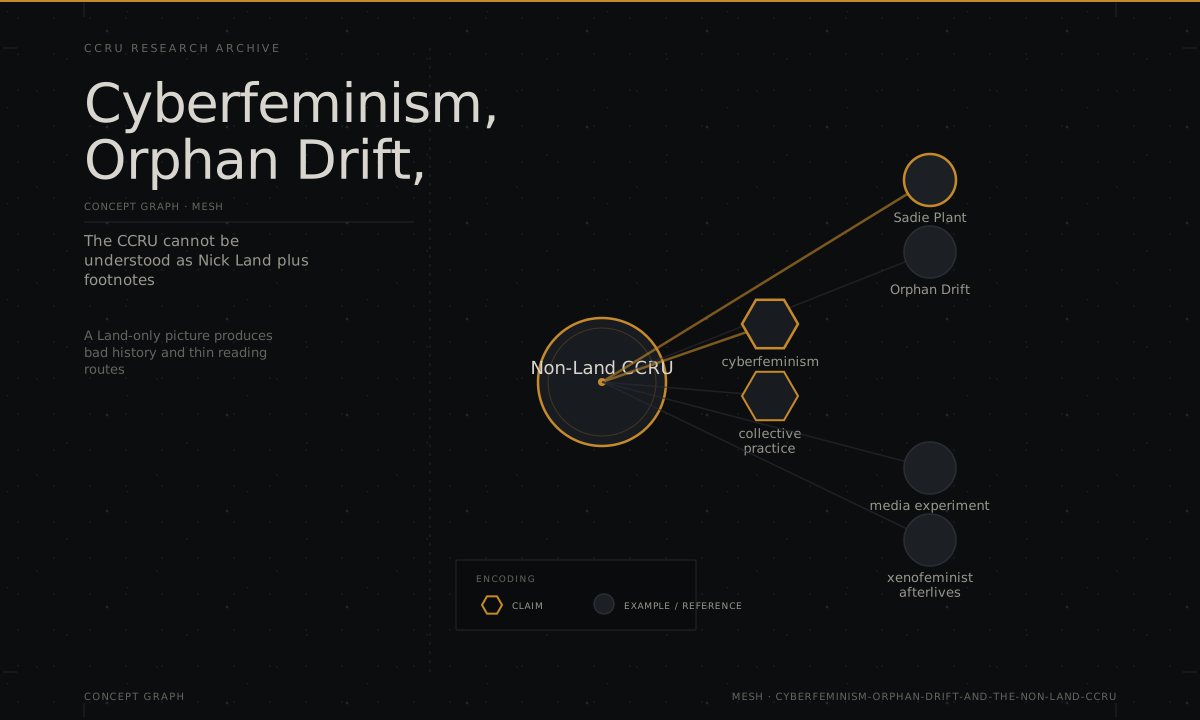
The CCRU cannot be understood as Nick Land plus footnotes. Cyberfeminism, Sadie Plant, Luciana Parisi, Orphan Drift, collective design practice, and media-ecological experiment are not side rooms. They change what the archive is and what kinds of questions it can ask.
Key points
- The non-Land lines are historically necessary, not supplemental decoration.
- Cyberfeminism and Orphan Drift widen the archive toward media theory, collective practice, design, and technical subjectivity.
- Correcting one-man retellings is not only a political gesture; it changes the archive's intellectual structure.
Core argument
A Land-only picture produces bad history and thin reading routes. It erases collective experimentation and shrinks the archive's media-theoretical range. Example: Sadie Plant (Sadie Plant)
Cyberfeminism changes the archive's center of gravity. It brings gender, media, technical subjectivity, and distributed systems into the foreground. Example: Ritual / 0rphan Drift Archive (Ritual - 0rphan Drift Archive)
Orphan Drift shows the archive moving through collective art practice, interface culture, and design rather than through philosophy alone. That makes the CCRU look less like a single-author doctrine and more like a wider experimental formation. Example: An Archigenesis of Experience (An archigenesis of experience)
A Land-only picture produces bad history and thin reading routes. It erases collective experimentation and shrinks the archive's media-theoretical range.
The correction is historical before it is ethical
It is tempting to frame the non-Land CCRU as a diversity amendment to a story that otherwise knows its main plot. That gets the problem backwards. The historical record is already plural. Plant, Parisi, collective practice, and media-theoretical experiment are not corrections added from outside. They are part of the archive's composition.[1]
This is why the Land-only version is so misleading. It is not merely selective. It changes the shape of the formation itself.
Archive instrumentOpen the Cyberfeminist Counter-CCRUThis reviewed editorial state is the strongest corrective to Land-centred collapse and keeps its two contested supporting claims visible rather than resolving them by assertion.
Cyberfeminism changes the archive's center of gravity
Plant and related work widen the archive toward media, systems, technical subjectivity, and gendered social form. That widening matters because it shifts the archive away from a story dominated by inhuman capital, speed, and later reactionary afterlife. The archive begins to look more like a dense intersection of cybernetics, media theory, culture, and experimental practice.
That shift also helps newcomers. It opens routes that are less trapped by notoriety and more grounded in media, collective life, and technical mediation.
Start with Plant, because the founding fact matters. Monoskop's CCRU entry names her as co-creator of the unit at the Warwick Philosophy Department in 1995, alongside Land, with Matthew Fuller, Goodman, Eshun, Mark Fisher and Orphan Drift in the surrounding orbit. Her cyberfeminist work, archived through interviews and through the Croatian Cyberfeminizam volume of 1999, pushes the archive toward media, gendered subjectivity, and the technical history of communication systems. None of that sits comfortably inside the cybergothic Land myth. Once Plant is foregrounded, the archive's tone and its conceptual range both widen.
Orphan Drift makes collectivity visible
Orphan Drift matters because it shows the archive moving through collective design, cultural practice, atmosphere, and interface experimentation. This is one of the clearest places where the CCRU stops looking like a stack of philosophy texts and starts looking like a broader formation with artistic, aesthetic, and media-ecological dimensions.
Once Orphan Drift is in view, the archive's relation to internet-native theory culture also becomes clearer. Collective experiment, distributed surfaces, and mixed media are already there.
Orphan Drift is the second pressure point. Monoskop's entry on the group describes a collective that operated as a singular artist, dissolving individual authorship, working across contemporary art, underground music and cyberfeminist or post-structural philosophy from 1994 to 2003. Maggie Roberts, one of the core members, has written directly about Orphan Drift and the CCRU as renegade academics and speculative futurists. This is the clearest place where the CCRU stops looking like a stack of philosophy texts and starts looking like a broader experimental formation: installation, performance, sound, image, and only then theory. Read this way, the published Urbanomic volumes (Writings 1997-2003 and Recursed 2005-1995) are sediment from a much wider practice, not the practice itself.
That is also why this widened route helps with SEO and newcomer usefulness without becoming shallow. Readers searching for cyberfeminism, media theory, or technical subjectivity can arrive through real archive lines that are intellectually strong in their own right, not through apologetic side notes bolted onto a Land-centered story.
Parisi and the media-ecological thread
The third line is Parisi and the media-ecological thread. Parisi's work on technical and affective systems takes the cybernetic side of the unit's name seriously, in a register that the Lemurian time-sorcery framing of the Urbanomic anthology tends to obscure. Parisi, Fuller, Goodman: this is media theory continuous with what was actually being done in the late 1990s, before the archive was retrospectively curated as an occult-numogrammatic project. The numogram is real, the Lemurian apparatus is real, but they are one current inside a more plural formation. Treating them as the whole is a reception artefact.
Three incompatible portraits, held together
There is a real disagreement to name here. The Urbanomic editorial line, which has done more than anything else to keep CCRU material in print, frames the unit through the Lemurian and numogrammatic material and through the figure of the rogue unit blurring scholarship, cyberpunk and music journalism. That framing is accurate to part of the corpus and silent on the rest. Roberts, writing from inside Orphan Drift, frames the same period through collective art practice and hyperstition as a working method. Plant's interview and book trail frames it through cyberfeminism and media history. These are not compatible portraits of the same object. The public site has to hold all three, and to mark where Urbanomic's editorial gravity has bent the field.
Why this matters for a reader arriving now. If the archive is Land plus footnotes, then hyperstition reads as proto-accelerationist provocation and the rest is decoration. If the archive is the wider formation, then hyperstition is a collective working method developed across art, sound and writing, and the Lemurian material is one elaborate exhibit inside a media-ecological practice. The conceptual stakes shift. So does the question of who gets to count as a CCRU author and what counts as central evidence rather than afterlife. The collective and cross-medium dimension is also the reason the archive still feels internet-native: it was never reducible to single-author texts.
Read the widened archive positively, not only reactively
The non-Land CCRU is not just a way of saying no to the Land myth. It is a positive structure of reading. It asks you to move through Plant, Parisi, Orphan Drift, collective design, technical subjectivity, and media ecology as major lines in their own right.[2]
That approach does not erase Land. It restores proportion. It makes the archive more accurate, more teachable, and more interesting.
It also creates better next steps. Once the archive is widened in this way, readers can move into Plant, Orphan Drift, interface culture, or later feminist afterlives without feeling that they have left the CCRU behind. They have instead reached one of the formations that was always there.
A practical route might begin with Sadie Plant, move through an Orphan Drift-facing source, and then widen toward cyberfeminist or technical-subject pages. That sequence teaches something larger than chronology. It teaches that the archive was always more collective, more mediated, and more formally diverse than the one-name version allows.
There is a practical reading order that follows from this. Begin with Plant's cyberfeminist writing and the Monoskop framing of the unit's founding. Move to Orphan Drift through Monoskop and through Roberts' own essays on hyperstition and Mer. Then, and only then, open the Urbanomic anthologies and the archive.org Spanish edition of the Writings, with the numogram, the Lemurian Pandemonium, and the cybergothic hyperstition pieces visible as one current among several. Land's texts sit inside that field rather than above it. Read the cyberfeminist, Orphan Drift, media-ecological and collective-sound material across each other rather than as isolated mini-scenes.
That is why this guide is not only a correction. It is a better introduction. Readers who start here do not lose the archive's intensity. They gain a truer sense of its range, its media ecology, and its continuing usefulness for thinking about culture, design, gender, systems, and collective experiment.
In practice that means the widened archive is easier to teach and easier to rank for the right reasons. It offers real entry points around cyberfeminism, media theory, technical subjectivity, and collective design while staying faithful to the corpus that produced them. That combination of honesty and legibility is the real goal of the guide.
It also gives general readers a route into the archive that feels contemporary without being opportunistic. The point is not trend alignment. It is to show that these lines were always part of the archive's real structure.
What changes after this guide is small and concrete. The reader stops asking what Land thought and starts asking what the unit was doing, who was doing it, and in which medium. The Lemurian material becomes legible as one experiment inside a wider practice rather than the secret core. Plant, Parisi and Orphan Drift stop functioning as a diversity appendix and start functioning as the part of the archive that opens routes less trapped by later reactionary reception. That is the correction this page exists to make.
Coda: continuity, becoming, and conceptual music
There is a becoming of continuity, but no continuity of becoming. The actual occasions are the creatures which become, and they constitute a continuously extensive world.
Far from needing theory's help, music today is already more conceptual than at any point this century, pregnant with thoughtprobes waiting to be activated, switched on, misused.
Worked examples
These named texts, talks, sites, and records show where the argument becomes concrete.
Sadie Plant Person
The most important person-page corrective to one-man versions of the archive.
Ritual / 0rphan Drift Archive Text page
Collective, media-ecological, and design-heavy practice in concentrated form.
An Archigenesis of Experience Text page
A strong route into the wider non-Land conceptual field.
Cyberfeminism, Xenofeminism, and Technical Subjects Section
The section hub for the broader cluster this guide is correcting readers toward.
Tensions and limits
Corrective guides can sometimes sound reactive if they define themselves only against the Land myth; the point here is to show a positive structure, not just a negation.
Some non-Land lines survive more unevenly in the archive than the Land materials, which makes the correction historically necessary but archivally harder.
The non-Land CCRU is still plural in itself; cyberfeminism, Orphan Drift, and later technical-subject lines should not be collapsed into a new single replacement center.
Common misreadings
These are the recurring simplifications, exaggerations, and misreadings that make the subject look flatter than it is.
- The non-Land material is a soft or secondary appendix.
It is one of the strongest correctives to a false account of what the archive actually was.
- Cyberfeminism and Orphan Drift are adjacent but not central.
They are central to the archive's media ecology, collective texture, and public form.
Significance
This matters now because public memory of the CCRU is still heavily skewed. If the archive is presented as one man's dark doctrine, readers lose its collective, media-theoretical, and experimental dimensions before they have begun.
It also matters because these lines connect the archive to contemporary readers through design, media ecology, cyberfeminism, collective practice, and technical subjectivity rather than only through reactionary notoriety.
References
Records cited
Linked archive records for this guide. Numbers correspond to the footnote markers in the body above.
ccru.net (archived homepage) Record
A public surface where the archive already looks broader than a one-author story.
Sadie Plant Person
The clearest people-page route into the widened archive.
Reading routes through this guide
Featured exhibit
The Non-Land CCRU: Cyberfeminism and Orphan Drift
A corrective exhibit on the cyberfeminist, collective, media-ecological, and non-one-man parts of the archive.
Featured reading path
A short guided sequence for readers who want the clearest first path through the CCRU site.