The diagram as research instrument
This is why the project takes poster, alchemical diagram, and tarot form rather than monograph form. A genealogy drawn as a tree forces the reader to see which roots feed which branches simultaneously; a tarot deck forces the reader to shuffle and juxtapose, producing combinatorial readings the author never fixed. The format is the argument. Treat HEXEN 2.0 as diagrams accompanying an essay and the work collapses into decoration. Treat the diagrams as the primary cognitive surface and the essays as legend, and the method becomes legible.
Occult correspondence as Systems analysis
The second distinctive move is Treister's refusal to separate the iconography of the occult from the iconography of systems theory. HEXEN 2.0 draws alchemical circles, Sephirothic trees, and tarot arcana in the same graphic language as cybernetic feedback loops and diagrams of research networks. This is not kitsch synthesis. It is the claim that Western esoteric diagrammatics and twentieth-century cybernetic diagrammatics share a structural vocabulary — correspondence, nesting, feedback, sympathetic linkage — and that the history of the military-industrial-computational complex can be read through that shared vocabulary without loss of rigor.
HEXEN 5.0 (ongoing, 2020–) extends this into the terrain of planetary survival, AI, and speculative futures, deploying the same method against a different corpus. The consistency matters: across two decades of tarot-format works and diagrammatic genealogies reaching back into the 1990s, Treister has refined a single research practice rather than producing a series of thematic art projects. The iconographic convergence of hex, hexagram, and hexadecimal is treated as a finding, not a pun.
Conspiracy diagrams taken seriously
Treister's third move is the hardest to hold steady: she takes the formal structure of the conspiracy diagram — the wall of index cards and red string, the paranoid web connecting research institutes to pharmacology to network infrastructure — and uses it as a legitimate instrument of historical research rather than as an object of ironic display. The risk is obvious. The same graphic syntax that connects real institutional histories also underwrites QAnon-grade derangement. Treister's wager is that the form is not discredited by its abuse, and that refusing to use it cedes a powerful cognitive tool to bad actors.
The specific discipline that prevents collapse into paranoia is annotation: nodes in HEXEN 2.0's diagrams are extensively labelled with named institutions, figures, and dates, and the volume's accompanying indices and essays function as a citation apparatus. The diagrams are dense with historical referents rather than free-associative. What the form adds is the capacity to see these referents as one field. This is what separates the work from both the academic monograph (which would refuse the visual compression) and the conspiracy wall (which would refuse the archival discipline).
The two-register problem
Treister's work is priced and circulated in two incompatible registers. In the art register it is a gallery object, collected, reviewed, exhibited, discussed in terms of practice and medium. In the research register it circulates among readers working on cybernetics, counterculture, and systems history, where the tarot cards and diagrammatic posters function as reference material. The two registers select different audiences, price the work at radically different scales, and largely do not read each other.
The temptation is to pick one register and treat the other as secondary — to say the gallery context is a distribution accident, or conversely that the research uses are a cultural spillover from the art. Both readings are wrong. The work is constitutively bi-valent: the tarot-format of HEXEN 2.0 only functions as research because it is also an art object that can be shuffled, exhibited, and sold; it only functions as art because its content is genuinely load-bearing historical argument. The common misreading — that Treister is an illustrator who provides imagery for theory others have written — gets the directionality exactly backwards. The diagrams are primary research; the prose commentaries (her own and others') are secondary.
Why the cluster cannot lose her
Without Treister, the CCRU-adjacent field has a theoretical account of diagrammatic thought but no fully realised diagrammatic practice at scale. HEXEN 2.0 and HEXEN 5.0 are the worked examples. They demonstrate that the abstract claim — that diagrams can think — is not merely a philosophical assertion but a practice that can be executed, refined, and potentially taught. The transmissibility of the method, rather than its uniqueness to a single author, is the minimum condition for treating it as research rather than idiolect.
Deepest single document: HEXEN 2.0.
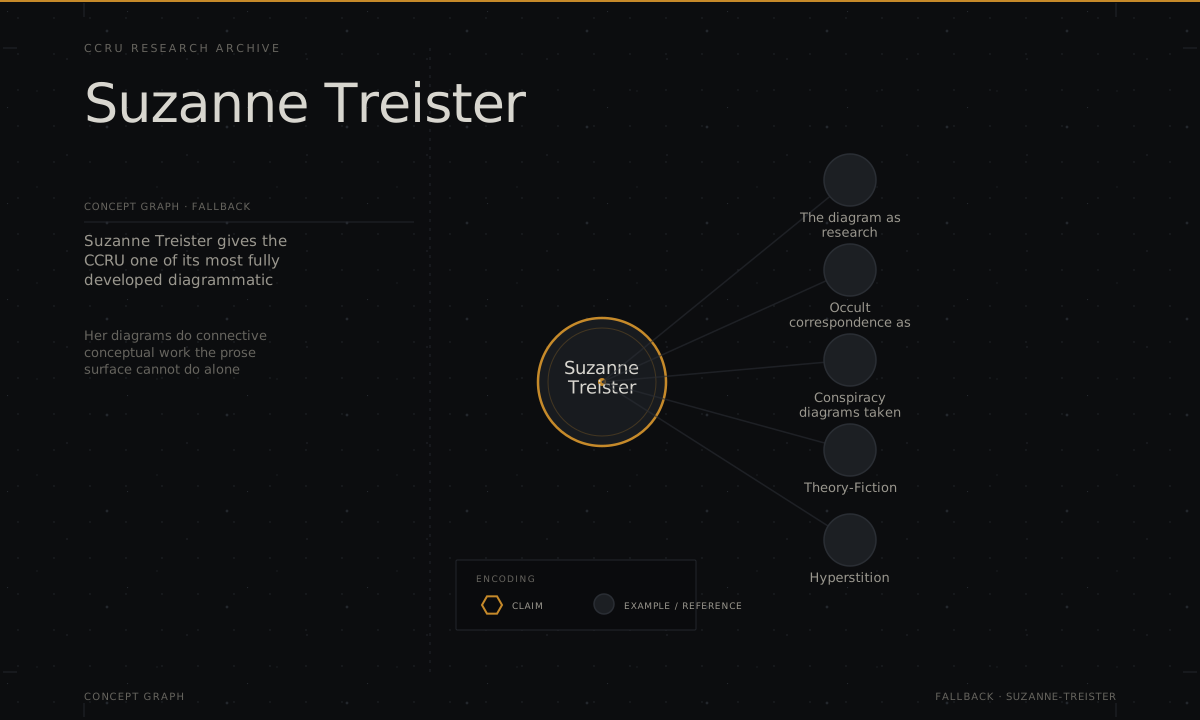
Suzanne Treister gives the CCRU one of its most fully developed diagrammatic research practices. HEXEN 2.0 (Black Dog 2012) and HEXEN 5.0 (2018) treat genealogy, occult correspondence, and conspiracy diagrams as serious conceptual instruments rather than as illustration.
Core argument
Treister's diagrams are research, not illustration. Treating them as illustration loses the conceptual work the diagrams do — they make connective claims the textual side of the archive cannot easily produce.
HEXEN 2.0 is the principal document of her CCRU-adjacent project. The series traces the cybernetic-counterculture-mysticism complex the archive itself has never quite stopped running.
Worked examples
These named texts, talks, sites, and records show where the argument becomes concrete.
CCRU and Internet-Native Theory Culture Guide
Where Treister's diagrammatic work intersects with the archive's online afterlife and visual culture.
Theory-Fiction Concept
The mode her diagrammatic research most closely belongs to — narrative, citation, and image working together as one operation.
Hyperstition Concept
The CCRU concept her HEXEN diagrams most directly intersect with by mapping operative cultural feedback.
Common misreadings
These are the recurring simplifications, exaggerations, and misreadings that make the subject look flatter than it is.
- Treister is illustrator for theory.
Her diagrams do connective conceptual work the prose surface cannot do alone. HEXEN 2.0 is research in its own right.
Significance
Treister's diagrammatic practice gives the archive a working visual register that the contemporary debate about cybernetics, counterculture, and conspiracy increasingly needs. Reading the HEXEN series alongside CCRU prose makes both surfaces sharper.
Stakes of this figure
Artist whose HEXEN 2.0 (Black Dog 2012) and HEXEN 5.0 (2018) treat diagrammatic genealogy and conspiracy cartography as serious conceptual instruments.
Periodisation
- 2000s onward
Key works for entering the figure
- Suzanne Treister — HEXEN 2.0 (Black Dog 2012)
- Suzanne Treister — HEXEN 5.0 (2018 onward)
References
Records cited
These linked sources are the quickest way to test the argument against named materials rather than second-hand summary.
CCRU and Internet-Native Theory Culture Guide
Where Treister's diagrammatic work joins the wider visual line of the archive's afterlife.
Theory-Fiction Concept
The conceptual mode her diagrams operate inside.