Reading capital as horror, not dressing it in horror
The nearest term to refuse is cyberpunk, or more broadly techno-gothic aesthetics. Cyberpunk supplies imagery — chrome, rain, corporate noir, body horror as decoration on a human-scaled plot. Cybergothic removes the human plot and retains the apparatus of nonhuman agency that Gothic literature had already built out: possession, bloodline, crypt, revenant, inheritance of curse. The smallest unit of work the term does, as synthesised here, is that swap: wherever a cybernetic or capital process would normally be described in neutral systems vocabulary, Cybergothic substitutes the Gothic term that tracks its agency, its appetite, and its indifference to the host.
Count Zero rigorously formulates cybergothic interlock, condensing the digital underworld onto the black mirror. Human neural-to-infonet uploading and Loan infonet-to-neural exactly correspond as phases of a circuit, amalgamating travel and possession.
Where it starts doing work
The concept is load-bearing in Nick Land's 'Cybergothic' and the adjacent mid-1990s pieces gathered in Fanged Noumena: Collected Writings 1987–2007 (Urbanomic / Sequence Press, 2011), and read alongside 'Meltdown' and 'Machinic Desire' in the same volume (see the contents pages reproduced in A Nick Land Reader). Our retrieval did not surface running prose from the 'Cybergothic' essay itself, so the claim that this is where Gothic vocabulary first operates as a technical register for capital-as-process should be taken as editorial placement rather than a textual demonstration.
What the retrieval does attest directly is that Cybergothic has, by the late 1990s, settled into the CCRU's own glossaries as a technical vocabulary. The 'Syzygy' entry in Ccru: Writings 1997–2003 lists 'Cybergoth Polytics' as one of nine registers of the twin-system — 'convergent twinning, diploid coincidence, or coproduction' — confirming that Cybergothic names a working category within the collective's architecture, not a mood. The Crypt-cult materials extend the same vocabulary: in the Occultures/Divus lecture fragment, Y2K-Positive Calendric Agitation describes 'Crypt-cultures spill[ing] into the closed economy of history through a rupture in chronological ordering', with the Crypt that 'exists from before the origin of time, but … begins at Year-Zero' — precisely the Gothic figure (crypt, revenant, untimely inheritance) being used as technical notation for calendric and machinic process.
The brief also names Anna Greenspan's contributions to Ccru: Writings 1997–2003 and Steve Goodman's 'Swarmachines' and 'Cybernetic Culture' fragments as load-bearing; our retrieval did not surface chunks from Swarmachines, Cybernetic Culture, or identifiable Greenspan-authored sections, so their role is noted here on the authority of the brief and the published volume rather than demonstrated from quoted text. Readers wanting the primary instances should consult those fragments directly in Ccru: Writings 1997–2003 (Time Spiral Press / Urbanomic, 2015/2017).
K-space and the axis of dehumanization
Cybergothic slides K-space upon an axis of dehumanization, from disintegrating psychology to techno-cosmogony, from ideality to matter/matrix at zero intensity. From a mental 'non-space,' 'non-place' (Gibson), or 'notional void' (Gibson) that results intelligibly from human history to the convergent spatium from which futuralization had always surreptitiously proceeded, 'a quite different field of matter' (Kant).
The misreading to refuse
The dominant circulating misreading is that Cybergothic is cyberpunk with extra candles — goth aesthetics applied to computers, a stylistic preference for darkness over the cheerful cyber-utopianism of the same decade. On that reading, the Gothic vocabulary is ornament that could be stripped off to reveal a neutral argument about networks. The synthesis proposed here refuses that move: if the Gothic terms are ornament, the thesis about nonhuman agency goes with them, because neutral systems language was specifically calibrated to suppress agency-talk. This is the entry's interpretive wager, not a quoted claim.
A subtler misreading treats Cybergothic as pessimism — horror-as-affect, doom as mood. The archive's usage, where we can see it directly (the Syzygy entry's flat taxonomic listing; the Crypt-cult fragment's technical vocabulary of calendric agitation and digital time-mutation), is flatter than that. Horror here functions as epistemic equipment: a genre that already knows how to describe agents that do not care about you, inheritances you did not consent to, and processes that use your body to continue themselves. Whether one is for or against the process is a separate question the prose does not answer.
Turbular moan of digitally irresolvable recyclones. Telecommercial contagions pulse through cybergothic switching systems. Faceless horror.
Deepest single document for use: Fanged Noumena: Collected Writings 1987–2007.
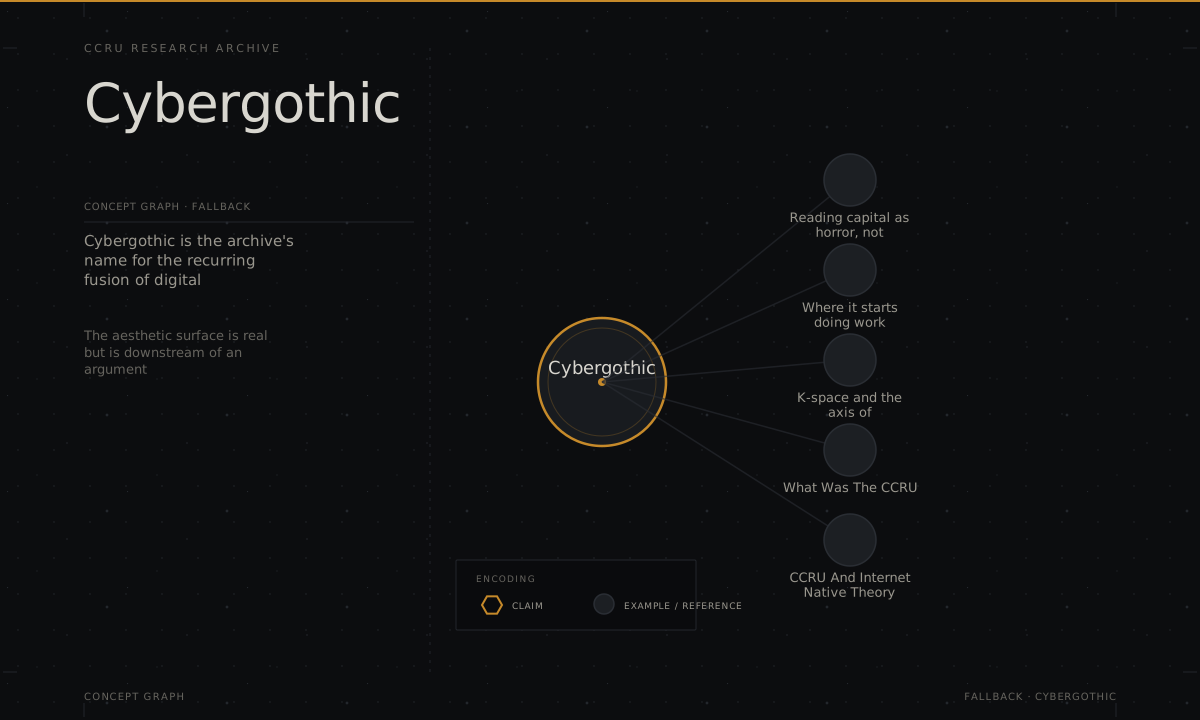
Cybergothic is the archive's name for the recurring fusion of digital infrastructure with gothic affect. It is less an aesthetic preference than an argument: the technical world is best read through horror conventions because horror has the equipment for nonhuman agency.
Core argument
Cybergothic is a method, not a mood. It treats horror conventions as a serious instrument for thinking machinic agency, not as a stylistic flourish.
It is the prose register where the CCRU works most distinctively. Many of the archive's strongest arguments — about contagion, possession, distributed cognition — only become legible in this register.
Worked examples
These named texts, talks, sites, and records show where the argument becomes concrete.
Cybergothic Record
Gothic prose, cyberspace, and capital-time compression carry the concept as style. It makes Cybergothic checkable against a concrete archive object.
Nick Land Fanged Noumena Record
Fanged Noumena gives the Land corpus its retrospective editorial architecture. It makes Cybergothic checkable against a concrete archive object.
Nick Land Person
"Nick Land" shows who carries, translates, or contests Cybergothic in practice.
What Was The CCRU Guide
"What Was The CCRU" keeps Cybergothic attached to a guide-length argument and route map.
Common misreadings
These are the recurring simplifications, exaggerations, and misreadings that make the subject look flatter than it is.
- Cybergothic is just goth aesthetics applied to computers.
The aesthetic surface is real but is downstream of an argument. Cybergothic uses gothic conventions because those conventions already know how to think about agencies that are not human.
Significance
Cybergothic offers a vocabulary for AI and infrastructural agency that does not collapse into either techno-utopianism or moral panic — the gothic register has equipment for nonhuman agency that the dominant policy and product registers lack.
Working definition
The archive's recurring fusion of digital and machinic infrastructure with gothic affect, used as a working argument that horror conventions supply conceptual equipment for nonhuman agency.
Representative extracts
Definition · extracted passage
2) Markets, desire and science fiction are all parts of the infrastructure. 3) Virtual Capital-Extinction is Immanent to production. The short term is already hacked by the long-term.
Why this matters: Here the text lays out its programme as numbered axioms, giving the record's single-circuitry claim its most compressed statement: fiction and desire count as infrastructure, not commentary on it.
Definition · extracted passage
Monopod anti-production inhibits meltdown (to the machinic phylum), boxing Al in synthetic thought control A(zimov-) ROM, '[e]verything stops dead for a moment, everything freezes in place' (Deleuze and Guattari). Under police protection the story carries on. Wintermute is arriving from the future to sort that out.
Why this matters: The splicing method is fully visible here: Deleuze and Guattari's anti-production is rewired through Asimov's control-boxed robots and Gibson's Wintermute, with the fiction doing genuine theoretical work rather than illustrating it.
Definition · extracted passage
As the access gate to es an impossible zone - and navigator within it - 'you' are an avatar (as cyberspace nomads call such things in the future): a non-specific involvement site, interlocking intelligence with a context.
Why this matters: The second person itself becomes a technical term in this passage: by addressing 'you' as an avatar, the text makes its reader a component of the circuitry it describes.
Definition · extracted passage
As the access gate to es an impossible zone - and navigator within it - 'you' are an avatar (as cyberspace nomads call such things in the future): a non-specific involvement site, interlocking intelligence with a context. You (= (())) are an index, a box, such as Gibson's Case: a place to be inside the system. 'I had learned something (already) in the dead city: You are wherever you are' (Acker).
Why this matters: Extending the avatar definition through Gibson's Case and an Acker citation shows the record's characteristic sourcing: fiction supplies the concept's actual coordinates, not decorative examples appended to a finished argument.
Mechanism · extracted passage
Time produces itself in a circuit, passing through the virtual interruption of what is to come, in order that the future which arrives is already infected, populated: '[I]t's just a tailored hallucination we all agreed to have, cyberspace, but anybody who jacks in knows, fucking knows it's a whole universe.
Why this matters: This is the record's core mechanism in one motion: a feedback model of time in which the arriving future has already altered the present, sealed with Gibson's cyberspace testimony as evidence.
Style · extracted passage
The code would lead me to the human construct who would lead me to - or allow me - my drug (Acker) 'You made me blow my game ' she said. 'Look there asshole. Seventh level dungeon and the goddam vampires got me ' She gassed him a cigarette. You look pretty smug, man Where you been?' (Gibson) The future wants to steal your soul and vaporize it in nanotechnics.
Why this matters: The collage of Acker and Gibson dialogue snapping into a direct threat demonstrates the record's stylistic wager: atmosphere performs the argument here rather than decorating it, exactly as the text insists it must.
References
Records cited
These linked sources are the quickest way to test the argument against named materials rather than second-hand summary.
Cybergothic Record
Gothic prose, cyberspace, and capital-time compression carry the concept as style. Use it to test Cybergothic against source material rather than summary.
Nick Land Fanged Noumena Record
Fanged Noumena gives the Land corpus its retrospective editorial architecture. Use it to test Cybergothic against source material rather than summary.
ccru.net Home Record
The old web interface shows how zones, links, and presentation became part of the argument. Use it to test Cybergothic against source material rather than summary.
What Was The CCRU Guide
"What Was The CCRU" widens Cybergothic through linked sources, people, and sections.