Bacteria before persons
Virotechnics in the archive begins here, in the molecular. A virus is not a figure of speech for rumour or meme. It is a transfer mechanism that rewrites a host from inside, and Parisi's endosymbiotic frame makes contagion rather than heredity the baseline of mutation. Every later use of the word — cultural contagion, hyperstitional transmission, swarm capital — inherits this technical backbone from bacteriology and symbiogenesis, whether or not the later text names the debt. Readers who skip Parisi and go straight to the stylish material tend to miss that the archive has done the biology.
Zeros, ones, and distributed feedback
Sadie Plant's Zeros and Ones runs a parallel logic through a different substrate. Where Parisi has bacteria, Plant has the long history of looms, switchboards, and modems — distributed networks that keep working precisely because no single node holds the whole plan. This strand of the archive is the one where control stops meaning "command" and starts meaning the shape of feedback in a network without a throne.
The cluster does not agree on the affect of that diagram. Plant's reading is broadly affirmative: a cybernetic feminism read off the history of weaving and telephony. Other moments in the archive — Land's machinic materialism in particular — take the same distributed topology and read it colder, as capital-process rather than emancipation. I'll note the contrast rather than over-sharpen it: the vocabulary of switches, flows, and loops is shared across the cluster, but the politics attached to that vocabulary is not.
Virotechnics as a precise term
The CCRU fragments give the word its technical edge, and the clearest surviving gloss sits inside the hyperstition material collected in Ccru: Writings 1997–2003: hyperstition is defined there as "semiotic productions that make themselves real," arriving as "cryptic communications" inside a reading-group dedicated to the "intersection between the Nma cultural constellation, Cthulhoid contagion, and twisted time-systems." Contagion in that sentence does real work — it names the mechanism by which a fiction installs itself in a host cultural field and becomes operative.
So virotechnics, as the archive uses it, is not "viral marketing" and not Baudrillard. It names engineering at the level of transmission itself: building a sign or object so that it propagates through hosts and alters them on contact. The parts I'll name here — carrier, payload, latency, reactivation — are my synthesis rather than the archive's explicit schema, but they follow the underlying logic the hyperstition fragment lays out: a signal engineered to induce its own conditions of reception. The common trap is hearing "virotechnic" as a Deleuzian flourish. It is closer to epidemiology with the politics left in.
Swarm against pack against crowd
Swarm is not pack, and the archive is sharper on this than most of its readers. Iain Hamilton Grant's reading of the Rat-man, in Demonology of the New Earth, pulls the distinction tight by way of Freud: the Oedipal pack is rats bound to the father through a reconstructed grudge, while the anoedipal escape runs through "a molecular affectivity for death" — rats feeding on corpses, sharp teeth, keen smell, a becoming-carrion that has left the family triangle entirely. Pack under Oedipus is kinship under pressure; what breaks loose from it is molecular and swarm-like.
Grant's text licenses that pack/swarm distinction directly; the further contrast with crowd (a mass organised around a leader-slot) is my own extension, offered to mark how easily readers collapse these terms. The point for this cluster is that swarm is the behavioural signature of the virotechnic substrate from the earlier strands: what a population of agents looks like when control is distributed and feedback-driven rather than centralised. Reading swarm as a synonym for online pile-ons collapses a formal distinction the archive spent real pages earning.
Desiring-machines and the machinic unconscious
Nick Land's rereading of Anti-Oedipus, gathered in A Nick Land Reader: Selected Writings, supplies the philosophical chassis the cluster bolts onto. Desiring-machines are "assemblages of flows, switches, and loops — connective, disjunctive, and conjunctive syntheses — implementing the machinic unconscious as a non-linear pragmatics of flux." Social production, by contrast, "rigidifies virtual switchings as actualized alternatives, and territorializes the nomadic control circuits of machinic drift into sedentary command lines of hierarchized representation."
Translate: command is a territorialisation of control, not its native state. Native control is swarm, flux, drift. This is the sentence that unifies Parisi's bacteria, Plant's switchboards, and CCRU's virotechnics into one cluster. It also flags the internal fault line: Land pushes the machinic reading toward capital-as-runaway-process, while Parisi pushes it toward a non-reproductive sexuality of mutation, and Plant toward a weaver's feminism of the net. The vocabulary is shared; the politics are not.
Where to enter
The common trap, once more, is reading the cluster's vocabulary as style. Swarm, contagion, virus, feedback, drift — each has a technical sense the archive builds slowly, mostly from biology and cybernetics, and each is doing argumentative work. Treat these as terms of art, not atmosphere. And treat the disagreements inside the cluster as real: distributed feedback is read as emancipation by some contributors and as capital's own operating logic by others, using the same diagram.
For a single deepest entry, go to Parisi's Abstract Sex. It is the most patient piece of machinery in the cluster: it earns endosymbiosis from the molecular biology up, and once you have it, the CCRU hyperstition fragments, Plant's networks, and the Land machinic readings all slot into the same frame without needing to be translated.
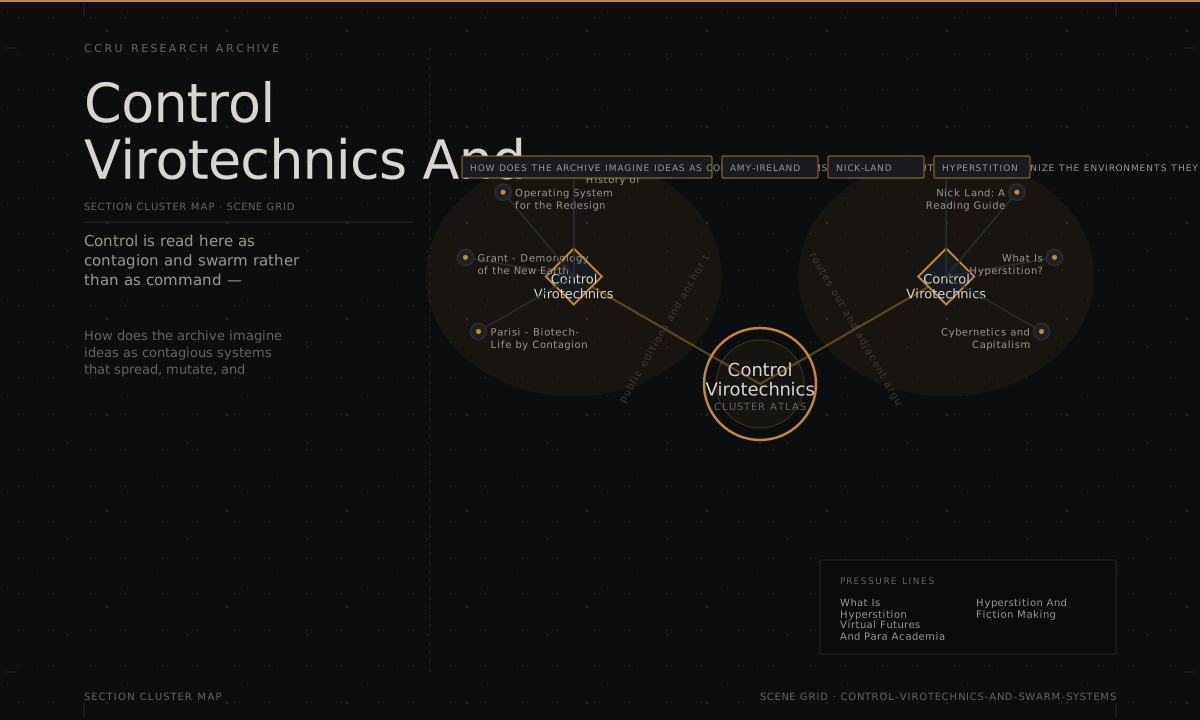
Control is read here as contagion and swarm rather than as command — virotechnics and distributed feedback are the archive's main models for thinking how social and technical systems actually behave.
Core argument
Control in the archive is distributed and infectious rather than merely centralized. That helps explain why swarm and virotechnic language recur so often.
Contagion is treated as a systems logic, not just as a metaphor. The section keeps social, technical, and cultural spread inside one analytical frame.
Worked examples
These named texts, talks, sites, and records show where the argument becomes concrete.
What Is Hyperstition Guide
Start with "What Is Hyperstition" if you want the wider frame before dropping into Control Virotechnics And Swarm Systems.
Amy Ireland Person
"Amy Ireland" is one of the clearest figures for the pressures gathered inside Control Virotechnics And Swarm Systems.
Hyperstition Concept
"Hyperstition" names one recurring problem inside Control Virotechnics And Swarm Systems.
Hyperstition New Weird 1 Record
"Hyperstition New Weird 1" is a checkpoint where Control Virotechnics And Swarm Systems stops sounding abstract.
Land AI Transcripts Note Record
"Land AI Transcripts Note" is a checkpoint where Control Virotechnics And Swarm Systems stops sounding abstract.
Common misreadings
These are the recurring simplifications, exaggerations, and misreadings that make the subject look flatter than it is.
- Swarm language is only stylish metaphor.
The section shows how it functions as a model of distributed control and propagation.
Significance
This section matters because contagion, distributed control, and swarm logics remain central to contemporary technical and political thought.
Themes
- control
- virotechnics
- swarm
- viral method
- abstract dynamics
Where this section sits in the archive
Luciana Parisi opens the cluster from underneath the human. In Abstract Sex: Philosophy, the load-bearing argument is that endosymbiosis — the bacterial incorporation that two billion years ago produced nucleated cells — is the default condition of life, not an exotic case. "Contagious transmission rather than filiative heredity. Molecular differentiation rather than differences of form and function." This is the sentence to hold onto when anything in this section starts sounding metaphorical.
Sources by cluster
These mini-clusters widen the section through named works and support traces rather than through adjacent keywords alone.
Section source cluster
Control Virotechnics And Swarm Systems: public editions and anchor texts
Anchor editions: Brassier - ALIEN THEORY (PhD Thesis); Hyperstition New Weird 1; Land AI Transcripts Note.
Work
Brassier - ALIEN THEORY (PhD Thesis)
7 philosophy can help discover materialism’s non-materialist essence by developing the unilateral Identity and duality of ‘theory’ and of ‘matter’. Conscious of the fact that such formulations must appear chronically...
Work
Work
Work
Work
Work
Section source cluster
Control Virotechnics And Swarm Systems: talks, captures, and support traces
Source traces: 30 Years after Les Immatériaux Art, Science, and Theory; The Nanoengineering of Desire; Autistic Mercury - Dark Star; A Review of Nick Land's 'The Thirst for Annihilation'.
Text page
30 Years after Les Immatériaux Art, Science, and Theory
220 30 Years after Les Immatériaux word that implied an object that offered resistance to any kind of project that attempted to alienate it from its primary finalities.9 For Lyotard the historical moment of immaterial...
Text page
QUEERING THE NON/HUMAN 288 and Guattari 1994) between thinking and doing, between philosophical concepts and technoscientific functions, which may enable us to rethink at the ontology of queer sexuality and sexual diff...
Text page
Autistic Mercury - Dark Star; A Review of Nick Land's 'The Thirst for Annihilation'
“Particles decay, molecules disintegrate, cells die, organisms perish, species become extinct, planets are destroyed and stars burn-out, galaxies explode… until the unfathomable thirst of the entire universe collapses...
Text page
Abstract. The aim of this study is to illuminate in a novel and original manner the political and ethical character of Nietzche's project of revaluation and to demonstrate its continued import and significance for thi...
Text page
Brassier - Alien Theory - The Decline of Materialism in the Name of Matter (Cleaned Layout)
7 philosophy can help discover materialism’s non-materialist essence by developing the unilateral Identity and duality of ‘theory’ and of ‘matter’. Conscious of the fact that such formulations must appear chronically...
Section source cluster
Control Virotechnics And Swarm Systems: routes out and adjacent arguments
Adjacent routes: What Is Hyperstition; How To Use This Archive; Amy Ireland.
Guide
"What Is Hyperstition" gives the wider argumentative frame around this section.
Guide
"How To Use This Archive" gives the wider argumentative frame around this section.
Person
"Amy Ireland" is one of the figures most closely bound up with this section's local problem.
Person
"Nick Land" is one of the figures most closely bound up with this section's local problem.
Concept
"Hyperstition" names one of the recurring conceptual pressures inside this section.
Section
Virtual Futures And Para Academia
"Virtual Futures And Para Academia" is the neighboring cluster to open once this section's local pattern is visible.
Texts in this section
38 classified works grouped into 3 editorial subclusters. Reviewed: 19; needs review: 19.
Biotech and contagion 13 works
- Abstract Sex
- AD 118 Architects in Cyberspace 1996
- Break the Law of Information
- Ccru - Swarmachines (1996)
- CCRU- Swarmachines
- hypervirus
- Parisi - Biotech- Life by Contagion
- Parisi - What Can Biotechnology Do - (Theory Culture Society) (2009)
- Parisi Goodman - The Affect of Nanoterror
- Plant - Preface (The Spam Book 2009)
- NeoStalingrad Voodoo Politics and Neo-Neural Gene HackingNeeds editorial review
- white magicNeeds editorial review
- Xenotation NotesNeeds editorial review
Control and modulation 11 works
- Digital Automation and Affect
- Mnemonic Control
- Parisi Terranova - A Matter of Affect Digital Images and the Cybernetic Re Wiring of Vision
- The Nanoengineering of Desire
- CCRU- DoomNeeds editorial review
- ccru-abstract-cultureNeeds editorial review2 source files
- Goodman - Fei Ch'ien Rinse Out Sino-Futurist Under-Currency (Pli v.7) (1998)Needs editorial review
- Luciana Parisi - Recursive Philosophy and Negative Machines by Luciana Parisi - libgen.liNeeds editorial review
- luciana-parisi-a-matter-of-affect-digital-images-and-the-cybernetic-rewiring-of-vision-1Needs editorial review
- pli 7Needs editorial review
- Recursive Philosophy and Negative MachinesNeeds editorial review
Swarms, networks, and distributed systems 14 works
- CCRU- Datastreams
- CCRU- The Body of Foucault
- Comparative Ethnomathematics and Divination Systems
- Goodman - Darkcore (Abstract Culture) (Swarm 3)
- Parisi - Information Trading
- A-DeathNeeds editorial review
- Insect CommunismNeeds editorial review
- luciana-parisi-symbiotic-architecture-prehending-digitalityNeeds editorial review
- meshNeeds editorial review
- Ode to the Industrial RevolutionNeeds editorial review
- Parisi - Symbiotic Architecture (Theory Culture Society) (2009)Needs editorial review
- submersionNeeds editorial review
- The A-Death 'Phenomenon'Needs editorial review
- The InvolutionNeeds editorial review
References
Records cited
These linked sources are the quickest way to test the argument against named materials rather than second-hand summary.
Hyperstition New Weird 1 Record
"Hyperstition New Weird 1" is the first record to test the framing around Control Virotechnics And Swarm Systems.
Land AI Transcripts Note Record
"Land AI Transcripts Note" is the first record to test the framing around Control Virotechnics And Swarm Systems.
What Is Hyperstition Guide
"What Is Hyperstition" gives the larger argument around Control Virotechnics And Swarm Systems before you widen sideways.
External references
Inherited outward references from the guides, exhibits, people, and concept pages that anchor this section cluster.