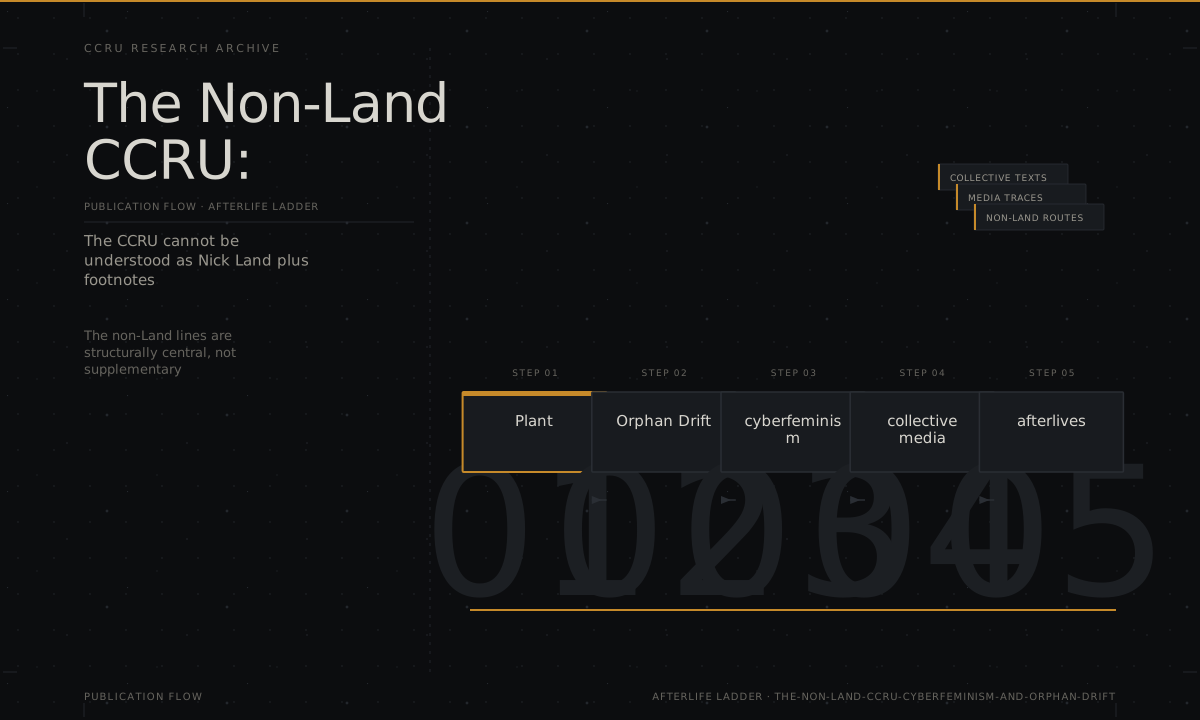
The CCRU cannot be understood as Nick Land plus footnotes. Cyberfeminism, collective experiment, technical subjectivity, media ecology, and Orphan Drift are not side rooms. They change what the archive is.
Core argument
The non-Land lines are structurally central, not supplementary. Without them the archive becomes historically inaccurate and conceptually narrower.
Cyberfeminism and collective practice widen the archive's center of gravity. They push the scene toward media theory, design, interface culture, and technical subjectivity rather than philosophy alone.
Orphan Drift shows that artistic and collective surfaces are part of the archive's method. This is one of the clearest routes away from one-man mythology.
A corrective exhibit on cyberfeminism, Orphan Drift, collective practice, and the non-Land lines that change the shape of the CCRU.
Why these objects, in this order
The sequence proves that the anti-flattening argument has to be material, not just moral. It is not enough to say that the CCRU was more than Nick Land. The page has to show the objects that make that statement true. These five sources alter the archive's working map: collective practice, cyberfeminism, interface, sonic method, and technical life become load-bearing parts of the formation.
The route opens with An Archigenesis of Experience because it gives the exhibit a wider conceptual frame before moving into collective practice. Ritual then brings the question into Orphan Drift's media-ecological field, where authorship, image, ritual, and archive do not behave like a standard essay lineage. Operating System for the Redesign of Sonic Reality keeps the route in experimental practice rather than abstract correction.
ccru.net then enters as a public-facing archive surface that already looks plural. It is useful because the correction is visible in the interface itself, not only in later interpretation. Parisi's Biotech closes the sequence by shifting the exhibit into technical systems and contagion, showing that non-Land CCRU is part of the archive's hardest thinking about bodies, systems, and technical life, not a soft cultural remainder.
It makes the correction architectural rather than merely argumentative, because the public surface already arranges the archive differently.
An Archigenesis of Experience
Why here: This object opens the exhibit because it widens the conceptual frame before the sequence enters Orphan Drift and technical practice. It helps dislodge the one-man mythology at the level of thought.
Notice: The useful move is not simple inclusion. The object changes what counts as central to the archive, forcing the reader to treat experience, media, and subject formation as core materials.
Ritual: 0rphan Drift Archive
Why here: Ritual brings collective and media-ecological practice into focus. It makes clear that the archive includes forms that do not behave like single-author theoretical essays.
Notice: Watch how image, ritual, archive, and collective method occupy the same space. The source refuses the clean split between theoretical argument and experimental cultural practice.
Operating System for the Redesign of Sonic Reality
Why here: This object keeps the exhibit attached to experimental cultural method. It prevents the non-Land route from becoming only a list of excluded names.
Notice: The phrase operating system is important: the object asks how media forms organize perception and action. It treats culture as something designed, installed, and rerouted.
ccru.net
Why here: The CCRU web surface is included because it already presents the archive as plural and distributed. It is a visible counterexample to the one-man retrospective myth.
Notice: The interface matters. Public archive surfaces organize memory before later readers arrive, and this surface already resists a single-author sorting principle.
Sequence: It makes the correction architectural rather than merely argumentative, because the public surface already arranges the archive differently.
Parisi, Biotech: Life by Contagion
Why here: Parisi closes the exhibit by moving the non-Land route into technical systems, bodies, and contagion. This is a different hard edge, not a softer margin.
Notice: The technical vocabulary matters because it connects cyberfeminism and systems thinking without reducing either to metaphor. It makes embodiment and technical life part of the same problem.
Cyberfeminism changes the center of gravity
Cyberfeminism matters here because it shifts the archive away from the fantasy that its deepest questions are only speed, capital, and inhuman process in a narrowly Landian form. Plant and adjacent work reopen the archive through media, systems, technical subjectivity, and gendered cultural form. That widening is not cosmetic. It changes what counts as central evidence, and it changes which readers can recognize the archive as theirs.
It also shows that the CCRU was never only about one rhetorical mode. Once cyberfeminist and media-theoretical materials are foregrounded, the archive becomes easier to connect to design, interface culture, distributed systems, and later technical-subject debates. The scene becomes less doctrinal and more plural.
That shift matters for contemporary readers because it reconnects the CCRU to arguments about media systems, design, gender, and collective experiment that are still alive now. The result is a more accurate and more demanding version of the archive, not a softer one.
Orphan Drift proves that collective surfaces matter
Orphan Drift matters because it makes the archive's collective dimension impossible to ignore. Here the CCRU's pressure moves through art practice, atmosphere, design, and experiment rather than through individual philosophical signature alone. That matters historically, because it restores media ecology and collaborative production to the center of the picture. It matters conceptually, because it reminds readers that the archive often thinks through form, circulation, and collective arrangement rather than thesis statements alone.
Once Orphan Drift is in view, the archive's public life also looks different. It becomes easier to understand why websites, interfaces, sonic culture, and aesthetic packaging matter. Those are not merely side effects. They are part of how the archive operates and survives.
This is why the exhibit keeps Orphan Drift beside ccru.net and Parisi rather than isolating art practice as a colorful supplement. Collective surfaces, technical systems, and public interfaces belong to the same historical correction.
Why collective practice is structural
One recurring mistake is to assume that the more collective or aesthetic materials only illustrate the real thought happening elsewhere. This exhibit argues the opposite. Collective practice is one of the archive's thought-forms. It changes how concepts are delivered, what counts as evidence, and how the scene addresses readers beyond a small internal audience. That is why a record like ccru.net and texts related to Orphan Drift belong beside more obviously theoretical materials: they are different surfaces of the same formation.
This also helps explain why the archive still feels relevant now. Collective experiment, media ecology, technical subjectivity, and aesthetic transmission are precisely the kinds of questions contemporary readers use to reconnect the CCRU to present problems.
What readers usually miss
Readers often miss that correcting the one-man story is a structural correction, not a polite supplement. Once the non-Land lines are restored, the archive's relation to internet-native theory culture, cyberfeminism, media systems, and collective practice becomes more visible. The entire shape changes.
They also miss that plurality can make the archive easier to read. Land-only accounts tend to produce either hero worship or recoil. Broader accounts produce comparison. Comparison is what lets readers see the CCRU as a scene with internal differences rather than as a doctrine with a cult around it.
That is the real gain of the non-Land corrective. It does not reduce intensity; it redistributes it. Once comparison becomes possible, the archive stops feeling like a single voice to be accepted or refused and starts feeling like a formation with real internal structure.
Curated items
Text page
An Archigenesis of Experience is a strong route into the broader conceptual field because it reopens the scene through media, systems, and technical subjectivity rather than a single heroic figure.
Text page
Ritual 0rphan Drift Archive condenses collective practice, media ecology, and aesthetic experiment into one visible surface, making it hard to keep calling those lines secondary.
Text page
Operating System for the Redesign of Sonic Reality
Operating System for the Redesign of Sonic Reality shows how experimental practice, sonic design, and conceptual pressure travel together rather than occupying separate cultural zones.
Record
ccru.net belongs here because plurality is already visible on its public surface if you stop looking for one sovereign voice to explain every line.
Text page
Parisi - Biotech- Life by Contagion
Biotech Life by Contagion is a route into technical systems and media-theoretical pressure that widens the scene beyond one-man mythology and toward distributed technical life.