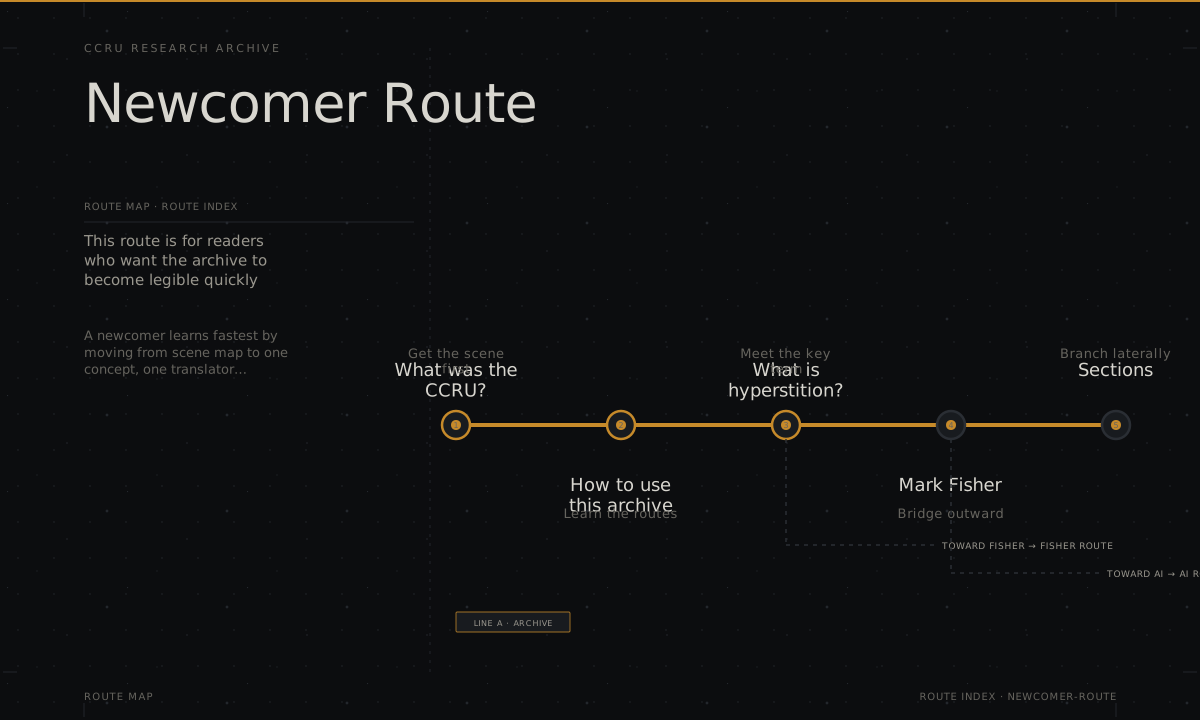
This route is for readers who want the archive to become legible quickly without pretending it is simple. It moves from scene map to bridge concept to bridge figure to one vivid primary source.
Route thesis
A newcomer learns fastest by moving from scene map to one concept, one translator, and one source. The goal is proportion: enough context to make Ghost Lemurs or CCRU Lecture 1 read as arguments rather than atmosphere.
Why this route begins with proportion
Most readers arrive at CCRU through a single door, usually the wrong one. They hit the numogram, or a Nick Land essay from 1994 dense with thanatropic Spinozism, or a fragment about machinic capitalism as a 'nihilistic vortex', and they read it as either poetry or prophecy. Both readings fail. The Newcomer Route is built to prevent that failure.
The route's thesis: CCRU is a research programme before it is a mythology, and the mythology only operates when you can see the research underneath. So the sequence moves from method, to materials, to the constructed fictions, and only then to the late-period diagrammatics. A reader who reverses this order ends up with aesthetics and no traction. A reader who follows it ends up able to tell which parts of the corpus are doing philosophical work, which parts are doing fiction work, and which parts are doing both at once.
What Was the CCRU? comes first because it breaks the one-name myth. Hyperstition follows because it gives the scene one memorable problem. Fisher comes next because he translates without replacing. Only then does Ghost Lemurs or CCRU Lecture 1 stop reading like atmosphere and start reading like argument.
Early stage: recalibrating what counts as a text
Early stage, the reader's job is to recalibrate what counts as a text. Begin with the Lecture 1 transcript and the short framing pieces on hyperstition. The lecture is useful precisely because it is loose, spoken, and recursive; it names the operating concepts (decoding, abstract machines from A Thousand Plateaus, 'realism of the future') without sealing them into doctrine. Pair this with the William S. Burroughs epigraph that opens 'The Emergence of Hyperstition', where contact is distinguished from communication and marked as painful. That distinction is the route's first hinge. CCRU writing wants contact, not communication. If you read it for arguments-to-agree-with, you have already missed it.
Middle stage: source materials and vocabulary
Middle stage, the reader meets the source materials the Unit was metabolising. This is where the Fanged Noumena editors' introduction earns its place: it gives you Land's reading of Kant, the move from conceptual identity to real difference, and the link between the death-drive and 'the desert at the end of our world'. Without that scaffolding, the later cybergothic material reads as edgelord theatre. With it, you can see Land doing a specific philosophical operation, namely refusing Deleuze and Guattari's alignment of the death-drive with a desire for death and rerouting it as 'an immanent generative principle'. Around this, place Plant on cybernetic feminism and Parisi on abstract sex. The point of the middle stage is to install the vocabulary before the fictions start using it as ammunition.
Late-middle: the constructed apparatus
Late-middle, the reader is ready for the constructed apparatus: the Numogram, the Book of Paths, the tic-systems, the Cthelll material. Here the route asks for a specific discipline. Treat the numerical practices as what the Lecture calls them, schemas alongside Cantor's set theory and Crowley's numerology, all of which 'seek to open up language' rather than close it onto a single esoteric meaning. The Lecture is explicit that any attempt to fix one decoding as the true one is illusory, since another arbitrary schema can always decode it again. This is the trap most newcomers fall into on the Book of Paths, reading lines like 'Immersive nightmares spawn promising developments' as either nonsense or as a hidden cipher with a correct answer. Both are mistakes. The numbers are operational. They generate routes, not truths.
The page where a newcomer is most likely to misread the scene is the late hyperstition material, particularly anything written after the Hyperstition blog went 'radio silent in 2007'. Read in isolation, those texts look like accelerationist manifestos with occult decoration. Read after the middle stage of this route, they are legible as continuations of a method already established, fiction routed back into the real as an operational vector, language decoded into 'alien death-scapes utterly subtracted from human sense' not as nihilist flourish but as the logical endpoint of the decoding programme begun in the lectures.
What the source step proves
The source step matters because it converts orientation into evidence. Ghost Lemurs shows narrative residue and recursion at work; CCRU Lecture 1 keeps the scene audible; Virtual Futures ties the whole sequence back to events, programs, and public surfaces.
Late stage: turning outward
Late stage, the route turns outward. Once the internal grammar is in place, the reader can use the secondary literature productively rather than as a crutch. The Urbanomic catalogue and the Fanged Noumena editorial apparatus become useful here, as does the 2012 Cyclonopedia symposium volume Leper Creativity, which reads Negarestani's triadic logic against Peirce and shows what a post-CCRU theory-fiction looks like when it is doing its own work rather than imitating the Unit's voice.
The payoff
The payoff: after this sequence, the archive stops looking like a single black monolith and starts resolving into distinct registers. You can tell when a text is arguing, when it is performing, when it is generating, and when it is doing all three. You can read a fragment about capitalism's 'senseless and indifferent death core' and locate it inside a specific philosophical lineage rather than treating it as atmosphere. You can open the Book of Paths at random and know what kind of object you are holding. Most importantly, you can move laterally across the corpus, from Land to Plant to Parisi to the collective texts, without losing the thread. That lateral mobility is what the rest of the archive assumes you have. This route is how you get it.
When to fork
Once that map is stable, branching becomes informative rather than chaotic. Move to the AI route if recursion and systems brought you here, to the Land route if notoriety is the live question, or to the non-Land guide if cyberfeminism and collective experiment are what the first pass made newly visible.
If you only read three things
-
What Was the CCRU?
Why this stop matters: Begin with the broadest scene answer so every later page has somewhere to attach and every later name has a setting rather than a halo.
-
What Is Hyperstition?
Why this stop matters: Take one concept that later readers actually search for and that the archive can explain well across talk, fiction, and later public discussion.
-
Mark Fisher and the CCRU
Why this stop matters: Fisher is the fastest route from weird archive memory to public-theory intelligibility, especially if your way in is music, criticism, or blog-era cultural writing.
Full route
-
Why this item is here: Start with the broad scene map so later figures, keywords, and afterlives attach to a formation rather than floating in isolation.
-
Why this item is here: Use one portable concept to keep the archive from becoming pure lore and to give later pages one problem that can recur in different media.
-
Why this item is here: Fisher helps readers move from scene history into public criticism and afterlife, which is why he is such a reliable third step rather than a misleading first one.
-
Ghost Lemurs of Madagascar
Why this item is here: This source page is vivid enough for first contact but rich enough to repay rereading later, which makes it better than a merely famous difficult fragment.
-
Warwick and Formation
Why this item is here: End by returning the route to scene history so the source page does not float free of its formation context and so one source becomes a cluster rather than an endpoint.
Where the route forks
If Nick Land was the name that brought you here
Switch once you have the scene map, so Land appears as one branch inside a larger formation rather than as the whole explanation.
Fork to: Land Route
If cyberfeminism or collective practice is the real interest
That route widens the archive before one-man mythology hardens into your default frame.
If you arrived through AI or systems discourse
From here you can fork toward AI, Land, or the non-Land corrective depending on what first caught your attention and what kind of pressure you want to follow next.
Fork to: AI Route
Read next
Exhibit
Virtual Futures and the Para-Academic Scene
A strong next step if you want the social scene, event culture, and public surfaces behind the CCRU kept in one tight evidence set.
Reading path
A useful continuation if public theory, criticism, and blog-era translation are the clearest bridge for you.
Section
The best widening move if you want formation history, adjacent figures, and named records rather than another keyword page.
Flagship guides
Sections
References
External references
Inherited outward references from the guides, works, and adjacent pages this route relies on.