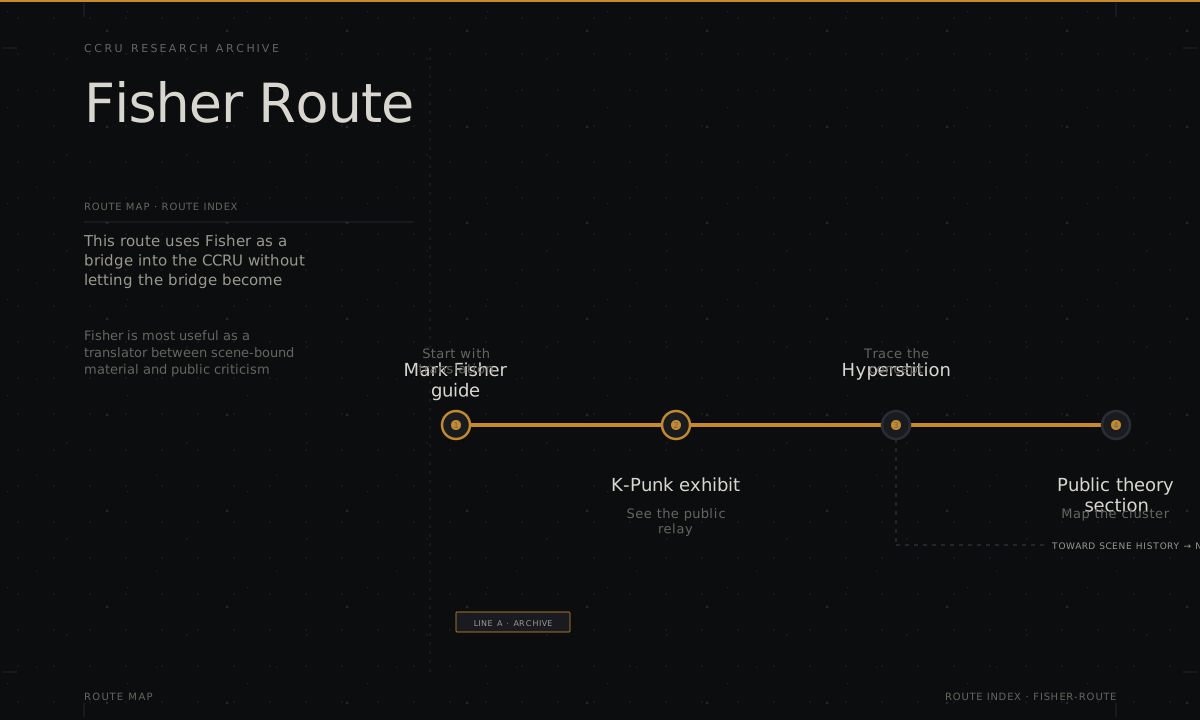
This route uses Fisher as a bridge into the CCRU without letting the bridge become the whole landscape.
Route thesis
Fisher is most useful as a translator between scene-bound material and public criticism. This route keeps that translation visible so the bridge never becomes the whole landscape.
Why the route begins with Fisher as bridge
The guide comes first because it sizes the problem correctly: Fisher belongs to the afterlife and to the archive's intelligibility, but he is not its soft-focus public version. The person page then slows the bridge down by keeping periods, works, and neighboring figures visible.
The early stage: CCRU Fisher
The early stage is the CCRU Fisher. "White Magic" is the anchor because it shows him operating inside the hive-mind register the unit cultivated, where citation, fiction, and theory braid into one surface. Pair it with the Cyberpositive material he co-authored with Sadie Plant, where Wiener's cybernetics is read as a defence technology against runaway process. At this stage the reader should not be looking for arguments. They should be learning to recognise a writing practice: a tone that treats Gibson's biochip slabs and Gödel's incompleteness as the same kind of object. Most newcomers misread these texts as juvenilia or Land-pastiche. They are neither. They are the laboratory where the Fisher-Function was assembled.
The middle stage: k-punk and the practical eliminativism hinge
The middle stage is the k-punk archive (2003 onward) and the Urbanomic-published lectures. The k-punk posts are where the CCRU's collective voice gets metabolised into a single writer's signal. Fisher's 2014 talk on practical eliminativism, published in Speculative Aesthetics, is the document to read here: he opens by naming "Nick Land, Landianism" as the position "many of us were oriented around in the 90s" and works out what survives once that orientation is abandoned (Urbanomic). This is the hinge of the route. The reader should track what Fisher keeps from the CCRU, the commitment to impersonal process, the suspicion of phenomenological experience, and what he discards, the libidinal investment in capital's deterritorialising velocity.
What the middle of the route does
The middle of the route shows medium change in real time. k-punk is the public surface, White Magic keeps Fisher in his own prose, and Ghost Lemurs tests what the bridge actually makes legible in a primary source.
The late stage: Capitalist Realism as hyperstitional report
The late stage is Capitalist Realism (2009) and The Weird and the Eerie. Read after the cybergothic and k-punk passes, Capitalist Realism stops looking like a stand-alone polemic and starts looking like a hyperstitional report from inside the cancellation of the future (Monoskop PDF). The depressive register is not a mood. It is a diagnostic instrument calibrated against the cyberpositive optimism of the Warwick years. The famous line about it being easier to imagine the end of the world than the end of capitalism only lands properly once you have read the earlier Fisher who genuinely believed something was tearing through from the outside.
The trap to avoid
The trap to avoid sits at the Capitalist Realism stage. Readers who arrive there first, via the book's afterlife in Anglophone left commentary, tend to file Fisher as a cultural-studies melancholic and read backward through that filter. "White Magic" then looks like embarrassing teenage Land-worship. The k-punk hauntology posts look like nostalgia. This is the standard misreading and the route is built to block it. The Urbanomic memorial frames the problem precisely by asking "What is the Fisher-Function?" as a hyperstitional rather than biographical question (Urbanomic memorial). The route treats that question as the one organising every stage.
A short detour: Leper Creativity
A short detour is worth taking between middle and late stages: the Cyclonopedia symposium volume Leper Creativity, where Fisher's contemporaries work through Negarestani in the same theory-fiction register Fisher had been using a decade earlier. Reza Negarestani's geotrauma material, and Mackay's reconstruction of Barker's "Brief History of Geotrauma", show what the CCRU style looked like once it left Warwick and entered international circulation. Fisher is not in that volume but his methods are everywhere in it. Reading the symposium clarifies what Fisher's solo voice was doing differently: domesticating the cybergothic apparatus for cultural diagnosis without losing its operational edge.
The payoff
The payoff: after this route the archive's other paths become legible as variations on a single problem Fisher kept reformulating. The Land path reads as the road Fisher walked partway down and then stepped off. The hyperstition path reads as the toolkit he carried with him when he left. The Plant and cyberfeminism material reads as the unfinished alternative he kept gesturing toward in the k-punk years. You can now read a 1995 CCRU communique and a 2016 lecture on acid communism as outputs of the same writing function, distorted by twenty-one years of pressure. That recognition is what the route is for. It is not a Fisher introduction. It is a way of seeing why his work refuses to settle into either the cybergothic 90s or the depressive 2010s, and why the archive treats him as a continuous operation rather than a sequence of phases.
When to fork
The main fork is between Fisher as bridge figure and Fisher as one node in a wider public-theory ecology. Some readers should leave for internet-native theory culture; others should stay with sonic culture or public pedagogy. Either way, the ideal outcome is the same: Fisher remains central, but not sovereign.
If you only read three things
-
Mark Fisher and the CCRU
Why this stop matters: Start with the page that sizes Fisher's bridge role correctly before blog nostalgia or public-theory familiarity starts doing the work for you.
-
k-punk.abstractdynamics.org (archived homepage)
Why this stop matters: The blog surface matters because it shows the archive entering public criticism as medium as well as content, not just as a list of references.
-
Ghost Lemurs of Madagascar
Why this stop matters: This keeps the route tied to a named source rather than to commentary alone and shows what the bridge actually makes possible for a reader.
Full route
-
Why this item is here: Begin with the flagship bridge page so Fisher's importance is sized historically before the route becomes biographical or nostalgic.
-
Mark Fisher
Why this item is here: The person page helps separate blog-era visibility, public criticism, pedagogy, and the archive's afterlife routes without collapsing them into one role.
-
k-punk.abstractdynamics.org (archived homepage)
Why this item is here: See the public interface that made later CCRU discourse portable and discussable beyond a small scene of already-initiated readers.
-
Mark Fisher - White Magic
Why this item is here: A text-page route keeps Fisher in his own language rather than in pure retrospective summary or second-hand explanation.
-
Why this item is here: The route lands on a source page so the afterlife stays tethered to named material rather than hardening into commentary about commentary.
Where the route forks
If you want the public web afterlife beyond Fisher alone
That guide widens k-punk into the larger question of distributed theory culture and online circulation.
If music writing and sonic culture are the active interest
This keeps Fisher inside a broader cultural field rather than a purely literary or political frame.
Fork to: Sonic Futures and Audio Theory
If the blog/public-theory transition is what interests you most
From here you can fork toward sonic culture, public theory, or the wider internet-native afterlife depending on which medium now feels most explanatory.
Fork to: Mark Fisher and Public Theory
Read next
Exhibit
A tighter exhibit on translation, blog form, and public-theory circulation once you want the Fisher bridge condensed into a smaller evidence set.
Guide
CCRU and Internet-Native Theory Culture
The best widening move once k-punk starts looking like part of a larger media ecology rather than a singular miracle of transmission.
Section
A fuller cluster of public-theory materials, adjacent routes, and later pedagogical afterlives.
Flagship guides
Sections
References
External references
Inherited outward references from the guides, works, and adjacent pages this route relies on.