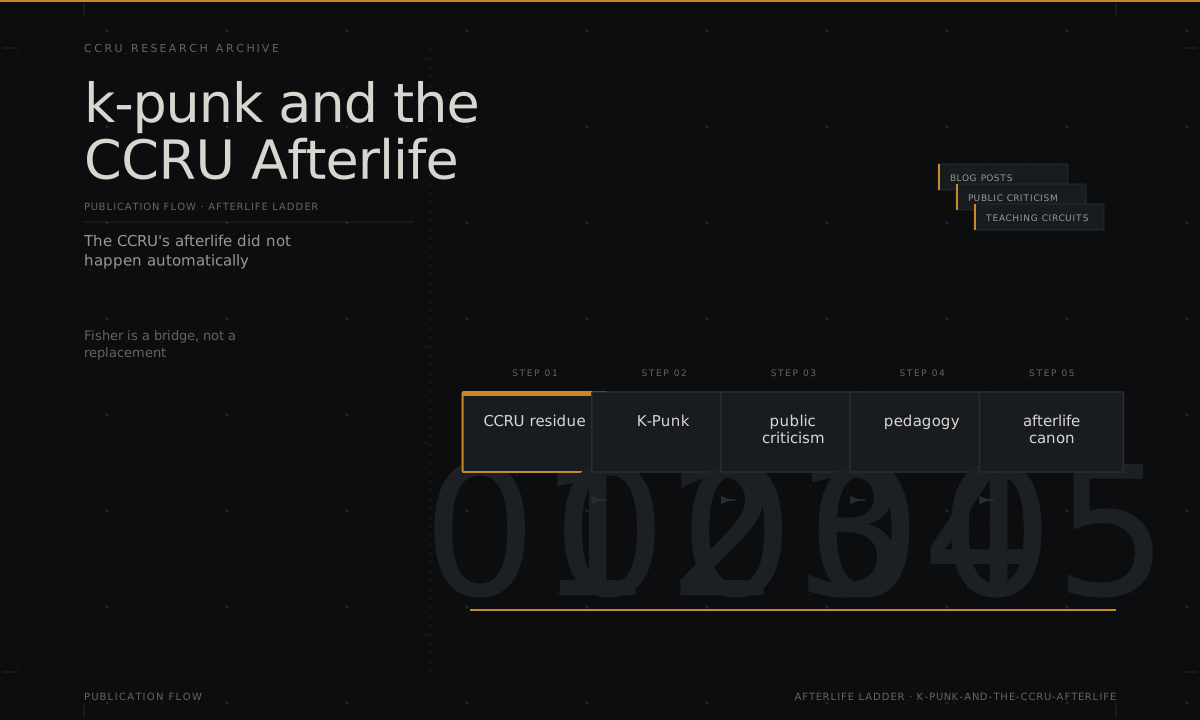
The CCRU's afterlife did not happen automatically. Mark Fisher and adjacent public-theory surfaces translated, argued over, and redistributed the archive in forms that new readers could actually enter.
Core argument
Fisher is a bridge, not a replacement. He makes the archive legible to wider readers, but he should not be mistaken for the whole explanation.
Blog culture mattered because it changed the archive's scale of circulation. The move from scene-specific material to public criticism and cultural writing is one of the main reasons the archive remained discussable.
Translation always changes proportion. The afterlife clarifies some lines of the archive while softening, amplifying, or omitting others.
An exhibit on Mark Fisher, k-punk, and the public-theory afterlife that made the CCRU newly legible to later readers.
Fisher made the archive legible without making it simple
One reason Fisher matters is that he could translate atmosphere into argument. He understood that parts of the archive worked through mood, style, and conceptual compression, but he also knew how to reopen those pressures in prose that could survive outside the original scene. k-punk shows that translation happening in public. The site becomes a bridge between a difficult archive and later readers who arrive through culture, politics, depression, labor, music, or neoliberalism rather than through Warwick scene history.
That does not mean Fisher simply softened the archive. The stronger claim is that he reweighted it. He made some lines much easier to teach and transmit, especially those connected to affect, public criticism, and cultural diagnosis. That reweighting is why the afterlife remains so productive, and why it needs to be read historically.
Blog culture altered the scale of circulation
The move from scene-specific documents to blog culture changes more than the platform. It changes the audience, the rhythm of circulation, and the social context in which ideas become memorable. k-punk is invaluable because it shows how archive problems can become public without becoming trivial. Ideas move through links, posts, fragments, references, and public conversation. They gain a scale of address that the original scene rarely had.
At the same time, blog culture makes selective emphasis inevitable. Some materials are easier to quote, paraphrase, and circulate than others. Some figures become central because they can translate. Others recede because their materials are harder to stabilize. That is one of the conditions under which archives acquire afterlives, not a failure of blog culture.
That is also why k-punk belongs beside White Magic and ccru.net here. One shows the public interface of translation, one shows Fisher's own intellectual handling of the material, and one shows the older public surface being restaged for later readers.
Translation is also a filter
The important thing is not to romanticize translation. Fisher clarifies, but he also filters. Public theory needs a different level of portability than scene-internal theory-fiction or event culture. Once the archive starts moving through public criticism, some of its stranger or more experimental dimensions inevitably get narrowed, reframed, or backgrounded. The afterlife is thus neither a betrayal nor a perfect continuation. It is a reconstruction under new media conditions.
That is why this exhibit puts k-punk beside older surfaces such as ccru.net and beside nearby voices like Brassier. The point is comparative. One can see the archive being redistributed through different registers: analytic, atmospheric, critical, blogged, teachable. That comparison is more useful than a story in which one figure magically unlocks everything.
Once the comparison is visible, Fisher's importance becomes more precise. He matters because he helped build a public language in which the archive could survive. He does not matter because every later route should collapse into his voice alone.
What readers usually miss
Readers often miss that Fisher's bridge role is strongest when it remains visibly partial. If he becomes the entire explanatory key, the archive shrinks. But if he is treated as one translator among several, his importance becomes clearer, not smaller. He is central because he made the afterlife public and discussable. He is not central because all other lines should disappear behind him.
They also miss how much medium matters. k-punk is one of the forms through which the archive's afterlife became socially real, not just a place where archive ideas were mentioned. Once that is visible, public theory itself starts looking like part of the archive's history rather than a detached commentary on it.
The objects in sequence
The first object establishes blog culture as infrastructure. k-punk is one of the public interfaces through which CCRU-adjacent material became readable outside the immediate Warwick and para-academic scene, more than a biographical marker. White Magic then narrows the question to Fisher's own language, showing how his writing could be compact, critical, and still attached to the weirder archive.
Ghost Lemurs brings the sequence back to a source motif that Fisher's route helps readers approach without flattening. The Brassier conversation widens the frame by placing Fisher near a larger post-CCRU intellectual field, where realism, theory, politics, and philosophy all pull against the myth. The final object returns to ccru.net so the afterlife can be compared with the older public archive surface. The exhibit's central claim is that public theory culture did not simply inherit CCRU; it reformatted it.
k-punk
Why here: The k-punk surface is the necessary opening because it shows afterlife as public interface. The blog is where difficult archive materials meet readers, music culture, politics, and web-era circulation.
Notice: The important feature is not only Fisher's name but the form: posts, links, short arguments, and public-facing relay. The blog format lets theory arrive as a sequence of interventions rather than as a finished monument.
White Magic
Why here: White Magic gives the exhibit a compact route into Fisher's own language. It keeps the sequence from treating Fisher as a node or brand rather than as a writer.
Notice: The useful thing is the compression: Fisher can make a concept public without dissolving its strangeness into explanation. It shows the bridge function at sentence scale, not only at the scale of reputation.
Ghost Lemurs of Madagascar
Why here: Ghost Lemurs is included because it lets the exhibit test what Fisher's bridge work makes accessible. It is a charged source object, not a secondary summary.
Notice: The text asks for a reader who can handle motif, haunting, and argument at once. That is exactly the sort of reader the afterlife produces.
Ray Brassier — Mad Black Deleuzianism
Why here: This conversation widens the exhibit beyond Fisher alone. It places the afterlife inside a broader field of post-CCRU philosophical reception and dispute.
Notice: The value is contextual pressure: the archive is being reread by adjacent thinkers, not merely preserved by fans. That wider field keeps Fisher from becoming the only gate into the material.
ccru.net
Why here: The old CCRU web surface is the final comparison point. It shows the earlier presentation layer that blog-era culture had to inherit, recode, and make newly navigable.
Notice: Compare its archive-like opacity with the more public, argumentative relay of k-punk. The difference shows how much interpretation happens through interface before any explicit commentary begins.
Archive instrumentView the k-punk afterlife across four registersThe exhibit's sequence of blog, recollection, memorial, print, and collected objects maps exactly onto the reviewed Fisher circuit's separation of event, recollection, publication, and canonization.
Afterlife as editorial problem
The exhibit proves that the CCRU afterlife was not simply a matter of influence. Influence is too smooth a word for what happened. The material had to be reformatted by blogs, public criticism, teaching, music writing, and adjacent philosophy before it could circulate at scale. Fisher's importance lies in that relay work. He made parts of the archive intelligible without making them harmless, and that is why the afterlife still matters as an editorial problem.
Curated items
Record
k-punk.abstractdynamics.org (archived homepage)
k-punk is the public surface where Fisher's translational role becomes visible as medium as well as argument: the archive enters everyday criticism, links, and repeatable online circulation.
Text page
White Magic matters because it shows Fisher's own prose at work rather than a retrospective summary of his role, letting you hear what he preserved and what he recoded.
Record
Ghost Lemurs of Madagascar is where Fisher's public voice meets one of the archive's strongest motifs directly, making the bridge measurable rather than abstract.
Record
Ray Brassier - Mad Black Deleuzianism; On Nick Land
Ray Brassier - Mad Black Deleuzianism gives a nearby analytic register, helping size Fisher's bridge work against another serious afterlife translation.
Record
ccru.net is the older public surface that later criticism and blog culture kept recoding for new readers, which is why it belongs in any serious account of afterlife.
References
External references
A compact outward trail: original sites, archived copies, and trusted relay surfaces for this exhibit’s source cluster.