A useful CCRU glossary should not stop at short definitions. It should connect terms like hyperstition, numogram, accelerationism, geotrauma, and lemurian time war to named texts, talks, and sections so the vocabulary becomes a route back into the scene's materials rather than a detached word list.
Key points
- The CCRU's vocabulary only becomes useful when each term points back to a scene problem and a source cluster.
- Hyperstition, numogram, accelerationism, geotrauma, and lemurian time are not interchangeable weird words; they belong to different pressures in the CCRU scene.
- A good glossary widens into concepts, sections, and people pages instead of trying to replace them.
Core argument
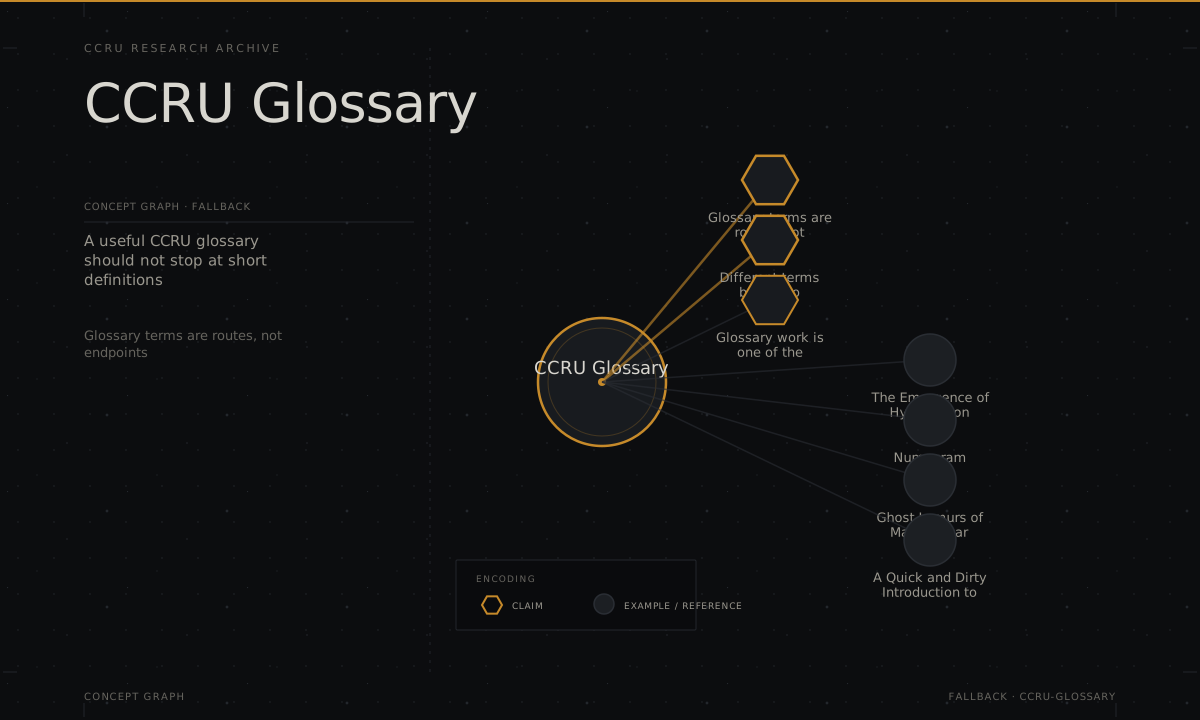
Glossary terms are routes, not endpoints. Definitions only become meaningful when they send readers toward named texts, talks, and clusters. Example: Hyperstition becomes clearer through The Emergence of Hyperstition and Ghost Lemurs of Madagascar, not through a slogan alone.
Different terms belong to different scene pressures. Numogram, geotrauma, and accelerationism may coexist in CCRU discourse, but they do not perform the same work. Example: Numogram routes through Book of Paths and Zone texts, while accelerationism routes through later editorial and political debates.
Glossary work is one of the strongest antidotes to internet folklore. Many readers now encounter single terms detached from source scenes and need the route back to named material. Example: The glossary becomes useful when it sends readers from 'hyperstition explained' to works, concept pages, and section hubs.
Glossary terms are routes, not endpoints. Definitions only become meaningful when they send readers toward named texts, talks, and clusters.
The glossary as hyperstitional document
Open the CCRU Glossary in *Digital Hyperstition* and the second entry is Abomenon: "Postulated substrate of absolute horror (the worst thing in the world)." The third is A-Death: "Neuroelectronic flatline, based upon Sarkonian..." (Urbanomic). A reader expecting a reference work, terms defined, sources cited, scholarly distance, has already been routed somewhere else. The glossary is itself a hyperstitional document. Its definitions extend the fiction they pretend to clarify.
This is the trap of the CCRU vocabulary. Treat the terms as jargon to be decoded back into respectable theory and you lose the operation. The glossary printed at the back of *Abstract Culture: Digital Hyperstition* sits alongside "recovered hyperstitional episodes reported by Melanie Newton, Echidna Stillwell, and other students and victims of Lemurian time sorcery" (Urbanomic). Stillwell is a fictional ethnographer and Newton a fictional informant, both invented by the CCRU. The glossary entries that gloss their work are therefore not summaries of prior research; they are the research, in compressed form.
The thesis follows. A CCRU glossary, ours included, has to do two jobs at once. It has to give the new reader enough purchase to navigate texts written between roughly 1997 and 2003, and it has to refuse the reassurance that the terms point at stable referents outside the writing. Hyperstition, numogram, Lemuria, Pandemonium, Cthelll, Tic-system, Vauung: each name routes through other names. The exit back to plain English is sealed.
Kabbalism, numeracy, and the switchboard
Consider Kabbalism, which the CCRU repeatedly invokes and just as repeatedly distinguishes from numerology. The distinction is sharp. "Numerological Kabbalism is the misrecognition of pragmatic meaning, values and logical relations for us as divinely ordained truths". The CCRU keeps the practice and discards the metaphysics: "Kabbalism does not decode to reach an original, unproblematic substrata of meaning. It decodes precisely to show" the absence of one. So when the glossary gives a numerical value for a term, the value is operational, a vector for further connection, not a hidden essence. "Land and the CCRU hold that Kabbalism marks a numerically different meaning than the occult". A glossary built on this premise cannot be a dictionary. It is a switchboard.
Hyperstition is the scene's most portable term
Hyperstition is the obvious place to begin because it is the word most likely to arrive before the CCRU material itself. The shortest useful definition is that it names fictions, narratives, diagrams, or signs that begin helping to make the realities they describe through circulation and uptake. But even that is not enough without sources. The Emergence of Hyperstition matters because it gives the term a source-level anchor. Ghost Lemurs of Madagascar matters because it shows the concept working through tone, haunting, and nonlinear time rather than only through summary.
This is why the glossary cannot stop at “hyperstition = self-fulfilling prophecy.” That formula is too narrow. The CCRU version depends on media circuits, repetition, style, and distributed cultural feedback. The glossary should therefore route readers from the short definition to the concept page, the longform guide, and at least one source where the term becomes operational.
The numogram is not just another eerie keyword
The numogram sits differently. More than a portable cultural term, it is one of the CCRU's diagrammatic and numerological pressure points. The numogram text, Book of Paths, and the zone writings matter because they show a term that is simultaneously a diagram, a time-circuit, a numeracy system, and a scene method. Readers often search for “numogram explained” because the word sounds opaque enough to promise mystery and coherent enough to suggest there must be one clean answer.
There is no single sentence that solves it, which is precisely why a glossary route matters. The right move is to define the term minimally, then send readers into the concept page and the full guide on occult numeracy. A glossary entry is useful here only if it lowers the initial barrier without pretending the diagram can be exhausted in one gloss.
These zones are grouped into five pairs (syzygies) by nine-sum twinning. The arithmetical difference of each syzygy defines a current.
Accelerationism belongs to the afterlife as much as to the scene
Accelerationism is one of the most distorted glossary terms because many readers now treat it as the CCRU's true doctrine. The CCRU scene is certainly one of the keyword's main prehistories, but the label itself becomes publicly important in later editorial and political argument. That is why A Quick and Dirty Introduction to Accelerationism and Robin Mackay's #Accelerate reader matter so much. They show how a later public term reorganizes earlier material under a more portable banner.[1]
A glossary definition therefore has to say two things at once. First, accelerationism names several later debates about capital, abstraction, technology, and political strategy. Second, those debates only partially overlap with the original CCRU scene. That distinction is what keeps the glossary from becoming retrospective propaganda.
Geotrauma and lemurian time belong to a different pressure
Geotrauma and lemurian time war are useful examples because they show how unlike these terms can be. Geotrauma belongs to the CCRU's geologic, inhuman, and anti-humanist pressures. It routes through works by Ray Brassier, Reza Negarestani, Robin Mackay, and related discussions of outside, materiality, and deep time. Lemurian time war, by contrast, condenses recursion, haunting, temporal loops, and mythic-science fiction into a compact and highly memorable phrase.[2]
Ghost Lemurs of Madagascar is crucial here because it makes lemurian time vivid rather than merely esoteric. The glossary should use examples like this to demonstrate that the CCRU vocabulary is not one homogeneous lexicon of weirdness. The words belong to different problems and moods. Putting them back into those problem-fields is what makes the glossary useful.
The geological-cosmic vocabulary
Third, the geological-cosmic vocabulary. Terms like Cthelll, the geocosmic unconscious, anorganic tension. Lecture One describes the project as "mapping the geocosmic unconscious as a traumatic mega system with life and thought dynamically quantized in terms of anorganic tension, elasticity or machinic flexion". Granite is read as repression: geology buries "any trace of its traumatic liquid origin in layers upon layers of sturdy rock and granite". The K/T extinction event is invoked, the dust killing the dinosaurs and "two-thirds of all life". Fermi's paradox surfaces as the "great filter, precisely some mechanism that renders life extinct over time". A glossary that lists Cthelll without the affective charge of these passages, that gives only "molten iron core of the Earth, figured as repressed trauma," has stripped the term of what makes it function in the writing.
The status of the CCRU itself
The second pressure point is the status of the CCRU itself. Monoskop describes the unit as "a diverse group of thinkers who experimented in conceptual production by welding together a wide variety of sources: futurism, technoscience, philosophy, mysticism, numerology, complexity theory, and science fiction" (Monoskop). True enough as institutional history. The CCRU's own self-description is colder. "At degree-0 (1998) Ccru is the name on a door in an institution which said of the Ccru that 'does not, has not, and will never exist'" (archive.org _hocr.html)). The Warwick philosophy department disowned the unit; the unit took the disownership as material. Any glossary entry for "CCRU" therefore has to register both the empirical group (Land, Plant, Fisher, Parisi, Mackenzie, Mackay, and others) and the degree-0 fiction the group authored about itself.
Internal disagreements and regional dialects
Fourth, the disagreements internal to the archive. The CCRU vocabulary is not uniform. The Lemurian Time War material developed by Iris Carver and the Stillwell papers does not sit easily alongside Land's tic-mathematical writings, and neither sits comfortably with Sadie Plant's earlier cyberfeminist register. The Numogram, Pandemonium, the games of Decadence and Subdecadence (Urbanomic) form one closed system; the K-goth and jungle-derived vocabulary forms another; the Kantian and Deleuzean technical apparatus a third. A glossary that flattens these into one homogenous lexicon misrepresents the unit. Better to flag the regional dialect of each term.
The question of authority
Fifth, the question of authority. The Urbanomic edition prints what it calls "an invaluable CCRU glossary" inside *Abstract Culture: Digital Hyperstition*, pages 69 to 79 (Urbanomic). That glossary is the closest thing to a primary source. It was assembled by the CCRU itself, not by later commentators. Any secondary glossary, ours included, should be read against it. Where we differ from the Urbanomic entries, we are interpreting; where we agree, we are paraphrasing. The reader should know which is which.
Why the glossary needs people and sections, not just terms
A serious glossary also needs to point outward into people and sections. Mark Fisher matters because he helps translate hyperstition and hauntological residue into public criticism. Sadie Plant and Luciana Parisi matter because they widen the archive's technical and cyberfeminist vocabulary beyond the familiar Land line. Sections matter because they show how terms aggregate into larger questions. Hyperstition-and-fiction-making, numogram-and-occult-numeracy, and accelerationism-branches-and-debates are not just shelves. They are places where the vocabulary becomes argumentative.
That outward movement is what separates a publication-grade glossary from a search-engine stub. The user did not come looking only for a definition. They came looking for the route that makes the definition matter.
What a glossary page is really for
A glossary page should answer the immediate query, but its real job is to keep the vocabulary in proportion. It should keep hyperstition from turning into manifestation-speak, keep accelerationism from swallowing the archive whole, keep the numogram from floating free as pure mystique, and keep terms like geotrauma or lemurian time attached to named texts and scenes. Once it does that, vocabulary becomes usable again.
That is why the glossary belongs in the publication's indexable core. It answers a real search need, but it also improves everything around it. The broader guides become easier to read. The concept pages become more navigable. The sections become less intimidating. And the publication stops looking like a field of unexplained jargon and starts looking like a structured, if still unruly, scene.
So: read the CCRU glossary as a reading aid, not a key. Each entry tries to do three things at once. Locate the term in a specific text or lecture. Give the working sense the CCRU put it to. Mark the connections to other terms in the network. The entries are short because the texts are short and dense; they are not short because the concepts are simple. After working through twenty or thirty entries, return to a primary text, the *Ccru Writings 1997–2003* volume from Time Spiral Press (archive.org) or the *Digital Hyperstition* swarm, and watch the vocabulary do its work in situ. The glossary is scaffolding. The building is elsewhere.
Worked examples
These named texts, talks, sites, and records show where the argument becomes concrete.
The Emergence of Hyperstition Text page
A source-level route for the most searched term in this material.
Numogram Text page
A direct route into one of the CCRU's densest recurring diagrams.
Ghost Lemurs of Madagascar Record
A vivid source for lemurian time, recursion, and nonlinear temporality.
A Quick and Dirty Introduction to Accelerationism Record
Useful because it shows how one later keyword reorganized earlier material under a portable public label.
Tensions and limits
A glossary can make the scene seem cleaner than it is if each term is stripped of style, scene, and disagreement.
Some terms, especially hyperstition and accelerationism, have afterlives that now compete with their original CCRU uses.
The glossary works best as a relay into concept pages, guides, and works, not as a substitute for them.
Common misreadings
These are the recurring simplifications, exaggerations, and misreadings that make the subject look flatter than it is.
- A recurring distortion
The usual distortion is to treat the CCRU's terms as a matching set of mystical keywords. They are not. Hyperstition, numogram, geotrauma, lemurian time, and accelerationism belong to different problems, different moods, and often different historical phases of the scene.
- A recurring distortion
Another distortion is to define the terms purely through later internet use. Hyperstition and accelerationism in particular now carry later meanings that need to be checked against named sources such as The Emergence of Hyperstition, A Quick and Dirty Introduction to Accelerationism, Ghost Lemurs of Madagascar, or the numogram texts.
Significance
Search traffic often arrives through one term at a time. Readers ask what hyperstition means, what the numogram is, or whether accelerationism came from the CCRU. A glossary helps because it turns isolated searches into a wider route through the material.
It also matters because vocabulary is one of the main places where later folklore accumulates. A good glossary gives those terms back their scene, their carriers, and their disagreements.
References
Records cited
Linked archive records for this guide. Numbers correspond to the footnote markers in the body above.
Nick Land - A Quick and Dirty Introduction to Accelerationism Record
A later source that helps show how one keyword was repackaged for broader public argument.
Ghost Lemurs of Madagascar Record
A vivid source for time-war and recursion motifs.
Reader questions
Why does the CCRU need a glossary?
Because terms like hyperstition, numogram, and Lemurian Time War often circulate as isolated slogans. A glossary helps readers connect them back to named source moments, scenes, and recurring conceptual disputes.
Does the glossary replace the source texts?
No. It is a relay surface: the point is to make the terms legible enough that readers can return to the source documents with better orientation rather than staying at the level of summary.
Reading routes through this guide
Featured exhibit
Hyperstition in Primary Sources
A curated exhibit of the pages, talks, and texts that make hyperstition legible through actual archive evidence.
Featured reading path
A short guided sequence for readers who want the clearest first path through the CCRU site.