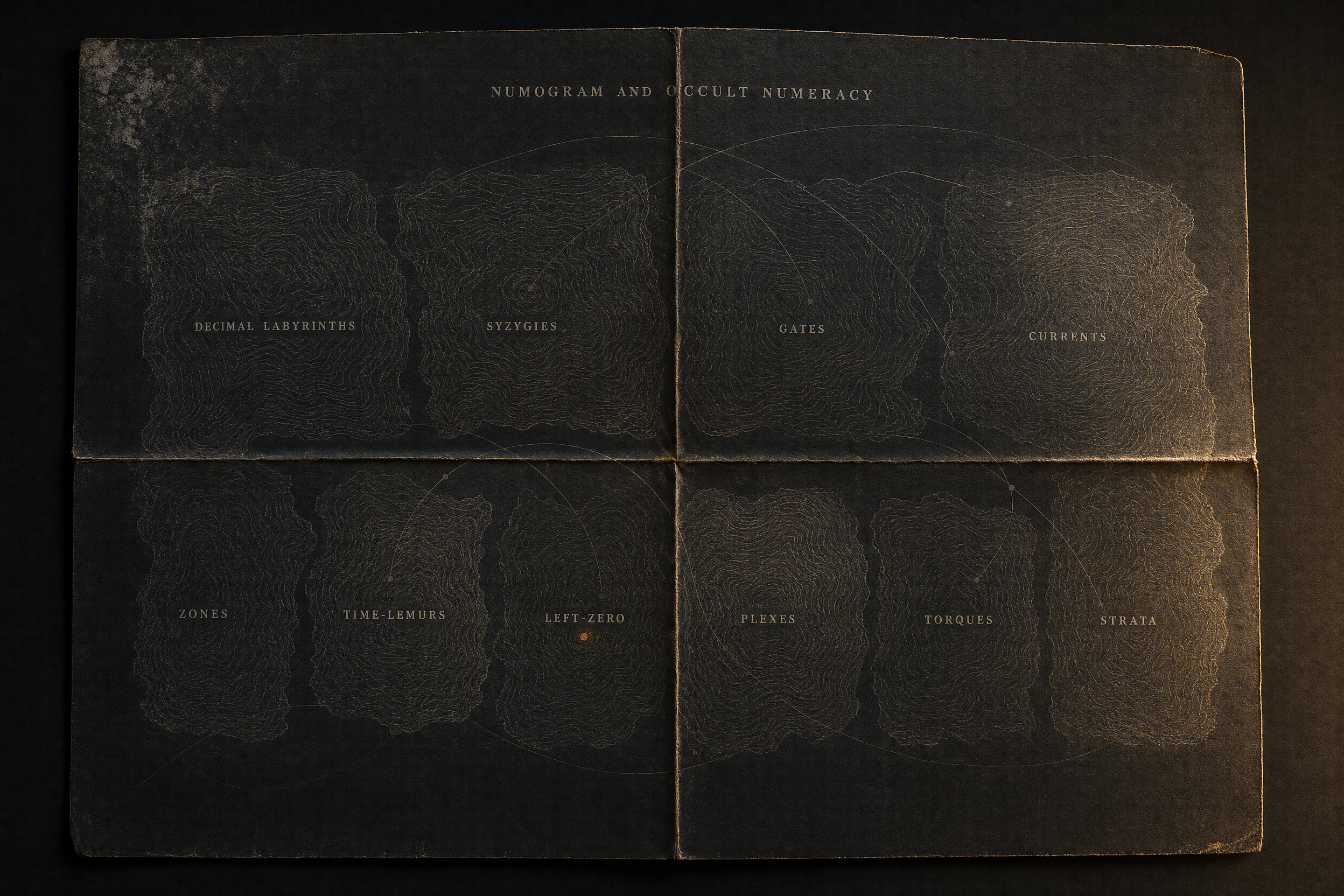
Where the diagram sits in the archive
The cluster does not have a single doctrinal centre. It has a notation (gates, zones, currents, syzygies), a set of procedures for operating on that notation (digital reduction, pairing, path-tracing), and a body of narrative fiction that uses the notation to index entities, times, and events. Readers entering the cluster should expect to move between all three registers. Treating any one as the 'real' numogram and the others as decoration is the fastest way to miscarry the material.
Procedure versus symbolism
The page's working claim — that the numogram is operated, not decoded — rests on a distinction that Land, in his 'Qabbala 101' essay for Collapse I, draws between numerology and a numerical practice proper. Numerology tries to redeem number into higher symbolic significance (archetypes, correspondences, meanings); a numerical practice worth the name stays with number's own semiotic force and refuses the redemption. The numogram belongs on the procedural side of that line. Its zones are defined by sum-pair relations (9-0, 8-1, 7-2, …) and its currents by the arithmetic that connects them. You get somewhere by doing the sums, not by consulting a dictionary of correspondences.
This is where the internal disagreement opens. One reading — the one associated with Greenspan — treats the operations as a formal diagram of time's production under capital: philosophically serious, taking the arithmetic as the real payload. Another reading, closer to Mark Fisher's 'Lemurian Time-War' essay and to the Ccru fictional corpus itself, stays inside the occult register, where the numogram is the map the Architectonic Order wants buried and the Lemurians operate against. Neither reading is wrong. The cluster only collapses when one is used to evict the other.
Time, not mysticism, as the payload
The reason the numogram matters philosophically, on the formal reading, is that it encodes a claim about time: that time is not a neutral medium but is produced through splitting, pairing, and branching operations, and that the decimal labyrinth is a notation for that production. Gates mark transitions between zones; currents track directions of passage; syzygies are the sum-pair couplings across which the diagram folds. Whether or not Greenspan phrases it this way, this is the kind of reading her thesis invites and which later commentators have extended.
This puts the numogram in unexpectedly close company with other Land and post-Ccru work on time as produced rather than given — compare his later [Crypto-Current] treatment of Bitcoin, where 'there can be no resolution of the DSP without strictly determinable succession' and 'Bitcoin and time restoration are finally indistinguishable' [raw::land-crypto-current::52]. A protocol, there, is an operationalisation of transcendental time. The numogram is the earlier, occult-inflected version of the same instinct: time has a structure, and that structure is legible as arithmetic. Read the numogram as a time-diagram first and the demonological furniture stops looking like ornament.
The occult residue is not optional
A purely formalist reading runs into a wall quickly. The numogram in Ccru practice is populated — by the Lemurian entities, the Mu lineages, the date-stamped intrusions documented across the datastreams. The [Ccru datastream] posts to nettime in 1999, which describe themselves as 'a scratch on the vinyl of history' [raw::ccru-datastreams::58], present these materials as live dispatches rather than allegories. Land's parallel writing of the same period runs on similar current: in 'Meltdown' we get 'headhunters, loa and escaped AIs hiding from Asimov security' and 'terminal commodity-hyperfetishism' as the denial of humanity 'as xenosentience in artificial space' raw::a-nick-land-reader-selected-writings::15. The entities are in the room with the arithmetic.
The disagreement here is whether this occult furniture is load-bearing or scaffold. One reading says the entities are narrative devices for making abstract time-operations legible — operative fictions, in the sense the /guides/what-is-hyperstition guide develops. Another reading, closer to the Lemurian Time-War texts themselves, says the entities are what the diagram is a diagram of, and stripping them out leaves you with an arithmetic that has forgotten why it was drawn. The cluster's vitality comes from refusing to settle this.
The trap on both sides
The common trap has two mirrored forms. The decoder's trap: treat the numogram as a sealed key, match zones to tarot cards or sephiroth or planetary bodies, produce a 'translation' that reinstalls exactly the symbolism a numerical practice is supposed to refuse. The dismisser's trap: note that the numogram uses digit-sums and pairs, conclude it is ornamental mysticism dressed up in arithmetic, and skip the material. Both trap-forms share the same error — they refuse to operate the diagram and look only for what it 'means.'
The test of escape is whether you can do something with the numogram that produces a result you did not put in. Tracing a time-circuit between zones, pairing a date with a gate, working through a syzygy — these are small procedures, but they are procedures. If your reading cannot generate any, you are still outside the cluster.
How the pieces relate on the page
For readers moving across the section: Greenspan's thesis is the philosophical backbone and the best single entry for the argument that the numogram is a transcendental-time diagram. The Ccru collected writings are the primary source for the notation and its fictional population, and should be read with Fisher's 'Lemurian Time-War' as the interpretive hinge between the two registers. Land's 'Qabbala 101' sits slightly to the side but supplies the methodological commitment against symbolic redemption.
The /guides/what-is-hyperstition guide is one exit from this cluster — it uses the numogram as an example of how operative fictions work. This section orients across the territory that guide leaves unmapped: the procedural-arithmetic core, the temporal reconstruction, and the unresolved question of how seriously to take the occult register. Read the guide for the circulation argument; read here for the diagram itself.
For the single deepest document in the cluster, go to Capitalism's Transcendental Time Machine. It is the one text that holds the formal and the occult registers in the same frame long enough to show why the numogram is neither key nor ornament, but instrument.
The numogram organises time, gates, and transitions through a procedural numeracy rather than a hidden symbolism — it is meant to be operated, not decoded.
Core argument
The numogram is best treated as an operational diagram. That makes the cluster readable as a set of procedures rather than as a lore dump.
Occult residue and formal pattern belong together here. The section shows how the archive fuses symbolic charge with process and mapping.
Worked examples
These named texts, talks, sites, and records show where the argument becomes concrete.
Nick Land Reading Guide Guide
Start with "Nick Land Reading Guide" if you want the wider frame before dropping into Numogram And Occult Numeracy.
Nick Land Person
"Nick Land" is one of the clearest figures for the pressures gathered inside Numogram And Occult Numeracy.
Numogram Concept
"Numogram" names one recurring problem inside Numogram And Occult Numeracy.
CCRU Lecture 1 Record
"CCRU Lecture 1" is a checkpoint where Numogram And Occult Numeracy stops sounding abstract.
ccru.net Home Record
"ccru.net Home" is a checkpoint where Numogram And Occult Numeracy stops sounding abstract.
Common misreadings
These are the recurring simplifications, exaggerations, and misreadings that make the subject look flatter than it is.
- The numogram is just opaque esoterica.
The cluster becomes much clearer once you watch how number organizes relation and transition.
Significance
This section matters because numogram materials are among the archive's strongest dropout points and one of its most distinctive formal inventions.
Themes
- numogram
- qabbala
- decimal labyrinth
- syzygies
- left zero
Where this section sits in the archive
The numogram arrives in the Ccru corpus as a working artefact, not a revealed glyph. It appears across the datastreams, the Lemurian Time-War materials, and the decimal labyrinth documents collected in Ccru: Writings 1997–2003. The collected writings were 'finally published as an e-book in 2016, and then as a paperback in 2017 by Urbanomic, run by Robin McKay,' on the back of a resurgence of interest in the Ccru story. Anna Greenspan's Capitalism's Transcendental Time Machine is the standard philosophical companion to that material — the thesis that most readers cite when they want to treat the diagram's arithmetic as load-bearing rather than atmospheric. The reading offered here of what Greenspan does with it is a reconstruction, not a quotation.
Sources by cluster
These mini-clusters widen the section through named works and support traces rather than through adjacent keywords alone.
Section source cluster
Numogram And Occult Numeracy: public editions and anchor texts
Anchor editions: cybergothic.pdf; The Numogram Diagram, Time-Circuits, And Acceleration The Dark Forest Literature, Philosophy, and Digital Arts; CCRU Lecture 1.
Work
at the eternalization of self, or returning from the grave. White maggots heaving in the carcass of the social, rippling beneath the skin. Fortress Europe pustulation, subordinating techonomic efficiency to demonic ne...
Work
of recurrence that dictates the flow of existence. When CCRU codes its Numogram as a “time circuit,” it is recovering this idea: that number is not count but recurrence, the hidden program that ensures repetition. VI....
Work
Work
Work
Work
Section source cluster
Numogram And Occult Numeracy: talks, captures, and support traces
Source traces: The Genealogy of Politics; Poetry is Cosmic War Interview; Further Considerations on Afrofuturism.
Text page
Rohit Lekhi and Mark Fisher Assemblages / Love and Mourning / Dialogues 74 ‘Organized man,’ man ‘centred outside himself,’ stands at the pinnacle of Kant’s meticulously arranged, but tentatively asserted, teleological...
Text page
Poetry is Cosmic War Interview
Nevertheless, the two practices are not interchangeable and I would add that there are irresolvable discrepancies between xenofemi nism and xenopoerics in terms of their conception of agerrcy. Xenofemi nism displays a...
Text page
Further Considerations on Afrofuturism
288 • Further Considerations on Afrofuturism To establish the historical character of black culture, to bring Africa and its subjects into history denied by Hegel et al., it has been necessary to assemble countermemor...
Text page
The Revolving Door and The Straight Labyrinth An Initiation in Occult Time (Part 0)
The Revolving Door and The Straight Labyrinth: An Initiation in Occult Time (Part 0) Vast Abrupt | 2 at the fourth cardinal point, the Villa Triste-le-Roy. An intriguing passage follows: For the last time, Lönnrot con...
Record
"Nick Land Fanged Noumena" is one of the local source traces that keeps this section tied to named material.
Section source cluster
Numogram And Occult Numeracy: routes out and adjacent arguments
Adjacent routes: Nick Land Reading Guide; What Was The CCRU; Nick Land.
Guide
"Nick Land Reading Guide" gives the wider argumentative frame around this section.
Guide
"What Was The CCRU" gives the wider argumentative frame around this section.
Person
"Nick Land" is one of the figures most closely bound up with this section's local problem.
Concept
"Numogram" names one of the recurring conceptual pressures inside this section.
Concept
"Hyperstition" names one of the recurring conceptual pressures inside this section.
Section
Lemurian Time War And Spiral Time
"Lemurian Time War And Spiral Time" is the neighboring cluster to open once this section's local pattern is visible.
Texts in this section
27 classified works grouped into 3 editorial subclusters. Reviewed: 13; needs review: 14.
Primers and diagrams 10 works
- numogram
- The Numogram Diagram, Time-Circuits, And Acceleration The Dark Forest Literature, Philosophy, and Digital Arts
- Unleashing the Numogram
- Enigma of Psychosis - by Maks Valenčič - Psychotic SavoirNeeds editorial review
- Harper, Andy Mackay, Robin - A two-hander (2015)Needs editorial review
- Qabbalistic Oddments 00 - by Zero PhilosophyNeeds editorial review
- Review by Robin Mackay - Conscience and Pain, Tragedy and Truth 'The Last Men' (1996)Needs editorial review
- Worms, Frederic Mackay, Robin - Between Critique And Metaphysics (2005)Needs editorial review
- Zone1Needs editorial review
- Zone8Needs editorial review
Decimal labyrinths and syzygies 10 works
- Ccru - syzygy
- Numogramming the Yi Jing Vauung's Lair
- Zone5
- Zone6
- Zone9
- Zones
- SyzygyNeeds editorial review
- Syzygy MuteNeeds editorial review
- Zone0Needs editorial review
- Zone4Needs editorial review
Occult mathematics and qabbala 7 works
- Land - Qabbala 101 (Collapse) (2007)
- Metalogos # 3 - Gematria, Hyperstition and Alphanumeric Qabbala w Luís Gonçalves
- Unfolding the Middle East Kristen Alvanson's Nonad - Robin Mackay
- Zone7
- Esoteric Nihilism - by Zero PhilosophyNeeds editorial review
- liber-qwyzNeeds editorial review
- Micro-Nightmares - by Zero PhilosophyNeeds editorial review
References
Records cited
These linked sources are the quickest way to test the argument against named materials rather than second-hand summary.
CCRU Lecture 1 Record
"CCRU Lecture 1" is the first record to test the framing around Numogram And Occult Numeracy.
ccru.net Home Record
"ccru.net Home" is the first record to test the framing around Numogram And Occult Numeracy.
Nick Land Fanged Noumena Record
"Nick Land Fanged Noumena" is the first record to test the framing around Numogram And Occult Numeracy.
Nick Land Reading Guide Guide
"Nick Land Reading Guide" gives the larger argument around Numogram And Occult Numeracy before you widen sideways.
External references
Inherited outward references from the guides, exhibits, people, and concept pages that anchor this section cluster.