Operating the 0–9: what the numogram notates
This is what distinguishes the numogram from an occult symbol or sealed cipher. A cipher promises one-to-one substitution: crack the key, recover the message. The numogram refuses that economy. Its zones are not stand-ins for hidden referents; they are positions in a digital lattice that accrue associations through repeated operation. That is why it is not numerology in the horoscope-column sense either: it does not assign pre-given meanings to digits, it produces relations by running procedures — pairings, doublings, branchings, time-splits. Vauung's elementary impology is exemplary: 'For any demon with terminal digit n, the number of imps = 2^n − 1', yielding the sequence 0, 1, 3, 7, 15, 31, 63, 127, 255, and summing via zone-and-demon inclusion to 2^10 − 1 = 1023 (Vauung's Lair, 'Numogramming the Yi Jing'). The numogram generates populations through strict procedures, and — as Vauung puts it — 'systematic coherence ultimately trumps tradition (or any other kind of opaque authority).'
Where the notation started doing real work
The numogram becomes load-bearing in the Ccru's late-1990s output and consolidates in print as Ccru: Writings 1997–2003 (Time Spiral Press / Urbanomic, 2015/2017). The 'Decimal Decadence', 'Tic-Talk', 'Barker Speaks', and 'Lemurian Time-War' sequences are where the diagram stops being ornament and starts driving the structure of Pandemonium demonography, Tick cosmology, and the Barker scale of geotraumatics; these are the texts to consult for zone, gate, and syzygy definitions. Anna Greenspan's Capitalism's Transcendental Time Machine (Warwick PhD thesis, 2000) puts the diagram to work outside its hyperstitional frame, using its time-circuits to model capital's temporality. Mark Fisher's 'Lemurian Time-War' (collected in the same volume) deploys the diagram's circuits as the architecture for a reading of Burroughs and Lovecraft. In each case the diagram is the argument's skeleton.
A second operational layer is visible in the Vauung's Lair 'Numogramming the Yi Jing' thread (2012), where hexagram lines are mapped to zonal exponents — 'Line-1 = 01, Line-2 = 02, Line-3 = 04, Line-4 = 08, Line-5 = 16, Line-6 = 32' — so that 'the entire hexagram is locked onto the Hex, or circuit of time … twin trigrams … which comprehends time even as it excludes the outer zones (0, 3, 6, 9) as a hyper-temporal triadic Abomenon.' This is the diagram extended by live procedure, which is how it was always meant to be grown.
The misreading to refuse, and one document to start from
The dominant misreading bifurcates and both branches miss the same thing. On one side: the numogram as sealed cipher — a hidden numerological scripture to be decoded, with the Ccru as a priesthood guarding the key. On the other: the numogram as decorative weirdness — an aesthetic prop for 1990s cyber-gothic affect, safely detachable from serious philosophical work. Both skip the procedural middle. The numogram is an instrument: it produces results when operated, and the results can be checked for consistency against other operations (imp counts, gate additions, syzygy closures). Vauung is explicit that in a 'non-faith based religion … all claims should be demonstrable (from strict procedures).' A numogram reading that cannot show its arithmetic is not esoteric — it is just sloppy.
Practically: treat the diagram as a score, not a scripture. Pick a zone, run the syzygy, check what circuit you land in, observe what demons and time-signatures the archive has already attached to that position, and ask whether your operation adds a consistent further attachment. If it does not close, the move was wrong, not mystical. For orientation across the full cluster — gates, currents, Pandemonium, Lemurian calendrics — see Numogram and Occult Numeracy. For the deepest single document to start operating from, go to Ccru: Writings 1997–2003.
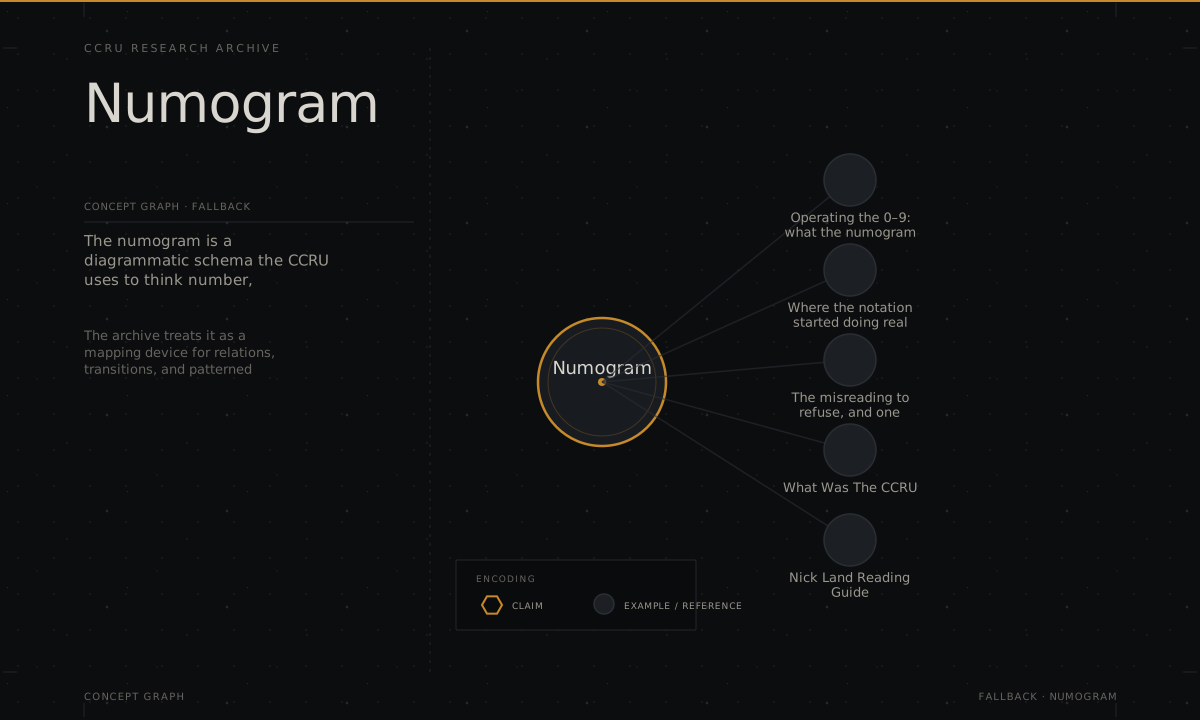
The numogram is a diagrammatic schema the CCRU uses to think number, orientation, transition, and patterned movement. It works better as a procedure than as a secret codebook.
Core argument
The numogram is procedural before it is symbolic. Readers understand it better by asking what it organizes than by searching for one hidden meaning.
The motif fuses number, ritual residue, and design. That explains why it feels both formal and occult at once.
Worked examples
These named texts, talks, sites, and records show where the argument becomes concrete.
ccru.net Home Record
The old web interface shows how zones, links, and presentation became part of the argument. It makes Numogram checkable against a concrete archive object.
CCRU Lecture 1 Record
The lecture format preserves cadence, definition, and Warwick-era scene explanation. It makes Numogram checkable against a concrete archive object.
Nick Land Person
"Nick Land" shows who carries, translates, or contests Numogram in practice.
What Was The CCRU Guide
"What Was The CCRU" keeps Numogram attached to a guide-length argument and route map.
Common misreadings
These are the recurring simplifications, exaggerations, and misreadings that make the subject look flatter than it is.
- The numogram is just numerology.
The archive treats it as a mapping device for relations, transitions, and patterned movement.
Significance
The numogram matters because it shows how the archive's strangeness often works as a form of organization rather than as decorative fog.
Working definition
A diagrammatic schema that condenses CCRU interests in numeracy, ritual patterning, and nonlinear mapping.
Archive instrumentOperate the definition on the NumogramThe working definition becomes auditable when the reader can follow zone twins, currents, and gate destinations on the instrument rather than treating the concept as a decorative diagram.
Representative extracts
Definition · CCRU - Lecture 1 · 01:27:51
Landefund's another kind of even earlier model for numerical decoding in Georges Cantor's set theory.
Why this matters: The line gives the numogram a mathematical pedigree, routing Land's numerical decoding back through Cantor so the schema answers to set theory as much as to occult tradition.
Definition · nick-land-fanged-noumena-collected-writings-19872007-1.mobi · extracted text
the single defining feature of the Numogram2 - the five Syzygies emerging from 9-sum twinning of the decimal numerals
Why this matters: By isolating a single generative feature, Land shows the numogram to be constructed by rule, which lets the record treat the diagram as derivation rather than decoration.
Mechanism · nick-land-fanged-noumena-collected-writings-19872007-1.mobi · extracted text
Treat the decimal numerals as a set of 9-sum twins - zygonovize - and they map an abstract intensive wave, indifferent to magnitude.
Why this matters: Land delivers the mechanism as an imperative: the conversion of number from magnitude to intensity, on which the record's whole argument rests, is performed in one operation rather than argued for.
Mechanism · CCRU - Lecture 1 · 01:30:20
Cantor calls it the first infinite set, or what he also calls a left zero,
Why this matters: This passage supplies the technical seed of the numogram's zero-logic, anchoring its treatment of zero in Cantor's transfinite rather than in ordinary arithmetic convention.
History · CCRU - Lecture 1 · 00:17:03
as they turned to Kabbalistic and mathematical numbering practices
Why this matters: Here the lecturer fixes the numogram's point of origin, dating the CCRU's shift into numbering practice and framing the diagram as working method rather than ornament on the fiction.
References
Records cited
These linked sources are the quickest way to test the argument against named materials rather than second-hand summary.
CCRU Lecture 1 Record
The lecture format preserves cadence, definition, and Warwick-era scene explanation. Use it to test Numogram against source material rather than summary.
ccru.net Home Record
The old web interface shows how zones, links, and presentation became part of the argument. Use it to test Numogram against source material rather than summary.
Nick Land Fanged Noumena Record
Fanged Noumena gives the Land corpus its retrospective editorial architecture. Use it to test Numogram against source material rather than summary.
What Was The CCRU Guide
"What Was The CCRU" widens Numogram through linked sources, people, and sections.