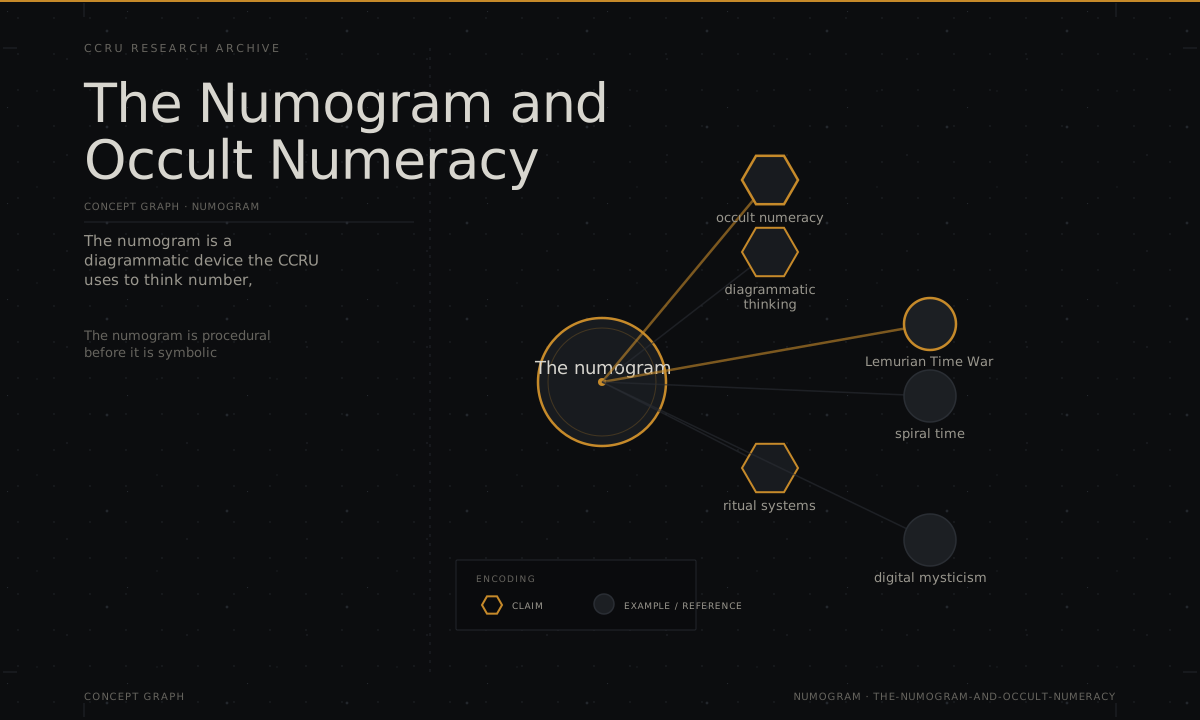
The numogram is a diagrammatic device the CCRU uses to think number, sequence, transition, and patterned movement. It is not just occult ornament and not just a puzzle to decode. It is a way of turning number into orientation, procedure, and temporal pattern.
Key points
- The numogram makes more sense as an operational diagram than as a secret codebook.
- Number matters here because it organizes gates, regions, transitions, and patterned movement rather than because arithmetic itself is the final point.
- The motif combines occult residue and diagrammatic precision, which is why it often gets mystified too quickly.
Core argument
The numogram is procedural before it is symbolic. Readers understand it better by asking what operations it performs than by hunting for one hidden meaning. Example: CCRU Lecture 1 (CCRU - Lecture 1)
The numogram condenses one of the archive's most distinctive fusions: number, myth, system, and design. That explains why it feels both rigorous and occult without being reducible to either term. Example: Fanged Noumena (nick-land-fanged-noumena-collected-writings-19872007-1.mobi)
Most online discussion of the numogram over-rewards obscurity. A clear guide should reduce dropout without flattening the motif into banality. Example: ccru.net homepage (ccru.net (archived homepage))
The numogram is procedural before it is symbolic. Readers understand it better by asking what operations it performs than by hunting for one hidden meaning.
Start with the diagram as a machine
Readers often approach the numogram as if it were a vault full of hidden meanings. That instinct is understandable, but it is rarely the best first move. The archive usually treats the diagram as something that organizes movement and relation. Ask what it does before you ask what every symbol secretly means.[1]
This is the most useful beginner shift. The numogram becomes more legible when treated as a procedure for arranging gates, zones, transitions, and sequences rather than as a static occult emblem.
Start with what the diagram actually does. The zones are numbered 0 through 9. Pairs sum to nine and form syzygies. Gates connect zones via digital reduction. The Cthulhu Club material attributed to Peter Vysparov labels the central region the "Time-Circuit" or "Domain of Chronos" (Urbanomic, Numogrammatic Time-Mapping). The arithmetic is closed and finite, and once you can run a few reductions yourself the diagram stops being mystical scenery. Amy Ireland and Lendl Barcelos make exactly this pedagogical wager in their Urbanomic workshop: "the best way to understand the numogram is to make one for yourself" (Urbanomic event listing). Construction is the route in. Exegesis is the trap.
The procedural character is visible in the working notes the archive preserves. "Unleashing the Numogram" runs through reductions like a ledger: "Zones: 9 + 0 = 9. Currents: 1. Gates: 45 = 9. Zones + Gates: 45 + 9 = 54 = 9 (Ciphers Katak)". Then it mutates the ordering and the sums shift. The text is not decoding a secret. It is testing what the diagram supports under different operations. That is the register to read in. Recurrence and transition matter more than any single labelled point.
Archive instrumentOperate the NumogramThe guide tells readers to approach the diagram as a machine rather than a codebook; operating the linked map demonstrates movement and relation in a way the explanatory prose cannot reproduce.
Why number matters here
Number matters because it gives the archive a way to think patterned movement with unusual intensity. Gates, syzygies, regions, cycles, and sequences become easier to imagine when they are diagrammed numerically. The point is not arithmetic for its own sake. It is a way of converting abstraction into trackable form.[2]
That is why the motif feels half mathematical and half ritualized. The archive wants precision and charged symbolism at the same time, and the numogram is one place where those pressures are forced together.
This is also why online discussions of the numogram often go wrong in two opposite directions. Some readers treat it as pure secret knowledge, while others dismiss it as decorative nonsense. Both responses miss the same thing: the diagram is useful because it organizes relation and transition with unusual intensity.
This is not mere occult decoration
Occult residue is real here, but it is not just costume. The numogram is one of the places where older symbolic repertoires and newer cybernetic or diagrammatic habits begin to overlap. Reducing it to aesthetic garnish misses why the motif persists. It persists because it gives the archive a way to think process, time, and relation through an image that feels both formal and charged.
That hybridity is part of the appeal. It is also part of the difficulty.
The occult vocabulary is real and it is doing work. The CCRU drew on a documentable tradition of decimal mysticism. Westcott's 1911 Numbers: Their Occult Power and Mystic Virtue surveys exactly the Pythagorean and Kabbalistic material the numogram metabolises (archive.org). Urbanomic's own commentary makes the Otz Chiim parallel explicit. So the diagram is not pretending to be esoteric for atmosphere. It is borrowing from older symbolic repertoires and routing them through cybernetic pressures at the same time. That is why it feels half-mathematical and half-occult: the archive wants both precision and charged symbolism without separating them cleanly.
Disagreement inside the archive
This is also where readers should locate the disagreement inside the archive itself. "Numogrammatic Time-Mapping" registers "misgivings about mythopoetic arguments" before rehearsing Vysparov's Time-Circuit material anyway (Urbanomic). The CCRU corpus is not internally unanimous about how seriously to take its own mythography. Some passages run the numogram as straight diagrammatic procedure. Others wrap it in Cthulhu Club fiction, Lemurian time-sorcery, and demonological cast lists. Treating every layer with equal literalism collapses the difference. The fiction frames are part of the hyperstitional method; the procedural diagram is a tool that survives translation out of the fiction.
How to read the motif well
Start with explanatory speech when possible. Then move into denser written material with one or two repeated operations in mind. Read for transitions and recurrences, not for a single master key that will suddenly dissolve all uncertainty. The numogram becomes clearer when you watch it being used.[3]
A good guide therefore does not pretend the motif is easy. It makes it manageable. That is enough to turn one of the archive's strongest dropout points into a real entry route.
Three practical consequences follow for how to read. First, do not begin with the densest pages. Sum a few syzygies yourself, watch how 4+5, 3+6, 2+7, 1+8, 0+9 all close, and notice that the gate numbers (reductions of zone-pair sums) are doing the same arithmetic in another register. Second, when you meet a name like Katak or Uttunul, treat it as a label for a position in the circuit before treating it as a demon with attributes. The position is stable. The demonology is a layer added on top. Third, when the prose gets dense, ask what operation is being performed: a reduction, a pairing, a transition between zones, a cycle. The text rarely pauses to teach patiently, so the reader has to supply the procedural reading.
Once readers reach that point, the numogram stops functioning like a sealed puzzle and starts functioning like a recurring method. That is the threshold this guide is trying to establish: not complete mastery, but usable orientation.
One practical way to keep that orientation is to move between formats. A lecture can supply pacing, a denser text can show the diagram under pressure, and a web surface can reveal how the motif circulated publicly. Together they keep the numogram from collapsing into either private lore or impatient dismissal.
That is also why the numogram rewards slow, comparative reading more than interpretive bravado. When readers watch the motif recur across voices and media, it becomes easier to separate real procedural consistency from the theatrical aura that later discussion sometimes exaggerates.
The numogram in the wider CCRU project
This reframing also clarifies what the numogram is for in the wider CCRU project. Numbers in this archive track gates, zones, syzygies, circuits, and transitions. They are a way of writing time and pattern that is not narrative and not equation. It sits next to hyperstition (fiction as operational vector) and the cybergothic mood as a third method: diagrammatic numeracy as a way of organising recurrence. Once you see the numogram as a repeated procedural habit rather than a single sacred object, the same habit shows up across the Lemurian time-war material, the calendrical writings, and the Pandemonium taxonomy. They are the same machine in different costumes.[4]
Pandemonium is the complete system of Lemurian demonism and time sorcery. It consists of two principal components: Numogram and Matrix.
What changes after this guide
What changes after this guide. You should stop reading the numogram for hidden meaning and start reading it for what it organises. The Urbanomic chapters on Pandemonium and Time-Mapping are the cleanest entry points; the working notes in "Unleashing the Numogram" show the diagram being used rather than explained; Westcott provides the older numerological substrate the CCRU is rewriting. The motif is durable because it is operational, and reducing it to aesthetic garnish misses what makes it durable. Treat the diagram as something to run, not something to decode, and the rest of the archive opens around it.
Worked examples
These named texts, talks, sites, and records show where the argument becomes concrete.
CCRU Lecture 1 Record
One of the best spoken routes into the motif when the written prose gets too compressed.
Fanged Noumena Record
A dense written route where the numogram appears as a mapping procedure rather than a decorative aside.
ccru.net homepage Record
Shows how the motif lived on the archive's public surface and not only inside printed explanation.
Numogram and Occult Numeracy Section
The section hub for the wider cluster around the motif.
Tensions and limits
The numogram really is difficult, so a clear guide can improve orientation without pretending to remove all complexity.
Because the motif sits between mathematics, occult residue, and design, readers often overcorrect in one direction and miss the hybrid structure.
The archive repeats the numogram more often than it teaches it patiently, which means later explanatory work has to do more framing than usual.
Common misreadings
These are the recurring simplifications, exaggerations, and misreadings that make the subject look flatter than it is.
- It is just numerology.
The archive treats it as an active mapping device, not as a flat belief system about magical numbers.
- You need the whole codebook before you can read anything.
You usually learn it faster by noticing repeated operations, regions, and transitions first.
Significance
The numogram matters now because it shows that the archive's weirdness is often a method for formalization rather than pure aesthetic fog. It is one of the clearest places where diagram, myth, and process converge.
It also matters because the motif is especially easy to mystify online. A good guide can break that cycle while keeping the real strangeness intact.
References
Records cited
Linked archive records for this guide. Numbers correspond to the footnote markers in the body above.
nick-land-fanged-noumena-collected-writings-19872007-1.mobi Record
A denser written route into the numogram's own vocabulary and procedures.
Numogram Concept
The compact concept page if you need the shorter definition and linked extracts.
CCRU - Lecture 1 Record
A spoken route where the motif gets historical and conceptual framing.
ccru.net (archived homepage) Record
A public surface that shows the motif circulating beyond one text.
Reading routes through this guide
Featured exhibit
Hyperstition in Primary Sources
A curated exhibit of the pages, talks, and texts that make hyperstition legible through actual archive evidence.
Featured reading path
A staged reading route that keeps early Land, collected writings, and later afterlives distinct.