Editing as philosophical operation
The editors' introduction performs the argument by refusing to domesticate what it frames. It names the 'bewildering vortex of hallucinatory conjunctions' — Cthelll, Axsys, Tic-Systems, Anglossic Qabbala — as belonging to philosophy rather than as escape from it, and sustains the tension the introduction itself flags: that from 'a certain point of view — one encouraged by Land himself' — Land's writing has 'nothing, or as little as possible' to do with philosophy, even as the editors produce an academic-grade Collected Writings. Mackay's editorial voice is characteristically the voice that holds that tension open rather than resolving it. This is already a theoretical position: the archive does not need to be protected from its own weirdness to be taken seriously.
The journal as research form
Collapse: Philosophical Research and Development (Urbanomic, 2006–) is Mackay's most sustained claim that the form in which theory appears changes what theory can do. Collapse departs from the model of a journal as a venue for pre-formed articles. Each volume is assembled as a composed object, with Mackay's editorial intelligence visible in the adjacencies between philosophy, science, art, and occult or marginal traditions. The wager — and here I am stating an interpretive argument of this essay, not a received historiographic fact — is that philosophical 'research and development' requires a format that can hold heterogeneous registers in the same frame without demanding they translate into one another first, and that this format is not incidental to how speculative realism became readable as a tendency.
The specific intellectual move is to treat the volume-as-unit, rather than the article-as-unit, as the relevant scale of philosophical argument. This is why Collapse cannot be replaced by an equivalent set of PDFs. The book-object, the sequencing, the editorial willingness to include long-form interviews and materials outside the standard academic register — these are choices that carry conceptual weight. Mackay is doing something the anglophone philosophical journal system had largely stopped doing: using the material constraints of publication as a compositional resource.
Canon-Formation under conditions of turbulence
#Accelerate: The Accelerationist Reader (Urbanomic, 2014), co-edited with Armen Avanessian, is the second act of Mackay's intervention into how the CCRU-adjacent archive enters general circulation. The Reader does something easy to underestimate in retrospect: it assembles a canon for a tendency that was, at the moment of assembly, actively fragmenting. The volume gathers texts from the prehistory (Marx's 'Fragment on Machines,' Samuel Butler, Veblen) alongside Land's 1990s writings and the contemporary left-accelerationist positions (Williams and Srnicek's 'Manifesto for an Accelerationist Politics') whose explicit project was to wrest the term away from its Landian inheritance. The editorial claim is that accelerationism has a prehistory and a present dispute, and that both must be legible together or the category dissolves into polemic.
The Reader's structure — the editors' framing introduction, the periodized sections, the deliberate inclusion of positions that repudiate one another on the page — is itself an argument about how contested intellectual formations should be transmitted. This has drawn the obvious objection from both flanks: left-accelerationists uncomfortable sharing covers with Land's reactionary trajectory, and readers of Land who viewed the left-accelerationist recuperation as a domestication. That quarrel is the point rather than a bug. A reader is infrastructure, not a manifesto: it lets later readers disagree with each other precisely, citing the same page numbers.
The underread editor
There is a structural problem in assessing this contribution: an editor's work appears as the texture of other people's books. Mackay's own writing — the Collapse introductions, the Falsifications fragments, essays scattered across Urbanomic documents and collaborations — is small in volume next to his editorial footprint, and the temptation is to treat the editorial labor as service work supporting the 'real' authors. That framing gets Mackay specifically wrong. The Fanged Noumena introduction is a piece of Land criticism that rivals most monograph-length treatments; the sequencing decisions in Collapse are philosophical arguments in their own right; the selection logic of #Accelerate constitutes a thesis about what accelerationism was.
The internal tension in Mackay's position is that his editorial commitments cut against easy attribution. Urbanomic's house style — restrained paratext, rigorous apparatus — deliberately recedes in favor of the material it frames. The editor who succeeds at this becomes hard to see, which is the point and also the problem. A CCRU archive that treats Mackay as biographical scaffolding for Land, Fisher, Negarestani and Parisi will have misread the archive's own conditions of existence.
Why this contribution cannot be subtracted
Remove Mackay from the cluster and the archive survives, but its afterlife changes. The Land writings remain a dispersed body of occasional texts; the accelerationist dispute a set of blog posts and manifestos without a shared reference volume; the CCRU's 1990s output a rumor-object rather than a teachable corpus. What Mackay built is the condition under which this material could be revisited without being either academicized into respectability or flattened into mystique. That is a primary achievement: it is the reason a CCRU research archive is possible as a category. The deepest single document for understanding how this works in practice is Fanged Noumena, where the editorial decision to present Land whole — weirdness, ruptures, coding systems intact — defines what subsequent readers have been able to do with the material.
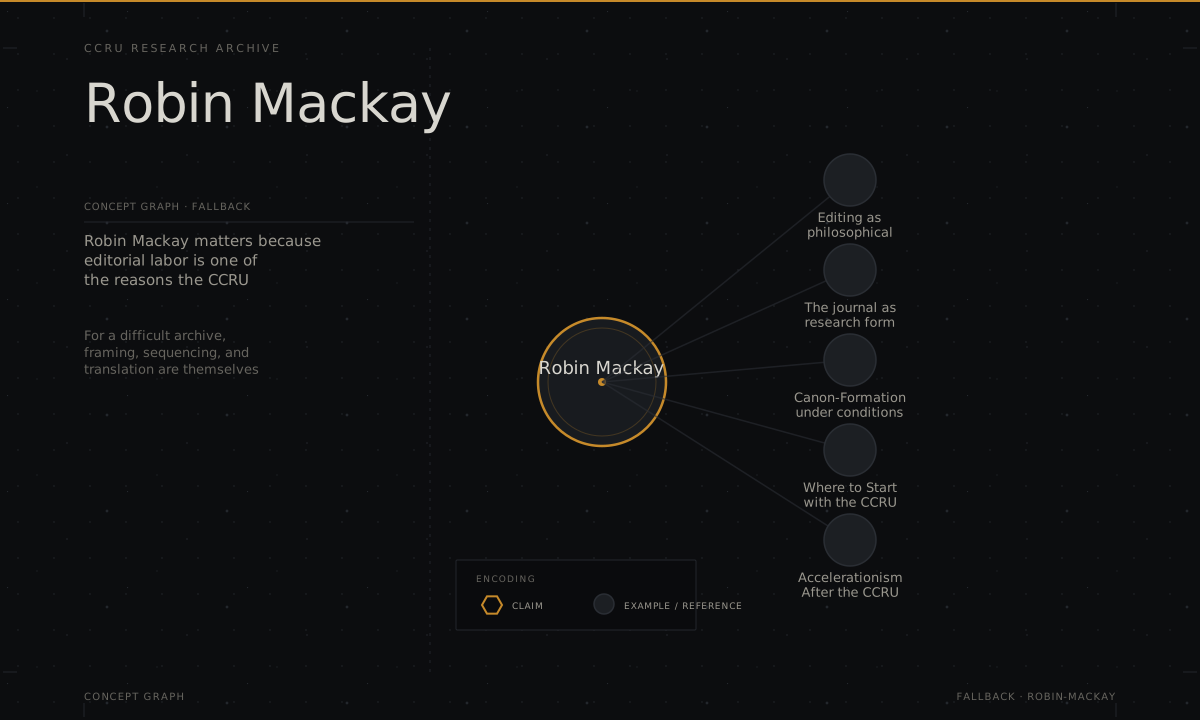
Robin Mackay matters because editorial labor is one of the reasons the CCRU remained readable at all. He helps turn a difficult archive into something that can be introduced, taught, and revisited without flattening it.
Core argument
Editorial framing is part of the archive's afterlife, not a service appended to it. Without that labor, much of the archive would remain inaccessible or badly mythologized.
Mackay's importance is infrastructural as well as intellectual. He helps stabilize routes, anthologies, and public interfaces that let later readers enter the material.
Worked examples
These named texts, talks, sites, and records show where the argument becomes concrete.
Robin Mackay Accelerate Reader Record
"Robin Mackay Accelerate Reader" is a good checkpoint because it keeps Robin Mackay inside scene evidence rather than later reputation.
Accelerationism Scoring Note Record
"Accelerationism Scoring Note" is a good checkpoint because it keeps Robin Mackay inside scene evidence rather than later reputation.
How To Use This Archive Guide
"How To Use This Archive" widens Robin Mackay back into the larger CCRU field instead of treating the figure as self-explanatory.
Accelerationism Concept
"Accelerationism" names one recurring pressure that helps Robin Mackay make sense beyond biography alone.
Common misreadings
These are the recurring simplifications, exaggerations, and misreadings that make the subject look flatter than it is.
- Editorial work is secondary to the real sources.
For a difficult archive, framing, sequencing, and translation are themselves part of the historical object.
Significance
Mackay matters now because he embodies the work of making difficult theory portable without turning it into bland summary.
Stakes of this figure
Editor, writer, and organizer whose introductions and editorial work are some of the best pathways into the archive for serious readers.
Periodisation
- 2010s editorial framing
- post-CCRU interpretation
Key works for entering the figure
- Robin Mackay-#Accelerate_ The Accelerationist Reader
- robin-mackay-introduction-to-the-medium-of-contingency.pdf
References
Records cited
These linked sources are the quickest way to test the argument against named materials rather than second-hand summary.
Robin Mackay Accelerate Reader Record
"Robin Mackay Accelerate Reader" ties Robin Mackay to a document, lecture, or interview you can actually test.
Accelerationism Scoring Note Record
"Accelerationism Scoring Note" ties Robin Mackay to a document, lecture, or interview you can actually test.
How To Use This Archive Guide
"How To Use This Archive" shows what changes once Robin Mackay is read comparatively rather than mythically.