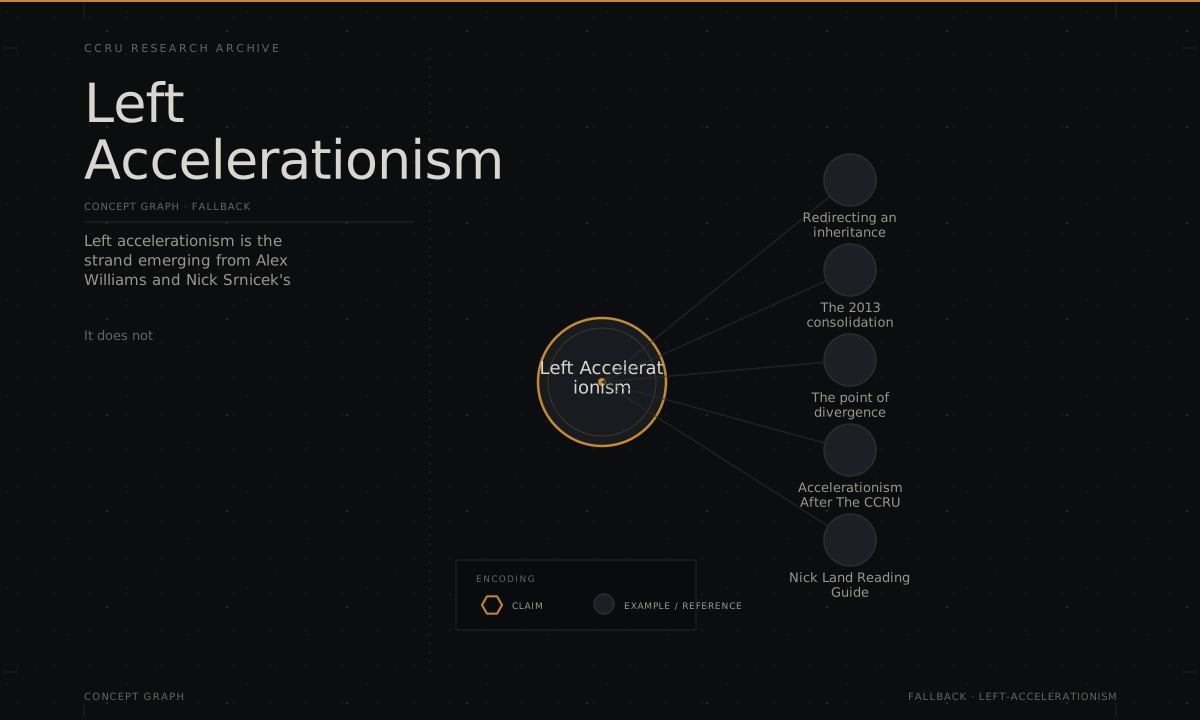
Redirecting an inheritance
The closest adjacent term is post-work politics, and the two get conflated constantly. Post-work is a broader demand-set: shorter hours, decoupling income from labour, the dignity of refusal. L/ACC is narrower and more specific — it is the wager that you get to post-work by seizing and accelerating the automating tendencies already present in capitalist production, rather than by decelerating, localizing, or exiting. Post-work can be Luddite. L/ACC cannot. That is the whole distinction: L/ACC keeps the Promethean register of Land's vocabulary and jettisons the anti-political metaphysics. The smallest unit of work the term does in the archive is to mark exactly that swap — same toolkit, inverted command structure.
The 2013 consolidation
The term becomes load-bearing with Alex Williams and Nick Srnicek's '#Accelerate: Manifesto for an Accelerationist Politics', circulated in 2013 and canonised the following year in Robin Mackay and Armen Avanessian's #Accelerate: The Accelerationist Reader (Urbanomic/Merve, 2014). Before the Manifesto, 'accelerationism' was a mostly retrospective label attached to Land and the CCRU milieu — one of the 'three major cultural movements' that lecturers now trace back to former CCRU members alongside speculative realism and a broader anti-humanist aesthetic. After the Manifesto, the word splits: there is now a Left accelerationism with its own programme, its own bibliography, and its own quarrel with the Landian inheritance. The Manifesto is the hinge.
Alex Williams + NickSrnicek's '#Accelerate: Manifesto for an Accelerationist Politics' can be read as an attempt to honour Fisher's demand for a contemporary left accelerationist position. In provoca tion of the contemporary Left's often endemic technological illiteracy, Srnicek and Williams insist on the necessity of precise cognitive mapping, and thus epistemic acceleration, for any progressive political theory and action today.
Alex Williams + NickSrnicek's '#Accelerate: Manifesto for an Accelerationist Politics' can be read as an attempt to honour Fisher's demand for a contemporary left accelerationist position.
The programme gets filled out in Nick Srnicek and Alex Williams, Inventing the Future: Postcapitalism and a World Without Work (Verso, 2015), which translates the Manifesto's gestures into policy-shaped demands: full automation, the shortened working week, UBI, the cultural defeat of the work ethic. A feminist continuation runs through Helen Hester's Xenofeminism (Polity, 2018), extending the Promethean wager into reproduction, gender, and the built environment. For orientation across the broader branching — R/ACC, U/ACC, Landian — see Accelerationism: Branches and Debates; this page stays inside L/ACC proper.
The point of divergence
Such is the kernel of the MAP's problematic and a point of diver gence between the various strains of accelerationism: Williams and Srnicek, for example, urge us to devise means for a practical realization of this separability, whereas for Nick Land and lain Hamilton Grant writing in the gos, Deleuze and Guattari's immanentization of social and technical machines was to be consummated by rejecting their distinction between technical machines and the capitalist axiomatic.
Against Williams and Srnicek, for whom 'capitalism cannot be identified as the agent of true acceleration', and Negarestani, for whom the space of reasons is the future source from which intelligence assembles itself, Land argues that the complex positive feedback instantiated in market pricing mechanisms is the only possible referent for acceleration.
The misreading to refuse
The circulating misreading — the one that actually damages use of the term — is that L/ACC is continuous with Land's accelerationism because the keyword is shared. It is not. Land's later position, as it works itself out across the Xenosystems essays and Crypto-Current, systematically demotes the political register: Neocameralism 'subsumes government into an economic mechanism,' teleology is stripped down to the 'sheer thing that is becoming,' and capital/machinic process are treated as the operative level on which political forms are secondary arrangements. L/ACC reverses exactly this ordering. For Williams and Srnicek, the political register is primary, capital's infrastructure is a contingent arrangement, and 'acceleration' names a set of tractable demands — not a metaphysical thesis about the autonomy of capital. The two projects share a vocabulary and argue incompatible things. Reading them as a single tradition with internal disagreements misreads both.
A secondary misreading, downstream of the first, is that L/ACC wants 'more capitalism, faster.' The Manifesto's actual line, as it circulates in the Mackay/Avanessian Reader, is closer to the opposite: neoliberalism accelerates precarity while decelerating the productive capacities (infrastructure, research, automation) that could underwrite a post-work exit. L/ACC wants more of that productive and automating machinery, under different ownership, faster. To read L/ACC as cheerleading for markets is to miss that its quarrel with neoliberalism is that neoliberalism is insufficiently Promethean.
Deepest single document for working out how the redirection functions as a programme rather than a slogan: Inventing the Future.
Left accelerationism is the strand emerging from Alex Williams and Nick Srnicek's 2013 'Manifesto for an Accelerationist Politics' and Inventing the Future (2015). The argument is that capital's Promethean machinery can be reclaimed and re-aimed rather than slowed.
Core argument
Left accelerationism is a Promethean argument, not an enthusiastic one. It treats capital's technical machinery as a resource to be claimed and redirected, not as an inherently liberating tendency.
It substantively breaks with Land's later writing. Sharing the word 'accelerationism' has obscured how different the underlying political and conceptual commitments are.
Worked examples
These named texts, talks, sites, and records show where the argument becomes concrete.
Robin Mackay Accelerate Reader Record
The Accelerate reader frames accelerationism through selection, sequence, and editorial recovery. It makes Left Accelerationism checkable against a concrete archive object.
Endgamers History Of Accelerationism Record
A later reception history exposes how accelerationism becomes a public controversy. It makes Left Accelerationism checkable against a concrete archive object.
Robin Mackay Person
"Robin Mackay" shows who carries, translates, or contests Left Accelerationism in practice.
Accelerationism After The CCRU Guide
"Accelerationism After The CCRU" keeps Left Accelerationism attached to a guide-length argument and route map.
Common misreadings
These are the recurring simplifications, exaggerations, and misreadings that make the subject look flatter than it is.
- Left accelerationism wants 'more capitalism, faster'.
It does not. The argument is about reclaiming the Promethean machinery capitalism developed and using it for ends — universal basic income, post-work, technological emancipation — that capital itself does not pursue.
Significance
Left accelerationism is the most fully developed political reuse of accelerationist vocabulary, and remains the clearest counter-position to e/acc and to right accelerationism inside the same conceptual neighbourhood.
Working definition
The strand emerging from Williams and Srnicek's 2013 manifesto, arguing that capital's Promethean machinery can be reclaimed and re-aimed against capital's ends.
Representative extracts
Definition · Alex Williams & Nick Srnicek — #Accelerate: Manifesto for an Accelerationist Politics (in Mackay & Avanessian, eds.) · manifesto
Today's politics is bereft of the capacity to generate the new. To recover that capacity, the left must take seriously the technologies and infrastructures capitalism has built, rather than abandoning them.
Why this matters: The strong form of the Promethean claim: technical infrastructure is treated as a resource available for political reuse, not as something inherent to capital's ends.
Mechanism · Robin Mackay-#Accelerate_ The Accelerationist Reader · extracted passage
If 'left accelerationism' is to succeed in 'unleashing latent pro ductive forces', and if its putative use of 'existing infrastructure as a springboard to launch towards postcapitalism' is to issue (even speculatively) in anything but a centralized bureaucracy administering the decaying empty shell of the historical product of capitalism, then the question of incentives and of an alternative feedback loop to that of capitalization will be central.
Why this matters: The strand's hardest internal test, posed from within the same volume: repurposing capital's infrastructure means specifying what replaces capitalization's feedback loop, not just who holds the controls.
Stakes · Nick Srnicek & Alex Williams — Inventing the Future: Postcapitalism and a World Without Work · Inventing the Future
What we need to do is to set up the conditions under which a counter-hegemonic project might be possible — using rather than refusing the technical achievements of late modernity.
Why this matters: The political programme that the manifesto pointed toward. Reading the two texts together gives the strand its full conceptual range.
History · Robin Mackay-#Accelerate_ The Accelerationist Reader · extracted passage
When Mark Fisher, former member of CCRU, returned in 2012 to the questions of accelerationism. outlining the current incon sistency and disarray in left political thought. the notion of a 'left accelerationism' seemed an absurdity. And yet, as Fisher asks, who wants or truly believes in some kind of return to a past that can only be an artefact of the imaginary of capitalism itself?
Why this matters: Fixes the origin point: a former CCRU member's 2012 intervention, made when the phrase still sounded like a contradiction, and the question that turned absurdity into a programme.
Afterlife · Robin Mackay-#Accelerate_ The Accelerationist Reader · extracted passage
Broadly speaking, today the anarchistic tendencies of 'French Theory' are tempered by a concern with the appropriation of sociotechnologi cal infrastructure and the design of post-capitalist economic plat forms, and the antihumanism of the cyberculture era is transformed, through its synthesis with the Promethean humanism found in the likes of Marx and Fedorov, into a rationalist inhumanism.
Why this matters: Positions the strand as a controlled mutation of nineties cyberculture rather than a break with it, supplying the connective tissue between CCRU antihumanism and left-accelerationist Prometheanism.
References
Records cited
These linked sources are the quickest way to test the argument against named materials rather than second-hand summary.
Robin Mackay Accelerate Reader Record
The Accelerate reader frames accelerationism through selection, sequence, and editorial recovery. Use it to test Left Accelerationism against source material rather than summary.
Endgamers History Of Accelerationism Record
A later reception history exposes how accelerationism becomes a public controversy. Use it to test Left Accelerationism against source material rather than summary.
Accelerationism Scoring Note Record
Accelerationism Scoring Note gives the concept a named source with its own texture, venue, and route. Use it to test Left Accelerationism against source material rather than summary.
Accelerationism After The CCRU Guide
"Accelerationism After The CCRU" widens Left Accelerationism through linked sources, people, and sections.