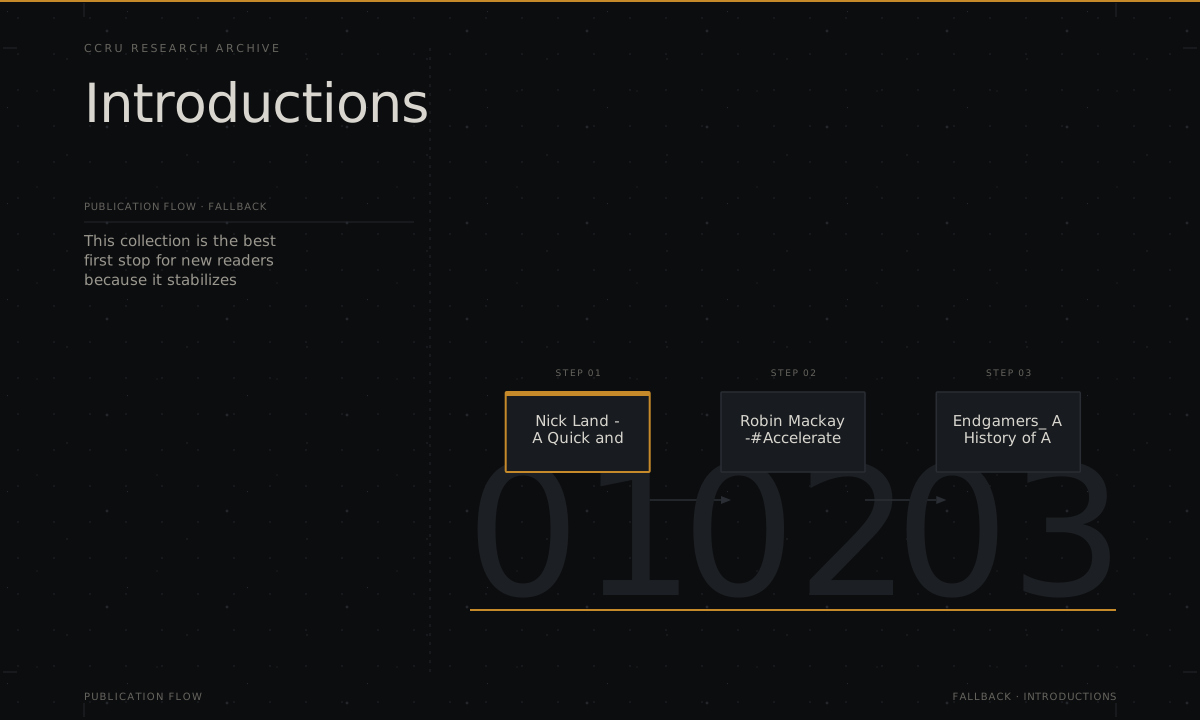
This collection is the best first stop for new readers because it stabilizes vocabulary, scene history, and reading order before the archive gets dense.
Core argument
Introductions are not optional padding. They save readers from mistaking density for depth on their first pass.
A small amount of orientation changes everything downstream. Once the formation story is clear, later guides and records become much easier to use.
The thesis
The thesis is simple. Introductions stabilize vocabulary, periodisation, and reading order before the rest of the corpus turns noisy. They are reception documents. They tell you how a later editor, lecturer, or anthologist decided the material should enter circulation, which differs from how it was produced. Mackay and Avanessian's introduction to #Accelerate (Urbanomic) is a 2014 framing of a thirty-year arc; Mackay's editorial introduction to Collapse II (Urbanomic) is a 2007 framing of a then-current debate. Both are useful. Neither is neutral.
What this layer contains
This collection contains short orientation texts that explain what the CCRU was, why later labels distort it, and how a first route might unfold.
It is strongest when paired quickly with a guide or section page. The point is to create enough stability that later reading feels chosen rather than random, without lingering in summary mode.
Triangulation across introductions
What the collection lets a reader do that a single guide cannot is triangulate. Read the Fanged Noumena editors' introduction next to the opening of CCRU Lecture 1, where the lecturer is already mid-argument about geotraumatics bringing "the Freudian psychic unconscious that we have into their being as its partial stratification", and the framing reveals itself as a framing. The lecture does not introduce; it assumes. Read Reza Negarestani's "Undercover Softness" introduction to decay alongside the symposium responses in Leper Creativity (2012), and the introduction stops being a doorway and becomes one position in a fight. Read "Unleashing the Numogram" with its careful walk through the digit six and its triangular cumulation to 666, and you see what an introduction by CCRU itself looks like: pedagogical surface over occult-mathematical interior, "participating amphibiously in both domains, mathematics and the occult".
Adjacent entry points
The collection also catches adjacent entry points that are not strictly CCRU but condition how CCRU is read. Ehmann and Eshun's A to Z of HF, or 26 Introductions to HF (2009, Monoskop), is one such document: a primer that borrows CCRU's alphabetic-encyclopaedic instinct and routes it elsewhere. The Outsideness compilation's table of contents, running 2013 to 2023, is itself an introduction to a decade of post-CCRU blogging by Land. Each of these tells you something about how the unit's vocabulary survived its dissolution.
Limitations
Limitations. The introductions layer cannot substitute for the primary corpus and will mislead anyone who uses it that way. Editors compress. The Mackay and Brassier introduction to Fanged Noumena treats Land's trajectory as a single readable arc, which is an editorial achievement, not a fact about the writing. Introductory framings also tend to smooth the ruptures the work was built around, partial stratifications, geotraumatic deferrals, the "artificial intelligence achieving partial lucidity only as a consequence of tidal pragmatic trends", into a tidy lineage. Provenance is a second problem. Several of the introductions here are scans or PDFs hosted on Monoskop, Urbanomic, or archive.org, and their pagination and edition status vary. A citation from an introduction is a citation from a particular print run, not from a stable text.
A third limitation is structural. CCRU produced very few introductions to itself. The unit preferred lectures, communiques, and numogram exercises, forms that begin in the middle. Most of the introductory apparatus around CCRU was written after 2003 by editors, students, and adjacent figures. That gap matters. When you read a 2011 introduction to a 1996 text, you are reading a reception, and you should mark it as such.
How to use it well
Read one introduction, then move into a guide that matches your interest. The point is to shorten the distance between curiosity and evidence, not to settle into orientation forever.
Practical instruction. Use this collection as a calibration layer, not a syllabus. Read one introduction, then read the primary text it introduces, then return to the introduction and note what it omitted. The omissions are where the actual research questions live. If you are new to CCRU, start with the Mackay and Brassier editors' introduction to Fanged Noumena, then go to Lecture 1 and feel the difference between framing and delivery. If you already know the corpus, use this layer to track how CCRU was sold to later audiences, the accelerationist reader, the Urbanomic catalogue, the symposium volume, and what each sale cost in precision.
Worked examples
These named texts, talks, sites, and records show where the argument becomes concrete.
Nick Land Quick And Dirty Introduction Record
"Nick Land Quick And Dirty Introduction" is one of the introduction pieces that gives scene vocabulary and proportion before denser sources take over.
Robin Mackay Accelerate Reader Record
"Robin Mackay Accelerate Reader" is one of the introduction pieces that gives scene vocabulary and proportion before denser sources take over.
Endgamers History Of Accelerationism Record
"Endgamers History Of Accelerationism" is one of the introduction pieces that gives scene vocabulary and proportion before denser sources take over.
Common confusions
These are the mistakes readers most often make when they arrive through simplified internet summaries or personality cult retellings.
- Beginners should skip orientation and go straight to the hardest material.
The introduction layer exists precisely to keep first contact from dissolving into disconnected intensity.
Significance
This collection matters because the archive is mixed enough that most readers need one reliable orientation layer before they can use the deeper materials well.
3 files
Canonical path: introductions/
How to use it
Read this collection first, then move into a guide page that matches the question that brought you here.
Why this layer matters
Three curated orientation texts designed for first-time readers.
Featured records
References
Records cited
These linked sources are the quickest way to test the argument against named materials rather than second-hand summary.
Nick Land Quick And Dirty Introduction Record
"Nick Land Quick And Dirty Introduction" shows how the introductions layer turns first contact into a workable reading route rather than a test of stamina.
Robin Mackay Accelerate Reader Record
"Robin Mackay Accelerate Reader" shows how the introductions layer turns first contact into a workable reading route rather than a test of stamina.
Endgamers History Of Accelerationism Record
"Endgamers History Of Accelerationism" shows how the introductions layer turns first contact into a workable reading route rather than a test of stamina.
External references
Inherited outward references from the guides and pages that frame this collection.
Read next
Guide
"What Was The CCRU" is the guide to open once Introductions has shown you its strongest materials.
Guide
"How To Use This Archive" is the guide to open once Introductions has shown you its strongest materials.
Section
"Warwick And Formation" is the section that carries Introductions into a larger cluster.