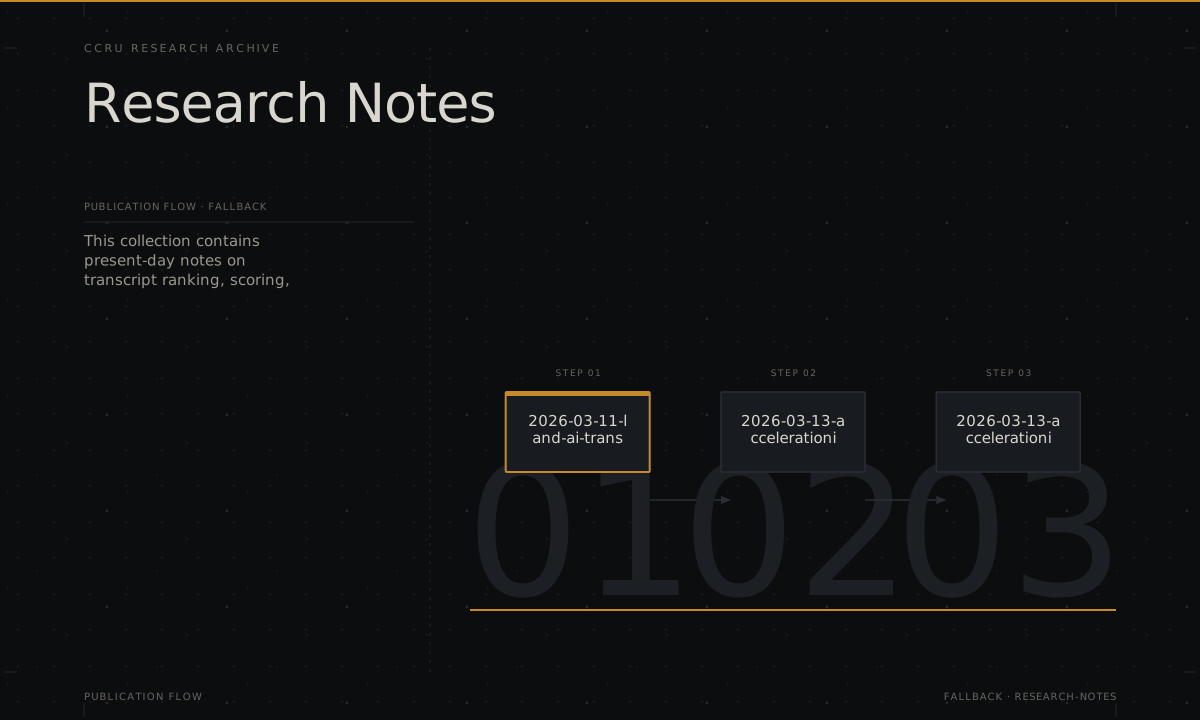
This collection contains present-day notes on transcript ranking, scoring, and corpus handling. It documents method, not the historical voice of the CCRU.
Core argument
Research notes document method rather than primary scene content. They show how selection, scoring, and comparison are being made.
Method is part of usability here. Readers need to know which filters shaped the current research surface.
What this layer contains
This collection contains notes on transcript scoring, text ranking, and corpus-level analysis that explain the current research apparatus around the CCRU materials.
Use it when you want to understand how discovery, selection, and comparison decisions are being made now. It is not a substitute for primary materials, but it does show which filters and judgments are shaping the public-facing experience.
The research-notes collection holds working documents produced by the present-day editorial process around the CCRU archive, not artefacts of the original Warwick scene. The files inside it, transcripts notes for the Land AI lectures, scoring notes for accelerationism rankings, comparison and selection memos, are the kind of paperwork that ordinarily gets discarded once a site goes live. They are kept here on purpose. The collection thesis is simple: any archive that ranks, filters, or transcribes its sources is also authoring them, and that authorship should be readable as such.
Why method needs to be visible
The material problem is that present-day method tends to disappear behind a finished interface. A reader arriving at a ranked list of accelerationist texts, or at a cleaned transcript of a Land lecture, sees the output and not the cuts. The notes here record those cuts. A scoring note explains why one essay sits above another in a ranking. A transcripts note records what was inaudible, what was guessed, what was corrected against a second pass. A selection memo lists what was excluded and on what grounds. None of this belongs to the 1995 to 2003 CCRU. All of it shapes what a visitor to the archive ends up reading.
What the collection lets a reader do, that no single editorial guide could, is audit specific decisions against specific files. If the Land lecture transcripts contain the kind of recursive duplication visible in the raw chunks, where a phrase like "perfectly mirrors how the AI golem to come will recursively rewrite" loops several times inside a single segment, the transcripts note is where that artefact gets named as an artefact of the automated transcription pipeline rather than a feature of the spoken lecture. Without the note, a reader could quote the loop as if Land or the lecturer had said it that way. With the note, the loop is legible as machine residue. The same logic applies to scoring: a ranking of accelerationist texts is a claim, and the scoring note is where the claim is shown its working.
Where this layer sits in the archive
The collection also marks the boundary between historical CCRU output and present-day editorial output. Hyperstition, the numogram, the tic-systems, the Ccru collective writings, those sit in other layers of the archive. The Outsideness collation of Land's 2013 to 2023 short-form writing sits in another layer again. Research notes are downstream of all of that. They explain how the upstream material was handled, indexed, scored, and presented. Treating a scoring note as if it were a CCRU document would be a category error of the same kind as treating a library's accession record as part of the book it catalogues.
Limits of the record
There are limits, and they should be stated. The notes are not comprehensive. Many editorial decisions across the archive were made without a written note, and those decisions are not reconstructable from this collection alone. The notes that do exist were written at different times, by different hands, with different levels of formality, and they do not share a single template. Some are dated, some are not. Some cite the specific file or chunk they refer to, some refer only to a general procedure. A reader who wants a full account of how the archive was built will not find it here; what is here is a partial, honest record of the moments when method was written down. The absence of a note on a given decision is not evidence that no decision was made.
Provenance also runs only one way. These notes can be cited against the archive's own outputs. They cannot be cited against the original CCRU corpus, because they postdate it by two decades and were never part of its circulation. Dušan Barok's observation that public research notes get formulated differently from private ones because they have to be readable by others (Monoskop interview) applies here. The notes were written knowing they would be read. They are editorial speech, not source speech.
How to use it well
Use these notes when you want to understand editorial method, not as a first route into the CCRU itself. They are most useful after the basic scene and collection structure are clear, because then the scoring notes read as methodological arguments rather than as mysterious side files.
A practical instruction for using the collection. When a claim elsewhere in the archive looks unusually clean, a tidy ranking, a smooth transcript of a long improvised lecture, a confident attribution, check whether a research note covers it. If one does, read the note before quoting the cleaned output. If one does not, treat the cleaned output as provisional and say so when citing it. The collection's job is to keep the seam visible between what CCRU produced and what this archive has done with it. Read it for the seam, not for the polish.
Worked examples
These named texts, talks, sites, and records show where the argument becomes concrete.
Land AI Transcripts Note Record
"Land AI Transcripts Note" matters here because it exposes present-day scoring, selection, or corpus method instead of pretending research handling is neutral.
Accelerationism Scoring Note Record
"Accelerationism Scoring Note" matters here because it exposes present-day scoring, selection, or corpus method instead of pretending research handling is neutral.
Accelerationism Text Scoring Note Record
"Accelerationism Text Scoring Note" matters here because it exposes present-day scoring, selection, or corpus method instead of pretending research handling is neutral.
Common confusions
These are the mistakes readers most often make when they arrive through simplified internet summaries or personality cult retellings.
- Research notes belong to the same layer as the primary archive.
They are a methodological layer that explains how the archive is being handled now.
Significance
This collection matters because it keeps current editorial method visible instead of hiding it behind a seamless interface.
3 files
Canonical path: research-notes/
How to use it
Read these notes when you want to understand methodology, corpus shaping, or how editorial selection happened.
Why this layer matters
Internal notes on transcript scoring, accelerationism ranking, and corpus-level analysis.
Featured records
References
Records cited
These linked sources are the quickest way to test the argument against named materials rather than second-hand summary.
Land AI Transcripts Note Record
"Land AI Transcripts Note" is a methodological checkpoint: it shows how current curation decisions are being argued rather than silently embedded.
Accelerationism Scoring Note Record
"Accelerationism Scoring Note" is a methodological checkpoint: it shows how current curation decisions are being argued rather than silently embedded.
Accelerationism Text Scoring Note Record
"Accelerationism Text Scoring Note" is a methodological checkpoint: it shows how current curation decisions are being argued rather than silently embedded.
External references
Inherited outward references from the guides and pages that frame this collection.
Read next
Guide
Accelerationism After The CCRU
"Accelerationism After The CCRU" is the guide to open once Research Notes has shown you its strongest materials.
Guide
"CCRU And AI" is the guide to open once Research Notes has shown you its strongest materials.
Section
Accelerationism Branches And Debates
"Accelerationism Branches And Debates" is the section that carries Research Notes into a larger cluster.