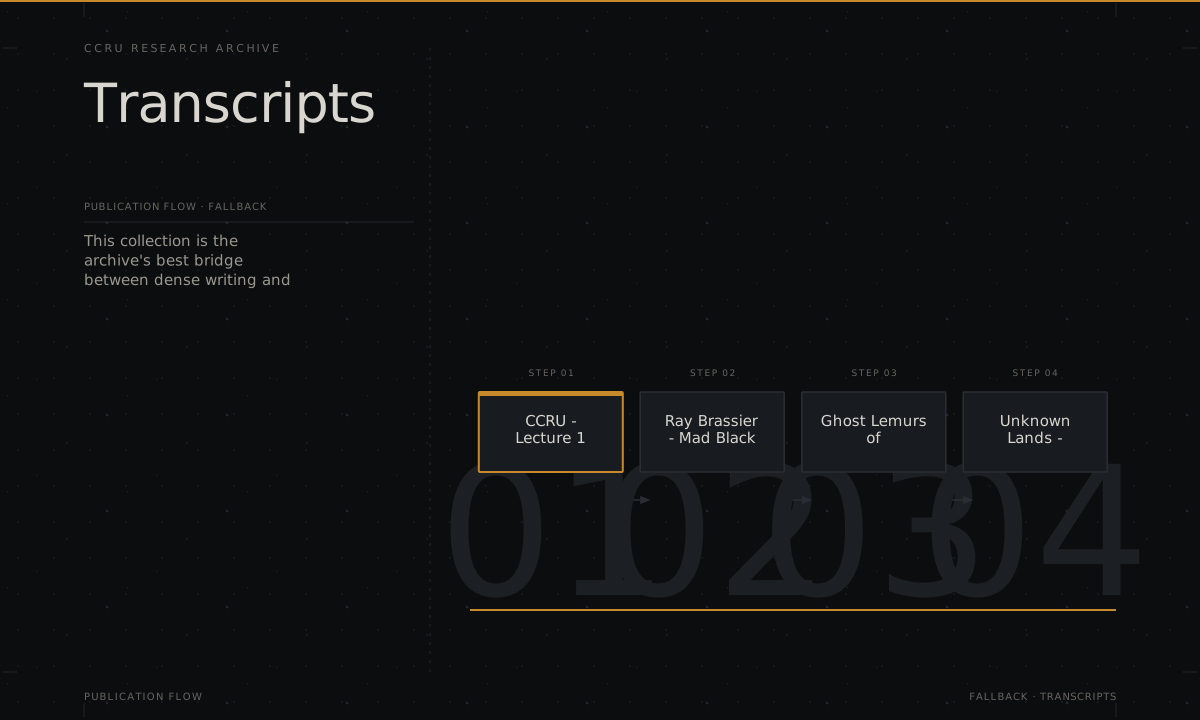
This collection is the archive's best bridge between dense writing and clearer explanation because speech slows concepts down and makes scene context audible.
Core argument
Transcripts are often the best first source layer. They let readers hear pacing, explanation, and scene context that compressed prose often withholds.
The transcript layer is interpretive as well as documentary. Talks and lectures frequently restage and simplify archive problems in historically useful ways.
What this layer contains
This collection holds lectures, seminars, interviews, and discussions in which concepts are slowed down, repeated, and historically placed.
It is also one of the best places to hear scene context directly. Public tone, pacing, and explanation often survive here better than they do in the densest printed materials.
The transcripts collected here are mostly secondary speech: lecture recordings turned to text, panel discussions, interview material, and edited workshop records. They are not, in the main, CCRU primary documents. The unit itself left zines, web pages, and print pieces; what survives as transcript is largely the talk that built up around CCRU after the fact, plus adjacent Urbanomic and academic events where the same authors, Mackay, Brassier, Negarestani, Land, were speaking aloud rather than writing.
What the collection preserves
The collection thesis is straightforward. Speech preserves the explanatory layer that CCRU prose deliberately strips out. When a CCRU lecture transcript walks through the Barker mythos, the imaginary professor of anorganic semiotics at Miskatonic Virtual University, or unpacks geotraumatics as the claim that every random variation marks a repression of some forgotten geotraumatic change, the speaker is doing interpretive work that the source texts refuse to do for the reader. That interpretive layer is what the transcripts collection actually preserves.
This is why the layer is useful for two different readers at once. A newcomer can hear the numogram described as ordinal indices and as a sorting of high numbers into sets and lower numbers into replications of the unity of the one before opening the primary numerical material. A researcher gets something different: a record of how specific concepts get framed in public, which framings stabilise, which examples recur, and which connections the speakers themselves draw between, say, Kabbalah, Lovecraft, and Deleuze. The transcript is evidence of reception and pedagogy, not just of content.
Adjacent edited transcripts
Adjacent material amplifies this. Urbanomic's Sonic Faction gathers edited transcripts of artists' discussions on the audio essay, and the Speculative Realism workshop of 2007 was published as an edited transcript in Collapse 3. The Cyclonopedia symposium at The Public School New York in 2011 became Leper Creativity, a printed transcript-and-response volume. These are not CCRU recordings, but they share a method: speech first, edited text second, with the editing visible.
Limitations and provenance
The limitations are real and should be stated. First, transcription is interpretation. Several of the lecture files in this archive show the artefacts of automated transcription: phrases doubling back on themselves, names mangled ("CCRU" for CCRU, "Landmore" where a speaker said something else), repeated clauses where the recogniser stalled. A reader using these transcripts as quotation sources needs to check the audio. Second, the speakers are not always CCRU members. A 2024 lecture explaining CCRU is a secondary source about CCRU; it is not Sadie Plant or Mark Fisher in 1996. The collection mixes primary spoken material, where it exists, with explanatory talk produced decades later, and the distinction matters for any citation. Third, coverage is uneven. The Hyperstition blog went quiet in 2007, and much of what was said in CCRU's Warwick years was never recorded in the first place. The transcripts cannot reconstruct what was lost; they can only document what later speakers chose to recover.
There is also a provenance question worth flagging. Edited transcripts, the Urbanomic kind, have been through an editorial pass with the speaker's consent. Lecture transcripts produced by automatic speech recognition from a YouTube upload have not. Both are useful, but they are not the same kind of document, and the archive treats them as if they were. A reader should check, for any given file, whether the text was edited by the speaker or generated from audio after the fact.
How to use it well
Use transcripts early and often. They are especially good for first contact, for clarifying dense motifs, and for hearing how ideas were presented in public rather than only on the page.
A practical reading instruction follows from this. Use the transcripts to find the explanation, then go to the primary text for the claim. If a lecture transcript here describes Barker's geotraumatics, read it for the framing, then open the Barker material in the writings collection and check the speaker's gloss against the source. If a symposium transcript glosses Cyclonopedia's triadic logic, use that gloss as a way in, not as a substitute for Negarestani's pages. The transcripts are the fastest route to a first orientation. They are the slowest route to an accurate quotation. Read them in that order and the collection works as intended.
Worked examples
These named texts, talks, sites, and records show where the argument becomes concrete.
CCRU Lecture 1 Record
"CCRU Lecture 1" is a good transcript checkpoint because spoken cadence and framing often make a difficult line easier to size.
Ray Brassier Mad Black Deleuzianism Record
"Ray Brassier Mad Black Deleuzianism" is a good transcript checkpoint because spoken cadence and framing often make a difficult line easier to size.
Ghost Lemurs Of Madagascar Record
"Ghost Lemurs Of Madagascar" is a good transcript checkpoint because spoken cadence and framing often make a difficult line easier to size.
Common confusions
These are the mistakes readers most often make when they arrive through simplified internet summaries or personality cult retellings.
- Transcripts are a lower-status layer than printed texts.
For this archive they are often the fastest route to clarity and one of the best records of public explanation.
Significance
This collection matters because spoken material often provides the cleanest entry into the archive without leaving the archive behind.
969 files
Canonical path: transcripts/
How to use it
Use transcripts to hear how concepts are introduced, revised, and simplified in public explanation.
Why this layer matters
Lecture, seminar, interview, and discussion transcripts drawn from the canonical corpus.
Featured records
References
Records cited
These linked sources are the quickest way to test the argument against named materials rather than second-hand summary.
CCRU Lecture 1 Record
"CCRU Lecture 1" shows what this layer preserves best: voice, pacing, and scene explanation that printed fragments can lose.
Ray Brassier Mad Black Deleuzianism Record
"Ray Brassier Mad Black Deleuzianism" shows what this layer preserves best: voice, pacing, and scene explanation that printed fragments can lose.
Ghost Lemurs Of Madagascar Record
"Ghost Lemurs Of Madagascar" shows what this layer preserves best: voice, pacing, and scene explanation that printed fragments can lose.
Unknown Lands Lecture 1 Record
"Unknown Lands Lecture 1" shows what this layer preserves best: voice, pacing, and scene explanation that printed fragments can lose.
External references
Inherited outward references from the guides and pages that frame this collection.
Read next
Guide
Mark Fisher And The CCRU Afterlife
"Mark Fisher And The CCRU Afterlife" is the guide to open once Transcripts has shown you its strongest materials.
Guide
"CCRU And AI" is the guide to open once Transcripts has shown you its strongest materials.
Section
"Mark Fisher And Public Theory" is the section that carries Transcripts into a larger cluster.