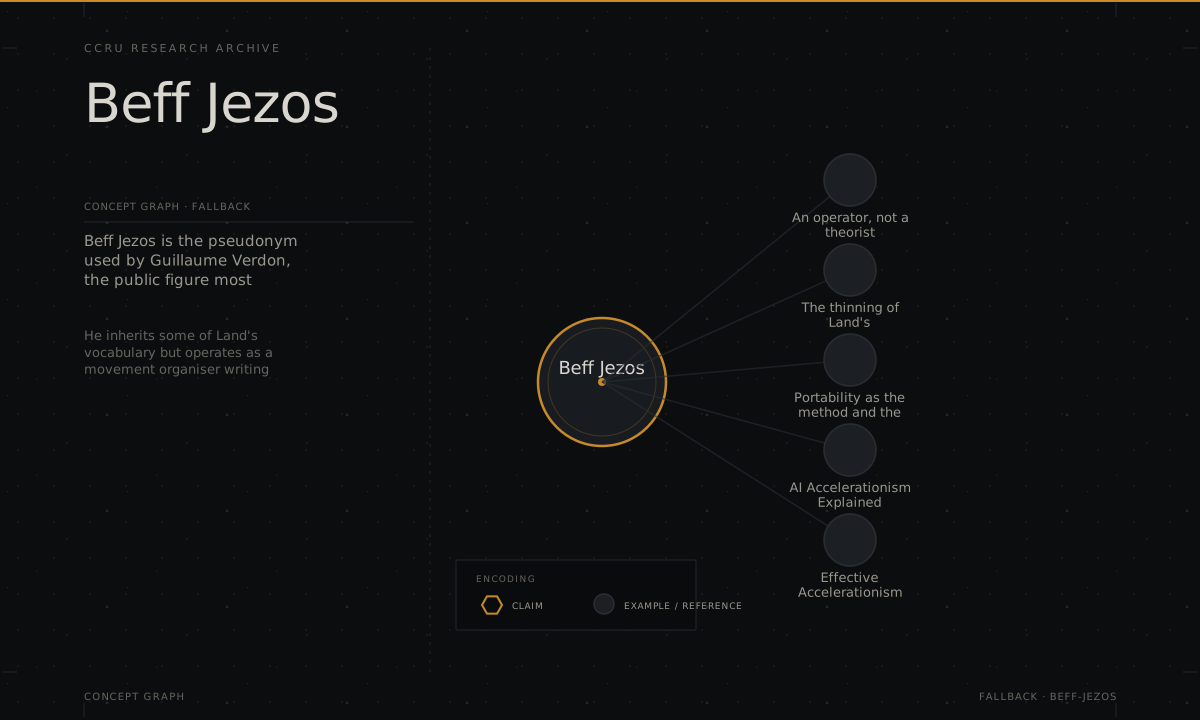
An operator, not a theorist
This makes Beff Jezos a distinctive kind of archive-entry. The question is not 'what does this person think' but 'what does this person route' — which upstream sources flow through the pseudonym into which downstream audiences, and with what losses in transit. Treating the feed as a routing protocol rather than a philosophy is, we would suggest, the only honest way to measure it. (The characterisation in this section is drafter inference from the public reception of e/acc rather than a close reading of archived primary texts; readers should treat it as framing, not as documented claim.)
The thinning of Land's thermodynamic argument
One thing can be said with textual confidence about what e/acc inherits and what it does not. Land's thermodynamic-selective argument, sharpened in 'Hell-Baked', is that the process which produces intelligence is, from a human perspective, 'indescribably cruel,' a 'pitiless killing machine,' drawing 'health, beauty, intelligence, and social grace' from 'a vast butcher's yard of unbounded carnage' — and that acknowledging this is 'scarcely bearable to think.' Land's 'Quick-and-Dirty Introduction' likewise insists that capital's 'positive cybernetic schema exhausts it': 'runaway consumes its identity,' and every humanly legible determination is 'shucked-off as an accident.'
What e/acc visibly borrows from this is the runaway vector — the posture of unbounded capital-intelligence acceleration. What it does not visibly carry forward, so far as the public performance of the pseudonym goes, is the horror and the indifference-to-the-human that make Land's position philosophically serious rather than merely enthusiastic. The asymmetry here is one of rhetorical posture, and we want to mark it as such rather than as a documented quotation-against-quotation comparison: the Land side is in the archive; the e/acc side is inferred from reception. The substitution we are claiming — optimism where Land had horror — is therefore offered as interpretation, and it is the interpretation the archive most needs on record, because the default public assumption that Beff Jezos is simply a more cheerful Land is wrong on the structural point, not on a detail.
Portability as the method and the limit
The internal tension in the e/acc phenomenon is that its success condition and its failure condition are the same property. It propagates because it is portable: short phrases, a recognisable aesthetic, binary in-group alignments, a coherent signal that a founder or engineer can wear publicly. That portability is what carries the vocabulary across from niche theory-discourse into mainstream AI debate. It is also what forecloses the recursive, self-undermining prose style that made the earlier accelerationist archive philosophically load-bearing. A slogan cannot perform its own argument; it can only assert it.
The relevant comparison, rather than to Land alone, is to the Srnicek–Williams 'Manifesto for an Accelerationist Politics,' which Land himself reads as an attempt to resolve accelerationism's 'intolerable — even "schizophrenic" — ambivalence' by drawing an 'artificial distinction between capitalism and modernistic technological acceleration.' Each prior accelerationist intervention spent an entire text negotiating the gap between a thermodynamic description and a political prescription. The characteristic move of the e/acc register, as it reaches wider audiences, is to close that gap by fiat. Whether any specific e/acc essay sustains a more careful argument than the meme-layer suggests is a matter the archive cannot presently settle: the primary texts are not in our retrieval, and our claim here is therefore explicitly about the public-facing rhetorical object, not about every sentence the pseudonym has written.
Why the archive includes him anyway
The case for inclusion is not that e/acc continues the CCRU's argument — it does not — but that it is the most visible contemporary site where CCRU-adjacent vocabulary is being recirculated, and the archive has to account for its own downstream effects. There is also, by now, a widely reported civilian identification of the pseudonym with Guillaume Verdon; we note this as a reception fact rather than document it here, since the disclosure sources are outside our retrieval. The relevant point for the archive is structural: at the moment such a pseudonym crosses from anonymous meme into named public position, the rhetorical freedom of the handle collides with the professional constraints of its author, and that collision is instructive about what happens when accelerationist aesthetics are forced to underwrite institutional commitments.
The honest framing is therefore double-sided. E/acc is a real phenomenon shaping how AI acceleration is publicly argued; ignoring it would leave the archive incomplete. E/acc is also not continuous with the philosophical project it cites; credentialing it as such would falsify the archive's own genealogy. Beff Jezos belongs here in the way a prominent translator belongs in a literary archive — the translation matters, and the translation is not the original.
Where to read
For the source of the argument e/acc selectively borrows from — specifically the thermodynamic-selective case with its anti-humanism intact — the deepest single document is Land's A Quick-and-Dirty Introduction to Accelerationism, alongside 'Hell-Baked' in the same volume, which together state the position e/acc softens. For the internal quarrel over whether acceleration can be politically redirected, see the Srnicek–Williams 'Manifesto' as discussed across #Accelerate: The Accelerationist Reader.
Beff Jezos is the pseudonym used by Guillaume Verdon, the public figure most associated with effective accelerationism (e/acc), an internet political movement that emerged on Twitter and Substack in 2022. The civilian-identity disclosure was reported by Forbes in 2023.
Core argument
Beff Jezos is the principal organiser of effective accelerationism (e/acc). Most readers arriving at the accelerationist tradition through current AI discourse encounter the term first through his Substack and X output.
The pseudonym was disclosed as Guillaume Verdon by Forbes in 2023. The civilian identity is part of the public record and matters for situating the project; the dossier states this as fact rather than inference.
Worked examples
These named texts, talks, sites, and records show where the argument becomes concrete.
AI Accelerationism Explained Guide
The guide where Jezos and e/acc are placed inside the wider AI-accelerationism reception story.
Left vs Right Accelerationism Guide
The comparison guide that distinguishes e/acc from the original right-strand argument it inherits selectively from.
Effective Accelerationism (concept) Concept
The compact concept page that gives the working definition of e/acc.
Common misreadings
These are the recurring simplifications, exaggerations, and misreadings that make the subject look flatter than it is.
- Beff Jezos is the contemporary Nick Land.
He inherits some of Land's vocabulary but operates as a movement organiser writing political pamphlet rather than as theoretical successor. The recursion claim that gave the original right-strand argument its argumentative force is routinely dropped.
Significance
Beff Jezos is the principal channel through which the word accelerationism currently reaches a general audience. Distinguishing what e/acc inherits from the CCRU and Land traditions from what it has invented is necessary work for any contemporary reader.
Stakes of this figure
Pseudonym used by Guillaume Verdon, the public figure most associated with effective accelerationism (e/acc), the 2022 internet political movement.
Periodisation
- 2020s
Key works for entering the figure
- Beff Jezos / Bayes Faist — e/acc Substack manifestos (2022 onward)
- Beff Jezos — X/Twitter posts and platform output (2022 onward)
References
Records cited
These linked sources are the quickest way to test the argument against named materials rather than second-hand summary.
AI Accelerationism Explained Guide
Where the e/acc movement is set against its CCRU and Land sources.
Left vs Right Accelerationism Guide
Where e/acc's selective inheritance from the right strand is examined directly.