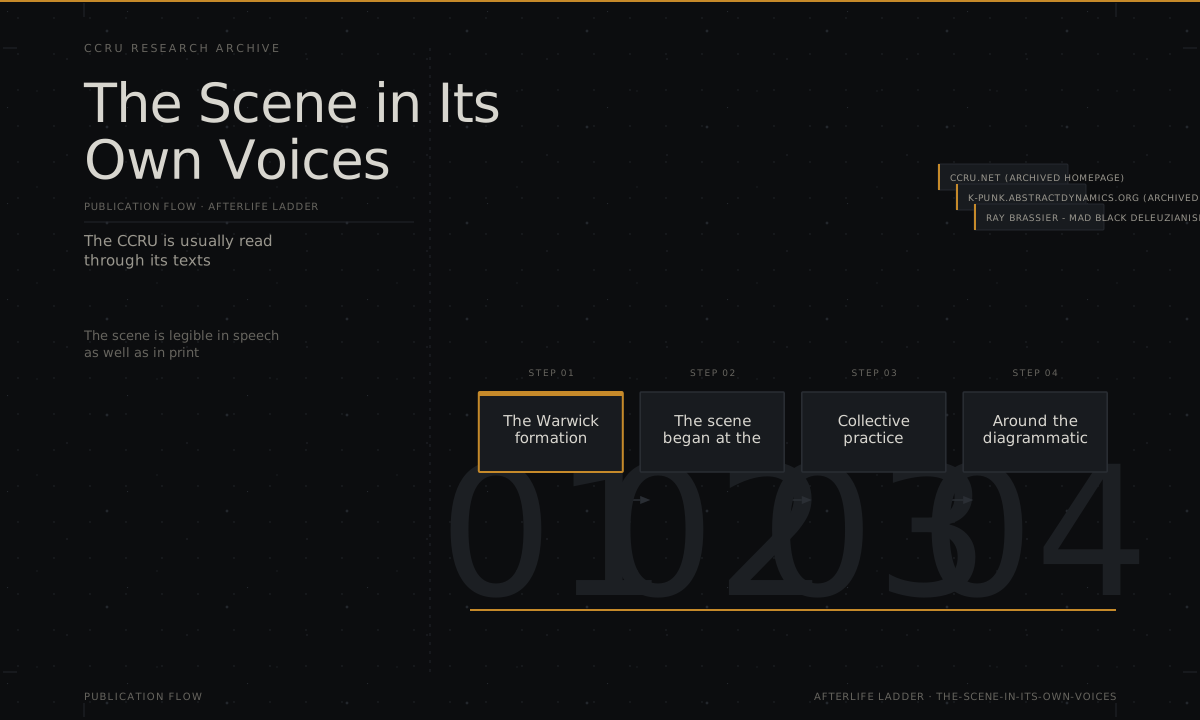
The CCRU is usually read through its texts. This exhibit reads it through the oral archive: twelve lecture and interview moments, each quoted verbatim from a session transcript and linked to the exact timestamp, arranged as an arc from the Warwick years to the present.
Core argument
The scene is legible in speech as well as in print. Lectures and interviews record tone, hesitation, and self-revision that the edited texts smooth away.
The CCRU's members and inheritors frame the group from very different distances. A retrospective by Robin Mackay and a memorial lecture by Kodwo Eshun describe the same scene from inside and from grief.
The archive's questions did not close when the group dispersed. Land, Ireland, and Parisi are still working the same material — path dependence, the numogram, machine intelligence — decades on.
A curated exhibit that reads the CCRU and its afterlife through the oral archive: lecture and interview moments quoted verbatim from the session transcripts and anchored to the timestamp where each one begins.
The Warwick formation
The scene began at the University of Warwick in the mid-1990s, in a philosophy department that tolerated, then expelled, a research unit with no fixed membership.
1. Robin Mackay — the collective at Warwick
"… there was definitely something very strange going on there in terms of like this, uh, building together this collective way of thinking about reality that was very far removed from, uh, consensual, the consensual model."
— Robin Mackay, K-Files CCRU retrospective, 01:04:10
Mackay was a student in the Warwick milieu and later became the CCRU's most careful archivist through Urbanomic. Here he describes the group by its atmosphere: a shared method of thinking that left its participants disoriented for years afterwards. The phrase "building together" locates the work in a collective, and the strangeness he recalls is the strangeness of a group reasoning its way out of the consensual world.
2. Anna Greenspan — a founding member, still counting waves
"And these waves, which we can't easily perceive, we can only perceive through mediated instruments, through our cell phones or through our technologies, right? I was interested in that. And I'm always also interested in this issue about how to think about time in relation to this moment."
— Anna Greenspan, Theory Underground interview, 00:09:31
Greenspan was one of the CCRU's founding members and now writes on media and urban futures from Shanghai. The waves she describes here, imperceptible and felt only through instruments, restate the group's old interest in forces that act below the threshold of experience. Her return to the question of time carries the same lineage, rerouted through China.
Collective practice
Around the diagrammatic work sat a cyberfeminist and media-theoretical practice that the Land-centred histories tend to drop.
3. Luciana Parisi — abstracting sex
"My first work was on the idea of sex, of abstracting sex from biological bias and biological grounds. So I was trying to work between questions of sexual difference and gender differentiation. I found a space between to really work with biology and through biology, to actually argue for a model of sex that was not enclosed within any organic form, or any kind of cultural discursive form neither."
— Luciana Parisi, interview, 00:00:19
Parisi came through the CCRU's cyberfeminist wing and its interest in biology, code, and contagion. Abstract Sex, the book she describes, treats sex as information rather than as an organic given, which places her close to Sadie Plant's line and some distance from the Land-centred story the archive is usually told through. The passage shows how technical the group's feminism was, and how early it reached for computation.
The numogram
The numogram is the CCRU's diagram of time, number, and demon — the piece of apparatus that most rewards a patient walkthrough.
4. Amy Ireland — starting from zero
"And the kind of construction that you get just from making this one shift starting from zero instead of one gives you a completely different occult system, philosophical system, political system. I think it's also apt to connect it to a kind of cyber-feminist mandate starting from zero instead of one, which is something that I think is really important."
— Amy Ireland (as billed), "Counting for Meat Puppets," 00:17:14
The corpus bills this numogram walkthrough to Amy Ireland, among the closest contemporary readers of the CCRU's diagrammatic work; the transcript carries no speaker labels, so the credit follows the billing. In the passage, counting from zero instead of one produces a different occult, philosophical, and political system. The link to a "cyber-feminist mandate" ties the walkthrough back to Plant's Zeros and Ones and to the wider claim that the numogram encodes a politics as much as a cosmology.
The dispersal of the Land line
As the group broke up, its most notorious thread — Nick Land's — went its own way, trailed by inheritors who admired the work and critics who did both at once.
5. Robin Mackay — an ism with dismal consequences
"I think I'd like to start off by saying that accelerationism is not a doctrinal position and I'm not going to define it. I seem to have an unfortunate tendency to create isms with dismal consequences."
— Robin Mackay, "Orientation, Acceleration, Futurity," 00:00:00
By the time Mackay assembled the #Accelerate reader, the word he had helped popularise was travelling faster than any argument attached to it. His wariness here, the admission that his isms tend to escape him, is the sound of a term dispersing into a movement. The exhibit places the moment at the hinge where the scene stops being a group and becomes a set of problems held in common.
6. Mark Fisher — Land's re-emergence
"Nick Land's re-emergence as a thinker in a highly controversial way, recently, featuring the Telegraph blog, being denounced as a fascist on the Telegraph blog. I mean, the sheer oddness of that."
— Mark Fisher, "Anti-Vital," 00:00:00
Fisher spent the 2000s carrying the CCRU's vocabulary into public writing, and he never stopped reckoning with Land. This lecture opens on Land's strange return through the reactionary blogs, and Fisher registers the oddness without either disowning or excusing it. What follows in the talk is his attempt to read Land's early work for what it still explains about desire under capitalism.
7. Ray Brassier — a cynical libertarian capitalism
"In other words, you become a pawn of another kind of impersonal force, but it's no longer the glamorous and seductive impersonal force that you hoped to make a compact with. It's a much more kind of cynical, it's cynical kind of libertarian capitalism."
— Ray Brassier, "Mad Black Deleuzianism; On Nick Land," 00:36:57
Brassier edited Land's collected writings and then delivered the most influential critique of them. His verdict here is bleak: the impersonal force Land wanted to fuse with turns out to be ordinary libertarian capital, stripped of its glamour. Read beside Fisher, the moment shows the two sharpest inheritors of the Land line pulling in opposite directions over what the work finally amounts to.
Mark Fisher's afterlife
No inheritor did more to carry the archive into public life than Mark Fisher, whose own death then set off a further afterlife.
8. Mark Fisher — the traces of the outside
"If capitalist realism is about the complete takeover of capital, not only of culture and economy, but also of the psyche, then Ghosts of My Life deals with what was thwarted by that, the traces of the outside, the persistences of exteriority in this world completely dominated by capital."
— Mark Fisher, "The Slow Cancellation of the Future," 00:00:01
Ghosts of My Life named a condition Fisher heard everywhere in the culture: the slow disappearance of the sense that the future might differ from the present. He glosses hauntology here as the persistence of "the traces of the outside," which reaches straight back to the CCRU's central figure, the outside as the source of everything that unsettles the given world. The mourning in the phrase is what makes it his own.
9. Kodwo Eshun — a work that is ongoing
"This is a work that many of us have already embarked upon, a work that has already begun, a work that is ongoing, a necessary work, a life-affirming work of thinking and rethinking, and thinking otherwise."
— Kodwo Eshun, Mark Fisher Memorial Lecture, 00:06:28
A year after Fisher's death, Eshun gave the first Mark Fisher Memorial Lecture at Goldsmiths. This passage turns grief into a task: the ongoing work of thinking with and past Fisher's writing. It is the clearest statement in the corpus of how an afterlife is actually made, through people who keep using the work.
The contemporary edge
The questions did not close with the scene. Land, Ireland, and Parisi are still at the same material, under the names of the present.
10. Nick Land — platforms are not products
"It leads to a suggestion of another possible formulation of what we might call a post-classical 20th, 21st century anti-capitalism as being something like platforms are not products. So if we take that thesis, platforms are not products, and we take this as just a straightforward translation of conditions of objectivity are not objects as a statement of the critical philosophical stance, this is obviously what David is saying in the essay we've been looking at."
— Nick Land, "Path Dependence in Platform Capitalism," 00:00:00
Land has taught online seminars for years, and Qwernomics is his long study of path dependence — the way an arbitrary standard like the QWERTY keyboard locks in and cannot be dislodged. The formula here translates the economist Paul David's QWERTY parable into a critique of platform capitalism. It shows the CCRU's oldest instincts about lock-in and fatality still running, now aimed at the infrastructure of the present.
11. Amy Ireland — a future of trans, post, and non
"Thus, it could be suggested that, in the complex folds of the critique of judgement, there lies a hidden genealogy which opens on to a future different from that foregrounded by Kant. A future without subjects and objects, a future of material interference patterns running through the human, a future of trans, post, and non. This, I want to argue, is the point that we're at now."
— Amy Ireland, "The Aesthetics of Transcendental Materialism," 00:21:56
Ireland closes her transcendental-materialism lecture by reading Kant against himself, to find a genealogy pointing past the human subject. The future she names, "trans, post, and non," is the accelerationist horizon rephrased as a poetics. Placed at the end of the arc, it shows how the CCRU's oldest wager, that thought could be pulled toward the outside, survives as a live artistic programme.
12. Luciana Parisi — the automation of philosophy
"So the automation of philosophy as the end of philosophy corresponds to the poverty of knowledge and also the kind of impossibility of doing critique insofar as critique can only reproduce the system of knowledge that has already been predetermined by machine."
— Luciana Parisi, Futuros Posibles 7, 00:14:31
Parisi ends the arc where the CCRU began, on machine intelligence, though the terms are reversed by forty years of computation. Her worry is that automated systems reproduce knowledge without touching the ground that makes knowing possible, so an automation of philosophy would impoverish thought rather than extend it. The same figure who abstracted sex into code now asks what the code cannot do.
Curated items
Record
The collective's own web surface, the closest the group came to a shared public voice.
Record
k-punk.abstractdynamics.org (archived homepage)
Fisher's blog, where the archive's afterlife was written in public and in real time.
Record
Ray Brassier - Mad Black Deleuzianism; On Nick Land
The written companion to Brassier's spoken verdict on the Land line.
Text page
A short route into Fisher's own prose, beside his recorded lectures.
Text page
A text-page entry into the collective, cyberfeminist archive these voices describe.
Text page
Orphan Drift's practice, the collaborative wing standing behind several of these speakers.