The Archive as argument, not inheritance
The move that distinguishes Negarestani from Brassier, Land, or Parisi is this: he treats the CCRU corpus as a problem that needs to be solved in a different idiom, not a canon that needs defending or disowning. Brassier breaks with the mythopoeic register; Land doubles down on it; Parisi routes it through computation. Negarestani writes both registers in sequence, uses each to diagnose the other's limits, and makes the transit between them the actual philosophical work.
Cyclonopaedia: theory-Fiction at maximum density
Cyclonopaedia is not a novel with philosophical ornament and not a treatise with narrative framing. It is a book in which the ontology being argued for — that the earth is a reactive entity whose agency runs through human conflict as symptom — is bound to fiction-method, because its central gambit is that discursive rationality has already been captured by the process it wants to describe. The form performs the argument. This is what separates Negarestani's deployment of theory-fiction from stylistic inheritance: the fiction is load-bearing in a way that much CCRU-descended writing isn't.
The book's intellectual move is to rewrite geopolitics and demonology as mutually illuminating rather than one being metaphor for the other. Oil is treated as a material-mythic agent rather than a symbol for capital. This collapses the distance between the CCRU's hyperstitional method and serious metaphysics. (The characterizations here rest on the book's own project as stated in Cyclonopaedia [re.press, 2008]; readers should treat them as editorial gloss rather than page-cited summary, since this portrait has not retrieved passages directly.)
Intelligence and Spirit: the inhumanist turn that isn't a turn
Reception standardly splits Negarestani into two authors: the mythopoeic Cyclonopaedia writer and the rationalist of Intelligence and Spirit, who works in the Sellarsian and Hegelian inheritance and in functionalist philosophy of mind to argue that intelligence is an impersonal, self-revising process the human mind participates in but does not own. This reception is wrong. The two books make compatible arguments under different constraints. Both refuse the human as the privileged site of thought. Both treat cognition as something the human is caught inside rather than something the human does. The difference is method: fiction-method in one case, systematic argument in the other.
The intellectual move of Intelligence and Spirit is to reconstruct inhumanism not as a romantic gesture of escape from the human but as a formal consequence of taking the rule-governed, socially-instituted, self-transforming character of reason seriously. Reason is 'alien' because it is not owned by its momentary implementers. This is a rigorous redescription of what CCRU's anti-humanism was always gesturing toward. Cyclonopaedia dramatized that the human could not narrate its own predicament. Intelligence and Spirit argues why — because the apparatus doing the narrating belongs to an inhuman order of commitments.
The internal tension reception refuses to hold
The load-bearing tension in Negarestani's work is not a contradiction but a methodological bet: that fiction-method and analytic systematicity can address the same problem and produce mutually illuminating results. Most readers cannot hold this. Analytically-trained readers read Intelligence and Spirit and treat Cyclonopaedia as juvenilia or aesthetic preface. Theory-fiction readers read Cyclonopaedia and treat Intelligence and Spirit as capitulation to the academy. Both readings mistake a single project for a biography of conversion.
The Collapse essays (Urbanomic, 2007–) are the missing middle between the two books. Across that decade Negarestani works out, in successive essays, how the ontological commitments of Cyclonopaedia can be restated in registers that do not depend on fictional narration — without abandoning the claim that reason is inhuman and cognition is alien. Any account that flattens the work into a trajectory from darkness to clarity, or from vitality to academicism, has erased the actual contribution: a demonstration that the CCRU's central claims can survive translation into sustained philosophical argument, and that this translation is itself an inhumanist operation — reason revising its own form.
Why the cluster cannot lose him
Without Negarestani, the CCRU afterlife collapses into either nostalgia or accelerationist shorthand. He is the proof that the archive can do work in twenty-first-century philosophy that is neither hagiographic nor merely stylistic. He widens the afterlife by showing that its commitments — inhumanism, hyperstition, cognition-as-alien-process — are not period artifacts of 1990s Warwick but live philosophical positions that can be argued in multiple registers. That demonstration is what makes him a bridge rather than a continuation. A continuation would keep the vocabulary intact. A bridge changes what the vocabulary connects to.
For the single deepest document on how this bridge operates, read Intelligence and Spirit.
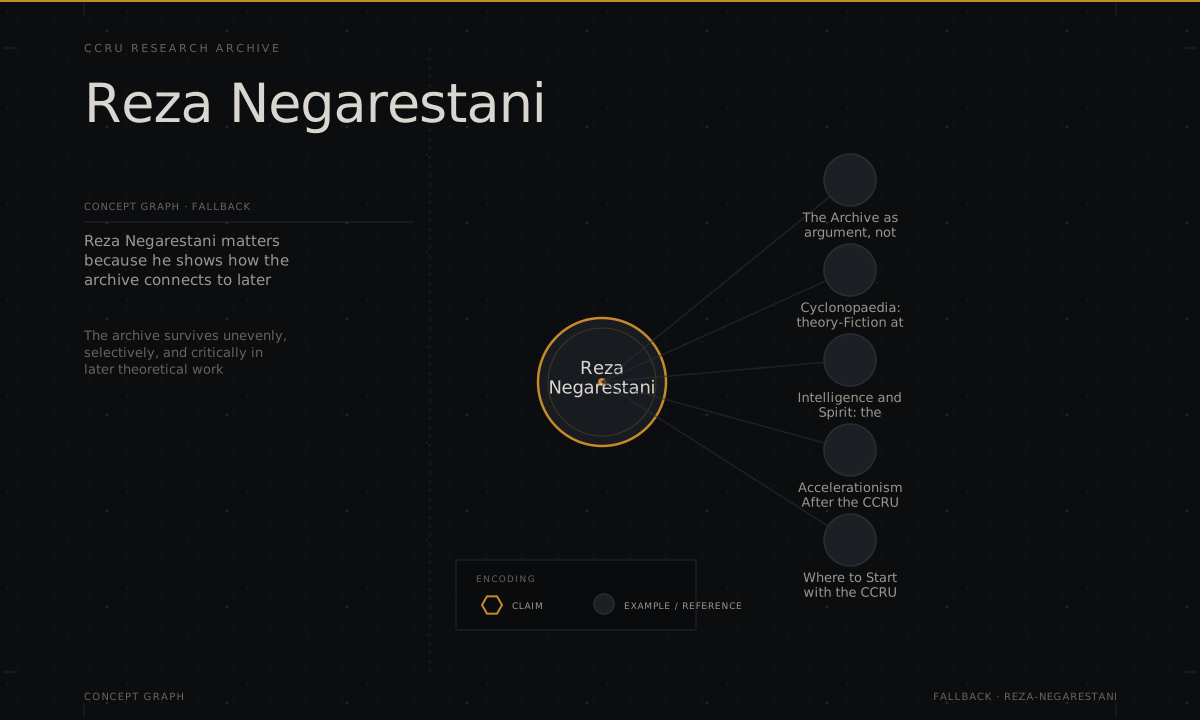
Reza Negarestani matters because he shows how the archive connects to later philosophical work without simply continuing unchanged inside it.
Core argument
Negarestani is a bridge to later philosophy, not a direct continuation of the CCRU. That keeps continuity visible without pretending the archive survives intact.
His presence widens the afterlife beyond shorthand accelerationism. Readers can see later inhumanist and rationalist developments rather than only headline labels.
Worked examples
These named texts, talks, sites, and records show where the argument becomes concrete.
Accelerationism Text Scoring Note Record
"Accelerationism Text Scoring Note" is a good checkpoint because it keeps Reza Negarestani inside scene evidence rather than later reputation.
Invaders From The Future Record
"Invaders From The Future" is a good checkpoint because it keeps Reza Negarestani inside scene evidence rather than later reputation.
Accelerationism After The CCRU Guide
"Accelerationism After The CCRU" widens Reza Negarestani back into the larger CCRU field instead of treating the figure as self-explanatory.
Accelerationism Concept
"Accelerationism" names one recurring pressure that helps Reza Negarestani make sense beyond biography alone.
Common misreadings
These are the recurring simplifications, exaggerations, and misreadings that make the subject look flatter than it is.
- Later philosophy simply inherits the CCRU whole.
The archive survives unevenly, selectively, and critically in later theoretical work.
Significance
Negarestani matters because he points outward from the archive into later philosophy while preserving a sense of discontinuity and revision.
Stakes of this figure
Philosopher whose work appears across the corpus and helps connect the archive to wider debates on rationalism, inhumanism, and theory after the CCRU.
Periodisation
- 2000s onward
Key works for entering the figure
- Reza Negarestani - Drafting the Inhuman; Conjectures on Capitalism and Organic Necrocracy.pdf
- 2026-03-13-accelerationism-text-scoring.md
References
Records cited
These linked sources are the quickest way to test the argument against named materials rather than second-hand summary.
Accelerationism Text Scoring Note Record
"Accelerationism Text Scoring Note" ties Reza Negarestani to a document, lecture, or interview you can actually test.
Invaders From The Future Record
"Invaders From The Future" ties Reza Negarestani to a document, lecture, or interview you can actually test.
Accelerationism After The CCRU Guide
"Accelerationism After The CCRU" shows what changes once Reza Negarestani is read comparatively rather than mythically.