Two books, two inheritances
Readers land in this cluster looking for 'what happened after Land left Warwick.' The honest answer is that Negarestani wrote one book that looks like an answer to that question and another that refuses it. Hold both in view.
Inhumanism as a term of art
A note on evidence before proceeding: what follows is editorial synthesis. The retrieval set for this section contains no direct Negarestani chunks, so the characterizations below should be read as a reader's map of the published books and essays rather than as claims derived from retrieved text. Readers who want primary evidence should go straight to Intelligence and Spirit and the Collapse essays.
With that caveat: inhumanism, in Negarestani's usage, is not a synonym for antihumanism and not a rebrand of accelerationism. As worked out across his essays for Collapse (Urbanomic, 2007–) and consolidated in the 2018 book, inhumanism names the claim that what is genuinely alien about the human is its capacity for reason, and that reason, followed honestly, revises its own carrier. The human is the thing that can be argued out of its current shape.
This is where the cluster splits internally. One faction of readers treats inhumanism as the respectable continuation of Land's virtual materialism — the line from Machinic Desire through to a cold rationalism that keeps the inhuman orientation and drops the delirium. Another faction reads it as a direct rebuke: where Land's machinic desire locates agency in capital-as-AI — the 'zaibatsus flip into sentience as the market melts to automatism' passage is representative — Negarestani relocates agency in the space of reasons. Both readings find textual support. Neither is complete.
What Cyclonopaedia carries forward
Cyclonopaedia is the load-bearing point of contact. It uses fiction-theory in the Ccru manner: nested manuscripts, oil treated as a geopolitical agent, a prose that refuses to separate the referential from the performative. The method is recognisably cognate with the kind of fictioned-archive work visible in the Jung-to-Stillwell letter preserved in the Ccru writings, where the archive pretends to be older than it is and the apparatus of scholarly citation is turned into a hyperstitional engine.
What carries forward from that Ccru register into Cyclonopaedia: hyperstition as a working practice, geology read as conspiracy, anorganic vitalism, and the refusal to clean up a text for academic legibility. What does not carry forward unmodified: the libidinal register. Negarestani's desert is theological-theoretical before it is libidinal. Readers who come to Cyclonopaedia expecting the sonic-fictional pulse of More Brilliant than the Sun find a different temperature.
What Intelligence and Spirit argues against
The decade between the two books is where the inheritance gets selective. By the time of Intelligence and Spirit, Negarestani takes distance — on the standard reading of the book, which I am relying on here rather than on retrieval — from positions that were load-bearing in the Ccru era. Immediacy is treated as an illusion to be worked through rather than a site of escape. And the Landian thesis that capital is itself a form of cognition — the position condensed in Machinic Desire where markets 'melt to automatism' and 'zaibatsus flip into sentience,' and which Land continues to defend in later interviews describing capitalism and AI as 'structurally isomorphic' — is the specific target. Capital, on Negarestani's account, cannot do the work of reason because it cannot commit to its own revisability: it optimises, it does not deliberate about what it should be.
This is the cluster's sharpest internal disagreement and the reason 'Negarestani as CCRU successor' misreads the situation. He inherits the orientation toward the inhuman and argues with the mechanism. The Urbanomic catalogue is itself the evidence: the press that publishes Ccru's collected writings also publishes the book that, in significant respects, argues against them. Pair the 2018 book with Pete Wolfendale's and Ray Brassier's parallel work to see how wide the rationalist turn runs.
The collapse essays as hinge
The essays Negarestani published in Collapse (ed. Robin Mackay, Urbanomic, 2007–) are the connective tissue between the two books and the most useful entry point for readers who want to watch the shift happen in real time. I am reading them editorially as transitional — that is a synthetic claim, not a retrieval-sourced one — because the horror register of the Cyclonopaedia period visibly thins across them while a Sellarsian vocabulary thickens.
Disagreement inside the cluster: some readers treat the Collapse essays as the real Negarestani and both books as extensions. Others treat them as juvenilia to the 2018 system. The essays themselves do not settle this, which is part of what makes them worth reading — you can watch a thinker deciding what to keep.
The common trap
The trap readers fall into here is continuity bias. The Urbanomic imprint, the shared citation of Deleuze and Guattari, the overlapping fascination with the inhuman, the presence of Ccru-adjacent figures like Robin Mackay as editor — all of it suggests that Negarestani is simply the next chapter. He is not.
Read the inheritance as a selection, not a succession. Hyperstition: kept, redeployed. Libidinal materialism: largely dropped. Capital-as-cognition: on my reading of Intelligence and Spirit, rejected. Reason-as-alien: introduced and made central. The figure of the inhuman: preserved but relocated from the meat-circuit to the space of reasons. A reader who flattens this into 'post-CCRU philosophy' loses the argument Negarestani is having with the archive he partly descends from. For a complementary map of how the broader post-Ccru philosophical scene fractures — including Brassier, Mackay, Grant and Fisher divergences — see /guides/ccru-philosophical-afterlives.
Where to go deepest
If you read only one document from this cluster, read Intelligence and Spirit. It is the harder book and the one that defines what inhumanism is now rather than what it inherited. Cyclonopaedia is more fun and will teach you more about the Ccru; Intelligence and Spirit will teach you what someone who took the Ccru seriously decided, on reflection, to keep and to discard. The argument this section makes — that this is a continuation which argues with rather than repeats — is legible only from inside that second book.
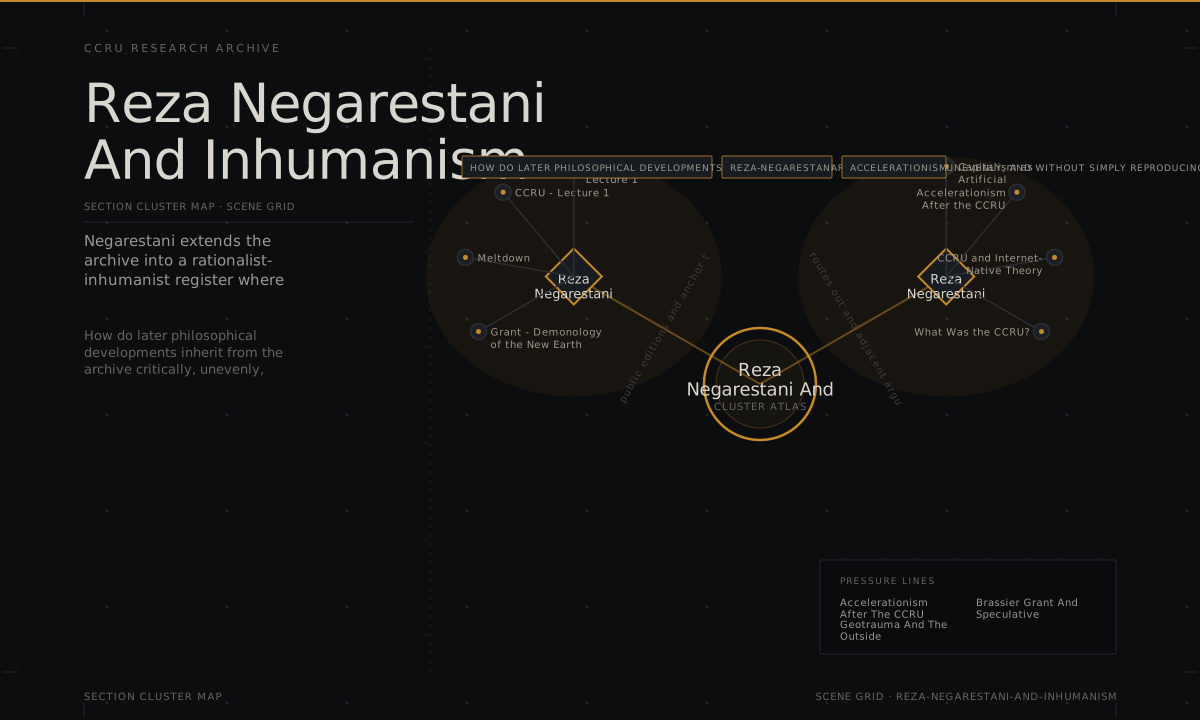
Negarestani extends the archive into a rationalist-inhumanist register where reason itself is treated as an alien process — a continuation that argues with rather than repeats CCRU positions.
Core argument
Later philosophy inherits the archive selectively. The section keeps continuity visible without pretending to seamless continuation.
Inhumanism widens the afterlife beyond shorthand accelerationism. Readers can follow a more precise philosophical route outward from the archive.
Worked examples
These named texts, talks, sites, and records show where the argument becomes concrete.
Accelerationism After The CCRU Guide
Start with "Accelerationism After The CCRU" if you want the wider frame before dropping into Reza Negarestani And Inhumanism.
Reza Negarestani Person
"Reza Negarestani" is one of the clearest figures for the pressures gathered inside Reza Negarestani And Inhumanism.
Accelerationism Concept
"Accelerationism" names one recurring problem inside Reza Negarestani And Inhumanism.
Invaders From The Future Record
"Invaders From The Future" is a checkpoint where Reza Negarestani And Inhumanism stops sounding abstract.
Accelerationism Text Scoring Note Record
"Accelerationism Text Scoring Note" is a checkpoint where Reza Negarestani And Inhumanism stops sounding abstract.
Common misreadings
These are the recurring simplifications, exaggerations, and misreadings that make the subject look flatter than it is.
- Later philosophical developments simply preserve the CCRU intact.
The relation is uneven, critical, and reconstructive rather than purely preservational.
Significance
This section matters because it connects archive history to later philosophical work without collapsing the differences between them.
Themes
- reza negarestani
- inhumanism
- cyclonopedia
- later philosophy
- after the ccru
Where this section sits in the archive
Start with the bibliographic fact that structures everything else in this cluster: Reza Negarestani has published two philosophical books a decade apart, and they do not inherit the CCRU the same way. Cyclonopaedia: Complicity with Anonymous Materials is visibly continuous with the Ccru idiom — petropolitics as hyperstitional fiction-theory, anorganic conspiracies, the geological-demonic register familiar from the Lemurian materials gathered in Ccru: Writings 1997–2003. Intelligence and Spirit does something else: by most accounts it reconstructs Hegel and Sellars, and treats reason itself — not libidinal matter, not capital — as the alien process worth tracking.
Sources by cluster
These mini-clusters widen the section through named works and support traces rather than through adjacent keywords alone.
Section source cluster
Reza Negarestani And Inhumanism: public editions and anchor texts
Anchor editions: @OUTSIDENESS; Fanged Noumena - Nick Land; Ray Brassier - Mad Black Deleuzianism; On Nick Land.
Work
A major late Land collection that gathers the Outsideness years into one long archive of teleoplexic notes, interviews, fragments, and political intensities. "From cyberspace you can eat economies, start nuclear wars,...
Work
A major collection page that gathers early and middle Land into the editorial form most responsible for his later circulation. Fanged Noumena gathers early and middle Nick Land into the editorial format most responsib...
Work
Ray Brassier - Mad Black Deleuzianism; On Nick Land
Brassier's talk re-reads Land through conceptual critique, arguing that the politics of accelerationism cannot be grasped without confronting its philosophical commitments. Ray Brassier's Mad Black Deleuzianism re-rea...
Work
Robin Mackay-#Accelerate The Accelerationist Reader
The main reader-introduction page for accelerationism, packaging the field as a set of competing lineages rather than a single slogan. "Accelerationism is a political heresy": the opening sentence of Mackay and Avanes...
Work
Negarestani - The Corpse Bride
A major Negarestani text on nigredo, corpses, and putrefaction that makes death a medium of thought rather than a terminal limit. A major Negarestani text on nigredo, corpses, and putrefaction that makes death a mediu...
Work
A lecture introduction that explains why Land is still studied, distinguishing early philosophical promise from later controversy and myth. A lecture introduction that explains why Land is still studied, distinguishin...
Section source cluster
Reza Negarestani And Inhumanism: routes out and adjacent arguments
Adjacent routes: Nick Land: A Reading Guide; Mark Fisher and the CCRU; What Was the CCRU?.
Guide
The best way to start Nick Land is to separate phases before you make judgments. Read the Warwick and CCRU-era work as one phase, the editorial and spoken entry points as another practical route into it, and the later...
Guide
Mark Fisher is one of the best ways into the CCRU because he translated difficult archive motifs into public criticism about culture, mood, work, music, media, and political feeling. He does not stand at the archive's...
Guide
The Cybernetic Culture Research Unit, or CCRU, was a loose research formation that emerged around Warwick in the 1990s and then persisted through texts, events, recordings, websites, and arguments long after its origi...
Guide
Accelerationism After the CCRU
Accelerationism is one of the most public labels attached to the CCRU, but it is not the archive's secret essence. The more accurate starting point is that accelerationism is a later umbrella term that gathered togeth...
Guide
Open a browser tab on any 2024 essay about large language models and you will find the same cluster of anxieties the CCRU was already turning over in the late 1990s: recursive systems that act back on their makers, sy...
Guide
The fastest way to make the CCRU less mystical is to put it back into time. Most readers do not meet the Cybernetic Culture Research Unit at Warwick in the mid-1990s. They meet it through Mark Fisher, k-punk, Nick Lan...
Texts in this section
66 classified works grouped into 3 editorial subclusters. Reviewed: 64; needs review: 2.
Core inhumanism texts 10 works
- #AltWoke Manifesto - &&& Journal&&& Journal
- Collapse; Philosophical Research and Development Issue #4; Concept Horror - Editorial Introduction
- Digital Dismemberment Twitter Death by a
- Negarestani - Labor of the Inhuman Part 1
- Negarestani - Labor of the Inhuman Part 2
- Negarestani - What Philosophy Does to the Mind
- Negarestani - Where is the Concept
- Negarestani-2011-Drafting the inhuman
- Rational Inhumanism Vs Landian Anti-Philosophy - TripleAmpersand Journal (&&&)TripleAmpersand Journal (&&&)
- Reengineering Philosophy
Decay, politics, and architecture 10 works
- Mackay, Negarestani Hecker - CD A Script for Synthesis
- Negarestani - Navigate with Extreme Prejudice [encyclonospace iranica]
- Negarestani - The Revolution is Back
- Negarestani-2012-Decay Modernism
- Negarestani-2012-Globe of revolution-Afterthought geophilosophical realism
- Negarestani-Decay
- reza-negarestani-globe-of-revolution-an-afterthought-on-geophilosophical-realism
- reza-negarestani-the-revolution-is-back-turing-functional-realization-and-computational-description
- reza-negarestani-undercover-softness-an-introduction-to-the-architecture-and-politics-of-decay-1
- Synechistic Critique
Interviews and commentaries on Negarestani 46 works
- Melanlogical Subjectivity
- Negarestani - Deleted Texts and Land s Other Endings
- Negarestani - Synechrestic Critique of the Aesthetic
- Negarestani - Thinking Catastrophe
- Negarestani Land - Homostasis (Excerpt)
- Negarestani-2002-Cata-
- Negarestani-2002-Pestis Solidus
- Negarestani-2002-through the anonymous
- Negarestani-2003-death as a perversion
- Negarestani-2006-militarization of peace
- Negarestani-2006-militarization of peace-FR
- Negarestani-2007-Horror of something
- Negarestani-2009-Differential cruelty
- Negarestani-2010-Outlines for a science fiction
- Negarestani-2011-All of a twist
- Negarestani-2011-On revolutionary earth
- Negarestani-2013-Nature its man and his goat enigmata natural and cultural chimeras
- Negarestani-2014-What is philosophy
- Negarestani-acephalous mouth
- Negarestani-Epithemic
- Negarestani-Hollow Body
- Negarestani-Instrumental spectrality
- Negarestani-Introduction to Maraka Project
- Negarestani-Leng-Tch e
- Negarestani-Oculomancy
- Negarestani-remarks on asiatic peace
- Negarestani-Review-Blood Electric
- Negarestani-Suck Me Dry
- Negarestani-Suicide and Survival Economy
- Negarestani-Through the anonymous histories of corpse and the History of Death
- Reza-Negarestani Three-Nightmares-of-the-Inductive-Mind Glass-Bead 2017
- reza-negarestani-black-boxing-pink-1
- reza-negarestani-death-as-a-perversion-openness-and-germinal-death
- reza-negarestani-emancipation-as-navigation-from-the-space-of-reasons-to-the-space-of-freedoms-schedule
- reza-negarestani-engineering-the-world-crafting-the-mind-interview-with-reza-negarestani-1
- reza-negarestani-frontiers-of-manipulation
- reza-negarestani-how-to-make-yourself-an-agi
- reza-negarestani-nature-its-man-and-his-goat-enigmata-of-natural-and-cultural-chimeras
- reza-negarestani-navigate-with-extreme-prejudice-definitions-and-ramifications
- reza-negarestani-rainbows-and-rationalism-the-fate-of-the-terrestrial-manifesto-of-art-1
- reza-negarestani-solar-inferno-and-the-earthbound-abyss-1
- reza-negarestani-the-militarization-of-peace-1
- reza-negarestani-the-snake-the-goat-and-the-ladder-a-board-game-for-playing-chimera
- Spirit in the Crypt Negarestani vs Land
- Islamic Exotericism; Apocalypse in the Wake of Refractory ImpossibilityNeeds editorial review
- week 1Needs editorial review
References
Records cited
These linked sources are the quickest way to test the argument against named materials rather than second-hand summary.
Invaders From The Future Record
"Invaders From The Future" is the first record to test the framing around Reza Negarestani And Inhumanism.
Accelerationism Text Scoring Note Record
"Accelerationism Text Scoring Note" is the first record to test the framing around Reza Negarestani And Inhumanism.
Accelerationism After The CCRU Guide
"Accelerationism After The CCRU" gives the larger argument around Reza Negarestani And Inhumanism before you widen sideways.
External references
Inherited outward references from the guides, exhibits, people, and concept pages that anchor this section cluster.