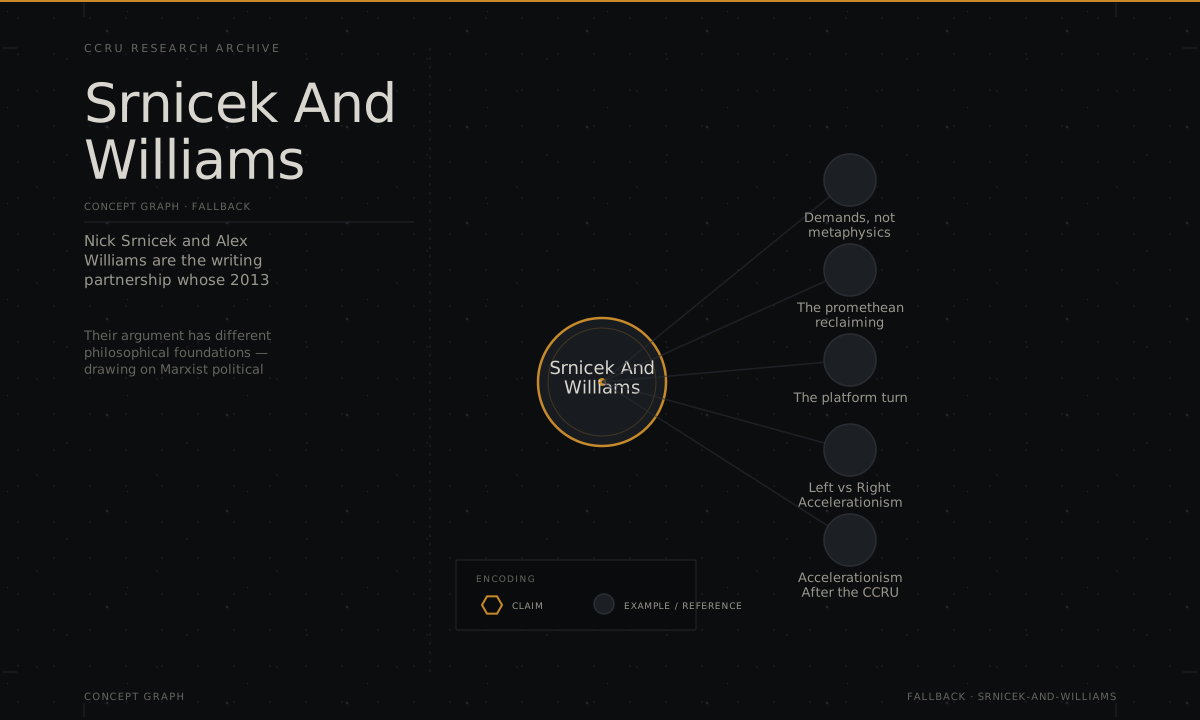
Demands, not metaphysics
Inventing the Future: Postcapitalism and a World Without Work (Verso, 2015) is commonly read as the long-form working-out of this procedural shift: full automation, universal basic income, the reduction of the working week, and the reconstruction of a counter-hegemonic ecology of organisations are presented as demands that can be legislated and fought for. The archive's older vocabulary survives there mainly as permission — permission to think technological modernity as something other than a trap to be refused.
The promethean reclaiming
Their second load-bearing claim, as it is commonly read, is that left politics forfeits the future whenever it concedes technical modernity to capital. The Manifesto and Inventing the Future are usually glossed as naming this concession 'folk politics' — the localist, horizontalist, prefigurative reflex that treats scale, abstraction, and planning as inherently compromised — and as staging a Promethean reclaiming of already-built infrastructures whose political valence is not fixed by their origin. (The direct textual support for these specific terms lies in Inventing the Future itself rather than in the retrieval evidence available here.)
On this reading, the 'Fragment on Machines' stops functioning as a prophecy of capitalism's breakdown and starts functioning as a permission-slip for post-work infrastructure, while Land's machinic-desire claim is kept as a description of what capital does and severed from the evaluative attitude that celebrated it. The operation, if it works, is surgical: keep the diagnosis, flip the prescription.
The platform turn
Platform Capitalism (Polity, 2016) is Srnicek's solo extension and — on its own terms — tightens the programme considerably. Where Inventing the Future gestures at 'the technical machinery capitalism has built', Platform Capitalism is widely read as naming that machinery with sectoral precision (advertising, cloud, industrial, product, and lean platforms) and as arguing that the platform is a specific economic form whose logic is data extraction and network-effect monopoly. The direct textual evidence for that typology is the book itself, which is not present in the retrieval set here; the claim is therefore attributed rather than quoted.
Taken together with Inventing the Future, the tension is visible. The 2015 book's rhetorical register demands a totalising horizon — post-work, post-scarcity, a universal subject reconstituted through counter-hegemonic work — while the 2016 book's analytic register is modest, sectoral, and tied to the profitability crises of particular firms. The two books share an author but not obviously a scale of politics.
The discontinuity with Land
A common confusion treats Srnicek and Williams as 'the polite version of Nick Land'. They are not. They share vocabulary and argue incompatible things. Land, in his 'Quick-and-Dirty Introduction to Accelerationism', writes that the Manifesto 'aimed to precipitate a specifically anti-capitalist Left-accelerationism, clearly demarcated over against its abominably pro-capitalist Right-accelerationist shadow', and judges that 'it was only by introducing a wholly artificial distinction between capitalism and modernistic technological acceleration that their boundary lines could be drawn at all'. For Land, 'capital, in its ultimate self-definition, is nothing beside the abstract accelerative social factor', and so any 'unambiguously Left-accelerationism gaining serious momentum can be confidently dismissed'.
Srnicek and Williams are best read — though this is interpretation rather than direct citation — as refusing the question rather than offering a metaphysical counter-claim. They need not deny that capital and technical modernity are entangled at the level of essence; they treat the political task as separating them in practice, and treat the essentialist framing itself as an ideological manoeuvre. On this charitable reading the two projects cannot be reconciled as 'wings' of one movement: they disagree about what kind of statement 'accelerationism' is — ontological diagnosis or political programme — and that disagreement is prior to any shared vocabulary.
The reception compounds the confusion. Mackay's framing of the Accelerate reader as constructing 'a philosophical counterhistory, the construction of a genealogy of accelerationism' after the MAP captures the risk: once the word consolidates publicly as a keyword, the older Warwick-CCRU register — hyperstition, numogrammatic fiction, machinic unconscious — is easily flattened into family resemblance with the Manifesto's programme. Srnicek and Williams are the moment the word goes public, and therefore also the moment the archive it claims as lineage becomes partially unreadable behind it.
Why the partnership matters to the archive
Without Srnicek and Williams the cluster loses its exit into mainstream left-political argument. The Warwick-era material can sustain itself as theory-fiction, as philosophy of time, as a style; it cannot by itself produce a demand for a shortened working week or a public cloud. The partnership matters because it performs a translation that the source material structurally resists — converting an untimely, deliberately unassimilable body of writing into proposals that can enter policy discourse without immediately dissolving. Whether the translation preserves or betrays the source is the live question; that it is the only serious attempt to perform it is not in dispute.
Deepest single document for the contribution: Inventing the Future.
Nick Srnicek and Alex Williams are the writing partnership whose 2013 Manifesto for an Accelerationist Politics and 2015 book Inventing the Future articulate the left-accelerationist programme. Their argument is Promethean: the technical machinery capitalism has built can be politically reclaimed for post-work and post-scarcity ends.
Core argument
Srnicek and Williams articulate the Promethean left-accelerationist position. Their argument is about who controls technical infrastructure, not about speed; conflating it with Land's right-strand position loses the central commitment.
The partnership develops in two stages. The 2013 manifesto sets the conceptual terms; Inventing the Future (Verso 2015) extends them into a workable political programme. Reading either alone gives a thinner version of the project.
Worked examples
These named texts, talks, sites, and records show where the argument becomes concrete.
Mackay & Avanessian, #Accelerate Reader (2014) Record
The volume containing the 2013 manifesto in its canonical reprinted form, alongside its right-strand counterparts.
Left vs Right Accelerationism Guide
The comparison guide where their position is set against Land's later writing.
Left Accelerationism (concept) Concept
The compact concept page that gives the working definition their work anchors.
Common misreadings
These are the recurring simplifications, exaggerations, and misreadings that make the subject look flatter than it is.
- Srnicek and Williams are the polite version of Nick Land.
Their argument has different philosophical foundations — drawing on Marxist political theory and post-work scholarship — and reaches different political conclusions. Sharing a keyword does not make them continuous with Land's later writing.
Significance
Srnicek and Williams supply the principal counter-position to e/acc and right accelerationism inside the same vocabulary. Without their strand, accelerationism reduces to its right-coded inheritors and the wider debate becomes flatter than it is.
Stakes of this figure
Writing partnership whose 2013 Manifesto for an Accelerationist Politics and Inventing the Future (Verso 2015) articulate the principal left-accelerationist programme.
Periodisation
- 2010s onward
Key works for entering the figure
- Alex Williams & Nick Srnicek — #Accelerate: Manifesto for an Accelerationist Politics (2013; reprinted in Mackay & Avanessian 2014)
- Nick Srnicek & Alex Williams — Inventing the Future: Postcapitalism and a World Without Work (Verso 2015)
References
Records cited
These linked sources are the quickest way to test the argument against named materials rather than second-hand summary.
Robin Mackay-#Accelerate_ The Accelerationist Reader Record
The editorial volume that fixed their position into public reception.
Left vs Right Accelerationism Guide
Where the partnership is set against the right strand at guide length.