Sonic fiction as method
The operative wager is that the music theorises on its own account. Where a conventional account would locate a track's meaning in its social context or its maker's biography, Eshun locates it in the sonic material and its forward pressure. A record is handled as a piece of applied thought, and the producer as a thinker whose medium is frequency and arrangement. This inverts the default in music writing, where sound is the occasion and the concept is imported from elsewhere. Here the concept is already in the groove, and the writing runs to keep up.
The concept engine
The prose is built to match that speed. Eshun writes in a compressed present tense, minting terms as he goes and dropping the historical and biographical scaffolding that usually slows a music book down. He cast the writer's role as that of a "concept engineer," a builder of usable ideas. The density is functional: the sentences are trying to be as fast as the records they track. Readers who find the book difficult usually mean that it declines to settle into the explanatory register that would let them lift out a summary. The refusal is the method.
Warwick adjacency
Eshun's 1990s work sits in the same milieu as the CCRU. He was affiliated with the Cybernetic Culture Research Unit, the cross-disciplinary group that formed around Warwick, and his writing shares the scene's habit of treating music culture and speculative writing as one continuous surface. The sonic line the archive develops through Steve Goodman has an obvious neighbour in Eshun's book, a proximity the record itself later marked: the 2017 Verso reissue of *More Brilliant Than the Sun* carried a new introduction by Goodman under his Kode9 name. Eshun is best read as an adjacent figure to the CCRU rather than a member of it. The vocabularies overlap and the scene is shared. The diasporic frame he brings is one the group's own sonic writing largely lacks.
The Otolith Group
In 2002 Eshun co-founded the Otolith Group with the artist Anjalika Sagar. The collective works mainly in the essay film and in exhibition, and its material is archival: futures once imagined and then stranded, and the residue of transnational histories. The move from the page to the moving image continues the sonic-fiction method by other means, relocating the interest in stranded futurity from the record to the reel. The group was nominated for the Turner Prize in 2010. Its practice is documented in the archive's sessions wing, including an Otolith Group visiting-artist lecture at Parsons and a Manifesto Marathon appearance from 2008.
Fisher and the afterlife
Eshun's closest tie inside the archive is to Mark Fisher. The two co-edited *Post-Punk Then and Now* (Repeater, 2016) with Gavin Butt, and Fisher wrote directly on the Otolith Group's *Anathema*, a talk preserved as Mark Fisher on the Otolith Group's Anathema. After Fisher's death Eshun delivered the Mark Fisher Memorial Lecture, which the archive hosts in full. Shorter talks in the same wing, a lecture at the Jornadas de Estudio de la Imagen and a brief piece on gabber, show the sonic-fiction habit still running in the spoken register long after the book.
Why the archive keeps him
Without Eshun the archive's sonic line has no diasporic frame and no bridge to Afrofuturism. Goodman supplies the physics of sound and Fisher the cultural diagnostic. Eshun supplies the claim that black music is a theory-producing tradition in its own right, with its own account of time and the machine. Remove him and the sonic material narrows to a British-scene story and loses the longer lineage, from Sun Ra to Detroit, that gives it depth.
For a reader wanting the method at full operating temperature, the anchor is More Brilliant Than the Sun. Read it as a set of concept-tools rather than a history of genres, and the distinctive contribution, black music treated as applied theory with sonic fiction as its working method, becomes legible in a way no secondary account reproduces.
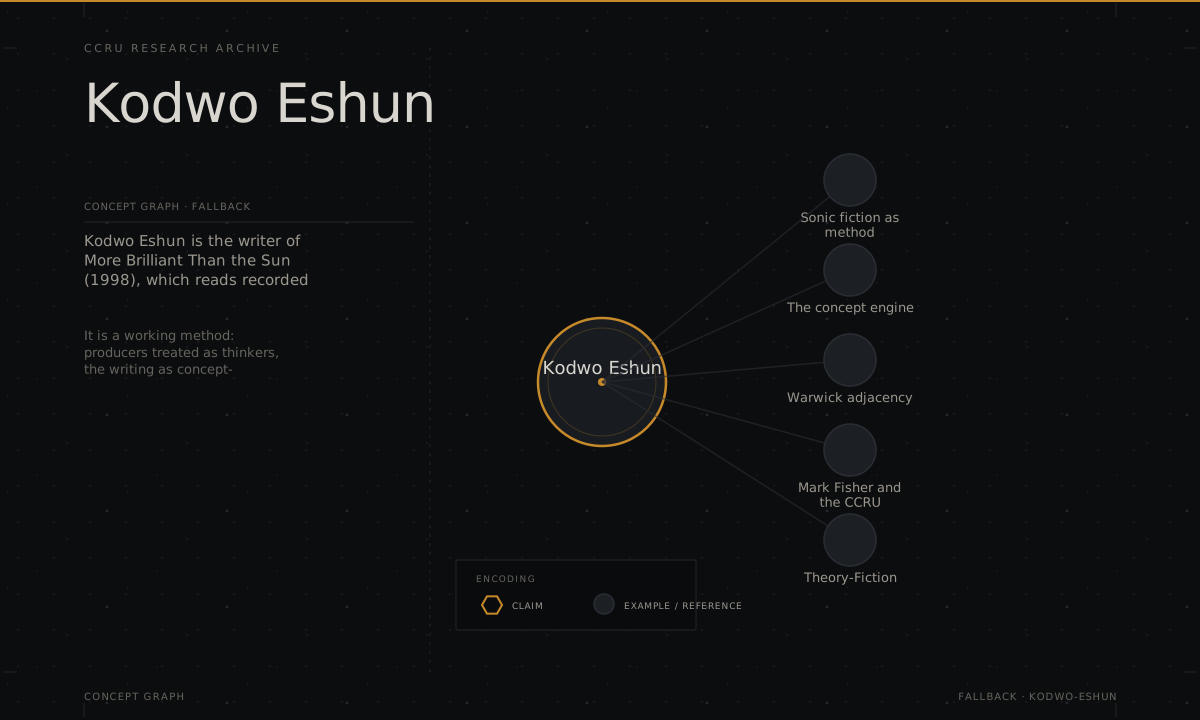
Kodwo Eshun is the writer of More Brilliant Than the Sun (1998), which reads recorded black music as a concept-producing system he calls sonic fiction. He worked adjacent to the CCRU in the 1990s and co-founded the Otolith Group in 2002, carrying the method into the essay film.
Core argument
Sonic fiction treats music as applied theory in its own right. It gives the archive a diasporic account of sound that the other sonic figures do not supply.
Eshun is adjacent to the CCRU rather than a member of it. The overlap is a shared 1990s scene and vocabulary, which keeps the archive historically accurate about who was inside the unit.
Worked examples
These named texts, talks, sites, and records show where the argument becomes concrete.
CCRU and Internet-Native Theory Culture Guide
The wider scene Eshun's 1990s writing belongs to, where music culture and theory circulate together.
Theory-Fiction Concept
The nearest method-term the archive already carries; sonic fiction is its music-side variant.
Common misreadings
These are the recurring simplifications, exaggerations, and misreadings that make the subject look flatter than it is.
- That sonic fiction is a metaphor.
It is a working method: producers treated as thinkers, the writing as concept-building.
Significance
Debates about Afrofuturism and machine-made music keep rediscovering positions Eshun set out in 1998. Reading More Brilliant Than the Sun directly is faster than reconstructing them, and it gives the archive's sonic line a diasporic frame the other figures lack.
Stakes of this figure
Writer, theorist and filmmaker whose More Brilliant Than the Sun (Quartet 1998) reads black music as a concept-producing system he calls sonic fiction, and whose Otolith Group carries the method into the essay film.
Periodisation
- 1990s music press
- 1998 sonic fiction
- 2000s onward Otolith Group
Key works for entering the figure
- Kodwo Eshun — More Brilliant Than the Sun: Adventures in Sonic Fiction (Quartet Books 1998; Verso reissue 2017)
- The Otolith Group — Otolith I–III (2003–2009), Turner Prize nomination 2010
- Kodwo Eshun, Mark Fisher and Gavin Butt (eds) — Post-Punk Then and Now (Repeater 2016)
References
Records cited
These linked sources are the quickest way to test the argument against named materials rather than second-hand summary.
Hyperstition Concept
The CCRU term that Eshun's forward-pressure reading of music runs parallel to.
Sonic Futures and Audio Theory Section
The section hub where his book sits alongside the archive's other sonic material.
External references
Stable outward routes for this figure: original sites, archived copies, and public relay surfaces worth keeping in view.